The post The Voyage of the Hector appeared first on ScotClans | Scottish Clans.
]]> It was only 28 years after the infamous Battle of Culloden, in 1773, when the Hector was moored within Loch Broom taking onboard a group of people from the Highlands. 189 passengers joined the Hector that day, 25 single men, 33 families, a piper and their agent, all of which had one thing in common. They had a fire in their hearts to find a better life and a new land. A land where they were free to speak their own language, Gaelic, to play the music of their ancestors and to wear their beloved tartan without fear of repercussions. This hefty and dangerous journey was to take three months, but would represent the first significant migration of Scottish settlers to Canada.
The Hector was a fully rigged fluyt built in the Netherlands sometime before 1750. She was employed in the local trade off the coasts of Great Britain but was also involved in the immigrant trade to North America. Whilst she had already made a trip carrying Scottish emigrants to Boston, Massachusetts in 1770, she had never before made a voyage to Canada. By the time of this voyage the Hector was an old ship and had definitely seen better days.

This famous voyage began with her departure from Loch Broom in the second week of July, 1773. Mr. John Pagan, the ships owner, had purchased three shares of land near Pictou, Nova Scotia, along with Dr. John Witherspoon, a presbyterian minister who is most famous for being one of the Founding Fathers of the United States. John Ross was hired by Pagan and Witherspoon to act as a recruiting agent for settlers willing to emigrate to Nova Scotia and was given authority to offer free passage, one years worth of free provisions and a farm as an incentive. John Ross recruited those that went from Greenock and Lochbroom in Rossshire, with the majority coming from Lochbroom. Most of those that boarded the Hector were poor crofters and artisans who only spoke Gaelic. There was a school teacher onboard, William McKenzie, who was one of only a few passengers who spoke both English and Gaelic.
The arduous journey was a long one and was not without troubles. The journey was delayed by 14 days due to increasingly bad weather. Dysentry and smallpox spread throughout the passengers and claimed the lives of 18 passengers. But spirits were not dampened, and in fact, were raised with the birth of a child not far fro the Canadian coast. A long 11 weeks after it left Scotland the Hector finally reached Pictou harbour. On the 15th September 1773 she made her landing at Browns Point, immediately west of the present day town of Pictou, just as the harsh winter weather was setting in.
Unfortunately the provisions they had been promised never materialised and the settlers had to hurry to build shelter without them before the harsh weather set in and starved them. This was a hard task, but the hardy Scottish settlers managed and proceeded to tame a small part of this wild new continent, naming it Nova Scotia in honour of their roots.

The town of Pictou holds great significance within the history of the Scots spreading throughout Canada. It is known as the ‘Birthplace of New Scotland’. Whilst there was already a great number of Scots settled in other areas of Nova Scotia by the time of the towns founding, it was the first settlement that was primarily made up of Scottish immigrants and was a receiving point for many Scottish immigrants moving to a new home in northern Nova Scotia and Cape Breton Island following the Highland Clearances.
During the early 90′s, officials in Nova Scotia sought to commemorate the Hector‘s contribution to Pictou’s, and Nova Scotiain, history. The Ship Hector Foundation was formed in 1992 as a result. Consisting of volunteers from Pictou county, the group began to raise funds in order for a replica of the Hector to be built. After several years of fundraising and construction, the replica Hector was launched with great fanfare and media coverage on September 17, 2000 and can still be visited today.
The post The Voyage of the Hector appeared first on ScotClans | Scottish Clans.
]]>The post A Victorian View Into Scottish North America: Part Two Of Lady Isabella Bird’s Encounters With Scots In Canada And America appeared first on ScotClans | Scottish Clans.
]]> A few weeks ago, we took a peek into the late nineteenth-century world of frontier Colorado with a most remarkable little Victorian era explorer named Lady Isabella Bird. On one of her many adventurous journeys around the globe, Englishwoman Lady Isabella introduced us to the Chalmers family in the foothills of the front range in territorial Colorado, and it was a revealing encounter.
As Lady Isabella described them, the Chalmers were a quirky frontier family with remarkably strong Scottish covenanter ancestral ties. Through Isabella’s letters home, we were able to explore those uncommon Scottish ties, albeit through the eyes and pen of a very particular Englishwoman loaded with her own opinions about the world.
In her thoughts about the Chalmers, Lady Isabella described the settler experience on the edge of the western frontier in 1876. She had other much different experience with North America however, as she had visited more than 20 years prior. So to continue our exploration of early Scottish immigrant life, we are going to travel backward in time and place to a much different frontier to meet Isabella Bird in 1854. She is about to disembark the paddle wheel steamer Canada of Cunard steam lines at Halifax Harbor following a “nine-day and five-hour voyage” from her Liverpool departure. We pick up the story in Isabella’s remembrances of the trip published as The Englishwoman In America.
Backward In Time To Halifax 1854.
In 1854 Halifax is the bustling capital of Nova Scotia (New Scotland), which is itself a self governing British province. It would not become part of the Canadian Confederation until 1867. Nova Scotia had originally launched in 1621 in part as a Scottish scheme to occupy and settle the Crown’s lands in Canada but mostly to financially and socially benefit one Sir William Alexander, 1st Earl of Stirling. By 1625 Sir William and the Crown were actively selling newly sanctioned Nova Scotia Baronetcies in exchange for a vow to arm, apparel and victualize six colonists for two years (or Buy Now! for a one time payment of 2,000 Merks to the Crown and Boom, you’re a Scottish Baron – Sir Whatnot - True story). There is also, of course, the 1,000 Merks that were payable directly to Sir William for his prior services in ‘discoverie’ of the area. Because there is ever so much ‘discovering’ that has to occur before Crown subjects can be turned loose on a wild land.
Unfortunately for Sir William, and the Crown, and the newly minted Nova Scotia Barons, the French snatched the entire province for their own over the course of three battles between 1629 – 1632. By 1633 Scots in Nova Scotia were rare as hens teeth. The province had been melodiously renamed Acadia, French not Scottish. Things remained thus until the worm turned again in 1763 at the end of the French and Indian War and Scotland, now Britain, once again claimed large portions of Canada in the Treaty of Paris.
 Fast-forward ninety-one very fast paced years and Isabella Bird steps onshore at Halifax Harbour. It doesn’t take long before she reports contact with exiled Gaels. During the course of less than 100 years of British rule, the Canadian land mass had become soaked with Scottish immigrants and most of those were Gaelic speaking exiles from the highlands and islands, sometimes by way of intermediate immigration to the Scottish lowlands or even England.
On the international superpower market, lands and towns switch names, allegiance, and sovereignty quickly with nothing more than the scratch of a pen across treaty parchment. Following the official transfer of Canada to Britain at the Treaty of Paris in 1763, there was a period of practical transition of everything French to everything British. Interestingly, however, almost immediately after the practicalities would have occurred, Nova Scotia began receiving the human overage that Scotland was actively casting off. From the end of the 18th century through the end of the 19th century, Nova Scotia, together with what was then called Upper Canada – generally southern Ontario on today’s map – served as a type of Gaelic refugee camp for the Highland exodus that was following agricultural improvement and weaponized land use policies of the post-Culloden era.
Halifax and Pictou began accepting hundreds of Gaelic refugees in the early 1770s as clearance, famine, hopelessness – and hopefulness – drove Scots toward the New World. Although North American history is peppered with bursts of Scottish immigration emanating from various parts of Scotland, those who arrived in the mid to late 19th century were largely Gaels, displaced directly by eviction notice or indirectly by loss of ancestral way of life and relentless cultural oppression in their homeland.
Isabella’s Scots.
The North American lands and towns that Lady Isabella visited during this particular adventure were far from exclusively Scottish of course. Yet mentions of immigrant Gaels, Scots, Highlanders and “Anglo-Saxon” Lowlanders are numerous and contemporary census numbers bear out the inference that Canada was fairly soaking with Scots in the middle part of the 19th century. Nevertheless, Lady Isabella perceives successes in Canada as tribute to the Anglo-Saxon English blood and way of life. Indeed, she rarely uses the terms Britain or Great Britain, or the United Kingdom, but prefers plain old England, as in her mind, England is the kingdom.
At this time in her life, Lady Isabella Bird had acquired a limited respect and affection for the “highlander” and the Gaelic language and culture, but largely by virtue of her English family’s capacity to send a sickly daughter to the Scottish Highlands for a landscape and environmental cure. In that role, Isabella knew Gaels only so far as she was allowed to know them. With the threat of upper class punishment or retribution always present in the Highlands of the day, it is likely that most Gaels showed Isabella and her vacationing family only those aspects of Gaelic life and culture that pleased them, and then, only in a very congenial not to mention deferential delivery. It is not surprising that Lady Isabella came away from that limited introduction to Gaelic world with affection and a certain degree of respect. It is, however, somewhat surprising that she also came away with at least a conversational level of knowledge of the Gaelic language.
While Lady Isabella paints a fun introduction to the early Canadian Scottish immigrant, there is much more to be learned about the world that the emigrant Scot actually faced by listening closely enough to discern the gross stereotypes and social hierarchy that color everything that our lady does and says.
She came to the New World well armed with the stereotypes of the Old World. Perky and determined, Isabella is also the product of a Victorian world view in which nothing can really measure up to England and the English way. This yields a clear ‘us and them’ approach to the world and like many during her time, Isabella is eager to ensure that everyone is placed well within their proper social spot in life, with the appropriate life story hung around their neck.
“The Irish are the noisiest of the enemies of England, and carry with them to Canada the most inveterate enmity to ‘Sassanach’ rule. The term ‘slang-whangers’ must have been invented for these.”
“The Irish are a turbulent class, forever appealing to physical force, influencing the elections, and carrying out their ‘clan feuds’ and ‘faction fights.’”
Slang-whangers? That’s a new one to me but clearly, Lady Isabella does not speak reverently about the Canadian Irish immigrant.
While in North America on this trip, aside from her own English countrymen and women, Isabella generally described four groups of people: Irish, Scottish Gaels, Indians and Americans. To Isabella, the Irish and Indians were distasteful but endurable and occasionally could be capable of performing useful service, although inevitably not very well. Scottish Gaels met along the route in Canada rated better in Lady Isabella’s reflections likely because of her affectionate memories of summers spent with them in the Highlands. But also because Scottish families often came with some wealth and had been able to establish a vigorous mainstream base for themselves and their Gaelic community. Gaels, on the whole, did not come to Canada as servants but as farmers. Isabella seemed to accept that more readily.
Isabella Had The Gaelic.
Having spent summers in the Scottish highlands as a child, it is not entirely surprising that the young English woman would have been encouraged to learn the local language. It is somewhat more surprising that she had maintained some fluency in the Gaelic language into her twenties at least but then, Isabella Bird had her reasons. Sometimes, speaking Gaelic provided the keys to the kingdom:
“Crossing the suspension bridge we arrived at the VR custom house, where a tiresome detention usually occurs; but a few words spoken in Gaelic to the Scotch officer produced a magical effect, which might have been the same had we possessed anything contraband.”
Lady Isabella remarks on many occasions during the Canadian part of her journey regarding the use of Gaelic in social situations. She regales in Gaelic with the lonely Highlands widow in the Canadian wilderness and exchanges clever quips with the Captain of the ship Peerless, a vessel that the good “Scotch” Captain brought from the Clyde to the Niagara country in 6,000 pieces. At least in the middle of the 19th century, Isabella makes it clear that Scottish Gaelic maintained a significant and respectable role in Canadian Scottish society.
On many occasions while in North America, Lady Isabella found the benefit of breaking the ice with Gaelic strangers using their native tongue. More than anything else, to the Gaels hearing Gaelic spoken, there was the possibility of news from home. It’s not that news was scarce. Given the strong inflow of immigrants, it was common. Nevertheless, things were changing very rapidly in the highlands in the 1850s and each day might bring news that some dreadful thing had happened to some one or some family or some village that was loved and missed.
Why You Should Read Isabella’s Account.
A great deal of The Englishwoman In America sheds light directly on the life of the immigrant Scot of the Victorian period and for that it is valuable. But it is also valuable for its descriptions of the world in which those immigrants lived. Lady Isabella was curious as well as plucky, determined and creative and she visited slums in Quebec as well as Governor’s mansions. She traveled by land and sea in comfortable vessels and deadly ones and she describes her adventures with a dry sense of English humor, a forever bright outlook and a stiff upper lip. Her accounts are charming and effective in conveying the look, smell, sound and feel of the mid 19th century North American Scottish immigrant’s environment and society. It’s a fun read, very educational and available on Kindle e-reader for not all that many Merks.
Epilogue: Listening To Gaelic Immigrants In Their Own Words.
 Gaelic was widely spoken on Prince Edward Island until the turn of the 20th century. In the 2011 census, 10 individuals on the island reported that Gaelic was their mother tongue with less than 100 claiming to speak the language.
Lady Isabella Bird’s account of Scottish and Gaelic immigrants in mid 19th century Canada is intriguing and a great way to begin to get a feel for life in a different place and time while learning about Scottish and Gaelic heritage. But the story told by Isabella and others like her fails to explain the tragic statistics like those in the paragraph above regarding the drastic, almost complete, loss of Gaelic language and cultural markers in a place where previously they flourished. The best place to look for answers to such a question is in the words of the Gaels themselves. Those words are out there but they have, until very recently, been forgotten by historians and social commentators particularly because the language and the culture is incomprehensible unless carefully and specifically studied.
We now have an initial resource, based upon Gaelic language resources and translated for English readers, that will help begin to unravel the story of the Gael in Canada more clearly. Published just last September, Seanchaidh na Coille: Memory Keeper of the Forest is an anthology of the Scottish Gaelic literature of Canada. It is edited by Dr. Michael Newton, an outstanding researcher, scholar, writer and fluent in Scottish Gaelic and entirely comfortable translating and interpreting Scottish Gaelic language resources of all kinds.. This book complements his earlier work on North American Gaels We’re Indians Sure Enough: The Legacy of the Scottish Highlander in the United States (2001).
The poems, songs and narratives included in Seanchaidh na Coille offer new and important insights, for the English language reader as well as the Gael, into the mind and experience of the North American Gaelic immigrant. Indeed, in one small but instructive instance, the reader is placed directly at the moment of Gaelic diaspora when a Gaelic family that had travelled together from the Highlands disburses into the vast Canadian world:
”From Quebec we came by boat right into the heart of Upper Canada. The Tiree people went their own way to Brock. The Perthshire people to other places on the way, but the majority of the Kilmartin people stayed together until they arrived at Port Stanley. From there they branched off among the rural townships of Yarmouth, Dunwick, and Southwold.”
We have so few resources that allow us to get to know our Gaelic ancestors through their own Gaelic words. Seanchaidh na Coille is one little resource with an enormous effect that should be on the desk of every member of the Scottish North American diaspora who is serious about understanding their Gaelic diaspora heritage.
Dr. Newton’s work is grounded in existing scholarship, where it exists on the subject, but because the story is told through careful analysis of Gaelic language literature, his work tends to explode old myths and assumptions of the Gaelic experience and supplant them with the voice of the Gaels themselves. You may believe you know the story of Gaelic immigration to North America. If you haven’t yet familiarized yourself with Dr. Newton’s work on the topic, you simply do not fully understand that story because you haven’t heard it from the Gaels themselves.
So dig in! A copy of Lady Isabella Bird’s An Englishwoman In America paired nicely with Seanchaidh na Coille: Memory Keeper of the Forest, a nice glass of wine, er .. whisky, and a quiet snowy weekend. Got one coming up! How’s that for a plan for a weekend without Outlander?
The post A Victorian View Into Scottish North America: Part Two Of Lady Isabella Bird’s Encounters With Scots In Canada And America appeared first on ScotClans | Scottish Clans.
]]>The post Murdo Mackenzie: The most influential cattleman in America was from Scotland appeared first on ScotClans | Scottish Clans.
]]> Any cattleman worth his salt will tell you that he’s in the grass business. He either grows it himself or takes his cows where it grows up naturally. That means that it is not so much the cow that deserves attention. The important thing is the land and the water – when water is available, which isn’t all that often in the great American desert.
When land and water combined well in the late 19th Century, endless American prairies produced the grass that fed the cows that fed a growing nation and then some. The iconic American cattle industry was a multi-ethnic team sport in the nineteenth century west, involving First Nations folk, Black Americans, Spanish and Mexican vaqueros and others. But the basic shape and direction of the western beef industry was in no small part the work of a handful of first and second generation Scottish immigrant company managers and their Scottish right hand men. They were dispatched to a land as freshly cleared of conflicting human settlement as Scotland was. They went to spend enormous amounts of Scottish/British imperial wealth and enlightenment ingenuity to overcome all obstacles and achieve success breeding, growing and moving “beeves” from west to east and south to north to feed an insatiable America.
Most of the profit of these huge and complex operations was sent back to Scotland to build Scottish infrastructure and baronial mansions. But many of the Scots cattlemen lingered on the prairie. They sprouted American families who have remained in the west, often still working in western agriculture. Scottish cowboys and cattlemen who came here to create a new industry have left a most indelible mark on the American west.
 Murdo Mackenzie (1850 – 1939)

From one cleared landscape to another. Perhaps the greatest of the immigrant Scottish American cattle barons was born in 1850, the second of eleven children of Gaelic tenant farmers in Ross-shire in northern Scotland. The area around Scotland’s oldest royal burgh, Tain, had been a ground zero for brutal clearance and removal of Gaelic communities in Scotland since 1792 when Sir John Lockhart-Ross introduced the first sheep into the area and cleared a corresponding number of Gaelic tenant farmers from his Balnagowan estate. Clearance of Ross County continued throughout the next century and almost sixty years later, during the same year that Murdo Mackenzie was born, his own clans folk, Mackenzies, were brutally cleared from Strathconon, just down the road.
Though Murdo Mackenzie’s parents were tenant farmers in Ross County, the family apparently did not itself suffer clearance and they were able to send their second born to the Tain Royal Academy where he could acquire skills to compete in the new highland economy. Even though Murdo’s family did not suffer removal, the tragedy of others’ lives was forever visible. The infamously cleared community of Strathnaver was less than sixty miles from the Tain Tollbooth where much of the administrative work of the clearances was done. No doubt, at the Tain Royal Academy, Murdo learned the best English grammar and the newest improved agricultural and economic ideas as they were sweeping across Scotland’s highlands and islands in the heady enlightenment atmosphere of the second half of the 19th century.
While it might make for a better rip roaring Wild West frontier saga if Murdo Mackenzie had led a young life more like a Rob Roy or if he had a bit of that outlaw William Wallace in him, the truth is that Mackenzie was groomed for clerking and law. And management. He didn’t like guns and made a strong argument that carrying one, even in the gun toting American west of the early 20th century, put a man at a distinct disadvantage. As a fellow who had more than once found himself looking down the business end of another cowboy’s hand gun, Mackenzie maintained that “A man who carries a gun is no man.” Lack of a sidearm was no disadvantage and Murdo Mackenzie was not a man with whom to trifle:
“He is is heavy-set. Physically, he is a man whom it would be hard to move. And when he looks straight at you out of his gray eyes, you cannot doubt that it would be still harder to move him from a course of action which he had decided was right.”
– From “Do you use fair play or gun play to gain your ends”, American Magazine, by Neil M. Clark (1922).
The man who would one day build and run a vast American cattle empire in the still largely wild American west was taken from the Scottish legal and banking industry to begin his first adult agricultural job as an assistant factor on the Balnagowan estate of Sir Charles William Frederick Augustus Lockhart-Ross, 8th Baronet, possessing Scottish lands extending to an estimated 500,000 acres and 500 tenants. By Scottish standards, that is an awful lot of land. By the measuring stick that young Murdo Mackenzie would learn to use in America, it was a drop in a bucket.
 Having performed well as assistant factor for ten years at Balnagowan, Murdo Mackenzie earned enough respect and confidence to attract the attention of some of the wealthiest Scottish investors of the period. Sir Charles Ross died in 1883, the same year that the Highland Land League was formed. Things were beginning to change in the highlands but not until they had become a sad and divided battleground pitting old ways against new. When those investors tapped Mackenzie to take his young family to the American frontier to help build great cattle empires, Mackenzie said yes.
The scholarship is not available to tell us for certain what Murdo Mackenzie was involved in during his decade long tenure as assistant factor on the Balnagowan estate. It seems unlikely though, that he was an active advocate of highland land reform, especially in light of the great trust he had gained from highly placed investors during that tenure. It is clear however, that Murdo Mackenzie’s early years were spent at the very heart of the new agricultural practices that were pushing his own Gaelic people out of the lands they had occupied from time immemorial. Undoubtedly, Mackenzie took these lessons and ideas with him to the wild American west where another episode of human clearance had also been underway.
The challenges Murdo Mackenzie met in the American southwest were very different from the chores of raising sheep and managing land and men in the Scottish highlands. Indeed, the Scot who Theodore Roosevelt would one day call “the most influential cattleman in America” had no personal experience with the type of environment he found in America. Yet it was the application of the lessons learned from a wider Scottish experience – one heavily influenced by Scottish enlightenment ideas, for good or ill – that Murdo Mackenzie likely used to shape new long lasting land use and ownership patterns across a great American frontier.
 Yee Haw! In 1885 Murdo Mackenzie removed his family from Ross County to the new town of Trinidad in the frontier state of Colorado. He was to help grow and market tens of thousands of cows in an unsettled and largely unimproved desert. Mackenzie’s first job was an unromantic one: watching over the finances of the already very substantial Prairie Cattle Company, based out of Trinidad. But the especially cold and snowy winter of 1885-86 saw thousands of Prairie Cattle Company stock perish as the cold and snow bunched the cows up along the endless ‘drift fences’ that southwestern cattlemen had erected to stop northern cows from drifting down to munch southern grass. It was called “the big die-up.” The winter storms drove the cows south into the fences and when the animals could go no further they piled up against the fences and simply died there by the thousands. In early 1886 the old Prairie Cattle Company ranch manager had left and Murdo Mackenzie took the reins of a very large but very young cattle operation.
Based out of southern Colorado, the Scottish owned Prairie Cattle Company ran around 100,000 head of cattle across range that covered a 300 mile section of land between the Canadian River and the Arkansas River. It would become Britain’s largest investment company, finally dying out in 1916, but it wouldn’t hold Murdo Mackenzie very long. As he continued to learn more about cattle, cowboys and American grass and water, other opportunities came his way.
Murdo Mackenzie left the Prairie Cattle Company in 1890 to become the general manager of the new Matador Land and Cattle Company. Though the Matador was based in Texas, Mackenzie chose to remain in Colorado with his family. He brought a great deal of the administration of the Matador operation to Trinidad in order to allow him to stay in that dusty and diverse little town. With Scotland firmly in his past, Mackenzie became a naturalized American citizen at the earliest opportunity and eventually was elected mayor of the roughly 3,000 citizens of the town of Trinidad, Colorado, where he remained for the majority of his long American life.
 The Matador Land and Cattle Company, Trinidad, Colorado. Before Kansas soil grew corn, wheat and soy beans, it sprouted short and medium grass prairies that fed migrant cattle. These were cows that Murdo Mackenzie had set in motion from Texan hills as part of his innovative – and braw – Matador herd management scheme in the 1890s. While the Kansas prairies did not ultimately prove the grazing panacea that Mackenzie sought, there were plenty of other places to try – and succeed – Montana, Wyoming, Colorado, North and South Dakota and Saskatchewan, Canada. Eventually, he would use them all, including several “indian reservations” where native bison had been replaced with Matador Herefords. The idea was to get two year old Matador cows off of dry Texans plains way down south and up to richer grass farther north for their third and fourth years with the least amount of expense to the cow and the cowman. According to Mackenzie’s plan, this would deliver the fattest and most profitable four year old steers to slaughter at Chicago. It did.

 Before the cows got there, however, that same Midwest soil grew the grass and forbs that fed vast herds of buffalo, elk, antelope and other animals. Thus, it also fed the First Nations peoples who lived there until they were cleared, along with the buffalo, under order of the U.S. Government and by settlers, with and without governmental sanction. The Natives and the buffalo and a great deal more were cleared to make way for cattle.
The pattern is hard to ignore when considering the perspective of an immigrant from Tain, Scotland in the 1890s. Like the Scottish highlands where Mackenzie was born and grew into adulthood, married and began a family, the American west was still in the process of being cleared for men like Murdo Mackenzie to recast as they thought best, for the alleged betterment of mankind, completion of Manifest Destiny and all that. It still bore the fresh marks and reminders of several very recently cleared societies when Mackenzie arrived about ten years following General George S. Custer’s bad day at Little Big Horn. The same year that Murdo Mackenzie undertook the management of the Matador Ranch, troops of the United States Army committed the massacre at Wounded Knee Creek on the Lakota Pine Ridge Indian Reservation in South Dakota. The Matador would a few years later graze cows on the Pine Ridge reservation. By removing the people and the buffalo, the land had been made ready to accept an American cattle industry of a grand scale.
The numbers of Scottish beef cattle on the prairies are greatly reduced today and the ranches are no longer the play things of Scottish empire builders. But the defining marks of immigrant Scotsmen on land use and management west of the Mississippi River remain in place long after the giant Scottish cattle empires have blown away with the dry cold prairie winds.
 We’re not at Falkirk anymore – driving cattle on an American scale. It seems a paradox that western American grass had, for centuries, richly supported herds of bison so large that it was reported early in the 19th century that entire days passed before the end of a migrating herd of native buffalo rambled through a valley. Yet Murdo Mackenzie reported cheerfully to Dundee shareholders at the close of the 19th century that portions of the Matador range could support one cow on every 15 acres. Back in Scotland the cattle to land equation was more along the lines of how many cows could be fed on each acre of grass instead of how many parched American acres were needed to carry one cow. America was definitely not Scotland, and it was not even especially well suited to growing fat cattle. But it possessed advantages that could, if rather mercilessly exploited, overcome all of the disadvantages and provide returns on investment to Scottish investors that satisfied their appetites.
Yes, it could be dry, cold, windy and blazing hot in ways that often conspired to kill cows by the hundreds and sometimes thousands. Yes, Americans were none too pleased that British bankers were buying up king sized portions of the American western frontier for their own foreign advantage. In response, Washington D.C. politicians were enacting limiting regulations that squeezed Scottish cattle profits. Railroads didn’t yet reach everywhere and where they were, the railroad men drove very hard bargains. Nonetheless, Mackenzie was determined to find ways to make cattle profitable on the high, dry American prairies.
One big thing that the American frontier gave Mackenzie to work with during the last decades of the 19th century was mind boggling geographical vastness. The incredible scope of the available landscape was accompanied by broad seasonal diversity across that land. In ways that were similar to the ancient Gaelic practice of moving cows from one landscape to the next according to seasonal variations, Mackenzie devised a network that would put the enormous western American landscape to work growing fat Matador cows and even fatter Matador profits. The Matador’s Scottish financiers were generally pleased with the results and Mackenzie continued to grow this king of American cattle companies stretching from Trinidad, Colorado to his namesake town of Murdo, South Dakota.
 Mackenzie’s network of Matador pastures strung from Texas to the Dakota country, west to Montana and back down south through Wyoming and Colorado. His Matador cowboys began moving cows along that plan in the 1890s and the practice continued until 1928 when Mackenzie himself suggested to the shareholders that conditions had changed enough that the Matador should release its vast network of pastures and grow cows entirely on Texas grass.
The numbers associated with these early livestock operations are amazing. From his headquarters in Trinidad, Colorado, Mackenzie directed not only the Matador’s home division in Texas but the leased divisions as well. The leased pastures included 500,000 acres on the Cheyenne River Indian Reservation, a Sioux preserve in South Dakota, 500,000 acres along the Milk River on the Fort Belknap Indian Reservation in northern Montana, 150,000 acres along the north bank of the Saskatchewan River in Canada, and 300,000 acres on the Pine Ridge Indian Reservation in South Dakota. Closer to home, in 1902 the Matador purchased 210,000 acres of the XIT Ranch in Oldham County, Texas. Subsequent acquisitions increased the size of this home Alamositas Divisions to approximately 800,000 acres. That year, when the ranch counted 69,213 head of stock including 600 horses, the ranch hands branded 17,647 calves with the Matador “Flying V”, a brand that was chosen to reflect the original 50,000 pound capital investment made to begin the outfit.
More to learn. There is no scholarly study of Murdo Mackenzie’s early life yet available and we do not know all of what motivated and influenced him. Of what impact were those ten years with Sir Charles Ross at Balnagowan, during active local clearances and removals? Was the tragedy possibly overshadowed by the excitement of the success of new agricultural improvement and every growing profits gained from the changes? We do not know how those infamous Scottish experiences affected Mackenzie or influenced his decisions and ideas on the American landscape. But it is difficult to believe that those vivid Scottish land and landlord experiences did not, in some ways, color America’s early cattle industry and the ultimate development of the American west.
- Highland Cowboys by Rob Gibson (2003)
- The Matador Land and Cattle Company by W. M. Pearce (1964)
- Frontier Scots: The Scots Who Won The West by Jenni Calder (2010)
The post Murdo Mackenzie: The most influential cattleman in America was from Scotland appeared first on ScotClans | Scottish Clans.
]]>The post Getting comfortable with Gaelic’s indigenous side – a few things to consider appeared first on ScotClans | Scottish Clans.
]]> Some of the advantages that accompany engagement with one’s Gaelic heritage are the wonderful and useful bits of relevance that a Gaelic past brings to modern life. That’s right. Lessons learned from a Gaelic perspective can be productively relevant to difficult problems we face today. Consider the following:
- Gaelic tradition introduces community oriented and inclusive perspective in an increasingly exclusive and inward looking modern world.
- Study of Gaelic culture encourages appreciation of diversity and an open, curious nature in a world with growing numbers of closed minds and an intolerant outlook.
- Gaelic tradition recognizes and celebrates the fact that humans are an integral part of the “natural” world and because we depend upon it for a vast array of values, we should pay very close attention to its health.
There is little question that Scottish Gaelic identity remains distinct from other cultures existing within the UK and Scotland. Certainly it bears a distinct history and tradition. To some observers, Gaelic distinctiveness shows most clearly through Gaelic society’s indigenous characteristics and experience and its historical existence within a larger not-very-indigenous dominant culture.
From the perspective of some in the Gaelic Diaspora, these indigenous characteristics of Gaelic tradition are of great interest. They allow us to begin to place our Gaelic heritage more closely and honestly within the histories of our own nations. Approaching Gaelic history and culture from an indigenous perspective opens windows and invites wonderful discussion.
But before diving too deeply into discussion of particular aspects of indigenousness, it is worth taking a moment to understand what it is, exactly, that links indigenous peoples’ experiences across the world, today and in their respective histories. What is an indigenous culture? It does not necessarily mean the first or only humans to set foot on certain soil.
The United Nations 2007 Declaration on the Rights of Indigenous Peoples includes this description:
Peoples … are regarded as indigenous on account of their descent from the populations which inhabited the country, or a geographical region to which the country belongs, at the time of conquest or colonization, who retain some or all of their own social, economic, cultural and political institutions.
Further guidance from the United Nations:
Considering the diversity of indigenous peoples, an official definition of “indigenous” has not been adopted by any UN-system body. Instead the system has developed a modern understanding of this term based on the following:
- Self-identification as indigenous peoples at the individual level and accepted by the community as their member.
- Historical continuity with pre-colonial and/or pre-settler societies
- Strong link to territories and surrounding natural resources
- Distinct social, economic or political systems
- Distinct language, culture and beliefs
- Form non-dominant groups of society
- Resolve to maintain and reproduce their ancestral environments and systems as distinctive peoples and communities.
You can read more about what the United Nations has to say about indigenous people and characteristics here.
A Few Things To Consider. Regarding consideration of Scottish Gaelic as an indigenous culture, here are five things – from a Diaspora perspective - that might be worth keeping in mind:
1. Gaelic Culture Is Not Just About Language and DNA. Although language and DNA can be seen as the entire shelf rather than just useful bookends, Gaelic identity is about so much more than language and DNA. In the void existing between those two things one finds all the rest of culture, socio-political institutions and spiritual outlook and learning, and basic life ways. Much of that has already been swept away in prior Scottish de-Gaelicicization efforts. What remains is threatened. Ultimately, however, these kinds of cultural markers are the things that remain of interest and about which we are still learning and trying to reclaim. Language is an incredibly important and enlightening element of culture but not the only one. It is important in its own right and for what it tells us about its mother culture. Language is also the key that opens the treasure chest of Gaelic historical perspective. If you cannot understand what Gaels have said in their own language – through your own study or by accessing some other reliable study – you cannot understand all of what you need to understand. Nevertheless, although language is the key tool, the ultimate prize is deeper cultural understanding.
2. Indigenous Does Not Mean Isolated. Indigenous cultures are not necessarily genetically pure or isolated from the outside world and from the additive cultural influence that warfare, trade and social interaction bring. Gaelic culture has enjoyed immigrant and trade influence as has almost every human culture and society including many indigenous ones. Pictish and Norse and Welsh and Irish influences make Gaelic a very rich and diverse culture today – but the admixture is still called Gaelic and diverse cultural influences do not necessarily argue against indigeneity nor do they make recognition of Gaelic less important.
3. “There can be only one.” NOT. Indigenousness is not a geopolitically exclusive status. Recognition of one culture as an indigenous culture does not mean that it has claimed exclusive right to that status throughout, in this case, Scotland and the UK. The many coexistent indigenous cultures in the US provide good examples, as does the history of North Britain itself to a certain extent. Fear of wiping out recognition of, or interest in the people that pre-dated and co-existed with the Gaels is unsupported. There is nothing about the idea of a recognized indigenous Gaelic culture that should lead to such an outcome. That, however, leads to the next really important thing to remember about indigenousness.
4. It’s Alive!!!! Indigenousness is, primarily, an element of a living global cultural structure that is actively and physically present today. Discussion of indigeneity is firmly hooked to living people and their contemporary lives. As demonstrated by the UN resources quoted above, whether there exists a logical basis for a culture to self-determine its own indigenous status is typically measured by historic continuity and status of living people. Reasonable claims to real rights are involved and so the determination is an important one not made lightly.
It is certainly wonderful news that some cultures that had gone missing from contemporary Earth have been successfully revitalized in recent years and even reclaimed from “sleeping beauty” status. Check out this great article on language (cultural) revival and video about the experience of the Barngarla people in Australia. These movements are difficult and sincere and they often demonstrate best how much is lost when a culture and society are thoroughly and intentionally suppressed as well as what amazing things can be achieved by people today who work to bring them back.
5. “I’m Gaelic, We Suck” Said Nobody Ever. Erosion and Anglicization of Gaelic culture and society did not happen without the need for consistent episodes of severe repression applied by various non-Gaelic kings over the course of several centuries to force ethnically stubborn Gaels to accept Anglo/Scottish incentives – or to leave Scotland. Near loss of Scottish Gaelic culture has not been an accident of history. In the largest of all nutshells, Gaelic culture and society have been specifically targeted for eradication and if not that, then severe containment. Gaelic society has been historically perceived by most Anglo, (non-Gaelic or anti-Gaelic) Scottish, and many American observers as barbaric, savage, uncivilized, backward, etc. Thus, under the general guise of “civilizing” the uncivilized, national policies have openly attempted to rid Scotland and America of significant and meaningful Gaelic influence. Culture-killing policies and projects have been clothed as beneficent reform and improvement. Such has been the imperial pattern across the globe. Did you watch that video linked above? You should. Gaelic culture, like many others, survives today because it has proven extremely stubborn in the face of centuries of repression.
In the event. Clearly, the Scottish Gaelic indigenous experience was broadly similar to other indigenous experience, but also different in a few stand-out ways. Scottish Gaels were some of the very earliest victims of the invasive Anglo influence flowing up from the south. Gaels are also closer geographically to England than indigenous people on other continents. Perhaps more interestingly than all of this, however, is the fact that Gaels look like the Europeans that they are and that makes the Gaelic indigenous experience its own. Gaels aren’t the only white indigenous people on the planet, but there aren’t all that many left.
Light skin and European features did not automatically provide keys to Anglo respect for Scottish Gaels. Nevertheless, those European physical traits did place Scottish and Irish Gaels in a peculiar posture as far as Anglo imperial victims generally go. Anglicized Gaels could be more readily and somewhat more deeply accepted by Anglos than were Anglicized dark skinned aboriginal peoples. Yet there is no evidence that suggests that giving up an ancient culture and way of life, pulling up roots and leaving a homeland under varying levels of duress was always easier or created less loss for Gaels than for other victims of similar cultural pressure elsewhere in the British empire.
There are many great reasons why it makes sense to examine Gaelic culture with an indigenous lens. In the end, it may be impossible for some people to attach the label “indigenous” to Scotland’s last remaining distinctly pre-Anglo culture. If so, at the least take a moment to appreciate the great variety of experiences and cultural characteristics that Scottish Gaelic culture shares with those people across the globe who have chosen to join the indigenous family.
One important indigenous marker has to do with the question of how humanity understands itself relative to the non-human world and how humans interact with that world. Questions such as whether we will continue to fuel extreme climate instability and how we adapt to climate changes that we fail to avoid are perfect opportunities to consider and integrate indigenous ideas. There are a growing number of people on the planet who recognize great personal and global value and potential in indigenous ideas and approaches to the world and are therefore keen to understand them more completely. Scottish Gaelic offers opportunity in this regard.
Speaking of land, heritage and indigenous souls, a far better McIntosh than I, Alastair McIntosh, along with a handful of other scholars in Scotland and North America, have been forging new ideas on the topic of Gaelic relationships with landscape. Especially through interdisciplinary insight and understanding offered by Alastair McIntosh’s climate and human ecology perspective, exploration of traditional Gaelic relationships to land and other “indigenous” Gaelic qualities has already contributed not just to the interests of Gaelic heritage but to humanity’s better understanding of itself and the planet.
More on this topic coming. In the meanwhile, some really great reading:
Soil and Soul: People Versus Corporate Power by Alastair McIntosh (2004)
Warriors Of The Word: The World Of Scottish Highlanders by Michael Newton (2009)
On The Other Side Of Sorrow: Nature And People In The Scottish Highlands by Jim Hunter (1996)
White People, Indians And Highlanders: Tribal People and Colonial Encounters In Scotland And America by Colin Calloway (2010)
The post Getting comfortable with Gaelic’s indigenous side – a few things to consider appeared first on ScotClans | Scottish Clans.
]]>The post “Our children are bred for emigration” appeared first on ScotClans | Scottish Clans.
]]>Yesterday was the birthday of a great Gael. One of the greatest in fact. Poet, story teller and Gaelic cultural warrior Somhairle MacGill-Eain (Sorely MacLean) was born on Raasay on October 26th in 1911.
Somhairle died in 1996. Had the Gaelic people, culture and kingdom not been overtaken and marginalized (i.e. stolen) by Anglo aggression, ethnic cleansing and forced assimilation, October 26th would likely be a national Gaelic holiday. Somhairle Mac Gill-Eain was a living, breathing 20th century Gaelic hero. He was relevant and influential. But he is largely forgotten by the Gaelic diaspora.
 Here is how the Sorley MacLean Trust describes Mac Gill-Eain’s work:
“His poetry is characterised by its innovation and boldness, both in its approach and subject matter. In his seminal work Dàin do Eimhir, his poetry speaks of love, choice, suffering and injustice, and simultaneously considers the seismic political events that were to shake Europe to its foundations in the 1930s and 1940s. Events such as the Spanish Civil War and the rise of Fascism were welded together with his own intense personal feelings to produce poetry that has attracted national and international acclaim.”
Instead of national celebration, Scotland and the Scottish diaspora – including the highlands and islands Gaelic diaspora – allow October 26th to pass by each year in sad, defeated silence. After all, Burns Nights are not that far away. Now there’s something to celebrate, right? Pull on that philabeag (wi’ hope it still fits) and dust off the Prince Charlie and piper’s hose and claim your Scottish highland heritage at your local Burns Supper. Even though Robert Burns was no Gael. Not even close.
Why does the Gaelic diaspora celebrate other people’s heroes at the expense of our own? It is done because that is what we have learned to do from those who have crushed our own Gaelic language and heritage and supplanted it with theirs. It is time for that craziness to stop. Fondly remember Robert Burns if you like. But if you are a Gael, it is time to discover your own heroes. Celebrate them.
You can read Somhairle’s words today and you should. The Sorley MacLean Trust website is a fantastic place to begin (don’t worry, you can read it all in English!). But you can listen to his thoughts as well. Do not allow this day to pass without hearing Somhairle Mac Gill-Eain’s own voice:
This is a fantastic recording backed by a haunting musical soundtrack. Great work. Did you hear what the great man said directly to you? He does not allow the Gaelic diaspora off the hook in terms of the root causes of the forced Gaelic march toward extinction.
“Our culture is vitiated by the sentimentality of those who have gone away,” he says. Mac Gill-Eain’s word “vitiate” means to spoil, destroy and ignore the validity of a thing.
 Yep. That’s us celebrating Robert Burns. That’s us teaching our children to dress up in Victorian costumes and dance the Anglo created knock off called “Highland” dancing and telling them it’s Gaelic. That’s us utterly failing to pass-on our Gaelic language and culture to the next generation of Gaelic Americans and instead filling our children’s wee heads with Anglo baloney and celebrating non-Gaels who actively marginalized Gaelic culture. The kids aren’t buying it by the way.
That’s us helping to murder our own culture and heritage, year in and year out. Do you think Gaelic revitalization is something that only people in Scotland need to think about? Do you think we Gaelic Americans have no part in it?
Think again.
The post “Our children are bred for emigration” appeared first on ScotClans | Scottish Clans.
]]>The post Dundee Actress Cast for Highland Clearances film appeared first on ScotClans | Scottish Clans.
]]>
Molly O’Brien
A young Dundee actress is to take on the lead role of a Highland heroine for a new short film about the Highland Clearances. The Last Footsteps from Home is a haunting story inspired by the real life story of Kate McPherson, a courageous young Scots woman who was forced to leave her family home during the turbulent Highland Clearances in 1813 and board an emigrant ship bound for Canada. Molly O’Brien (18) will bring the inspiring role of Kate to life for the forthcoming film.
Born in Blairgowrie O’Brien has had roles in theatre, small films and TV and has worked as a background artist on the Outlander television series. Molly started acting classes at the age of seven when she moved to Ireland for two years. Back in Blairgowrie, Molly continued her newfound love of acting at her local theatre company before going on to audition for a foundation acting class at Scottish Youth Theatre.
“The classes taught me a great deal about acting and performance,” says Molly who now lives in Glasgow, “especially about the more professional side to it – the importance of dedication, developing an appreciation for meeting deadlines and really committing yourself to a role.”
Filming of The Last Footsteps of Home starts in September, using locations like Brora, Golspie and the Strath of Kildonan and Laidhay Croft Museum, which is a 200-year-old thatched longhouse in Dunbeath. The Laidhay interior is a readymade film set with a substantial collection of 18th and 19th century agricultural and domestic items. It will be set in Sutherland and Caithness.
Elizabeth Cameron of Laidhay Croft Museum says: “Laidhay is delighted to be involved with Last Footsteps of Home. It’s certainly going to give a great boost to the displays in the museum. We feel confident that people will receive the finished film very positively.”

One of the film’s locations Laidhay Croft Museum is a 200-year-old longhouse
O’Brien, who was brought up in Blairgowrie and now lives in Glasgow, said: “When I first heard about the role of Kate McPherson I was very excited.
“The Highland Clearances is a subject that interests me greatly, especially in the light of the fact that although they took place hundreds of years ago, similar examples of people having to leave their homes and go elsewhere can be seen all over the world today.
“It is a privilege to be involved in a project that is telling Kate McPherson’s story in this way.
“She really was an amazing woman – her life inspires me and symbolises the determination of we as Scots in the quest for a better life.”
The film’s writer and director, Robert Aitken says: “Although separated by 200 years, Molly and Kate share a great quality – both are tenacious young women heading out to a new world hoping to make their mark.

Robert Aitken
“I knew instantly that Molly was perfect for the role. Pathos will be important in telling our story about the Highland Clearances. Regardless of the arguments, the idea of leaving your home forever is truly heart wrenching.
Throughout the filming, cast and crew will be based at The Golspie Inn, which itself played a key role in the story of Highland Clearances and of great, but little known, importance in the context of Scottish history. Resistance to the planned improvements, which included removing of tenants from the old townships in the Staths at Kildonan and Clyne to the coast, resulted in the ‘Golspie Riots’ of 1813. Around 500 people turned up in a collective act of defiance at the proposed clearance.

he Golspie Inn, Previously the Sutherland Arms Hotel
Starting in the late 18th Century and running into the 19th Century, the Highland Clearances saw townships occupied by generations of families cleared to make way for large-scale sheep farming and the rearing of deer. It was a forced and often brutal removal. The Clearances fundamentally changed the landscape of much of northern Scotland and destroyed gaelic culture.
A Commemorative Stone for The Gillespie Riots
“We intend to remember the significance of the ‘Golspie Riots’ with a commemorative stone,” says Eddie McRae, owner of Golspie Inn. “The Inn is only too glad to support the making of Last Footsteps of Home. We have ambitious plans to make the Inn a conducive meeting place for people and the amazing heritage we have on our doorstep. We want to offer visitors and locals alike a rewarding cultural experience. The story of the ‘Golspie Riots’ will also be of great interest to descendants at home and abroad and we feel Robert’s film will truly help communicate this pivotal point in the Scottish Diaspora.”
Concludes Robert Aitken: “I’m hugely excited that our story will use actual locations connected with the Highland Clearances. It’s very important that Molly feels an empathy with the area and the harsh circumstances that the local people often found them in. You can only do that by being on the land where the more turbulent events of the Clearances happened.”
Kate McPherson was among 80 people who were forced off land in Sutherland and emigrated to Canada where they were to be settled in the Red River colony. Ms McPherson and the others cleared from Sutherland had to walk 100 miles (161kms) to the colony in wintry conditions in handmade snowshoes.
Mr Aitken said: “The film follows Kate McPherson at the precise point when she is leaving her home, her way of life and her country and we will quite literally follow her ‘last footsteps of home’.
“While the Clearances are well documented, what happened to the displaced Highlanders following the evictions and the impact they made on the world is not so well known.”
Forcibly evicted
Interestingly the short will be free of dialogue.
Find out more about The Highland Clearances >
Find out more about The GlenCalvie Clearances >
The post Dundee Actress Cast for Highland Clearances film appeared first on ScotClans | Scottish Clans.
]]>The post Martin Fowler’s Graphic History of Scotland appeared first on ScotClans | Scottish Clans.
]]>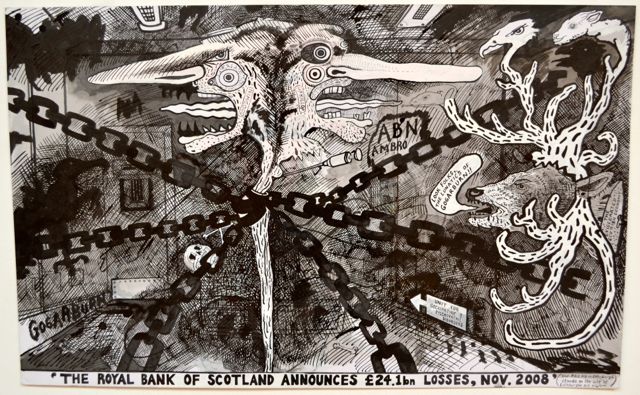
The Royal Bank of Scotland – Martin Fowler
Compiling 500 years of Scottish history is by no means an easy feat. Countless pages of history books burst at the seams with tales of battles, inventions, kings and queens, acts of law, migration, song – it’s hard enough to even pick where to begin. However, Scottish artist Martin Fowler has done just that, compiling his picks from the last 500 years in an astute new exhibition that serves as a catalyst to examine Scottish identity through history. Entitled Scotland the Brave – A Graphic History of Scotland 1513-2013, the exhibition features ink drawings that document the ‘warts and all’ side of Scotland’s story.
Works in the exhibition currently on show at the Scottish Storytelling Centre in Edinburgh range from monumental events such as the battles of Culloden, Bannockburn and Flodden, to more recent events such as the near collapse of the Royal Bank of Scotland, the Housing Act of 1980, Edinburgh’s tram debacle and the opening of the Scottish Parliament in 1998. The Relegation of Rangers FC and the comical disaster of the 1978 World Cup campaign also make an appearance – after all, it wouldn’t be a history of Scotland without the mention of football. The series also explores darker and often overlooked issues such as the arrival of the AIDS epidemic in Edinburgh in the 80s, Scottish self-hatred (a term coined by writer Irvine Welsh) and issues within the prison system where Fowler once worked with prisoners as an art teacher.

A Concise History of North Sea Oil – Martin Fowler
The exhibition serves as an aide-mémoire to Fowler, who said the drawings act as a way to understand and remember events from history. Fowler comes from a generation of Scottish children who were taught a distinctly English history at school, rather than the history of the country in which they were born and raised, saying: “At school there were no references to the Scottish Enlightenment, even though I grew up and went to school in Edinburgh where it happened. I didn’t even have an opinion on it.” Cynicism and satire are employed within some works as a way to critique the madness, as seen in A Concise History of North Sea Oil. Fowler said this piece attempts to address the lies and falsehoods surrounding the use of Scotland’s oil reserves, especially during the Thatcher years.
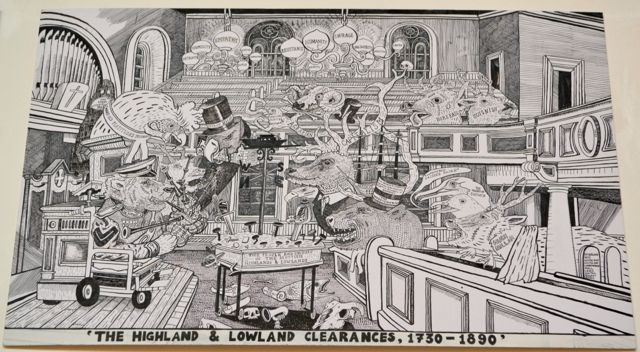
The Highland and Lowland Clearances – Martin Fowler
Fowler chose events based on those he had emotional engagement with, providing an alternative history and another way of looking at events that have often had a prescribed ‘John Prebble’ treatment. In his piece on the Highland Clearances, Fowler references the often overlooked role that women played in resisting landowners moves to clear land. This often resulted in heavy handed police brutality, riots and even deaths. He told me a story about the women of Coigach, where in 1853 attempts were made to clear families from the lands around Coigach in Wester Ross. The women defied orders to leave, and proceeded to strip the Sherrif in command of his clothes, destroying the summons he came bearing. He was then put into a boat, returning to Coigach absolutely nude and humiliated. Martin said the events surrounding the clearances are one of the events in the exhibition that have had the most impact on national identity, saying a sense of loss still exists in the Highlands to this day – something that is vitally important to Scotland’s sense of self.
Another piece in the exhibition looks at the Darien Venture in which Scotland unsuccessfully attempted to become a world trading nation by establishing the colony of Caledonia in Panama around 1690. Fowler said he didn’t know anything about the venture before he began this project, discovering the resulting economic and social situation in Scotland lead to one of the most important parliamentary acts being passed. The venture sucked half of the wealth out of Scotland, weakening the country’s resistance to the Act of the Union which was passed in 1707.
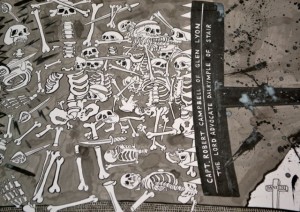
Detail – The Massacre of the MacDonalds of Glencoe
Fowler’s style has similarities with that of comic-book journalist Joe Sacco, saying he was influenced by the political and social satires of English caricaturist James Gillray. Fowler is currently living in Carlisle where he is a Senior Lecturer in Drawing and Fine Art at the University of Cumbria.
As Scotland looks towards the future in 2014, perhaps it’s useful to look back in time to see how Scotland’s identity has been shaped by the past. Not only has Fowler created an accessible collection of work but also one that shows a comprehensive appreciation of Scotland’s deep and rich history of the last 500 years.
You can see Scotland the Brave at the Scottish Storytelling Centre on the Royal Mile until the 28th of July 2013. Fowler will also be giving a talk about the exhibition on Saturday 20th July at 1pm where he will discuss how the collection came about and offer an insight into the practical and technical aspects of his work. All pieces in the exhibition are for sale and you can view more of his work here.
The post Martin Fowler’s Graphic History of Scotland appeared first on ScotClans | Scottish Clans.
]]>The post Highland Clearances Influence Composer appeared first on ScotClans | Scottish Clans.
]]>
Robert Aitken’s new soundtrack ‘Kildonan’
A new soundtrack by a Scottish composer has been influenced by the infamous Highland Clearances of the 18th and 19th Centuries. Kildonan, the latest work by Sutherland based composer Robert Aitken, draws on traditional, contemporary and classical styles to create an album that evokes the forced eviction of people from their lands.
During the industrial revolution, landowners in Scotland sought to make more capital by shipping people out and making way for shooting estates and large industrialised deer and sheep farms. Tracks on the soundtrack include Last Footsteps of Home which tells the story of a young girl on her way to an emigrant ship that lies in wait, and Red River Rant, a tribute to a piper on board an emigrant ship bound for Canada.
Aitken, who was born and brought up in Brora in Sutherland, said: “My aim is to drop the listener into a particular point in time and experience the life-story of a situation. I want the music to be felt rather than just heard. With Kildonan it was also important to examine the big themes of life, then and now – to connect the past with our present in what I do not see as time immemorial, but the ever moving cycle of life as time orbital.”
The soundtrack has received praise from Emmy-winning documentary producer Guy Perotta who called Kildonan a breath of fresh air. “Kildonan is very different from what is found in some works involving Scottish history, which sometimes resorts to what seems like a stereotypical take on what the music ought to sound like.”
Songs from the soundtrack feature on an app released in 2012 to mark the 200th anniversary of clearances in the Strath of Kildonan. Musuems Without Walls: Scotland’s Clearances Trail App uses GPS navigation, archival information and new media to guide users around important clearance sites, bringing the area’s history alive.
Several of the evicted Kildonan families sailed to Hudson Bay, in north east Canada, where they were forced to build their own shelters to protect themselves against severe winter conditions. The following spring, they set off on foot for the Red River Settlement around Lake Winnipeg in Canada where Scottish aristocrat, the Earl of Selkirk, had promised them land. Many made the 100 mile (161km) journey in handmade snowshoes.
Among the travelers was Catherine McPherson, who nursed the sick after typhoid broke out aboard ship on the journey from Scotland to Canada. She also survived a severe flood that carried away her log-built home. Her story is told in the app.
The soundtrack is available for purchase on Spotify, iTunes and Amazon.
The post Highland Clearances Influence Composer appeared first on ScotClans | Scottish Clans.
]]>The post Life On The Edge appeared first on ScotClans | Scottish Clans.
]]>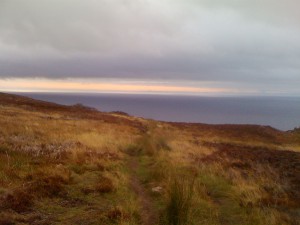
View from Badbea out to the North Sea
On the Caithness east coast, five miles north of the town of Helmsdale, you will see the ruinous remains of the once inhabited village of Badbea which saw its last resident leave at the start of the 20th century.
The Highland Clearances affected thousands of Highland families who were made to move from their homes. Some were persuaded through finacial means, such as having their fare to North America or Australia or New Zealand paid for, whilst the more unfortunate were forced out through violence and intimidation, where it wouldn’t be uncommon to see landlords have crofts burnt down. The people of the Highlands who fled ended up settling all over the place; with families moving to the lowlands or cities of Scotland and northern England looking for work in textile or shipping industries; or they emigrated to foreign countries; or some relocated to nearby coastal areas which were deemed unhabitable for the money-making sheep which replaced them.
Badbea was one of these coastal areas that some families were moved to. It was a cliff-top village established in 1793 when a number of tenant crofters were evicted from their homes to make way for the much more profitable sheep. The families were displaced on a steep, rough, small area of land. They were forced onto the tight area between the high Berriedale cliffs facing the North Sea and a large drystone wall built to protect the sheep.
Sir John Sinclair of Ulbster was the landowner who forced out many of the families from the nearby town of Ousdale, destroying their crofts to create room for the sheep. Sinclair was a politician, and also a writer on finance and agriculture who was a strong advocate for the protection and improvement of British wool.

The Badbea Monuement
Badbea was a tough place to live in; the conditions were horrendous with the land being barely fertile enough for the crofters to live on. Many of the families living there were from Ousdale, though there some from Auchencraig and Kildonan.
Each family who arrived was given their own plot of land to live on and farm. However there were no buildings actually present, and the families would have to clear their area and hack away at the difficult terrain and then build the houses from the stones they found. Each plot had enough space for a longhouse with a shed at the end, a couple of outbuildings and a kailyard. The rest of their land was then used for some cattle, a pig, and a few chickens. It was kind of primitive living for the most part as the whole village only had one horse, and so had no plough. Instead the fields were ploughed manually with the men using a spade-like instrument called a chaib. The harrow needed to be pulled by the men instead, and the manure was carried by the women on their backs in creels.
The families were industrious and frugal, with each household having a spinning wheel in the home where the young women would learn spinning and carding.
With the land provided it was impossible to be able to make a living from farming. The area wasn’t incredibly fertile, with the land being quite rocky. Also being right on the coast like they were the winds coming in from the North Sea were so violent that it would have been practically impossible to grow anything substantial there anyway. In fact, the winds were so strong that when the adults were working any children or livestock outdoors had to be tethered to rocks or posts to stop them being blown over the precipice.
Herring fishing was the the main source of income. The men would go to sea, and the women would gut what was caught. Fishing was a very dangerous occupation, especially in the North Sea. Before the Clearances most of these people lived in the sheltered inlands of the straths and the glens, and so were not accostumed to being out at the sea. However, at its height there were 13 fishing boats in use, and the herring fishing provided a lot of food for all families, including for the widows who had children to support children.
By 1814 the Laird’s Estate had been sold to James Horne. At this point the population of Badbea was 80 people within 12 different families. Though for the families in Badbea, this would turn out to have unfortunate consequences.
Donald Horne, James’ nephew, put a stop to the herring fishing, favouring to fish salmon instead. This put a stop to the community’s main form of employment, meaning that the people had to survive on much less, and the widowed families having to occasionally do without. However there were other means of income. Some of the women would weave baskets, or make flails of birch for threshing corn corps and then sell them at Dunbeath Market in November.

Inscription on Badbea Monument
On the landlord’s estate there would sometimes be some menial jobs to be done by people from Badbea, but the rate of pay would be very low, and in no way appropriate. This would encourage some of the men to look for work on other estates or elsewhere. However, if they were caught doing this by their landlord, as punishment the men and their familied could face being evicted from Badbea.
A notable resident of Badbea was John “Badbea” Sutherland. John was a very popular and respected member of the community. He lived most of his life in Badbea where he was preacher and doctor to all. John was thought of as a man of great piety and worth, and it is said that he possessed the only watch in the village. John died in his house at the age of 76 on the 31st August, 1864 and was burried in the burial ground at Berriedale.
The village of Badbea was occupied for over 100 years, with the last resident leaving in the early 1900s. In 1911 a memorial was errected in honour of the families who lived in Badbea and suffered during the Highland Clearances. The man who commissioned the monument was David Sutherland who visited Badbea in 1901 when only two tenants were left. Born in New Zealand, David was the son of Alexander Robert Sutherland who was born in Badbea and brought up by John “Badbea” Sutherland. Alexander emigrated to New Zealand in his 30s in 1839 and although he prospered in his new country, he never forgot Scotland. The memorial was built using the stones from the croft that was lived in by John “Badbea”.
The post Life On The Edge appeared first on ScotClans | Scottish Clans.
]]>The post The Year of Sheep – Scots Protest against The Highland Clearances appeared first on ScotClans | Scottish Clans.
]]>
Scotland’s sheep industry is worth more than £165m
The year of Homecoming is upon us, when expats and people from abroad with Scottish blood return to their homeland to celebrate all things Scottish.
But 217 years ago, the Government were doing quite the opposite, Scots were being banished from their homeland, threatened with execution if they refused. Amid the backdrop of ‘The Highland Clearances’ some inhabitants of Scotland did protest. In a year that was to become known as ‘The Year of Sheep’, there is evidence of a series of organised protests using one of Scotland’s most important exports- sheep.
In 1872 during The Highland Clearances a wedding party declared war on sheep and decided to undertake the ambitious job of driving thousands of sheep from the hills of Easter Ross and Sutherland. The majority of them members of the Ross family of Strathrusdale This escalated to 4 days later becoming a massive riotous group of 400 men. The Ross-shire Sheep Riots had begun.
Prof Jim Hunter, director of the UHI Centre for History said: “Announcements were made outside churches on a particular Sunday. The plan was drive the sheep from Sutherland and Easter Ross south.”
The sheep drivers recruited to their ranks as they pushed south.
By early August, they had rounded up 6,000 sheep and had reached Beauly, near Inverness.
Prof Hunter said: “The government was panicky. The situation was worse from their perspective because of the French Revolution and there was apprehension that the same thing might happen in Britain.
“The government cracked down on public protests.”
The Inverness County Sheriff Court Records reveal the punishments ordered for six men accused of driving sheep away.
They were Hugh Breck MacKenzie, John Aird, Malcolm Ross, Donald Munro, Alexander MacKay and William Cunningham.
MacKenzie and Aird were both ordered to be transported for seven years “beyond seas to such places as His Majesty shall appoint”.
If they returned to Britain in those seven years they were to be sentenced to death.
The post The Year of Sheep – Scots Protest against The Highland Clearances appeared first on ScotClans | Scottish Clans.
]]>