The post Saltire – The Flag of Scotland! appeared first on ScotClans | Scottish Clans.
]]> The Flag of Scotland is called the Saltire or the St Andrews Cross. It is a white diagonal cross on a blue field. The legend of it’s origins as the national flag go all the way back to 832AD.
A joint force of Picts and Scots under King Angus (or Óengus) of The Picts met a Northumbrian army under King Athelstan at a location near what would become Athelstaneford, four miles north east of Haddington, in East Lothian. The Pictish army were surrounded by superior numbers and prayed for assistance. That night Saint Andrew who was martyred on a Saltire shaped cross appeared to Angus and assured him of victory.
The following morning the two armies formed up for battle. As they did so, a strange cloud formation appeared, forming a broad diagonal white cross against the background of bright blue sky. The Picts and Scots believed this to be an omen: and so did the Angles. The battle that followed was an improbable victory for the outnumbered Picts and Scots. From then onwards the Saltire has been used as Scotland’s national flag.
Use of the familiar iconography of St Andrews martyrdom, showing the apostle bound to an X-shaped cross, first  appears in the Kingdom of Scotland in 1180 during the reign of William I. The earliest physical evidence of the Saltires use as a national symbol can be traced to 1286, were it was used on the seal of the Guardians of Scotland, and evidence of the symbol being used on a flag rather than a seal, brooch or surcoat dates to much later. The earliest reference to the Saint Andrew’s Cross as a flag is found in the Vienna Book of Hours, circa 1503, in which a white saltire is depicted with a red background. In the case of Scotland, use of a blue background for the Saint Andrew’s Cross is said to date from at least the 15th century, with the first certain illustration of a flag depicting such appearing in Sir David Lyndsay of the Mount’s Register of Scottish Arms, circa 1542, although the massive heraldic standard of the ‘Great Michael’, a great ship of the Royal Scottish Navy which was launched around 1510, had the “Sanct Androis cors” on a blue background in the Hoist.
Traditionally the Saltire is blue (some say to represent the sky in the vision) but some versions have existed which have the white cross on a black background (due to the shortage of vegetable dyes that could reproduce the colour) and even green or red.
 In modern Scotland the Scottish Government has ruled that the Saltire should, where possible, fly on all its buildings every day from 8am until sunset. Th only exception to this is during United Kingdom ‘National Days’, were the Saltire is replaced by the Union Flag if only one flag pole is present. Likewise on St Andrews Day, the Union Flag is only flown if more than one flag pole is present. In recent years, embassies of the United Kingdom have also flown the Saltire to mark St Andrew’s Day.
The seven British Army Infantry battalions of the Scottish Division, plus the Scots Guards and Royal Scots Dragoon Guards regiments, use the Saltire in a variety of forms to this day. Combat and transport vehicles of these Army units may be adorned with a small, 130mm x 80mm in size, representation of the Saltire. Such decals being displayed on the front and/or rear of the vehicle and on tanks these may also be displayed on the vehicle turret. In Iraq, during both Operation Granby and the subsequent Operation Telic, the Saltire was seen to be flown from the communications whip antenna of vehicles belonging to these units. Funerals, conducted with full military honours, of casualties of these operations in Iraq and Afghanistan, have also been seen to include the Saltire; the flag being draped over the coffin of the deceased.
There are several areas around the world that use a variation of the Saltire as their own flag, usually due to a connection  with Scotland. The Canadian province of Nova Scotia (Latin for ‘New Scotland’) uses an inverse version of the flag, with a blue cross on a field of white. Nova Scotia has more than just a name to connect it to Scotland, as it was the first colonial venture of the Kingdom of Scotland in the Americas and as such has a great number of Scottish descendants.
The Dutch area of Sint-Oedenrode, which is named after the Scottish princess Saint Oda, uses a version of the flag of Scotland, defaced with a gold castle having on both sides a battlement.
The flag of Tenerife is identical to the Scottish flag except for the shade of blue, Tenerife’s flag using a much darker colour. Although some theories claim a connection between the flags, their similarity is likely coincidental.


The post Saltire – The Flag of Scotland! appeared first on ScotClans | Scottish Clans.
]]>The post The Flower of Scotland! appeared first on ScotClans | Scottish Clans.
]]>
The thistle is the national flower of Scotland, much like the rose is the national flower of England and the United States. Today we’re going to look at two interesting things about this flower, the tale as to why it became the national flower and also the unofficial national anthem it inspired.

There are several different legends that tell how the thistle became Scotland’s symbol, but most date from the reign of Alexander III and in particular the events surrounding the Battle of Largs in 1263.
It is often forgotten, that for hundreds of years much of Scotland was part of the Kingdom of Norway. By 1263 however, Norway seems to have had little interest in their former territory. That was until King Alexander III proposed to buy back the Western Isles and Kintyre from the Norse King Haakon IV. The thought of relieving King Alexander of some of his riches and territories appears to have re-kindled Norse interest in Scotland.
Late in the summer of 1263 King Haakon of Norway, now intent on conquering the Scots, set off with a sizeable fleet of  longships for the Scottish coast. Gales and fierce storms forced some of the ships onto the beach at Largs in Ayrshire, and a Norwegian force was landed.
Legend has it that at some point during the invasion the Norsemen tried to surprise the sleeping Scottish Clansmen. In order to move more stealthily under the cover of darkness the Norsemen removed their footwear. But as they crept barefoot they came across an area of ground covered in thistles and one of Haakon’s men unfortunately stood on one and shrieked out in pain, thus alerting the Clansmen to the advancing Norsemen.
His shout warned the Scots who defeated the Norsemen at the Battle of Largs, thus saving Scotland from invasion. The important role that the thistle had played was recognised and so was chosen as Scotland’s national emblem.

‘Flower of Scotland’ is considered the unofficial national anthem of Scotland.
 There are several other songs that have been considered to be the unofficial national anthem of Scotland including; Scots Wha Hae, Scotland the Brave and the more recent Highland Cathedral. Although in July 2006, the Royal Scottish National Orchestra conducted an online poll in which voters could choose a national anthem from one of five candidates.10,000 people took part in the poll in which Flower of Scotland came out the winner.
The lyrics were written by Roy Williamson (1936-90) and the song was performed initially by The Corries, a Scottish folk band, and refers to the victory of the Scots, led by Robert the Bruce, over England’s Edward II at the Battle of Bannockburn in 1314. The music is actually somewhat older, and was composed by Peter Dodds McCormick (c1834-1916) who emigrated to Australia as a young man, and also composed the National Anthem of Australia, “Advance Australia Fair”.
The song is also known as Flùr Na H-Alba” in Scottish Gaelic, and “Flouer O Scotland” in Scots.
The title has also been used for a history book: The Flower Of Scotland: A History Of Scottish Monarchy by James J.  Sharp, and for the biography of Roy Williamson, which was published by his daughter Karen in 1993.
There also exists a Flower of Scotland tartan which was created in the early 90′s to honour the late Roy Williamson. The design is based on the setting and thread count of the Gunn tartan, as worn by Roy Williamson, using the traditional 18th-century colours of Lichen Green and Lochan Blue although it has no Clan or family affiliation and therefore is available for all to wear.
Thistle Products from ScotClans…


The post The Flower of Scotland! appeared first on ScotClans | Scottish Clans.
]]>The post How Gaelic is the Scottish clan system? appeared first on ScotClans | Scottish Clans.
]]> One of the many Scottish heritage subjects that could benefit from additional knowledge is the role of Gaelic culture and civilization in the remarkable development of what we lovingly call the Scottish clan system.
Go ahead. Google it. It is a simple question but you will not be finding a simple answer. At least not one that has any satisfying depth and truth about it. How and why the Scottish clan system got underway is a question that remains shrouded in the mists of attempted Anglo cultural and linguistic genocide. We may never really be able to get at it, but to date, we haven’t tried much.
So much of what we celebrate today is unrelated to our shared Gaelic heritage. Many clan traditions and changing clan societal and political roles developed post 13th century at a time well beyond the days when it was fashionable to be a Gael in Scotland. Unfortunately, this Gaelic-blind tradition is stubborn and endures in our modern world. Interest in and resulting support for Gaelic language and cultural studies from the mainstream Scottish heritage community has always been absent without leave at least in the Scottish diaspora. And yet that persistent Gaelic bug continues to irritate and eat at the otherwise comfortable Scottish heritage community – Scottish clan and family organizations in particular.
The etymology of the word “Clann” or “Clanna” (modern Gaelic) is popularly understood today by English speaking Scottish Americans. In modern Gaelic the word can be translated as “children” or “family”. The word has also connoted a social and political kin based unit which takes its name from a founding common ancestor.
The earliest written use of the word “Clann” in this last sense comes in the Gaelic language in margin notes inscribed in a gospel book from Buchan and dating to the 12th century. As an aside, the inscription specifically mentions Clan Cannon and Clan Morgan. The very powerful clans Dougal and Donald begin to be more commonly mentioned in written Gaelic by the 13th century and both of these seminal clans were founded by 12th and 13th century ancestors.
Interestingly enough, the word “Chief” is not of Gaelic derivation. It is a french – read Norman – import. Use of the word “Chief” in a Scottish clan context did not become popular until around the 15th century and it’s first (known) written mention came in 1432 in a document penned in Scots English not Gaelic. Time marches on and things are gained and lost.
While we grab at these kinds of historical snippets, despite it’s nearly 1000 years of existence, we know precious little about how the Clan system got underway and most of all, why. What we do know is that the origins and elements of the Scottish clan system were of the Gaelic civilization. However, the catalyst that triggered the societal and political innovation called the Scottish “clan” may well have little to do with Gaeldom itself, except that it would eventually almost completely overtake the Gaelic culture. You guessed it. It’s England’s fault.
Although we are deathly short on facts and figures, we know that the Scottish clan system began to coalesce into its modern form roughly at the same time as the Gaelic Kingdom of Scotland was becoming increasingly solid and unified (11th – 14th centuries). It was also a time when the Kings of Scotland became more English than Gaelic and the native Gaelic civilization began to feel serious social and political pressure to get on the Anglo bus and ride to the future. Leave your Gaelic baggage at the station, please. There was a great deal of instability at that time in the Kingdom of Scotland and definition of the eventual look and feel of the Kingdom was secured neither to the Gaels or to the inflowing Anglos.
Of course we know the outcome of that story. It did not take long for an Anglo tsunami to obscure the Gaelic roots of the Scottish clan. Today they are barely recognizable and that’s all right, but we have an obligation to understand how and why it happened together with some of what the tsunami modified or left behind. Gaelic people, language and institutions faced growing Anglo/Norman – feudal – pressure to assimilate from the 12th century forward. This context certainly influenced development of the Scottish clan system and for the most part gave it definition as time moved ahead.
A great example is the close relationship between Scottish clans and the Scottish Lord Lyon King of Arms. Scottish heraldry is not borrowed from the native Gaelic civilization but the Scottish Lord Lyon has borrowed from original Gaelic structure and law in his approach to Scottish clans. Indeed it is argued that the Lord Lyon replaced the Gaelic royal Seanchaidh or clan genealogist and bard. Heraldry was adopted as an add on to an already working clan system.
A former Lord Lyon, Sir Malcolm Innis of Edingight, put it nicely in a 1999 speech delivered to the Heraldry Society of Scotland: “The thrust of our stance must be that heraldry in Scotland served to support and reinforce the clan and the family …”. Yet after formation, Gaelic clans increasingly became defined by and interwoven with the heraldic laws and traditions of England and the continent and those laws and traditions form the basis of the clan system’s relationship with the Scottish Lord Lyon that flourishes even today.
One of the itchy things that we still do not know with much depth and clarity is what was the trigger or triggers that caused Gaels to combine, socially and politically, into a new clan system. Almost certainly it had something to do with the fact that Gaelic culture and political influence and even existence were under siege by incoming Anglo ideas and power at the time. Carrot and stick. Were new clans imposed as a vehicle to carry the Gaelic elite to the carrot stash? Or conversely, did Gaels adaptively come together in a new way to try to meet a new challenge that wasn’t anything like their experience with Picts and Vikings?
The clans that we know today were forming in the Scottish Gaelic world as social and political kindred units during the 12th, 13th and 14th centuries. As such, there are about 1000 years of social and political structure within the pre-clan Gaelic world generally and a good five or six centuries of a Gaelic Kingdom of Scotland that do not presently inform the general Scottish heritage community. This should be our new frontier for learning and communicating to upcoming generations.
Although we have become a bit comfortable and complacent in our knowledge, there is still a great deal of Gaelic history to be understood in order to really understand our Scottish clan heritage. If we choose not to meet this challenge we are the conflictasaurus that is a heritage community that does not care much about its roots.
We need to turn our attention and support to Scottish Gaelic language and cultural studies. We need to work harder to preserve what is left of our native roots in Scotland. We can well survive without four new books on the Battle of Culloden. It is time that we widen our field of inquiry and get acquainted with our Gaelic past because it was ubiquitous in Scotland despite many folks really wanting to get shed of it. Scotland was a Gaelic place for 1000 years before it became an English speaking feudal replica of its aggressive neighbor to the south. America’s Gaelic opportunity was snuffed in a few hundred years. It is time we get back to the root of the matter. The Gaelic roots.
The post How Gaelic is the Scottish clan system? appeared first on ScotClans | Scottish Clans.
]]>The post Symbols of Edinburgh appeared first on ScotClans | Scottish Clans.
]]>
The story of the Luckenbooth begins on the Royal Mile, the famous street that runs from the Castle all the way down to the palace of Holyrood. This street became the only acceptable trade route to and from the castle and as such became a very important thoroughfare.
By the 16th century many parts of this route became dedicated markets and featured some of the cities first permanent shops. Many of which housed trades people who made and sold their small selection of wares, and amongst the most popular were the jewellers. These shops were known as locked booths, and from this derived the term ‘Luckenbooth’ used to describe one of their most popular designs. It featured the ‘heart and crown of Scotland’ and was romantically linked to the tragic Mary, Queen of Scots, as it was the brooch she had given to Lord Darnley.
The tradition that rose up around the brooch was that a young man would give his lady the brooch on their wedding day. Once their first child the brooch would then be passed on to the newest member to protect it from ‘evil spirits’. As such it had very similar connotations to the Irish ‘Claddagh’ ring, especially with the similar heart shaped theme.
The style of the Luckenbooth brooch became very popular throughout the UK. By the 18th century the trade in silver to the New World included the little brooch and many ended up being traded with Native Americans, Particularly the Iroquois of the Six Nations. As a result of this the Luckenbooth became a popular decorative symbol in their traditional costumes.

Not a symbol of Edinburgh that you would see if you were not looking for it, the City Coat of Arms present version is a modified version of the arms registered by the Lord Lyon in 1732. This previous version had been used for centuries, but had not been officially recognised.
As with any Coat of Arms there is a fair amount of symbolism within the arms. The castle within the centre shield represents Edinburgh castle, it’s most prominent landmark. The anchor above this, or the crest, represents the Lord Provost’s position as the Admiral of the Firth of Forth. The sinister supporter, a doe, is a link to the city’s patron saint St Giles who, as the story goes, spent much of his life in solitude in the forests of Provence with only a doe for company. The dexter supporter, a “woman richly attired with her hair hanging over her shoulders” represents the fact that Edinburgh Castle was historically known as the “Castle of the Maidens” probably due to it being used to protect princesses and noblewomen in times of war.

Coat of Arms on a window in the City Chambers
The motto Nisi Dominus Frustra means “Except the Lord in Vain”, a shortened version of a verse from Psalm 127: “Except the Lord build the house, they labour in vain that build it: except the Lord keep the city, the watchman waketh but in vain.”
There was some controversy surrounding the arms as in Scotland it is a statutory requirement to register register armorial bearing with the Lord Lyon, who is responsible for regulating the system of Scottish Heraldry, in a process known as “matriculation”. An action was begun against Edinburgh council in 1732, for failing to matriculate it’s Burgh arms. But the council received the following legal opinion ”that the town would not be bound in law to matriculat”. Unfortunately no record exists of any subsequent action, suggesting that the case was dropped.
The Lyon issued a general statement in 1771 that “all persons whether Nobility, Gentry, Towns or Bodies Corporate, bearing arms any manner or way which are recorded in terms of the Act…to give in or send to the Lyon Office an account of such Arms and of the title whereby they claim to wear the same”. Edinburgh Councils reaction wa smuch the same as before and refused to comply on the grounds that Scotland’s royal burghs ”had possessed the privilege of using seals and armorial bearings from a remote period which far outdated the Acts of 1592 and 1672, from which the Lord Lyon derived his jurisdiction, and that since neither of these Acts specifically mentioned the Burghs, they did not apply to them”.
It was only 3 years later that a document was discovered among the papers of an Edinburgh lawyer - a Certificate of Matriculation of “the Ensigns Armorial or Coat of Arms of the good town of Edinburgh” signed by the Lyon and dated 21 April 1732. It seems the Edinburgh City Coat of Arms had been matriculated years before!

The Heart of Midlothian is a heart shaped mosaic formed in coloured granite setts, built into the pavement near the West Door of St Giles on the High Street section of the Royal Mile.
Together with brass markers bearing building dates, it records the position of the 15th-century Old Tolbooth, demolished in 1817, which was the administrative centre of the town, prison and one of several sites of public execution. This is believed to be were the modern tradition of spitting on the Heart came from. The spot lay directly outside the prison entrance, and people would spit on the heart to show their disdain for the former institution. Others believe the tradition may have been started even earlier, with former occupants of the prison spitting on the Heart upon their release. These days it is done for good luck.
The mosaic is named after the historic county of Midlothian of which Edinburgh is the county town. This is not to be confused with the council area of the same name which covers a smaller area and does not include the capital. The crest of the Edinburgh football team Hearts of Midlothian is based upon this Heart.

The stag with a cross between it’s antlers is a common site around the palace of Holyrood, found at the bottom of the Royal Mile. The tale of this intriguing symbol is believed to date back to the time of David I.
The son of King Malcolm Canmore and St Margaret, David was a keen hunter and there was nothing he liked better than to hunt stags in the forests of Drumsheugh. One day in the year 1128, he prepared to go hunting but he was approached by a priest who reminded him that it was the 14th September; Holy Rood Day. The term ‘Rood’ was at the time used as a term for the Holy Cross, and that day was considered to be a sacred one indeed, not a day for sport. King David ignored the rebuke and gathered together the hunters to saddle the horses ready for the hunt.

As the party rode through the forest King David found himself separated from his companions when out of nowhere a large white stag burst through the forest and knocked the King from his horse. The stag lowered it’s mighty antlers and seemed ready to gore the King, whose lips were moving in silent prayer, and was sure his time had come. In a moment of bravery the King seized the stag by the antlers and grappled with the fierce beast. But to his amazement the antlers twisted and reformed in his hands to form the shape of a Cross, and the stag bounded away out of sight. Shaken by the experience the King returned home to Edinburgh castle and the comfort and safety of his court.
That night as King David lay asleep in his bed, he dreamed that a voice spoke to him, commanding him to have an abbey built on the spot he had wrestled with the magnificent stag. The next morning spurred on by what he believed to be a Holy vision he ordered the construction of Holyrood Abbey.His orders were carried out and a fine abbey was built to house a community of Augustinian Canons who flourished there fro many years.
The ruins of Holyrood Abbey can still be visited to this day
The post Symbols of Edinburgh appeared first on ScotClans | Scottish Clans.
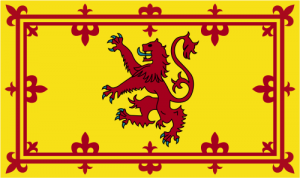
]]>The post The Lion Rampant from The Court of Lord Lyon appeared first on ScotClans | Scottish Clans.
]]>
This is taken from The Court of Lord Lyon’s facebook page: https://www.facebook.com/LyonCourt
“The Royal Standard of Scotland, (Scottish Gaelic: Bratach rìoghail na h-Alba, Scots: Royal banner o Scotland), also known as the Banner of the King of Scots, or more commonly the Lion Rampant of Scotland, is the Scottish Royal Banner of Arms. Used historically by the King of Scots, the Royal Standard of Scotland differs from Scotland’s national flag, the Saltire, in that its correct use is restricted by an Act of the Parliament of Scotland to only a few Great Officers of State who officially represent the Sovereign in Scotland. It is also used in an official capacity at royal residences in Scotland when the Sovereign is not present.
The earliest recorded use of the Lion rampant as a royal emblem in Scotland is by Alexander II in 1222; with the additional embellishment of a double border set with lilies occurring during the reign of Alexander III (1249–1286). This emblem occupied the shield of the royal coat of arms of the ancient Kingdom of Scotland which, together with a royal banner displaying the same, was used by the King of Scots until the Union of the Crowns in 1603, when James VI acceded to the thrones of the Kingdom of England and Kingdom of Ireland. Since 1603, the Lion rampant of Scotland has been incorporated into both the royal arms and royal banners of successive Scottish then British monarchs in order to symbolise Scotland; as can be seen today in the Royal Standard of the United Kingdom. Although now officially restricted to use by representatives of the Sovereign and at royal residences, the Royal Standard of Scotland continues to be one of Scotland’s most recognisable symbols.”
The post The Lion Rampant from The Court of Lord Lyon appeared first on ScotClans | Scottish Clans.
]]>