<br />
<b>Deprecated</b>:  mysql_connect(): The mysql extension is deprecated and will be removed in the future: use mysqli or PDO instead in <b>/var/www/apps/scotclans_wp/wp-includes/wp-db.php</b> on line <b>1142</b><br />
<?xml version="1.0" encoding="UTF-8"?>
<rss version="2.0"
	xmlns:content="http://purl.org/rss/1.0/modules/content/"
	xmlns:wfw="http://wellformedweb.org/CommentAPI/"
	xmlns:dc="http://purl.org/dc/elements/1.1/"
	xmlns:atom="http://www.w3.org/2005/Atom"
	xmlns:sy="http://purl.org/rss/1.0/modules/syndication/"
	xmlns:slash="http://purl.org/rss/1.0/modules/slash/"
	>

<channel>
	<title>ScotClans &#124; Scottish Clans &#187; Scottish Weddings</title>
	<atom:link href="http://109.74.200.198/category/scottish-events/scottish-weddings/feed/" rel="self" type="application/rss+xml" />
	<link>http://109.74.200.198</link>
	<description></description>
	<lastBuildDate>Fri, 20 Jan 2017 08:08:09 +0000</lastBuildDate>
	<language>en-US</language>
	<sy:updatePeriod>hourly</sy:updatePeriod>
	<sy:updateFrequency>1</sy:updateFrequency>
	<generator>http://wordpress.org/?v=3.6.1</generator>
		<item>
		<title>The Luckenbooth Brooch!</title>
		<link>http://109.74.200.198/the-luckenbooth-brooch/</link>
		<comments>http://109.74.200.198/the-luckenbooth-brooch/#comments</comments>
		<pubDate>Fri, 01 Jul 2016 11:00:30 +0000</pubDate>
		<dc:creator>Andy</dc:creator>
				<category><![CDATA[Edinburgh]]></category>
		<category><![CDATA[House of Stewart]]></category>
		<category><![CDATA[Mary I]]></category>
		<category><![CDATA[Scottish History]]></category>
		<category><![CDATA[Scottish Kings and Queens]]></category>
		<category><![CDATA[Scottish Weddings]]></category>
		<category><![CDATA[Brooch]]></category>
		<category><![CDATA[edinburgh]]></category>
		<category><![CDATA[Holyrood]]></category>
		<category><![CDATA[Luckenbooth]]></category>
		<category><![CDATA[Mary Queen of Scots]]></category>

		<guid isPermaLink="false">http://www.scotclans.com/?p=61151</guid>
		<description><![CDATA[<p>The Royal Mile, one of the most famous streets in Edinburgh, runs from the castle all the way down to Holyrood Palace. When Edinburgh castle was first established this was the only accessible route, a natural ramp formed thousands of years ago gave access to a castle otherwise impregnable from the east. With the establishment [&#8230;]</p>
<p>The post <a rel="nofollow" href="http://109.74.200.198/the-luckenbooth-brooch/">The Luckenbooth Brooch!</a> appeared first on <a rel="nofollow" href="http://109.74.200.198">ScotClans | Scottish Clans</a>.</p>
]]></description>
				<content:encoded><![CDATA[<p style="text-align: center;"><a href="http://www.scotclans.com/scottish-shop/?search=luckenbooth"><img class="wp-image-61155 aligncenter" alt="Luckenbooth" src="http://www.scotclans.com/wp-content/uploads/2016/07/Luckenbooth.jpg" width="700" height="350" /></a></p>
<p>The Royal Mile, one of the most famous streets in Edinburgh, runs from the castle all the way down to Holyrood Palace. When Edinburgh castle was first established this was the only accessible route, a natural ramp formed thousands of years ago gave access to a castle otherwise impregnable from the east.</p>
<p>With the establishment of Holyrood palace, or rather the original monastery in the 12th century, the route between the two became an important thoroughfare. Businesses and government offices sprang up as well as several churches such as the magnificent St Giles Cathedral.</p>
<p><a href="http://www.scotclans.com/product/heather-luckenbooth-brooch/"><img class="alignleft  wp-image-61154" alt="SB10" src="http://www.scotclans.com/wp-content/uploads/2016/07/SB10-300x300.jpg" width="150" height="150" /></a>By the 16th century many parts of this route became dedicated to markets and the wide area running down from St Giles towards the Canongate featured some of the city’s first permanent shops. Many of these housed small trade people who made and sold their wares, and among the most popular were the jewellers. The shops themselves were very small and were known as &#8216;Locked Booths&#8217;. From this we get the word &#8216;Luckenbooth&#8217;.</p>
<p>The Luckenbooth brooch became a very popular item in 16th century Scotland. It featured the &#8216;Heart &amp; Crown of Scotland&#8217; and was romantically linked to the tragic Mary, Queen of Scots as it was the brooch she had given to Lord Darnley.</p>
<p>The style of the Luckenbooth brooch became very popular throughout the UK. By the 18th century the trade in silver to the new world featured the little brooch and many ended up traded with Native Americans, particularly the Iroquois of the Six Nations. As a result of this the Luckenbooth became a popular decorative symbol in their costumes.</p>
<p>The tradition was that the young man would give his lady a Luckenbooth brooch on their wedding day. When their first <a href="http://www.scotclans.com/product/luckenbooth-thistle-scarf-ring/"><img class="alignright size-thumbnail wp-image-61153" alt="906" src="http://www.scotclans.com/wp-content/uploads/2016/07/906-150x150.jpg" width="150" height="150" /></a>child arrived the brooch would then be pinned to the babies shawl to protect it from &#8220;evil spirits&#8221;. As such it had very similar connotations to the Irish &#8216;Claddagh&#8217; ring especially with the similar heart shaped theme. This tradition can be carried over to today. A Luckenbooth Brooch makes a fantastic gift for your bride on your wedding day, or a gift for a newborn as a symbol of protection and love. Whatever you pick one up for, it is and always will be an enduring symbol of Edinburgh and of Scotland.</p>
<p>&nbsp;</p>
<p>&nbsp;</p>
<p><a href="http://www.scotclans.com/product/luckenbooth-brooch/"><img class="aligncenter size-large wp-image-61152" alt="Twitter9" src="http://www.scotclans.com/wp-content/uploads/2016/07/Twitter9-1024x511.jpg" width="980" height="489" /></a></p>
<p>The post <a rel="nofollow" href="http://109.74.200.198/the-luckenbooth-brooch/">The Luckenbooth Brooch!</a> appeared first on <a rel="nofollow" href="http://109.74.200.198">ScotClans | Scottish Clans</a>.</p>
]]></content:encoded>
			<wfw:commentRss>http://109.74.200.198/the-luckenbooth-brooch/feed/</wfw:commentRss>
		<slash:comments>0</slash:comments>
		</item>
		<item>
		<title>What is the Sgian Dubh?</title>
		<link>http://109.74.200.198/what-is-the-sgian-dubh/</link>
		<comments>http://109.74.200.198/what-is-the-sgian-dubh/#comments</comments>
		<pubDate>Fri, 24 Jun 2016 13:37:30 +0000</pubDate>
		<dc:creator>Andy</dc:creator>
				<category><![CDATA[Highland Games]]></category>
		<category><![CDATA[ScotClans Shop]]></category>
		<category><![CDATA[Scottish History]]></category>
		<category><![CDATA[Scottish Weddings]]></category>
		<category><![CDATA[Highland Dress]]></category>
		<category><![CDATA[scottish history]]></category>
		<category><![CDATA[Sgian Dubh]]></category>

		<guid isPermaLink="false">http://www.scotclans.com/?p=61140</guid>
		<description><![CDATA[<p>The Sgian Dubh is a small edged knife, usually 3-4 inches in length, that is worn as part of the traditional Highland dress tucked into the top of the kilt hose with only the handle visible. It&#8217;s origins are fairly unclear, although it is now a purely ornamental item, most communally applied with an underage [&#8230;]</p>
<p>The post <a rel="nofollow" href="http://109.74.200.198/what-is-the-sgian-dubh/">What is the Sgian Dubh?</a> appeared first on <a rel="nofollow" href="http://109.74.200.198">ScotClans | Scottish Clans</a>.</p>
]]></description>
				<content:encoded><![CDATA[<p><a href="http://www.scotclans.com/scottish-shop/kilt-accessories/sgian-dubhs/"><img class="aligncenter size-large wp-image-61142" alt="Sgian-Dubh" src="http://www.scotclans.com/wp-content/uploads/2016/06/Sgian-Dubh-1024x511.jpg" width="980" height="489" /></a></p>
<p>The Sgian Dubh is a small edged knife, usually 3-4 inches in length, that is worn as part of the traditional Highland dress tucked into the top of the kilt hose with only the handle visible. It&#8217;s origins are fairly unclear, although it is now a purely ornamental item, most communally applied with an underage blade, that is an essential part of the full Highland outfit.</p>
<p>The word sgian dubh, pronounced &#8216;skee-an doo&#8217;, translates from Gaelic to &#8216;black knife&#8217;. This is usually derived as meaning a &#8216;hidden&#8217; blade, with the black being used much the same way as in black market or blackmail. This is further given credence when compared to other Gaelic words, such as dubh-fhacal translated as &#8216;riddle&#8217; or &#8216;hidden word&#8217;, or dubh-cheist translated as &#8216;enigma&#8217; or &#8216;hidden question&#8217;.</p>
<p><a href="http://www.scotclans.com/product/clan-crest-celtic-sgian-dubh-with-coloured-stone-top/"><img class="aligncenter size-large wp-image-61143" alt="Clan-Crest-Sgian-Dubh" src="http://www.scotclans.com/wp-content/uploads/2016/06/Clan-Crest-Sgian-Dubh-1024x512.jpg" width="980" height="490" /></a></p>
<p>One theory behind the origins of the sgian dubh is that the knife evolved form another blade carried by the Highlanders, the sgian achlais. Slightly larger than the sgian dubh and likely a close relative of the dirk, the sgian achlais was carried on the upper sleeve or concealed within the jacket. During this time etiquette demanded that a guest would reveal any weapons upon entering their hosts home. As such the knife would instead be placed on display, but still within reach, usually within the top of the hose.</p>
<p>The sgian dubh also has a lot in common with a more practical utility blade, used for cutting fruit. food or for skinning. When the Highland Dress Proscription Act came into effect after the Battle of Culloden, it was made illegal for Highlanders to bear arms of any kind. The relatively small size of the sgian dubh was deemed acceptable and it therefore became a popular utility knife for everyday use.</p>
<p><a href="http://www.scotclans.com/product/luss-thistle-sgian-dubh-with-coloured-stone/"><img class="aligncenter size-full wp-image-61144" alt="Luss-Sgian-Dubh" src="http://www.scotclans.com/wp-content/uploads/2016/06/Luss-Sgian-Dubh.jpg" width="700" height="350" /></a></p>
<p>The early blades varied in construction, some having a &#8220;clipped&#8221;, such as found on the Bowie knife or &#8220;drop&#8221; point. The &#8220;spear-point&#8221; tip has now become universal. The earliest known blades, some housed in the National Museum of Scotland in Edinburgh, are made from German or Scandinavian steel, which was highly prized by the Highlanders. Scalloped filework on the back of the blade is common on all Scottish knives. Most early sgian dubhs are shown to have used stag horn for the construction of the handle, as it was a readily available and hardwearing.</p>
<p>Since the modern sgian dubh is only used in a ceremonial capacity the blades tend to be of a simple construction with a blunted edge and are typically made from stainless steel. The hilts on modern sgian dubhs are made form a variety of materials. The lower quality versions usually utilise a molded resin or plastic, which lowers the price but also the quality. The mid range again dubhs tend to utilise more traditional materials such as real stag horn(generally collected as it is is naturally shed, so no harm is caused to the animals at all), which is renowned for it&#8217;s hardiness, or carved wood. On the higher end of the scale full metal handles are used, generally featuring some kind of coloured stone, such as a cairngorm.</p>
<p><a href="http://www.scotclans.com/scottish-shop/?search=lochy"><img class="aligncenter size-large wp-image-61145" alt="Lochy-Sgian-Dubh" src="http://www.scotclans.com/wp-content/uploads/2016/06/Lochy-Sgian-Dubh-1024x512.jpg" width="980" height="490" /></a></p>
<p>Here at ScotClans we sell a fine range of Scottish made sgian dubhs in various styles and finishes and we are sure we will have the right one for you. Something to keep in mind, as with a kilt, is a good sgian dubh will last more than a lifetime and can make a fantastic heirloom to pass down to your children. One of my prized possessions is my fathers sgian dubh.</p>
<p>Come take a look at our full range of sgian dubhs <a href="http://www.scotclans.com/scottish-shop/kilt-accessories/sgian-dubhs/">HERE</a></p>
<p>The post <a rel="nofollow" href="http://109.74.200.198/what-is-the-sgian-dubh/">What is the Sgian Dubh?</a> appeared first on <a rel="nofollow" href="http://109.74.200.198">ScotClans | Scottish Clans</a>.</p>
]]></content:encoded>
			<wfw:commentRss>http://109.74.200.198/what-is-the-sgian-dubh/feed/</wfw:commentRss>
		<slash:comments>0</slash:comments>
		</item>
		<item>
		<title>What is a Quaich?</title>
		<link>http://109.74.200.198/what-is-a-quaich/</link>
		<comments>http://109.74.200.198/what-is-a-quaich/#comments</comments>
		<pubDate>Wed, 22 Jun 2016 12:09:11 +0000</pubDate>
		<dc:creator>Andy</dc:creator>
				<category><![CDATA[Scottish Food and Drink]]></category>
		<category><![CDATA[Scottish History]]></category>
		<category><![CDATA[Scottish Weddings]]></category>
		<category><![CDATA[Bonnie Prince Charlie]]></category>
		<category><![CDATA[Quaich]]></category>
		<category><![CDATA[Whisky]]></category>

		<guid isPermaLink="false">http://www.scotclans.com/?p=61119</guid>
		<description><![CDATA[<p>&#160; &#160; The quaich is a traditional Scottish drinking vessel which was used to offer a guest a cup of welcome and also a farewell drink, usually a dram of whisky. The quaich has a rich heritage in Scotland. Indeed, they are a uniquely Scottish invention, having no apparent connection to any other European drinking vessel. [&#8230;]</p>
<p>The post <a rel="nofollow" href="http://109.74.200.198/what-is-a-quaich/">What is a Quaich?</a> appeared first on <a rel="nofollow" href="http://109.74.200.198">ScotClans | Scottish Clans</a>.</p>
]]></description>
				<content:encoded><![CDATA[<p style="text-align: center;"><a href="http://www.scotclans.com/scottish-shop/?search=quaich"><img class="wp-image-61132 aligncenter" alt="QUAICHS" src="http://www.scotclans.com/wp-content/uploads/2016/06/QUAICHS.jpg" width="700" height="350" /></a></p>
<p>&nbsp;</p>
<p>&nbsp;</p>
<div id="attachment_61120" class="wp-caption alignleft" style="width: 260px"><a href="http://www.scotclans.com/product/clan-crest-engraved-large-thistle-handle-quaich/"><img class="wp-image-61120" alt="Clan Crest Engraved Large Thistle Handle Quaich" src="http://www.scotclans.com/wp-content/uploads/2016/06/1655179_714689208584040_2037630029_o.jpg" width="250" height="250" /></a><p class="wp-caption-text">Clan Crest Engraved Large Thistle Handle Quaich</p></div>
<p>The quaich is a traditional Scottish drinking vessel which was used to offer a guest a cup of welcome and also a farewell drink, usually a dram of whisky. The quaich has a rich heritage in Scotland. Indeed, they are a uniquely Scottish invention, having no apparent connection to any other European drinking vessel.</p>
<p>The word quaich comes from the Gaelic word &#8216;coach&#8217;, meaning cup and is pronounced &#8216;quake&#8217;. To be really accurate the &#8216;ch&#8217; sound at the end of the word is sounded as in the word &#8216;loch&#8217;, which can be tricky for non Scots.</p>
<p>Quaichs are generally shallow, circular in shape and traditionally made from wood, with a pair of small lug handles projecting horizontally from opposite sides of the rim. The lugs, though functional, are of a unique curved style adding to the character of the quaich.<br />
The making of these cups was an intricate art y which the quiach was either turned from a solid block or built up with tiny staves. The best quaichs, considered to be masterpieces, were built up with light and dark wood staves and bound round with withies or metal bands. The dozen or so staves of alternating woods such as plane-tree or laburnum were coopered together and also &#8216;feathered&#8217; into each other; This was a technique in which small slivers of wood were split away from the sides of the staves and slotted into equivalent parings cut in the opposite direction.</p>
<div id="attachment_61123" class="wp-caption alignright" style="width: 260px"><a href="http://www.scotclans.com/product/clan-crest-3in-pewter-quaich-with-gold-coloured-trim/"><img class="wp-image-61123" alt="Clan Crest 3in. Pewter Quaich With Gold Coloured Trim" src="http://www.scotclans.com/wp-content/uploads/2016/06/1399718_641241392595489_455097443_o-300x300.jpg" width="250" height="250" /></a><p class="wp-caption-text">Clan Crest 3in. Pewter Quaich With Gold Coloured Trim</p></div>
<p>As use of metals became more common int he late 17th century, so the quaich came to be made form brass, pewter, silver and sometimes a combination of these materials. When making a metal quaich the original design was kept but, where the originals wooden versions had solid, thick bases, metal quaichs were designed with a deeper and more bowl like inner cavity; reducing the overall weight while still retaining the outer shape. Thus the ladies of the era were saved the struggle of drinking elegantly from something that weighed the same as a large rock.</p>
<p>Quaich making became a highly regarded profession in 17th century Scotland. It&#8217;s likely quaichmakers made a large variety of different items, but took the name of their profession from their most accomplished and adored work.</p>
<p>Having originated in the Highlands, the quaich didn&#8217;t become popular throughout Scotland until around the 1740&#8242;s, when quaichs were carried from the north of Scotland with the canteens of the armies of Bonnie Prince Charlie. As a result the quaich was introduced to the Lowlands, making it as far south as Edinburgh. There are even accounts of quaichs being used as far south as Derby. The quaichs used by the Princes army are said to have glass bottoms, allowing those sipping a dram to keep an eye on what was going on around them; surely a sign of treacherous times.</p>
<div id="attachment_61124" class="wp-caption alignleft" style="width: 260px"><a href="http://www.scotclans.com/product/clan-crest-engraved-pewter-birthstone-quaich/"><img class="wp-image-61124" alt="Clan Crest Engraved Pewter Birthstone Quaich" src="http://www.scotclans.com/wp-content/uploads/2016/06/10541435_783958031657157_1611906762828187051_o-300x300.jpg" width="250" height="250" /></a><p class="wp-caption-text">Clan Crest Engraved Pewter Birthstone Quaich</p></div>
<p>Today quaichs have become a common site during Scottish wedding ceremonies. The newly married couple will each take a hold of one of the handles as they share a drink to symbolise their love, togetherness and trust. They may also pass the quaich around the guests to reinforce the trust and happiness of the couple, the families and all invited.</p>
<p>Many people today still offer welcome toasts to their guests using the quaich, but most give them as a gift to those they hold dear, or to celebrate a joyous occasion, such as a birth or marriage. These beautiful Scottish drinking cups are displayed in homes the world over and are, overwhelmingly, seen as a symbol of love, friendship, admiration and respect.</p>
<p>Take a look at our full range of quaichs <a href="http://www.scotclans.com/scottish-shop/?search=quaich">HERE</a> or take a peek at some of our favorites below&#8230;.</p>
<p style="text-align: center;"><a href="http://www.scotclans.com/product/hundred-thousand-welcomes-quaich/"><img class="alignleft size-full wp-image-61129" alt="Failte-Quaich" src="http://www.scotclans.com/wp-content/uploads/2016/06/Failte-Quaich.jpg" width="1000" height="500" /></a> <a href="http://www.scotclans.com/product/lion-rampant-quaich/"><img class="wp-image-61131 aligncenter" alt="Lion-Rampant-Quaich" src="http://www.scotclans.com/wp-content/uploads/2016/06/Lion-Rampant-Quaich-1024x512.jpg" width="980" height="490" /></a> <a href="http://www.scotclans.com/scottish-shop/?search=horn+quaich"><img class="wp-image-61133 aligncenter" alt="Real-Horn-Quaichs" src="http://www.scotclans.com/wp-content/uploads/2016/06/Real-Horn-Quaichs-1024x512.jpg" width="980" height="490" /></a> <a href="http://www.scotclans.com/product/celtic-thistle-quaich/"><img class="wp-image-61134 aligncenter" alt="Thistle-Quaich" src="http://www.scotclans.com/wp-content/uploads/2016/06/Thistle-Quaich-1024x512.jpg" width="980" height="490" /></a> <a href="http://www.scotclans.com/product/clan-crest-engraved-heart-of-the-highlands-quaich/"><img class="wp-image-61130 aligncenter" alt="Heart-Quaich" src="http://www.scotclans.com/wp-content/uploads/2016/06/Heart-Quaich-1024x512.jpg" width="980" height="490" /></a></p>
<p>&nbsp;</p>
<p>&nbsp;</p>
<p>&nbsp;</p>
<p>The post <a rel="nofollow" href="http://109.74.200.198/what-is-a-quaich/">What is a Quaich?</a> appeared first on <a rel="nofollow" href="http://109.74.200.198">ScotClans | Scottish Clans</a>.</p>
]]></content:encoded>
			<wfw:commentRss>http://109.74.200.198/what-is-a-quaich/feed/</wfw:commentRss>
		<slash:comments>0</slash:comments>
		</item>
		<item>
		<title>The Brooch of Scotland &#8211; Stirling</title>
		<link>http://109.74.200.198/the-brooch-of-scotland-stirling/</link>
		<comments>http://109.74.200.198/the-brooch-of-scotland-stirling/#comments</comments>
		<pubDate>Fri, 08 Jul 2011 20:49:33 +0000</pubDate>
		<dc:creator>davemcnicoll</dc:creator>
				<category><![CDATA[Armstrong]]></category>
		<category><![CDATA[Baird]]></category>
		<category><![CDATA[CLANS - Big List of Scottish Clans]]></category>
		<category><![CDATA[Scottish Humour]]></category>
		<category><![CDATA[Scottish News]]></category>
		<category><![CDATA[Scottish Weddings]]></category>
		<category><![CDATA[Tartan News]]></category>

		<guid isPermaLink="false">http://www.scotclans.com/bletherskite/?p=3003</guid>
		<description><![CDATA[<p>Sitting at one of the great junctions of Scotland and guarding the road north to the Highlands, is Stirling Castle – towering high on an extinct volcano and dominating the lower reaches of the River Forth. Known as the Brooch of Scotland, it has from time immemorial been a key strategic location securing the kingdom; [&#8230;]</p>
<p>The post <a rel="nofollow" href="http://109.74.200.198/the-brooch-of-scotland-stirling/">The Brooch of Scotland &#8211; Stirling</a> appeared first on <a rel="nofollow" href="http://109.74.200.198">ScotClans | Scottish Clans</a>.</p>
]]></description>
				<content:encoded><![CDATA[<p class="MsoNormal" style="margin: 0cm 0cm 0pt;"><span style="font-size: small; font-family: Times New Roman;">Sitting at one of the great junctions of Scotland and guarding the road north to the Highlands, is Stirling Castle – towering high on an extinct volcano and dominating the lower reaches of the River Forth. Known as the Brooch of</span></p>
<div id="attachment_39267" class="wp-caption aligncenter" style="width: 651px"><a href="/wp-content/uploads/2011/07/stirling1.png" data-lightboxplus="lightbox[5711]" title="The Brooch of Scotland - Stirling"><img class="size-full wp-image-39267" alt="Stirling Castle" src="/wp-content/uploads/2011/07/stirling1.png" width="641" height="426" /></a><p class="wp-caption-text">Stirling Castle</p></div>
<p class="MsoNormal" style="margin: 0cm 0cm 0pt;"><span style="font-size: small; font-family: Times New Roman;">Scotland, it has from time immemorial been a key strategic location securing the kingdom; indeed the very name <em style="mso-bidi-font-style: normal;">Stirling</em><em style="mso-bidi-font-style: normal;"> </em>may derive from an ancient term for &#8216;struggle&#8217; or &#8216;battle&#8217;. It was here in 1314 that <a href="/scotland/kings-queens/1306-robert1/">Robert the Bruce</a> defeated the English king, Edward II at the <a href="http://www.scotclans.com/scotland/scottish-history/medieval-scotland/1314-bannockburn/">Battle of Bannockburn</a> and saw Scotland reclaim her freedom – and with the 700<sup>th</sup> anniversary looming; and all the potential events planned it is a good time to look at this most enigmatic of cities.</span></p>
<p>&nbsp;</p>
<p class="MsoNormal" style="margin: 0cm 0cm 0pt;"><span style="font-size: small; font-family: Times New Roman;">The Dark Age annals record a famous siege at an unidentified fort in central Scotland called <em style="mso-bidi-font-style: normal;">Iuddeu </em>in the year 655; when King Penda of Mercia (a kingdom in the English Midlands) surrounded his Northumbrian counterpart. Most scholars are in agreement that this mystery fort is probably Stirling Castle. The geography seems right: plus the much travelled Roman road runs close by and until the medieval period the Forth was navigable as far as the modern town. Combining this with Stirling&#8217;s natural defensive position close to the border of several Dark Age kingdoms the case is strong.</span></p>
<p>&nbsp;</p>
<p class="MsoNormal" style="margin: 0cm 0cm 0pt;"><span style="font-size: small; font-family: Times New Roman;">Castle rock has probably had some sort of fortification built on it since at least 500BC, and during the early middle ages it way a key site for the Maetae<em style="mso-bidi-font-style: normal;"> </em>(a Celtic people related to the Britons of Strathclyde and the Goddodin of Lothian), until absorbed into Scotland around 1000 years ago. Over the next 600 years it played a huge part in the evolution and defence of the realm – kings were born, crowned and killed here; and the battles fought under the ramparts forged a nation that would be as stubbornly resistant as the very basalt rock itself. The town of Stirling developed below these ancient walls, echoing the growth of Edinburgh&#8217;s Royal Mile; and soon became and important market town; both independent from and welded to the castle and court. In 1130 <a href="http://www.scotclans.com/scotland/kings-queens/1124-david1/">King David I</a> elevated Stirling into a Royal Burgh: a town with special rights and trading privileges derived directly from the crown, giving the burgeoning settlement a huge economic boost (nearly 900 years later his descendent Queen Elizabeth would bestow City Status, again resulting in economic advantages). </span></p>
<p>&nbsp;</p>
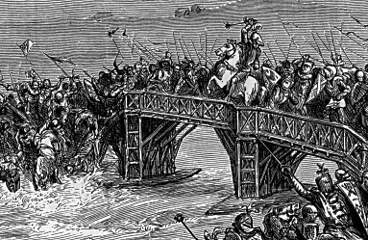
<div id="attachment_39268" class="wp-caption aligncenter" style="width: 378px"><a href="/wp-content/uploads/2011/07/stirling2.gif" data-lightboxplus="lightbox[5711]" title="The Brooch of Scotland - Stirling"><img class="size-full wp-image-39268" alt=" The Battle of Stirling Bridge" src="/wp-content/uploads/2011/07/stirling2.gif" width="368" height="240" /></a><p class="wp-caption-text"><br />The Battle of Stirling Bridge</p></div>
<p>&nbsp;</p>
<p class="MsoNormal" style="margin: 0cm 0cm 0pt;"><span style="font-size: small; font-family: Times New Roman;">As part of that deal, Bruce held fairly regular parliaments, and one in 1326 was at Cambuskenneth Abbey across the river from Stirling. Although little remains today, apart from the tower, it is still possible to visit the site. Within the grounds is the grave marker to <a href="/scotland/kings-queens/1460-james3/">King James III</a> who was killed nearby at <a href="http://www.scotclans.com/scotland/scottish-history/medieval-scotland/1488-sauchieburn/">Sauchieburn</a> in 1488 by a rebel force loyal to his teenage son (later <a href="/scotland/kings-queens/1488-james4/">James IV</a>). Queen Victoria paid for the elaborate tomb, paying homage to her ancestor who met with such a bloody end. Above the ruins lies Abbey Craig, and in 1861 work was begun on an even more elaborate expression of Victorian historical sycophancy – the <a href="http://www.scotclans.com/scottish-clans/clan-wallace/">Wallace</a> Monument. That said, it is fantastic tower and worth the visit; and today the exhibitions do tell the story of Wallace and the <a href="http://www.scotclans.com/scotland/scottish-history/medieval-scotland/1297-stirling/">Battle of Stirling Bridge</a> well. Seemingly airbrushed out of that history is Sir Andrew <a href="/scottish-clans/clan-murray/">Moray</a>, the co-commander that day – but Stirling Council now plan to set this right with a statue to the accepted brains behind the operation. </span></p>
<p>&nbsp;</p>
<p class="MsoNormal" style="margin: 0cm 0cm 0pt;"><span style="font-size: small; font-family: Times New Roman;">Following the battle in 1297 a new bridge was erected, this time of stone, and it still remains. Although no traffic crosses today it you still get the sense walking across its cobbles of being ushered north into the Highlands. Capturing and crossing the Bridge was a key objective for any Highland army heading south; particularly during the Jacobite wars. However, during the &#8217;45 Rising the Jacobites chose to by-pass both Bridge and Castle and crossed the Forth upstream at the Fords of Frew and marched unhindered to Edinburgh. It was a vision of the future: the age of stone castles was drawing to a close. By ignoring completely Stirling and her huge garrison the mobile Jacobite army ushered in a new age of modern warfare. It is perhaps fitting then that within a year the last battle would be fought on British soil; a new dawn was rising.</span></p>
<p>&nbsp;</p>
<div id="attachment_39269" class="wp-caption aligncenter" style="width: 599px"><a href="/wp-content/uploads/2011/07/stirling3.png" data-lightboxplus="lightbox[5711]" title="The Brooch of Scotland - Stirling"><img class="size-full wp-image-39269" alt="Wallace Monument" src="/wp-content/uploads/2011/07/stirling3.png" width="589" height="900" /></a><p class="wp-caption-text">Wallace Monument</p></div>
<p>In 1603 <a href="/scotland/kings-queens/1567-james6/">James VI</a>, who had been christened and partially raised behind the cold walls of Stirling Castle (and crowned nearby at the Church of the Holy Rude), became the king of England; and moved south to London. The Stewart dynasty owned and variously resided in a large number of castles and palaces across Scotland, but with James&#8217; move south many of them became redundant. Indeed, only the Palace of Holyroodhouse in Edinburgh would be retained as an official royal residence. Stirling, with her royal association and long traditional as residence needed a new role – and the most obvious was as garrison. Many regiments would come to call home a castle more used to kings; but, the collapse of the Jacobite cause in 1746 raised the question of the necessity of retaining such places – where was the practical value in comparison to the utilitarian and effective moderns garrisons such as Fort George near Inverness? Yet, there was something special about Stirling Castle – a sense of connection with both the nation and the monarchs that have ruled it that fostered a sense of sentimentality. Not until 1964, when the Argyll and Sutherland Highlanders finally departed did the citadel cease to be an active military barracks.</p>
<p>&nbsp;</p>
<p class="MsoNormal" style="margin: 0cm 0cm 0pt;"><span style="font-size: small; font-family: Times New Roman;">Today, the Castle is essentially a museum – but a brilliant one, with few parallels, especially after all the renovation work to restore it to her Renaissance heyday. Hundreds of thousands visit yearly, making it the second most visited castle in Scotland after Edinburgh. Technically, it still belongs to the Crown and the Queen has visited on more than one occasion. The town remains a bustling market, although with a heavy reliance on the service industry, and the university has brought a lot of rejuvenation. Tourism of course plays a big part in the economy and good links to Edinburgh and Glasgow adds vitality. In 2014 we hope to host the next international Clan Gathering here, and what a celebration that has the potential to be!</span></p>
<p>The post <a rel="nofollow" href="http://109.74.200.198/the-brooch-of-scotland-stirling/">The Brooch of Scotland &#8211; Stirling</a> appeared first on <a rel="nofollow" href="http://109.74.200.198">ScotClans | Scottish Clans</a>.</p>
]]></content:encoded>
			<wfw:commentRss>http://109.74.200.198/the-brooch-of-scotland-stirling/feed/</wfw:commentRss>
		<slash:comments>1</slash:comments>
		</item>
		<item>
		<title>Bride&#8217;s och aye, the poo!</title>
		<link>http://109.74.200.198/daily-sport-brides-och-aye-the-poo/</link>
		<comments>http://109.74.200.198/daily-sport-brides-och-aye-the-poo/#comments</comments>
		<pubDate>Wed, 01 Jun 2011 15:29:19 +0000</pubDate>
		<dc:creator>Amanda Moffet</dc:creator>
				<category><![CDATA[Scottish Humour]]></category>
		<category><![CDATA[Scottish Weddings]]></category>

		<guid isPermaLink="false">http://www.scotclans.com/bletherskite/?p=2868</guid>
		<description><![CDATA[<p>A FUMING bride DECKED her kilt-wearing hubby when he sat on her knee at the reception and left a SKIDMARK on her wedding dress! Like all true Scotsmen, Angus McClure, 26, didn&#8217;t wear pants under his kilt when he married sweetheart Sarah Grant in Greenock, Renfrewshire. But his traditionalism led to uproar when he perched [&#8230;]</p>
<p>The post <a rel="nofollow" href="http://109.74.200.198/daily-sport-brides-och-aye-the-poo/">Bride&#8217;s och aye, the poo!</a> appeared first on <a rel="nofollow" href="http://109.74.200.198">ScotClans | Scottish Clans</a>.</p>
]]></description>
				<content:encoded><![CDATA[<div id="attachment_2869" class="wp-caption alignleft" style="width: 131px"><a href="http://www.letsbuyscottish.com/wp-content/uploads/2011/06/poo.jpg" data-lightboxplus="lightbox[2868]" title="Cutting from The Daily Sport"><img class="size-medium wp-image-2869" title="Cutting from The Daily Sport" alt="Cutting from The Daily Sport" src="http://www.letsbuyscottish.com/wp-content/uploads/2011/06/poo-121x300.jpg" width="121" height="300" /></a><p class="wp-caption-text">Cutting from The Daily Sport</p></div>
<p>A FUMING bride DECKED her kilt-wearing hubby when he sat on her knee at the reception and left a SKIDMARK on her wedding dress!</p>
<p>Like all true Scotsmen, Angus McClure, 26, didn&#8217;t wear pants under his kilt when he married sweetheart Sarah Grant in Greenock, Renfrewshire.</p>
<p>But his traditionalism led to uproar when he perched his poorly-wiped backside on 24-year-old Sarah&#8217;s pristine frock, leaving an unsightly smear.</p>
<p>After Sarah swiped at Angus, the well-refreshed McClure and Grant clans led the reception into bloody mayhem.</p>
<p>A police source said: &#8220;I&#8217;ve been a police officer in Greenock for nearly 20 years and so I&#8217;ve seen a lot of wedding parties turn nasty but this was something else.&#8221;</p>
<p>In total, seven people were arrested in the grounds of wedding venue, Greenock Reformed Temperance Hall, and face public order offences.</p>
<p>It&#8217;s believed that Angus and Sarah were reconciled when they sobered up, and have no memory whatsoever of the melee.</p>
<p>Posted On Friday, 13 May 2011 in the Daily Sport</p>
<p>The post <a rel="nofollow" href="http://109.74.200.198/daily-sport-brides-och-aye-the-poo/">Bride&#8217;s och aye, the poo!</a> appeared first on <a rel="nofollow" href="http://109.74.200.198">ScotClans | Scottish Clans</a>.</p>
]]></content:encoded>
			<wfw:commentRss>http://109.74.200.198/daily-sport-brides-och-aye-the-poo/feed/</wfw:commentRss>
		<slash:comments>2</slash:comments>
		</item>
	</channel>
</rss>
