The post Clans to take part in the Edinburgh Military Tattoo in August appeared first on ScotClans | Scottish Clans.
]]>
Rallying the Clans together. Chiefs of Clans Bruce, Leslie, Macnab and Carmichael on Salisbury Crags with Edinburgh Castle below.
Clan chiefs have been sending out rallying calls to their Clansmen and Clanswomen all over the world to come and join them at the Edinburgh Tattoo this August. Rather than setting a fire on-top of a hill – this time they’re using the internet.
Back in 2009 many of us remember the epic Clan March up Edinburgh’s Royal Mile to the Castle, Clans walking behind their banners and many with their Clan Chiefs, being cheered on by thousands of onlookers. This was the largest Clan display by far seen in Scotland, Over 125 Scottish Clans took part in the parade . Since then Clans have had their individual gatherings and clusters of Highland games but nothing touching what happened in 2009.
Jamie Macnab – Chief of Clan Macnab said in an interview for The Times .”It was absolutely phenomenal… I don’t think anyone who took part that weekend will ever forget it.”

Clan Douglas at the Clan Parade in 2009
So now in 2017 the Clans will be marching again – this time to the Tattoo. It will be a series of Clan Parades that will take place each night of the Tattoo. This will be a major event within the Clan-themed Events that will be happening throughout this year, backed by the Scottish Clan Event Fund.
There are 25 performances of the Edinburgh Tattoo. Tickets have been put aside for the clans to buy for each performance to make sure that as many tartan-clad clansmen, women and children attend as possible.

The Edinburgh Tattoo
The Tattoo’s Chief, Brigadier David Allfrey approached the Standing Council last August to gain support for his ‘Splash of Tartan’ theme for the Tattoo. This opportunity provides an excellent platform to promote Ancestral Tourism to International audiences. 2017 is Visit Scotland’s year of History, Heritage & Archaeology. The Clans will be playing a large part.
Clan Chiefs have been contacted and have signed up, now it’s all about mustering up support to get people to follow them up the Royal Mile. Currently 53 Clan Chiefs have signed up, so each night there will be 2 Clans in the parade. Some Clans have already got 100 people signed up.
Jamie Macnab explains that this is a great opportunity to reposition the views within Scotland of Clan Heritage. Here especially it can be seen as a bit twee – a shortbread version of Scotland, one that is just for tourists not for the people that live here. Jamie adds:
” My hope is that our involvement in the Tattoo will get some home-based engagement and Scots will don their tartan and go, ‘Right, I’m putting my kilt on and going on my clan night.’ I mean, I think this is the first time the Tattoo has ever done anything like this so hopefully it will generate some interest.”
Clan events have always attracted people from oversees. the Convenor of the Standing Council, Sir Malcolm MacGregor has been over in the US trying to drum up support for this event.
Visit Scotland’s research has shown that history and heritage is the second most popular reason cited by visitors coming to Scotland from overseas. First was landscape and scenery.
So if you’re interested in joining your Clan – please contact your Clan Society and join in, let’s make this a great event!
For full list of clans and dates please see: http://www.scotclans.com/list-of-clans-and-dates-for-tattoo-clan-parade/
The post Clans to take part in the Edinburgh Military Tattoo in August appeared first on ScotClans | Scottish Clans.
]]>The post Scotland’s Most Inspiring Places: A Personal View appeared first on ScotClans | Scottish Clans.
]]>1. Skye: The Trotternish Peninsula.
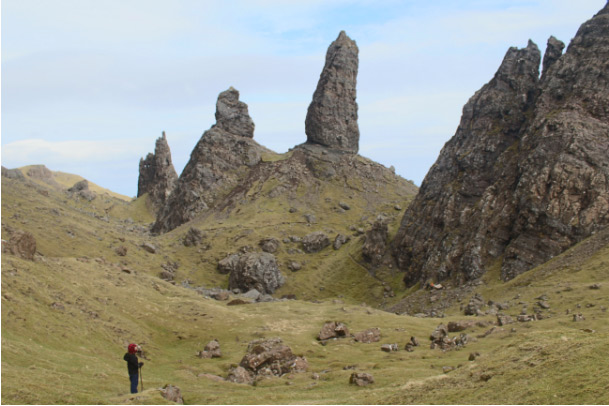
The Old Man of Storr
The Island of Skye is nearly always on peoples ‘bucket list’ and with good reason. The island is very large with so many different things to see its hard to know where to start. Dominated by the brooding ‘Black Cuillins’ a ragged mountain range that sits in its centre the island fans out to a number of peninsulas. All of them have spectacular views and hidden gems to explore but our favourite is the Trotternish peninsula.
Travelling north beyond Portree; the island’s main town a strange jagged ridge comes into view, this ridge features the Old Man of Storr, a giant rock tower that sits at an impossible angle near the rugged Storr cliffs. Further up the Quiraing extends the ridge line, the remnants of an ancient landslide of epic proportions. Walking through this area is like entering another world, the complexity of the landscape and broad vistas as you reach the ridge tops is quite simply astonishing.
What else is like this: In many ways it reminds me of Hadrian’s Wall (yes I know thats in England). Also the sea stacks of Orkney.
2. Glencoe and Rannoch Moor.
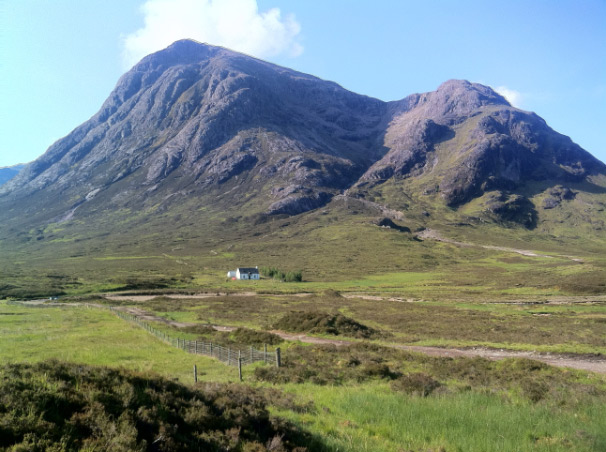
Glencoe
It would be impossible and indeed unforgivable to not include Glencoe in this list but I would extend it a little south to cover Rannoch Moor, an extraordinary landscape of bogland and small lochans that signal your approach to the glen as you venture north. The main road seems to float over the landscape and its hard not to find yourself trying to imagine what it must have felt like in the days before Thomas Telford build the first metalled road here as people picked their way through the moor. It must hold many dark secrets.
Then there is Glencoe. The majestic Buchaille Etive Mor stands guard at the entrance to the glen with her sister peaks lined up beside her, on the other side the Aonach Eagach ridge, the narrowest and most exposed ridge in Britain is a place not for the feint hearted. Handy parking places are scattered along the length of the glen, nearly always packed with tour busses and the odd bagpiper raking in the cash. The real rewards though, come when you take a step or two away from these busy lay byes and out into the glen itself. Despite its fearsome reputation in winter Glencoe has meny less challenging low level walks that get you away from the crowds and give you the space to contemplate life before the ‘quieting of the highlands’ and the tragic events that have been so linked to this place forever more. Caution and a sensible attitude (and footwear) of course goes without staying, this is a wild place that can claim lives in any season.
What else is like this: Scotland has many deep glens like Glencoe though few are so well known. Glenshiel with it towering 5 sisters comes to mind or for a more scaled down version Mennock and Enterkin passes in Dumfriesshire feels like a lowland rural equivalent.
3. The Border Abbeys
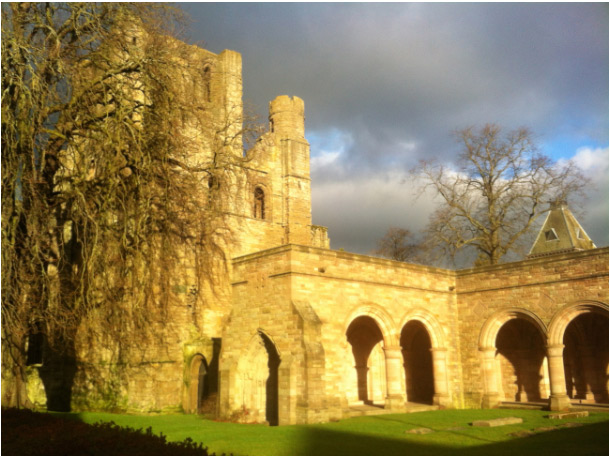
Kelso Abbey
The cluster of small border towns that nestle in the south east part of the Scottish borders feature a ring of magnificent ruined abbeys. In their heyday Monks from the Tironesian, Augustinian, Premonstratensian and Cistercian orders occupied these impressive buildings which became centres of learning and sat at the centre of many small communities. Inevitably though, sitting as they do in the heart of the sometimes lawless border region and with neighbouring England a few hours ride away the abbeys were partly destroyed, much of the damage being done during the ‘Rough wooing’ of King Henry VIII of England.
The violence of that time has long gone now and what is left of the abbeys are preserved as they were left all those centuries ago. Each has its own character and are peaceful places where you can sneak away from a busy market day and try to imagine the sounds of morning prayers being offered up in an echoing chapel.
For people of a fitter disposition it is possible to follow a 5 day walking route that takes in these wonderful buildings. The walk is not too challenging and gives you even more opportunity to explore this often missed part of Scotland.
What else is like this: Our own Holyrood Abbey in Edinburgh of course, Iona (featuring shortly) and Linlithgow Palace certainly have a similar feel in many ways.
4. Arisaig
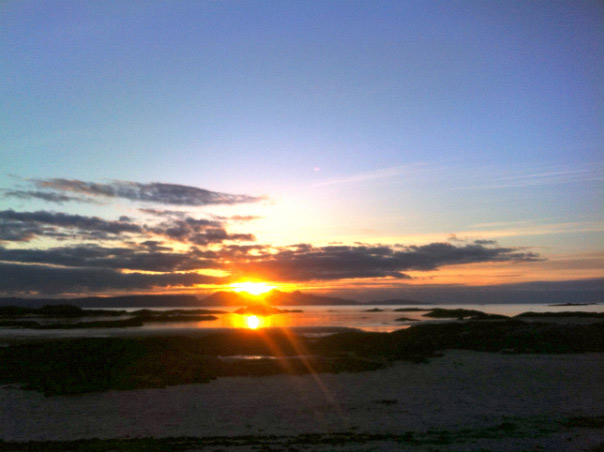
Arisiag at Sunset
As you take the route north to venture into the North West Highlands you hit the town of Fort William, spreading near the foot of Ben Nevis this busy town is an inevitable stop off for a quick snack and a stretch of the legs. Most travellers continue to the north towards Skye and Loch ness but just taking a left turn will lead you on a journey that rewards you with fantastic beaches, scenes from Harry Potter and romantic tales of Bonnie Prince Charlie. This road which was once a twisting and perilous single track is much improved, it takes in the Jacobite monument at Glenfinnan and an added bonus of a view from there of the Glenfinnan Viaduct a victorian marvel of railway engineering that will now forever be known as ‘the Harry Potter Bridge’. If you are very lucky you might catch the steam train that regularly travels this way on tourist trips puffing over the viaduct.
This was where the ‘Young Pretender’ (not the young wizard) first landed on the Scottish mainland in 1745, raised his standard and forever changed the covers of shortbread tins and tea towels, just a few minutes drive away loch Nan Uamh is where he set sail back to Europe a year later, his followers scattered in the highlands or buried in the mass graves at Culloden.
At the small village of Arisaig is what could only be described as a camper’s paradise, a collection of campsites sit along this stretch of coast set into grassy areas beside beaches with impossibly white sand. Its hard to compete with the feeling of settling down to a mug of tea or something stronger watching the waves on the shore as the sun sets over the islands of Rhum and Eigg. A sunset in Arisaig is not just a sunset, its gods own theatre, and he knows how to put on a good show!
For those who want to venture further though this route has one last gift to give, the Malliag ferry to Skye. An altogether gentler and more dignified way to reach our first destination on the list. As the ferry pulls out of Malliag harbour its inevitable that you catch yourself humming the Skye Boat Song to yourself.
What else is like this: The west coast and in particular the islands have incredible beaches, Tiree for example or Durness in the far north, The small island of Eriskay has the connection with Bonnie Prince Charlie too as of course does Culloden.
5. South Uist
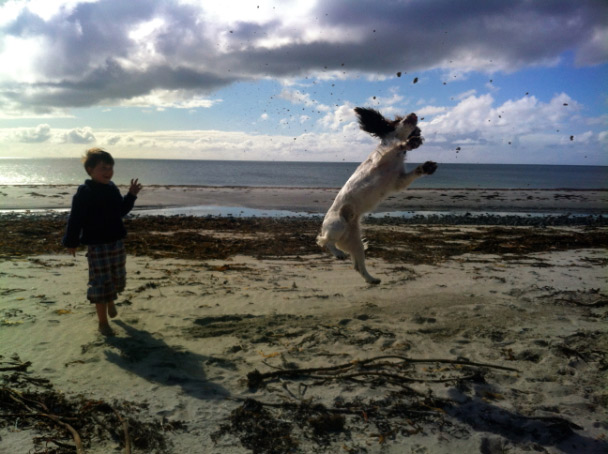
Happy Dog on South Uist!
The island of South Uist forms part of the Outer Hebrides (more of them to feature later). The island stretches from north to south linked by causeways to Benbecula and Eriskay. A modest range of low mountain peaks run like a spine down its east side and to the west is the legendary Machair. The Machair is a low lying coastal plain, formed by millennia of wind blown, calcium rich sand that forms a valuable fertile layer. The habitat is the fragile home to many species of birds and small crofting communities are scattered along the island’s east side.
There is something about the light here that feels like nowhere else on earth. There always seems to be some drama in the sky as another raincloud skids in over the Atlantic to the sound of oystercatchers and gulls.
This is an ancient place too – Settlers have been here since neolithic times and this is the only location in Britain where prehistoric mummies have been found. Looking at the ramshackle collection of little crofts you are reminded that now just as then the people who live here have a relationship with the land and pace of life that many of us would envy (in the summer at least).
What else is like this: Orkney and Shetland certainly have that feel of a link with the prehistoric past though the Machair is peculiar to the Outer Hebrides. also Barra and Vatersay just to the south and further on, the islands of Islay and Jura.
6. St Kilda
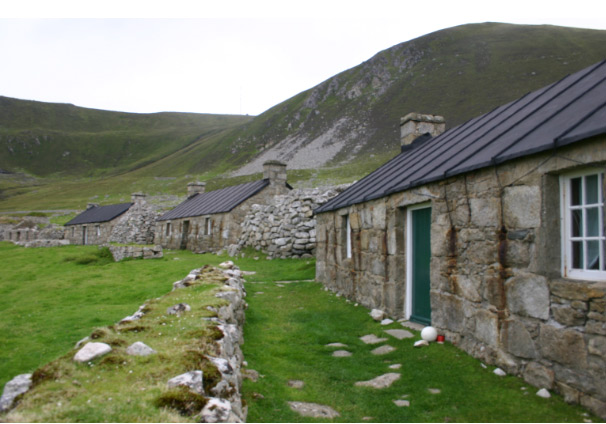
St Kilda
On 29 August 1930, 36 men women and children boarded a boat to the mainland from the island of St Kilda. Breaking a continuous period of settlement that had stretched back over two thousand years. These people were not evicted by harsh landlords, they had asked to be taken away to start a new life elsewhere. For them life in the most remote part of the British Isles had simply become too difficult.
Remote is too simple a word for St Kilda, just getting here is an adventure, and something of a hit and miss affair as the journey over rough seas is not always possible at all. Arriving at the small bay on Hirta, the main island in this small group is like arriving at the edge of the world, the deafening sounds of Gannets, Fulmars and Skuas fills the air and the island itself seems to rise out of the sea to meet you, one second there, one second disappearing as the boat lurches between the waves. As you step onto the shore you step back in time to the moment those last settlers left the island behind. The village street still stands as if trapped in amber, the remains of centuries of island life lie scattered up the hill side.
If you want to come to Scotland and get the feeling of being totally alone try spending a few days here with just the mice for company (and the army personnel who man a nearby base but thankfully never leave their quarters). There is a peculiar feeling to standing on the shore watching the tiny boat head back out into the open sea wondering if it really will be ‘back on Wednesday’ as promised.
Where else is like this: The Monach Islands off the coast of Uist were also until lately inhabited and North Rona is another remote destination. There are also a number of clearance villages such as Bororaig in skye and near Tongue in Sutherland.
7. The Isle of Lewis.
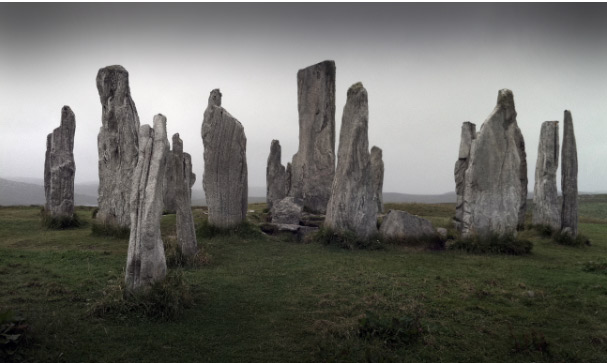
Callanish Standing Stones – Lewis
A few years ago I was on a flight back from Iceland on a clear summer evening. The flight path took us over the Butt of Lewis and as first sights of ‘home’ go, its about as good as it gets (also see entry number 10). Lewis has become a popular destination recently thanks to Peter May’s ‘Black House’ trilogy of books, May’s infectious description of the landscape has also inspired an excellent coffee table photography book. A trip to Lewis inevitably begins with the long ferry journey from Ullapool to Stornoway, passing by the Summer Isles, the setting for the classic British horror movie ‘The Wicker Man. Stornoway is a bustling small town that has a bit of a frontier feel about it, its a bit rough round the edges and can be a bit wild of a Saturday night before the ‘sabbath’ calls a halt to all activity. But before you disappear off to explore the island, stop off at MacLeod’s Butchers and stock up on as much Black Pudding as you can sensibly carry.
The stand out feature of Lewis is the standing stones at Callanish. For nearly 5,000 years these remarkable stones have stood here. Academics still argue over their true purpose, partly as a burial site possibly as a calendar no one can really say for certain. Folk tales say that they were a family of giants who refused to convert to Christianity and Saint Kieran turned them to stone as punishment.
Like many parts of the west coast, Lewis has its fair share of incredible coastal landscapes with wide open beaches and stark cliffs. As you travel south from Stornoway towards the mountains of Harris you pass seemingly endless expanses of peat bog, stacks of freshly cut peat stacked up and drying ready for collection. The smell of peat smoke is the air is a reminder once again that this is a place where people work and live not just a toilet stop and cafe.
What else is like this: Again, Orkney springs to mind for its unrivalled collection of ancient artefacts (the only reason Orkney is not on our list is because we have yet to visit there and this is our personal list). Wick and Thurso in Caithness have a similar frontier feel about them that Stornaway does and the wetlands of Caithness and Sutherland are very much like the Interior of Lewis in some ways.
8. Iona
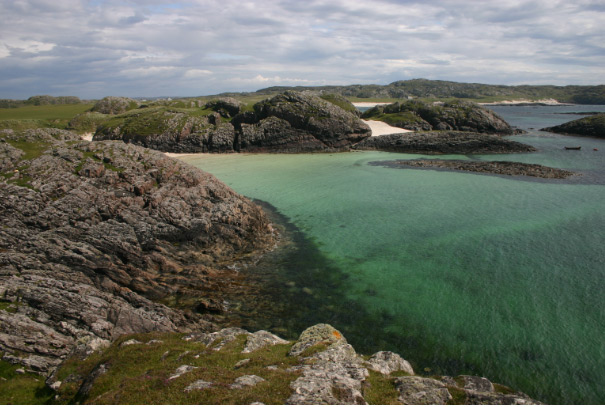
West Coast of Iona
Sometimes the beauty of a place is magnified by the effort it takes to get there. If thats the case then Iona must be one of the most beautiful places on earth! First of all you need to get to the island of Mull, that is either reached via a ferry from Oban or by a couple of smaller ferries and a long drive down towards Ardnamurchan. This is followed by a long drive down the Ross of Mull until you literally ‘run out of island’. From there a small ferry takes mostly foot passengers (theres is not much point in taking the car as theres not really anywhere to drive to) over the short hop to Iona. The famous abbey is immediately visible as you land in the tiny village that sits beside it.
Iona abbey is one of the most famous in Scotland. its by no means the largest and would be dwarfed by the Border abbeys though it is one of the best preserved. St Martins Cross is probably the most photographed and recognisable celtic cross there is and the abbey grounds have more than a few famous interments: Kenneth MacAlpine, Donald II, Malcolm I, Duncan I and Macbeth all lie here, as does the late Labour leader John Smith.
The island is tiny and can be walked round entirely in a day. If you chose to do this there is a good chance you will hardly spot a soul the whole time as pretty much all the tourists flock to the abbey. Their loss is your gain though, the island circuit takes in more sandy beaches on the north shore the rugged west coast with crustal clear waters and small secluded bays, a spouting cave and the remains of an abandoned marble quarry before returning back to the village for a well earned drink while you wait for the ferry back.
What else is like this: Right next to Iona is the small island of Erraid. its tidal so can easily be walked to. There is an incredible campsite at Fidden farm nearby too. Holy isle (in England,,, just) is also very similar and also Inchcolm Abbey in the Forth Estuary.
9. Plockton
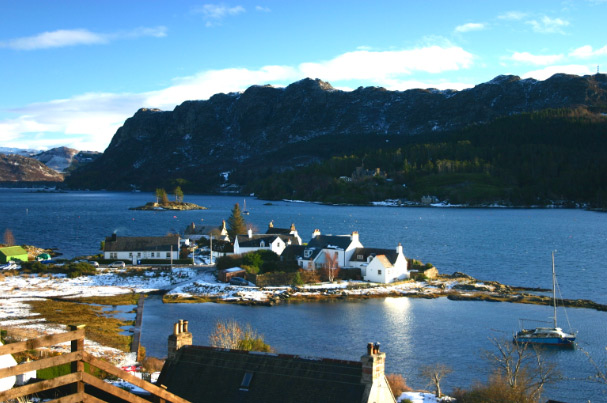
Plockton
The tiny village of Plockton sits at around the same line of latitude as Moscow, yet the little road around the bay is lined with palm trees! These are not made of plastic but thrive here thanks to a phenomena properly known as the Atlantic Conveyor though most of you know it as the Gulf Stream. a current of warmer water that runs North-East from the Gulf of Mexico makes landfall on Scotland’s north west coast leading to a far milder climate than we would expect. Before you pack your bermuda shorts and beach volleyball set though remember this is STILL Scotland.
The small village was a fishing community that sprung up in the 19th and 20th centuries in an attempt to slow down emigration from the highlands. The end result is possibly the most picturesque small village in Scotland. Just like Iona above, getting here is half the fun. There is the long drive skirting within touching distance of the Skye bridge and up the road to the ironically named ‘Stromferry (no ferry)’ , or you can take a more indirect route via Lochcarron, or you can treat yourself to one of the worlds greatest train journeys, travelling north to Inverness and then west via the tiny settlement of Achnasheen through some of the grandest majesty that the highlands can serve up, it might be a long journey but I really wouldn’t bother with a book unless its dark 
For those who like an element of terror on their days out then its not too far from Plockton to the small town of Applecross. The last half hour of your trip will be memorable as you wind up the notorious Bealach na Ba (the pass of the cattle) a single track road that twists steeply up an impossible looking slope before sliding down the other side. On the way back you can reward yourself with an early tea at the excellent seafood cafe at Kishorn, where the seafood is so fresh it answers you back.
What else is like this: Rothsay on the Isle of Bute is also known for its palm trees though its a much larger and busier town. The East Neuk of Fife also has a string of quaint fishing villages and Tobermory on Mull is also very picturesque.
10. Edinburgh
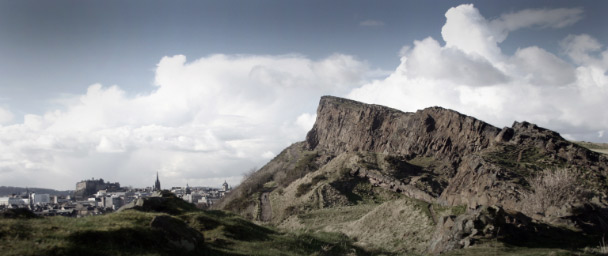
Salisbury Crags, Edinburgh
This comes as no surprise to anyone who knows us, after all its where we live. what can you say about Edinburgh that not already been said. Known as the Athens of the North the city has some of the most impressive architecture in the world covering the Middle ages, and Neo Classical eras in particular. Arriving in Edinburgh by train is one of the great tourist experiences of all time: As the train slips through the outskirts it could be anywhere in Britain, then the train dives into a long tunnel, for a moment you emerge to catch a glimpse of the castle rock and gardens before ducking under the art galleries on the mound and arriving in the station. If you have never been before (or even if its been a while) Then walk up the sloping roadway to emerge on Waverly Bridge. Ahead of you stands the impressive if rather rocket like structure of the Scott Monument, the Classical pillars of the National Gallery and Royal Scottish Academy and behind that Castle rock with the iconic Edinburgh Castle crowning the top. It really is one of the most impressive cityscapes in Europe if not the world.
Edinburgh is bursting to the point of overflowing with history and culture, the compact city centre makes most sites easily walkable (for those who can easily walk), you can take in an art gallery, loose yourself in a museum or scare yourself witless on one of the many ghost tours that run from the high street.
And if all that bustle is too much then in 15 minutes or so on foot you can find yourself at the bottom of the Royal Mile past Holyrood palace and into Holyrood park, Here you can leave the city behind and feel like you are back in the highland wildernesses that I’ve eulogised about above (in fact parts of Arthurs Seat in Holyrood park have been used to represent the wild highlands in film shoots). After half an hour or so of puffing you might find yourself on top of Arthurs seat or nearby Salisbury Crags giving you a reward of an incredible view over the city and down the east coast on one side and up to the Forth bridges on the other.
What else is like this: Glasgow’s west end is for Victorian architecture what Edinburgh is for Georgian. Stirling has its castle too and is handy for Wallace Monument and Bannockburn, Inverness too is worth visiting if only for the beautiful Ness islands and Leakeys bookshop.
Well thats our personal top ten list for now. I’ve set a date in the Calendar to revisit this list same time next year and see what new places we have discovered by then…
Rodger and Amanda Moffet – Scotclans
The post Scotland’s Most Inspiring Places: A Personal View appeared first on ScotClans | Scottish Clans.
]]>The post Edinburgh Zoo! appeared first on ScotClans | Scottish Clans.
]]>
On Wednesday 22nd July Edinburgh Zoo celebrated the 102nd anniversary of the day it first opened to the public. Going from strength to strength through the years the zoo has become Scotland’s second largest paid for tourist attraction, only being beaten by Edinburgh castle, and attracting over 600,000 visitors every year. This week we will be taking a look at this marvellous attractions history and a few of the things that make it so special….

The Beginning…
Before there was the zoo there was a charity that was behind the endeavour, the Royal Zoological Society of Scotland, founded in 1909 by Edinburgh lawyer, Thomas Hailing Gillespie and others. The Society’s first president was lawyer and politician Edward Theodore Salvesen, son of the Norwegian merchant Christian Salveson—a connection which would prove significant in later years.
Gillespie set out to build a zoological park and was inspired by the open design of Tierpark Hagenbeck in Hamburg and the New York Zoological Park. The design promoted a more spacious and natural environment for the animals, and stood in stark contrast to the steel cages typical of the menageries built during the Victorian era. All that was needed was a suitable site for the park and Gillespie hoped for a site that could shelter the park and therefore the animals from the cold north and east winds and luckily just such an area was available.
The society secured an option to purchase the 75-acre (30 ha) Corstorphine Hill House estate for £17,000. Unfortunately the society had a fair amount of trouble raising the necessary funds for the purchase and the option to buy was nearing expiry. An unlikely hero came to the rescue in the form of Edinburgh City Council, who purchased the site outright in February 1913. The zoological society was granted full use of the estate in return for a 4 percent annual repayment of the cost. This also meant the funds the society had raised could be put to good use building and stocking the park.
Town planner Patrick Geddes came on board to design the park following Gillespie’s vision of an open design. The Scottish National Zoological Park, as it was initially called, opened to the public with a large collection of gifted and borrowed animals on 22 July 1913, after only 15 weeks of work. The zoo still occupies very much the same area of land today, though the park has, and still is, being extensively redeveloped.
Early History
The Scottish National Zoological Park was opened to the public in 1913 and was incorporated by Royal Charter later that year. In 1948, following a visit by His Majesty King George VI, the Society was granted the privilege of adding the prefix ‘Royal’ to its name. It remains the only zoo with a Royal Charter in the United Kingdom.

Edinburgh Zoo’s long association with penguins began in January 1914, thanks to the zoological society’s connection with the Salvesen family, with the arrival of three king penguins from the Christian Salvesen whaling expedition which docked in Leith. These where the first penguins in the world to be seen outside of the south Atlantic, and the subsequent hatching of a king penguin chick in 1919 was the first penguin ever to be hatched in captivity. Penguins continued to arrive with whaling ships for years afterwards and even today penguins are closely associated with the zoo, as you can see by their logo.

In 1925 a tropical bird and reptile house was added, followed in 1927 by an aquarium and in 1929 an ape house. In 1930, the now famous, penguin pool was constructed, though it has since been rebuilt, in 1990, to include a new under water viewing area. In 1928 the Corstorphine Golf Club evacuated the 47 acres to the north of the estate, allowing the zoo to expand significantly and this new area was completed in 1937.
Hagenbeck’s modern zoo techniques proved effective, and Edinburgh quickly gained a reputation for its good animal conditions. 1934 saw the births in captivity of a sea lion and beaver, and in 1936 a baby chimpanzee followed. A litter of wolves was born in 1938, and soon afterwards the first orangutan to be born in Britain.
The War Years…
Edinburgh Zoo, like most of the Zoos in the UK during the war, was significantly affected even though they would not normally be considered a target. Bombs could fall at any time and the zoos housed animals that would be dangerous to the public if they should escape due to a damaged enclosure. Edinburgh Zoo was bombed twice during the Second World War, but remained mostly unharmed although it was reported that one of the bombs killed a giraffe. In 1941 the recently born wolves had to be euthanized, along with a collection of dangerous snakes in case more bombs hit the zoo and allowed them to escape.
Despite the war the zoo continued to grow, with land to the east being purchased in 1942 and construction of a lake beginning soon afterwards.
Following the War…
It was around 1950 that one of Edinburgh Zoos most famous traditions began, the penguin parade and it was all started by a mistake. One of the zookeepers who had been working in the penguin enclosure had left the gate open on their way out. The penguins followed the zookeeper out of the enclosure and around the park much to the delight of visitors, and from then on it became a regular occurrence up to today, when it occurs every afternoon. The birds have even paraded along Princes Street in 1955 and at the Royal Highland Show for the Queen in 1960. It’s interesting to note that the penguin parade is run on an entirely voluntary basis. The penguins are not encouraged to take part with food or other tricks.

One of the zoo’s famous inhabitants during the post-war period was Voytek, a Syrian brown bear and a member of the Polish army. During the Second World War, Voytek was sold to a group of Polish soldiers who taught him to carry crates of ammunition, and took him in as an unofficial mascot. In 1944 when the Polish II Corps where to sail to Italy along with the British 8th Army, Voytek had to be officially drafted into the Polish army in order to secure him passage on a British transport ship.


The II Corps were demobilised in 1946 and ended up settling in Winfield Camp near Hutton, Berwickshire, Scotland. Voytek retired to Edinburgh Zoo in 1947 and lived there until his death in 1963. During his time in the army Voytek had developed a liking for cigarettes, and this may have contributed to his popularity as an attraction at the zoo.
In 1972 the zoo gained yet more military credentials when king penguin Nils Olav was adopted by the Norwegian King’s Guard. Norway’s connection with Edinburgh’s penguins began with the Salvesen family’s links to the zoo, and renewed interest was sparked when a lieutenant called Nils Egelien visited the zoo with the King’s Guard in 1961. On his return in 1972 Egelien arranged for the unit to adopt one of the penguins. Nils Olav was named after Egelien and in honour of King Olav V of Norway, and given the rank of lance corporal. He died in 1987 and his successor, Nils Olav II, inherited his rank. Nils was visited by the Norwegian King’s Guard on 15 August 2008 and awarded a knighthood. The honour was approved by the King of Norway, King Harald V. During the ceremony a crowd of several hundred people joined the 130 guardsmen at the zoo to hear a citation from King Harald the Fifth of Norway read out, which described Nils as a penguin “in every way qualified to receive the honour and dignity of knighthood”.

Three-year-old polar bear Mercedes was given to the zoo in 1984, after she was rescued in Churchill, Manitoba, Canada. She had begun wandering into the town in search of food. Because of the danger she posed to residents, Mercedes was tagged with a number so she could be tracked. When she could not be persuaded to return to the wild, a decision was taken to shoot her. A member of the Edinburgh Zoological Society collaborated with a cousin in Canada and they were able to rescue Mercedes, finding her a new home at Edinburgh zoo. The bear would become one of the zoo’s most popular attractions.
The Modern Day…
In October 1999 the zoo had begun to explore the possibility of relocating in order to improve its facilities as there was limited room for expansion in the current site. As of February 2000 the zoo had scrapped its plans to relocate, instead announcing a “masterplan” for the redevelopment of the entire site, which continues to today.
The foot-and-mouth scare of 2001 forced the zoo to close to protect the animals from possible infection. Since the zoo could not welcome any visitors, it faced significant financial losses. Questions were posed about the zoo’s future, though in the end the park was able to reopen after only five weeks. The generosity of a former resident of the city was a huge help to the zoo in this difficult time, as in early April they donated £1.9 million just as the zoo reopened.
In 2005 the new Budongo chimp house was unveiled, along with the Living Links to Human Evolution Centre, Britain’s first primate behaviour research site. Named after the Budongo Forest in Uganda, the Budongo Trail is a state-of-the-art facility that houses a troop of common chimpanzees. The main building features viewing galleries, a lecture theatre and interactive games and displays that are designed to teach the public about chimpanzees and their lifestyle, social structure and what threats they face in the wild. The Living Links centre is an area built around a field station and research centre for the study of primate behaviour. The exhibit also features enclosures housing common squirrel monkeys and brown capuchin monkey. In a scientific breakthrough in 2006 chimpanzees at Edinburgh were found to use word-like vocal labels for food.

In 2011, two giant pandas, a male named Yáng Guāng (陽光, meaning “sunshine”) and a female named Tián Tián (甜甜, meaning “sweetie”), were leased by Edinburgh Zoo from the Bifengxia Breeding Centre in China at a cost of $1m a year. An enclosure was constructed especially for the pandas. Both pandas have identical, but separate indoor and outdoor enclosures as giant pandas are entirely solitary animals that only meet during breeding season once a year. The outdoor enclosures feature tree trunks for the pandas to scratch against and climb; large wooden climbing frames and tree houses; caves and ponds. The indoor enclosures, where they often choose to sleep, include raised wooden platforms and hammocks. They will remain at the zoo for a maximum of ten years before being returned to China. Edinburgh Zoo is currently the only zoo in the United Kingdom that houses giant pandas.

Edinburgh Zoo is home to the only four koalas in the UK, Goonaroo, Yabbra, Alinga and the newest arrival, Yoonarah, who was the first koala born in the UK. The koalas are part of the European Breeding Programme. Edinburgh Zoo is the European ‘holding facility’ for male koalas that are either too young to breed or have successfully bred and are now “retired”.

Edinburgh Zoo has recently opened two very unique exhibits, the Wallaby Outback and the Lemur Walkthrough. Both are a new design which allows visitors to enter and follow a trail around the enclosure, getting closer to these species than ever before. Visitors enter via a double-gated entry system and can take a leisurely stroll on a looped pathway and although visitors will not have direct physical contact, the new walkthrough experiences immerse people in the enclosure, offering them an unrestricted view of the animals.

Edinburgh Zoo is now fully interactive on the internet with several live cam feeds, take a look at them below:
The post Edinburgh Zoo! appeared first on ScotClans | Scottish Clans.
]]>The post ScotClans on the Road to the Isles appeared first on ScotClans | Scottish Clans.
]]>I don’t think there is anywhere on earth that can compete with it, it’s a magical place.
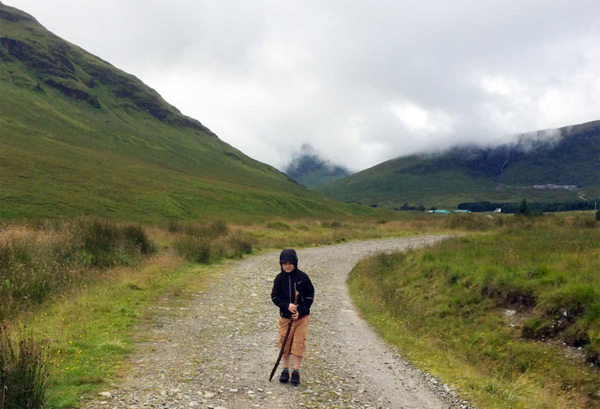
Walking in the Rain near Tyndrum
Last week we packed up our camper van and began our journey North-West. We decided to take a two day rest stop on the way by Tyndrum. This scattering of houses on the road north is a popular stop; the West Highland Way has it’s halfway point here and the famous Green Welly stop has become an institution for those travelling along this way. We drove through blazing sunshine all the way and within minutes of arriving the skies darkened over and rain began to fall… typical!
Never mind though, the Real Food Cafe in Tyndrum which serves the best fish and chips in the highlands was a short walk from our camping spot and we spent our free day taking a walk up through the woods to explore the path to Ben Lui.
With the van batteries charged and ready to cope with a few days of rough camping we set off for Arisaig. The journey to this remote part of the North-West highlands is like a history lesson in tarmac. From Tyndrum the road climbs up towards Rannoch Moor and then into Glencoe. Several miles of twisting road opens out at Fort William, a sprawling highland town that was once part of the government’s ‘quieting’ of the highlands but is now an economic and tourist hub for the area. Breaking away from the main route to Inverness you venture into a Jacobite story book; The Glenfinnan monument where Charles Edward Stuart raised the standard and lit the blue touch paper of the rebellion of 1745 and just a few miles further on Loch Nan Uamh where the Jacobite adventure both began and ended on mainland Scotland.

A Picnic Spot at Loch Eilt
On the way we found a quiet lay by to stop for a short picnic. Loch Eilt is a beautiful location and one that might be familiar with Harry Potter fans. A small island in the loch featured as the site of Dumbledore’s grave. There are even more obvious links to the boy wizard on this route too of course, the Glenfinnan viaduct made famous in the second movie and you are almost guaranteed to spot the steam train that takes tourists from Fort William to Mallaig at some point – the train that doubled for the Hogwarts Express.
By the afternoon we had left the main road and we were bumping up and down over the twisting beach road to the site of Arisaig Games.
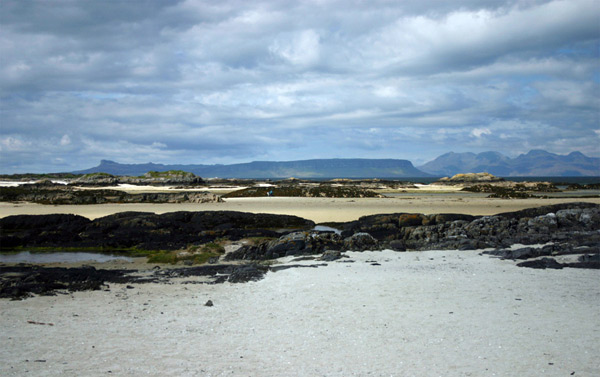
The Beaches by Arisaig
As locations go Arisaig has one of the best for a highland games you could imagine. From the back of the field you can look over stunning beaches to the Cuillins of Skye and the island of Eigg. This is a useful feature; when the island of Eigg disappears as it often does its time to find shelter!
With every campsite in the area full (and there are many of them) we were fortunate to be allowed to camp on the corner of the games area. ScotClans would be running a stand at the games a few days later. For now though we had a very interesting engagement to attend, the Clanranald barbecue.
On the map Castle Tioram looks like a short hop, even faster by boat but a twisting route along single track roads. Our ageing camper van struggled valiantly over the difficult terrain and after a bone shaking last few miles we arrived at the castle, well not quite the castle but the mainland across from it. Tioram sits on a tidal island and is cut off for a few hours at high tide, unfortunately the tide was coming in so ourselves and many guests had to take off socks and shoes to wade across to the island. in time several boats arrived with more guests and others were ferried over as the gathering began.

Guests Arrive by Boat
In my time I’ve met a lot of clans folk from the highlands and the lowlands, I’ve passed the time of day with many a clan chief but the Clanranald MacDonalds are from a mould that was broken a long time ago. They are welcoming, gracious but absolutely bonkers! Refreshing, hedonistic and above all great fun to be around.
under the presence of the magnificent castle a marquee had been erected. with the sun starting to go down I was keen to explore around the castle and was rewarded with some great shots in the fading light. Tioram is a fantastic ruin but still well preserved in its structural integrity, so much so that restoring the castle would not be impossible or prohibitively expensive. Imagine being the first to spend a night there in a wind and watertight dwelling in nearly 300 years!
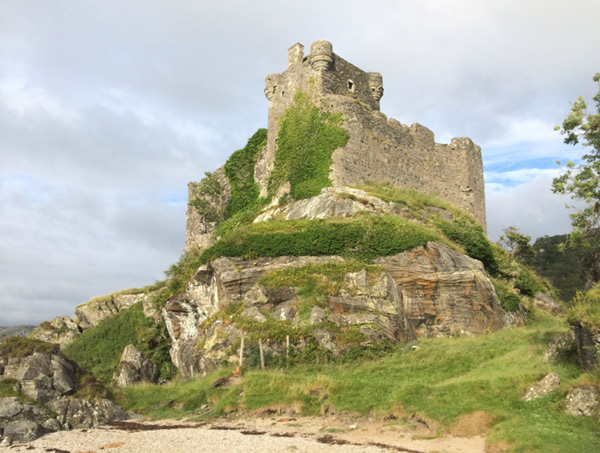
Castle Tioram
The night soon fell and the tide once again revealed the sandy causeway back to the mainland and guests began to drift away, Fortunately for us our home for the night was just a short walk as we made use of the fact we had brought the camper van and spent the night in the small car park. While helping to clear up and taking back the camping chairs we had loaned for the night Amanda and I had discovered a large unsmoked cigar tucked in the cup holder. With the kids safely tucked in we stole an hour sharing a cigar and watching the last of the light fade behind the castle. We felt like a couple of naughty kids!
The next day we took a stroll along the beach and helped take down the marquee on the island before retracing our bone shaking journey back to Arisaig. There was more work to do here with another marquee to erect but in no time all was nearly ready for the games.
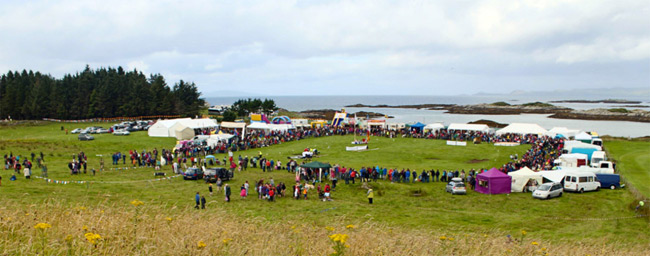
Arisaig Games
The wonderful thing about small highland games is the way they involve the community, everyone and his dog lends a hand and things may look chaotic but this is very deceptive. There is a method in the madness and in no time everything comes together. ScotClans had been asked here to take part in a new venture for these games, to provide an area that was more focussed on ancestry and heritage. With our experience of Grandfather Mountain Games we decided to replicate much of what COSCA does there and provide assistance tracing peoples clan roots. We also set up a small stall of clan merchandise in the hope that a few sales would at least cover our fuel costs.

The ScotClans Stand, Somewhere in There
The few hours we had there were well spent and the stand was busy right up to the end of the day. We had erected a large world map and invited visitors to place a sticker where they had come from. by the and of the day our map had stickers from Canada to Samoa and many interesting and unusual places in between. It was incredible to imagine how people from so many far flung lands had all descended on this little field beside a beach in the highlands of Scotland and for us it was a symbol of just how far our great Scottish Diaspora have travelled from these shores.
Hopefully our experiment worked and in a few months time we will be replicating this at Cowal Gathering at Dunoon. Our next stop though will be Killin games in a few day time as guests of Clan MacNab.
If you happen to be in that part of Perthshire please drop in and say hello.
To see more photos from our trip please visit our Flikr Gallery
The post ScotClans on the Road to the Isles appeared first on ScotClans | Scottish Clans.
]]>The post A Northward Meandering – Walking the West Highland Way – Part Four. appeared first on ScotClans | Scottish Clans.
]]>Day 6 Inveroran to Glencoe
Today was one of the days that I’d always considered the highlight of the walk, the route that takes you over the barren Rannoch Moor and finishes at the spectacular head of Glencoe. Earlier in the year I had walked this stage in reverse with friends but the weather was poor and winter was still clinging on to this part of the highlands. This hopefully would be a day to be on the moor in better conditions, I wasn’t disappointed!
The day started with a long walk up a well made path alongside a patch of forestry, well fenced off to protect it from the unwanted attention of deer who nibble away at young saplings and prevent regeneration. Many people complain when they see deer fences in the highlands thinking that these fences are keeping them in, the reality is quite different as in general the deer have the freedom to roam the larger glens and the fences are keeping them away from areas where new forest growth is being encouraged. Left unchecked the deer would strip away the tasty young trees and this leads to the loss of habitat for other woodland creatures. Its evidence of the careful balance that has to be achieved in order to maintain biodiversity.
The road I was walking on used to be the main route into the highlands until the 1930s and was built by the famous Scots engineer Thomas Telford. It replaced the earlier military road, the line of which still exists at a higher level. Probably no one person in the history of these Isles had been more responsible for the creation of the transport infrastructure we take for granted: Bridges, aqueducts, canals and of course roads. A poet friend of Telford’s called him ‘The Colossus of Roads’ a monicker which sat well with this giant of the industrial revolution.

Telford’s road through the moor
Tipping my imaginary hat to the good quality of Telford’s road I continued on and eventually cleared the trees, the sight as you emerge onto the moor is truly one of the most spectacular in Scotland, not your classic, mountain + loch + trees = postcard image but still a photographer’s dream, a landscape that has drama in any weather with a huge open plain stretching far off into the distance with the dark bulk of bare mountains marking the outer boundary. The scene feels like the “blasted heath” of Shakespeare’s Macbeth: ”Upon this blasted heath you stop our way”. One can imagine meeting sinister figures along this lonely track.
The road appears to sit like a ribbon over a landscape that is more bog than solid ground, straying from the safety of this road would lead you to a nasty and watery end and one cant help but think about what it must have been like in the days long before proper roads came to this area and how people would pick their way across this wild place. Soon a small clump of trees drew near and this indicated that the half way point had been reached, the River Ba, one of the larger rivers draining off the wide corrie on your left to a loch far down to your right is crossed by a stone bridge. Its a lovely spot on a good day and a natural place for walkers to stop for a spot of lunch. I found quiet spot beside the bridge down in the trees away from the path and savoured the peace and quiet.
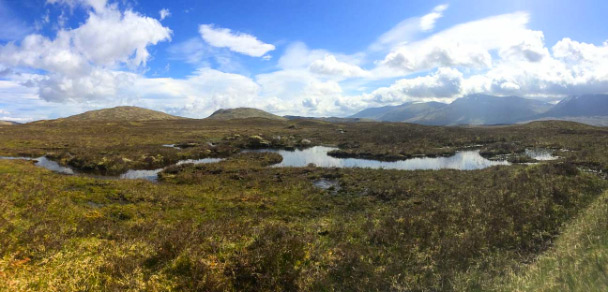
Rannoch Moor
After this the path begins to climb gently again as it climbs over the shoulder of Meall a’Bhuiridh and like some waking giant the shape of Buchaille Etive Mhor the mountain that stands guard at the head of Glencoe begins to rise over the horizon. This is Scotland in all its drama, ‘the Buchaille’ as its more popularly known, the full name translated as the Great Herdsman of Etive is one of the countries most popular climbing spots, even though from this angle it looks terrifyingly difficult there is what is described as the ‘tourist route’ that takes a winding route on the mountain’s south eastern flank to a high pass. Magically the path takes you right past Black Rock cottage a small house at the base of the mountain giving you the opportunity to take what is probably one of the best known views in Scotland.
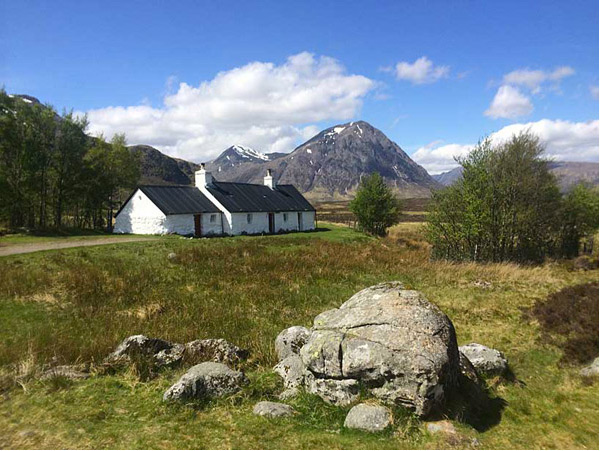
Black Rock Cottage and the Buchaille
from here a long descent eventually brought me down to Kings House hotel, an old drover’s inn that now does a roaring trade catering for tourists to the area. Naturally the place was also fully booked so I took advantage of a small camping area that lies just behind the hotel. After a quick refreshment my bags arrived and I got down to setting up the tent, within an hour of doing so the blue sky had turned an ominous dark grey and rain clouds came rolling up the glen. the view I had photographed earlier was lost in mist and rain and there was little to do but spend the rest of the day sheltering in the ‘climbers bar’ at the back of the hotel.
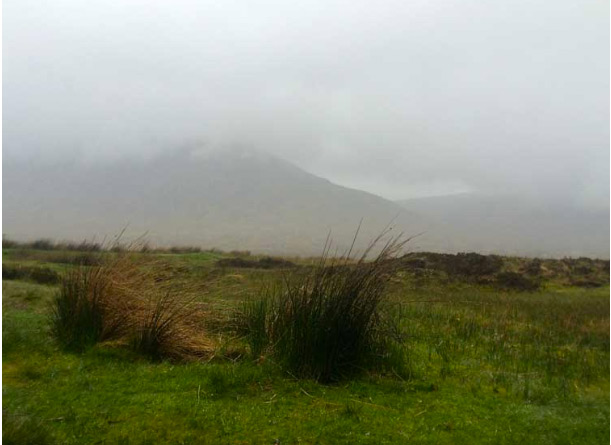
The weather closes in
Day 7: Glencoe to Kinlochleven
I’ve often said that Glencoe looks spectacular in any weather, well it does when you can see it!
I woke up to find that the perfect camping spot i’d picked out the previous night was more or less a small pond. My breakfast routine was accompanied by a pair of cheeky chaffinches who perched on a rock beside my tent and waited or me to pass them scraps. I’d been aware of them all morning and the pair of them appeared to be taking turns ducking under the outer shell of the tent for a good root around or else running up and over the pole ridges.
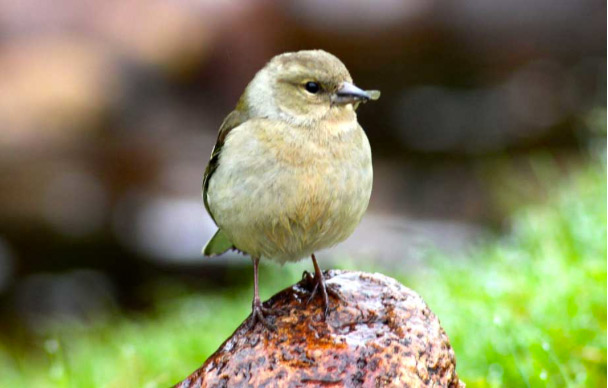
My breakfast guest
After packing up I set off along the long walk alongside the road down to a small stand of trees at Altnafeadh. This is the spot where most climbers doing the Buchaille start from and it wasn’t surprising to just see a couple of cars parked there. My route would take me the opposite way though and directly up the hill on the northers side of the glen, climbing steeply into the mist until I was alone with the rough path and a few metres of hillside to either side. The path then zigzags up a steep incline called the Devils Staircase. This name came about in the days when the Black Water reservoir dam was being built a few miles to the north. Workers on the construction of the dam would come over this way to reach the Kings House hotel, the only place in walking distance that they could spend their wages and have a drink, sadly for some the price of a drink was high indeed as many never made it back to safety, especially in winter and perished on the way. It was an eerie place to walk and I had an uncomfortable feeling as is often the case walking in thick fog, Its not uncommon for walkers to suffer from what is known as ‘mountain panic’ in these conditions and even experienced climbers can suffer from it, a sort of creeping dread and a feeling of being watched.
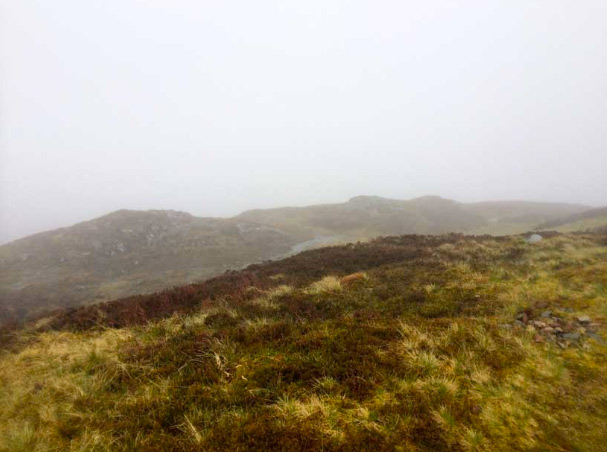
Glencoe – somewhere down there!
I wasn’t quite at that stage yet though and pressed on until the path levelled off and headed over the high pass at the top. from here the views are supposed to be some of the best on the whole way, unfortunately I wasn’t getting that opportunity in this weather. After a series of short up and down sections I rounded the hillside and slowly began to descend, far below the clouds seemed to be rising up out of the valley and the small town of Kinlochleven appeared now and again through the occasional break. From this distance it looked like some quaint alpine resort but Kinlochleven is a town that grew up quickly in the early 1900s when an aluminium smelter and later a hydro electric power station was built.

Kinlochleven
The town is like many you come across in the highlands that briefly rode the bow wave of industry in some form but then was left beached when that industry pulled away. At its height the aluminium smelter employed around 700 people but larger plants in the USA that could produce cheaper product drove it to closure in 1996. Now the town mostly relies on the tourist trade which has become harder since a bridge over Loch Leven bypasses the place entirely. I’m not sure what it is about Kinlochleven that I find attractive; it is in a beautiful spot with great walks nearby but maybe its a sort of kinship I feel with the it having grown up in two places that once had thriving industries only to have them closed down, I’ve experienced life in a town thats had its heart ripped out, its a sad thing but also uplifting to see how communities cope with this and new businesses spring up.
One such success story is ‘The Ice Factor’, housed in one of the former high roofed industrial buildings this small complex offers climbing walls, including a real ice climbing wall along with cafe a bar and shops. Having hobbled down the track that seemed to take forever to descend the cafe here was my first port of call for coffee and cake!
The weather was still pretty wet and the thought of pitching up for the last day on a boggy campsite wasn’t exactly getting me excited, on pure speculation I dropped into one of the small hotels in the town and enquired about rooms. To my joy they had one but was advised it was a twin room not a single and would be expensive. “how much?” “£55″ came the reply – SOLD! To the wet bloke with the rucksack!
So I came to spend a Saturday afternoon drying out in what turned out to be a suite of rooms in Kinlochleven lying on my comfortable bed watching the cup final on TV! bliss!
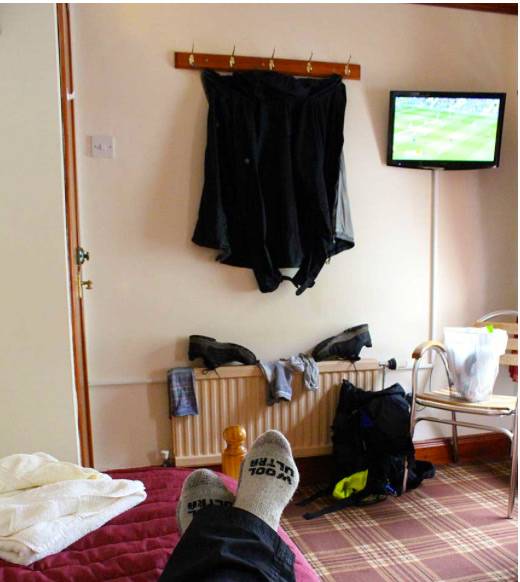
Luxury!
Day 8: Kinlochleven to Fort William.
After a fantastic nights rest in a proper bed I was up and about early and raring to go, I had to hobble off first to take my bag back to the place where it was supposed to be left that day and then after a proper cooked breakfast set off. My feelings were a little mixed as I walked to the start of the path up through the first stage of birch forest. It wasn’t ideal weather, still wet and cloudy but glad to be out and moving, excited about finishing but sad that the adventure would soon be over.
This last stage is a long one, around 15 miles with a very steep climb to start with up through the forest. It was pleasant enough though, I’d walked the start of this way with my young son last year and as we had trod up the path he had pointed out large stones, the colours of which reminded him of planets, I spent the first half hour looking for the ‘Mars stone, Jupiter stone and Saturn stone’, I’m pretty sure I found two of them. This was a pleasant start to the day made even nicer with the smells of the damp forest and scent of honeysuckle on the way. Pretty soon the path emerged over the tree line and onto a wide vehicle track and into the pass. This is called the Lairig Mhor which means, appropriately ‘The Big Pass’. This glen feels like a lost world, climbing up over the bealach in the Mamore range a long wide open valley stretches before you, virtually untouched apart from a small telegraph poles and the path ahead.
Unfortunately the heavy rain over the last few days were having a cumulative effect on this path along the valley floor. All along the hillside large waterfalls were visible cascading down and gathering into larger streams, more engorged than usual the streams were finding their way over and in some cases along the path making the going very wet. It wasn’t long before my walking shoes began to let in making the walking uncomfortable and rather cold.
There is no shelter along this section for a good 7 miles with just a couple of ruined farmhouses on the way, one seemed in fairly good shape and it seemed a pity that for want of a solid roof this might have made a great mountain bothy. Eventually the track hit the edge of a large forest plantation and the way diverted onto a smaller and muddier path. The open moorland gave way to pine plantations and began its mostly downward descent. The sight of people coming the other way gave me and indication that I was probably well past the halfway point and since there didn’t seem to be anywhere dry to shelter I pressed on. The forest section here was dense and a large fast flowing river seemed to always be nearby, the sound rumbling through the trees. After a while the path descended down steep stone steps and crossed over. A short section over an area of recently cleared ground toyed with a wide industrial logging road before joining it and entering another section of forest. Just as I was entering the forest a brief gap in the clouds revealed a patch of black rock and snow much higher up than expected, the looming shape of Ben Nevis! My first sign that journeys end was near!
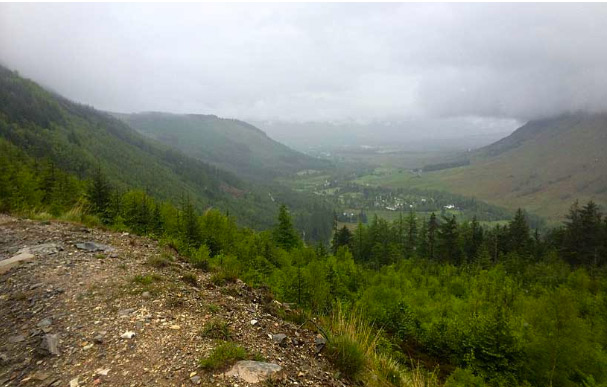
Fort William ahoy!
The logging road crested a hill moments later and over the other side far below I could see the scattering of houses on the outskirts of Fort William, just then my mobile sprang back into life and I was able to call my family who were en route to meet me. After a day of hardly seeing a soul it was a relief to be speaking to someone again! From here the road should have been a simple but long downhill run but the West Highland Way had one last surprise for me. A diversion due to forest operations took me down a perilously steep muddy slope through the trees to a lower track. Somehow the efforts of clambering down this way drained most of the energy from me and when I set off again it seemed to be at half speed.
On and on the track twisted and turned until it veered off and onto the minor road that again after what felt like hours to the outskirts of town, the bustle of cars and people going about their day was quite shocking after all this time, almost making me dizzy. As I chalked off the last mile and turned down onto the High street of Fort William I thought back to the amazing week that i’d just experienced. I was a little lost in thought when I spotted two tiny figures tearing up the road towards me and had a lump in my throat like a tennis ball when our two kids flung themselves at me.
cheered on by them I bounced over the last few paces and took my rightful perch on the bench that marks the end of the way.
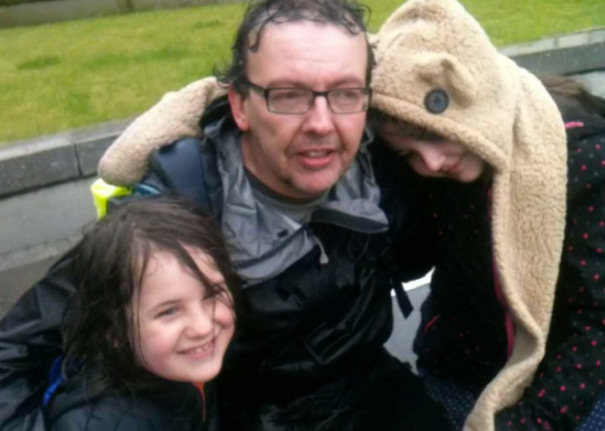
Journeys end
- 0 -
Over the last week I had a lot of time to spend with just myself for company, not something I have a problem with and I was surprised how clarifying the whole exercise had been, instead of walking along carrying all my day to day troubles and thinking about work or the countless other niggles of modern life the week had been about utter simplicity; get up, eat, walk, eat, walk, stop walking, eat sleep – that was all there was to it. When I had started at Milgavie my thoughts had been about what it would feel like reaching the end but as the week progressed I became less preoccupied with this and more focused on the moment. It struck me after a time that this was a great analogy for life: We are so obsessed about where we are trying to get to in life, we forget to appreciate the process of getting there. Our trials are lessons we need to learn and become stronger from. Walking a long path is no different to how we should learn to live our life. Its not about the destination its about the journey, its always about the journey.
Rodger Moffet 2014
The post A Northward Meandering – Walking the West Highland Way – Part Four. appeared first on ScotClans | Scottish Clans.
]]>The post A Northward Meandering – Walking the West Highland Way – Part Three. appeared first on ScotClans | Scottish Clans.
]]>After a welcome pub meal I crawled back to my tent and called home. That evening I had wrestled with the dilemma of what to do now; my feet were in a sorry state and clearly my walking boots were causing me problems having not had the opportunity to break them in as well as I would have liked. Having set up the baggage service I was on a schedule and had also booked lodging at the end so taking a rest day would be problematic but not impossible, however just moving about was difficult and could not even imagine taking on another stage. I was not alone in this as quite a few camping around me had also reached the same conclusion and were contemplating or had decided already to pull out.
I decided to give it a night and see how I felt.
Day 4: Inverernan to Tyndrum
The next day I made two discoveries that saved my trip: The first was that the campsite shop sold elasticated knee supports which allowed me to strap up both legs, giving me a ‘John Wayne’ walk but less pain. The other was ‘Breakfast in a Roll’ which filled me up so much I was ready to take on the Zulu Nation with a plastic fork. As I began to go through the ritual of breaking camp the movement worked like a limbering up exercise and gradually my flexibility improved. By the time I was ready to set off I had made a quite astonishing recovery. Today was a long but straight forward walk towards Crianlarich and over to Tyndrum.
Having had major problems with the footwear i decided to change to an old pair of walking shoes that i’d decided to bring along. Not perfectly waterproof but well worn and comfy – these would prove invaluable in the days to come.
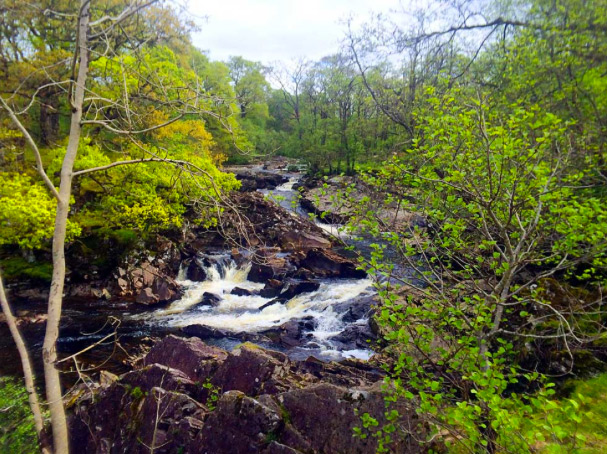
The Falls of Falloch
The walk begins with a steady climb from the campsite up into Glen Falloch with an impressive set of falls as you begin to bear North East. One of the delights of walking this route is the sometimes quite sudden changes in the landscape as you round a bend and a new glen opens up. Compared to the scenery of yesterday Glen Falloch was more barren, wild and open. It was quite easy to follow the track for miles ahead as it snaked along so there was no real need to worry about navigation, just enjoy letting the path carry you forwards and take in the surroundings. In this sort of meditative state the next few miles drifted by. I felt strangely elated by the fact that I was able to trot along at a decent pace, even catching up on a few walkers on the route. Anyone who had caught me unawares would have been quite concerned as I chatted away and chuckled to myself.
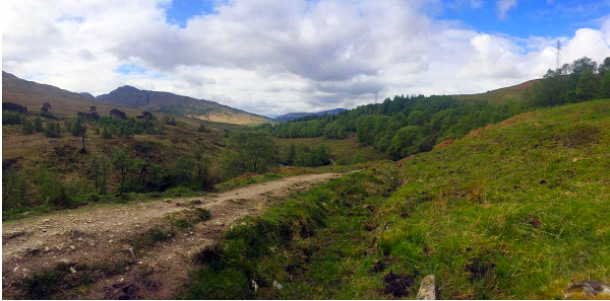
Glen Falloch
You don’t so much walk Glen Falloch as sort of gradually wear it down to the last half mile then a short pull up takes you to the point where walkers can take the route down the comically named ‘Bogle Glen’ to Crianlarich or continue on. I passed an elderly Canadian couple heading down for tea and scones, wished them well and headed on. The path then ascends steeply into a forest and you have the trees for company for the next few miles. The steep ascent at this stage was a concern, not so much the ascending part but just how much coming down the other side would take out of me, until now the knee bandages had done their job but this would be a big test.
However while no ‘walk in the park’ the descent was doable and before long I had passed under the main road and was heading towards Strathfillan.
Strathfillan is another familiar area having spent time there at Easter and the road from here to Tyndrum is one I’ve walked many times. The name comes from an Irish Monk St Fillan, the son of St Kentigerna who has connections with Balmaha and Loch Lomond. St Fillan was quite a character; legend has it he had a glowing left arm which he could use to read scriptures in the dark. He was patron saint of the mentally ill and people who suffered from mental afflictions were bound and dipped in St Fillans pool then left overnight by the chapel to cure.
A monastery was established near where Kirkton farm now stands established in the times of William the Lion and St Fillan was its superior. It was said that Robert the Bruce carried a relic from St Fillan into the Battle of Bannockburn, the Relic was said to be an arm bone but no one can be sure if it was the magic glowing one or not. After the battle Bruce reestablished a priory here.
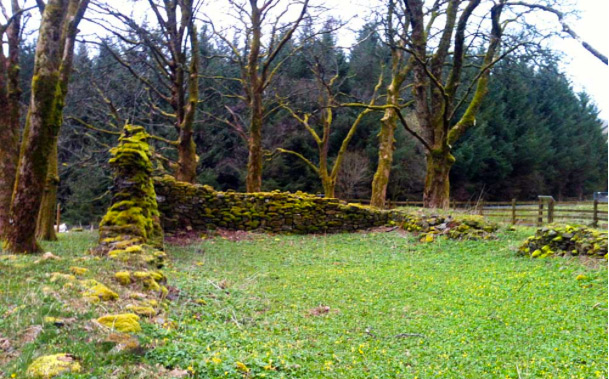
The Remains of St Fillans Priory
Having crossed the all too familiar main road that takes drivers in about an hour to where it would take me the rest of the week I passed the site of St Fillan’s priory and on to the campsite at Strathfillan Wigwams. This would not be my final stop but it was a chance to take a break and a snack from the campsite shop, sit on the benches outside and chat to fellow walkers while the local chaffinches begged for scraps. The final stretch of the walk takes you back under the road and up and over an undulating patch of moorland that passes the site of Robert the Bruce’s defeat at Dalrigh (something to remember if your sports team is having a poor start to the season, it probably isn’t as bad as Bruce’s) and the Lochan of the lost sword. More barren scrub land is testament to the town of Tyndrum’s lead mining past where very little grows in lead polluted soil and then a large gate in the deer fence takes you along a pleasant riverside walk that leads into the town of Tyndrum itself.

The Loch of the Lost Sword
Tyndrum is one of those small towns that pretty much everyone must have passed through at some point. The town sits at a point where road and rail links meet; the ones from Oban in the west and Fort William in the north. because of the topography the rail links don’t join here but slightly further south towards Craianlarich so Tyndrum is the smallest town in the UK to be served by two rail stations. These days though the town is famous for one thing, mention Tyndrum to anyone who’s been to the area and they will respond ‘aye the green welly stop’ This national institution started nearly 50 years ago as a couple of sheds and a filling station and has grown over the years into a huge sprawling complex of cafes, gift and outdoor shops (and a filling station) Its the natural rest stop on any trip north. Whats more the same family that took on the business all those years ago still run it today, you won’t see a McDonalds or Burger King in sight!
A quick set up and down to the village for supplies and food in the excellent Real Food Cafe (the best fish & chips in the highlands) all washed down by a beer. back to the tent and settled in for the night reminding myself that the other significant thing about reaching Tyndrum was that I had officially passed the half way point! bring on day 5!
Day 5: Tyndrum to Inveroran
This was a relatively short and straight forward stage but one I’ve thought about for a long time. The path runs not too far from the main road and railway all the way and is quite visible as you travel north clinging to the foot of the massive Ben Dorain. I’ve driven up and down this way many times and you can nearly always spot a walker or two as distant slow moving dots, I would always feel slightly jealous wishing I was out there walking the route (unless the weather was awful of course). Knowing this would be a short stage and also knowing there was not much in the way of entertainment at the other end I decided to try to leave it as late as possible before setting off. I killed some time by packing late and then heading down for a leisurely breakfast at the Green Welly. After finally running out of distractions I set off.

The Long Path
The path climbs up out of the town and heads towards the mountain of Beinn Odhar a bulky grassy mountain, eventually though this gives way to the more impressive conical peak Ben Dorain. The walking on this stage was excellent and my trials of a few days were long forgotten, the overcast sky and low cloud didn’t make for spectacular photographs but it was cooler more comfortable walking conditions. This top end of Strathfillan is a spectacular wide glen and new vistas open up as you progress along. Eventually the wooded area in the distance signalled that I was approaching Bridge of Orchy, the only alternative stop on the way.
The bridge at Bridge of Orchy is significant in this journey north as its the first time you come across solid evidence of the pacification of the highlands. This was an ongoing policy of building military roads to allow Government troops to reach into the highlands at speed and in force, this same policy led to the state sanctioned murder of the MacIain Macdonalds of Glencoe and would lead to the near extinction of highland culture after the ’45.
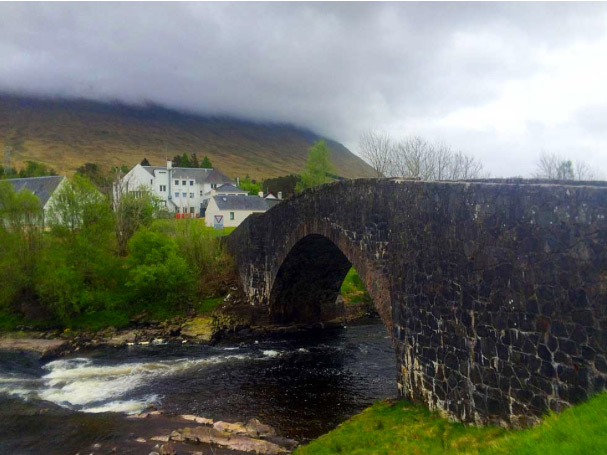
Bridge of Orchy
Now though Bridge of Orchy is a rather large hotel and train station and precious little else. Never mind though it was a good spot for a break and a sit down on a bench by the bridge to watch the impressive white waters of the Orchy river. From here the path snakes up through some light forestry until it reaches a pleasant view point giving you both a view back towards Ben Dorain and forward to the Black Mount in Rannoch Moor. The path from the view point leads back down the other side of this small hill and towards the Inveroran Hotel, my destination.
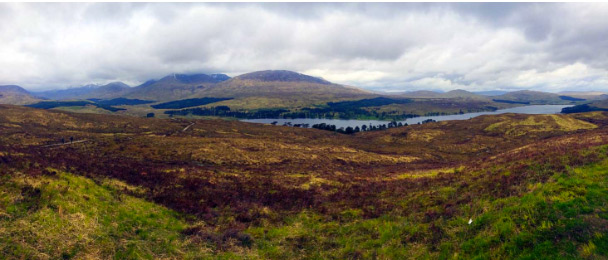
Hill Top View
The Inveroran is a peculiar place, a hotel in which time appears to have stopped at about 4:30 on a Wednesday afternoon in 1975. despite the gold mine of walkers who pass right under its nose the hotel seems either unable or just plain unwilling to cash in on the bonanza. add to this that a nearby wild campsite has been a popular spot for hill walkers and west highland way walker alike for as long as I can remember and its quite inexplicable how this has not been transformed into a bobbly hat wearers mecca. Their concession to their main source of income is a rather claustrophobic walkers bar with off the shelf pub decor and several signs to deter casual use of the facilities by non patrons. Then again maybe this is part of its charm, where would we all be without the Fawlty Towers of the highlands. Sadly though this was not home for the night because of course the hotel was fully booked as it is through most of the walking season. Home for me was a 200 yard dash with the big pack on my back down to the famous wild camp spot by the bridge.
Once again despite my best efforts to not only leave as late as possible but also to saunter along at at a leisurely pace I arrived to discover that there was no one else here. Even later as the spaces filled up there was a distinct lack of campers on this well known spot and several faces I’d got used to over the previous days were not to be seen. The wild camping area here is excellent and the ground actually better than many campsites I’ve paid good money to stay at, short grass and sandy soil making it a dream to pitch a tent on. The hills rise up on the distance all around you giving you the impression of sitting in the bottom of a giant bowl. Its a beautiful spot and all the better if you have lots of space and a prime pitch right by the rivers edge.

Pitched up at Inveroran
To kill a bit of time I took a little walk along the road to the Victoria Bridge (another military bridge) and had a brief wander down a footpath that was signed as leading to Loch Etive. This seemed to be a right of way rather grudgingly given as lots of warning signs abounded telling walkers this was not the West Highland Way and to turn round, the land on the other side of the bridge had a crudely constructed but rather ominous electric fence running across what was again supposed to be a right of way. All very mysterious and ripe for a Scooby Doo style investigation (for another day). While looking at this Loch Etive path though I consulted the map and discovered that this was indeed a very long trail that led down to Loch Etive and on to the small town of Taynult. This town is also served by the rail line that passes through Tyndrum, giving the potential of a very interesting long distance walk with a train taking you back to the start. (something also for another day). By now the sun had finally crept over the yard arm and it was a respectable time to head over to the walkers bar for a few drinks and an evening meal (no menu just one item take it or leave it). The evening was passed pleasantly catching up with James my walking companion from Rowardrennan as the bar filled up with fellow travellers.
Tomorrow would be the stage I had most looked forward to on the whole West Highland Way, the walk from here over Rannoch Moor to Glencoe!
The post A Northward Meandering – Walking the West Highland Way – Part Three. appeared first on ScotClans | Scottish Clans.
]]>The post A Northward Meandering – Walking the West Highland Way – Part Two. appeared first on ScotClans | Scottish Clans.
]]>Day 2: Drymen to Rowardrennan
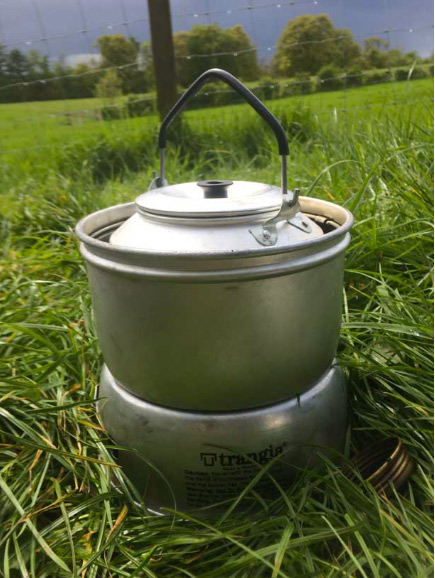
Brewing up for Breakfast
My first night under canvas (or rather whatever synthetic material tents are made from these days) was reasonably good considering. The sound of fellow campers going about their morning ritual got me up and moving. There had been a fair bit of rain overnight so had to take care while packing up. Today was a fairly long walk but fortunately had a lunch stop at Balmaha on the way so there was less of a requirement to pack lots of food.
with the forecast for the day not looking good I donned full wet weather gear and after dropping off the bag (and paying for the nights camping) I set off. Considering that my walking experience up to now had been doing one off mountains or trails I was surprised that after the second day I was not suffering as much as I had expected. The early stages of the walk brought me up onto a wide forest path, not much to see but in this grey wet weather it made little difference.
At this stage in the walk there is a choice of paths, walkers can either follow the traditional route up and over Conic Hill, a minor peak which gives you a good view over to Loch Lomond and its many small islands or you can choose to miss this out and take a small road down to the village of Milton of Buchanan and along the road to Balmaha. Having looked at the weather I thought that I would be lucky to see anything from Conic Hill and also considering Rowardrennan was a long way off I decided on the latter route.
On the descent from the forest track I felt my knee begin to twinge a little, this was going to be a day to be endured more than enjoyed! The small town of Buchanan is pleasant enough with a couple of interesting buildings including Buchanan Castle and an old mill house. With the weather not improving though I decided to head straight for Balmaha, a fairly dull trudge along a minor road where I had to time my walk to ensure I wasn’t alongside any large puddles as the cars came towards me at speed. The only highlight of this stage was watching some farmers with their working dogs as they herded some sheep into a farmyard pen.
After a long trudge I reached the village of Balmaha. The name Balmaha derives from the Gaelic Bealach Mo-Cha, ‘the pass of Saint Mo-Cha’. These days its a popular tourist spot with walking routes into the forest or boat trips out to the many small islands in Loch Lomond for his was also the point where the route made contact with the shore of Loch Lomond. The loch is the largest stretch of inland water in Great Britain (in surface area at least) and would be my companion for the next few days. This is where in geological terms the highlands and the lowlands meet, the loch forming part of the huge geological fault line that separate the two.
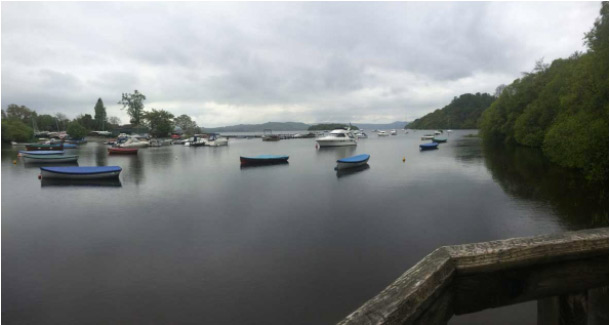
Balmaha Marina
Having made pretty good time I found myself in Balmaha a little early for lunch. The Oak Tree Inn at Balmaha is well known to walkers on the way and a welcome rest stop so I nursed a coffee for an hour until it was a respectable time to eat and then ordered lunch. The pub was quite busy but it was clear that pretty much everyone here was also on the same mission. Matching muddy boots and walking poles, maps in plastic cases hung from string and faces that were perhaps new to me now but would be pretty familiar as the week progressed.
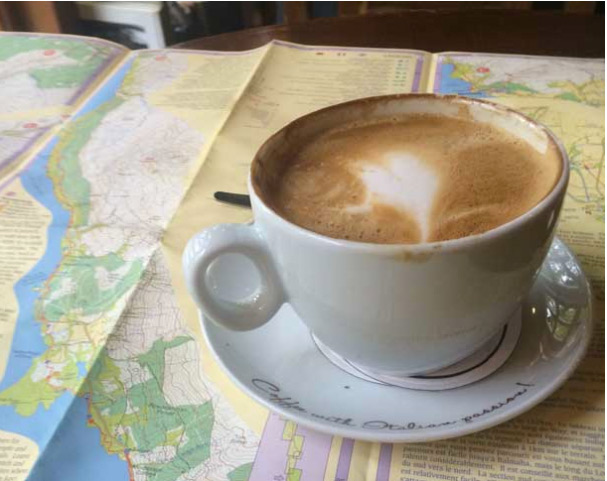
Taking a break at the Oak Tree Inn
Fed and watered it was finally time to move on. This section of the way was very familiar to me having camped nearby in the past so I set off at a confident pace, taking a slightly rougher shoreline path which cut out another short climb over a fairly unnecessary hill. Possibly my over familiarity with this section put a little too much spring in my step and I’d later regret that early eager pace. Just past the small camping area at Cashel the path has to negotiate a couple of small hills right on the shoreline, while the road on this section has the luxury of cutting through a tight valley the West Highland Way does not and there was no alternative but to get the head down and work my way slowly up through a series on steep ascents and descents.
This is a lovely stretch of forest mostly planted with native tree species. All part of an ongoing nationwide initiative to bring back more diversity into the environment and leave the swathes of pine forest to the job of producing timber on an industrial scale. Unfortunately most of this beauty was lost to me as I tentatively picked my way up and over these steep paths, the downhill sections playing real havoc with knee joints and feet in equal measure.
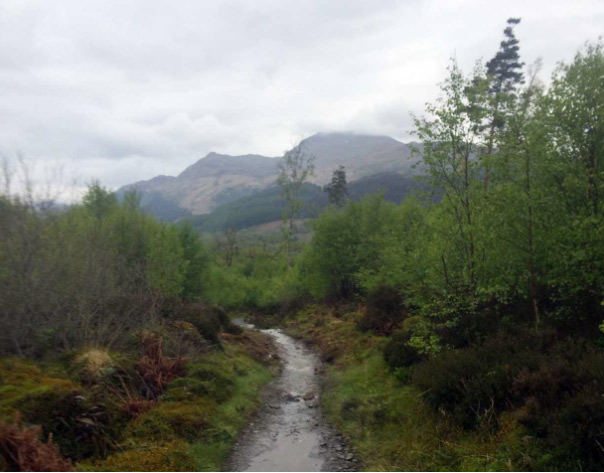
The Path to Rowardrennan
Eventually after a few punishing miles the Rowardrennan Hotel came into view, not my home for the night but a good place to sit down, have a well deserved pint and a quick rest before the short walk to the Hostel where I would take a break from the tent for the night. The youth hostel at Rowardrennan is a gorgeous former hunting lodge, one of the many large buildings that sprung up during the Victorian era’s love affair with the Scottish Highlands. Run by the Scottish Youth Hostel Association it affords inexpensive but comfortable accommodation. For anyone who can remember the SYHA from their younger days its very different now, cooked evening meals, breakfast and even a packed lunch can be laid on. Proper beds with bedding provided and a well stocked little shop make this about as good a stop on the West Highland way as you can get in terms of value for money. Much to my joy I also discovered that the shop sold tubes of ‘Deep Heat’ which worked wonders on my aching knees.

Rowardrennan Hostel
With a little time to spare and the feeling coming back into my feet after a shower and the application of several plasters I decided to take a stroll around outside. There is a small jetty by the hostel which offers a ferry service across the loch at certain times and also nearby is a small visitor centre. Normally quite busy with tourists they had mostly all departed by now. By the centre there is a monument which was erected to the memory of the fallen from the First and Second World War. (indeed the whole area here is designated as a ‘memorial park’. The monument created by the artist Doug Cocker is a contemporary piece of sculpture, while I like the design I’ve always found it rather odd in that it looks to me like the view through a gun sight perhaps an odd choice of metaphor.

The War Memorial
As I sat on the shore watching the clouds drift over, the weather already beginning to break I thought about the day ahead. Tomorrow was the day I was most concerned about, considered by many as the hardest stretch of the walk the journey from here to Inverernan.
Day 3: Rowardrennan to Inverernan
Rested and fed I was able to get moving early the next day and once moving was able to push my worries about this section to the back of my mind. The first few hours of the walk sped by as I was caught up by another traveller, A retired gentleman from Jersey called James. James was a Scot, a former merchant seaman, and clearly a keen walker and we chatted away about all manner of things for most of the first half of the day. This was quite welcome as the first few miles cut through fairly dense forest on a wide path with only occasional views through the trees to the loch. The miserable weather of the previous day was a distant memory now with bright sunshine and far less threatening puffy clouds in an otherwise blue sky. At one small clearing in the forest I decided to take a little break so temporarily waved off my companion and took a minute to enjoy the view.

A rare break in the trees
Once on the move again the path descended a little and back into the forest but now with the loch side never far away. after a few minutes I noticed a very powerful scent and reached a clearing where the hillside was completely covered in bluebells, the colour was magnificent in the strong sunlight and if I’d been a religious man I’d have been tempted to glance skyward and say ‘loving your work mate’.
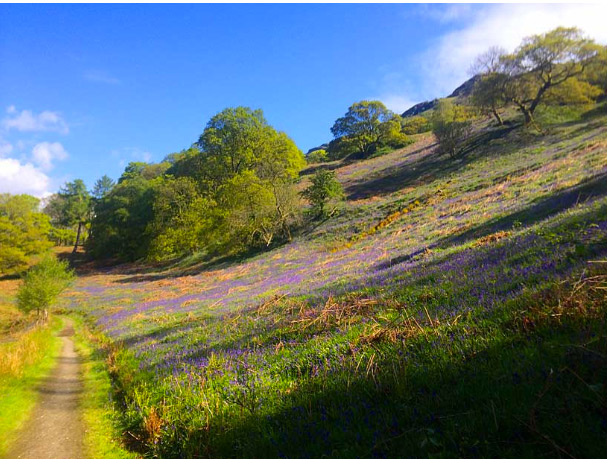
The Bluebell Fields
One slightly odd feature of walking this section of the route comes from the loch itself, or rather those who make a living from it. As you stroll along the path the natural sounds of the birds and wind in the trees is sometimes accompanied by distant voices, at first you think it’s maybe a walker coming behind you so you stop to let them pass, but no one comes so maybe its a particularly LOUD walker so you sit down so they definitely go past, still no one comes. Then you discover the source as a pleasure boat drifts by just off the shore. The boat’s captain provides a commentary via loudspeaker for his passengers which shatters the peace of the loch side. Fortunately though it was not a regular occurrence and I was soon used to the sound.
After around three and a bit hours of walking the Hotel at Inversnaid appeared out of the trees. Inversnaid is a pleasant little oasis on this stretch of the walk, sometimes used as a way to break up the stage. A large hotel dominates with a pier for ferry and pleasure boats and the impressive Arklet Falls next door. This was a wonderful opportunity to take a break, enjoy a drink and attend to the state of my feet.
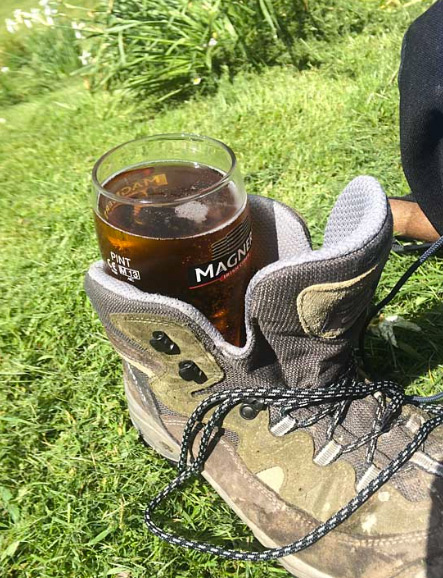
Combined drink holder and boot cooler (patent pending)
Having attended to all that I was up and ready to take on what is described as ‘the hard bit’. Describing it like this is like describing the pope as being ‘a bit catholic’! Things started off well enough. While this stage involves a lot of clambering up and over rocks and tree roots it is at the same time quite jaw droppingly beautiful too. It was quite a busy section also as walkers began to bunch up on the tricky parts. People I know have walked this section as part of a day out and have said that its not that bad but its one thing driving up for the day and having a little scramble along the shoreline and quite another doing it after having walked for two days with aching knees and blisters.

Loch Lomond
My guide book described this part of the walk as having two particularly rough sections and it was on the second of these that I encountered a number of walkers who were really struggling. I learned later the next day that a woman from one of these groups slipped and broke her ankle and had to be rescued from the loch edge, not a stage to be taken lightly. Eventually the path led down to a small beach and the hard part was behind me, or so I thought!
I took a short break, bathed my feet in the loch for a little and spotted a couple of wild goats grazing nearby, well aware of me but clearly well used to the walkers that pass this way.
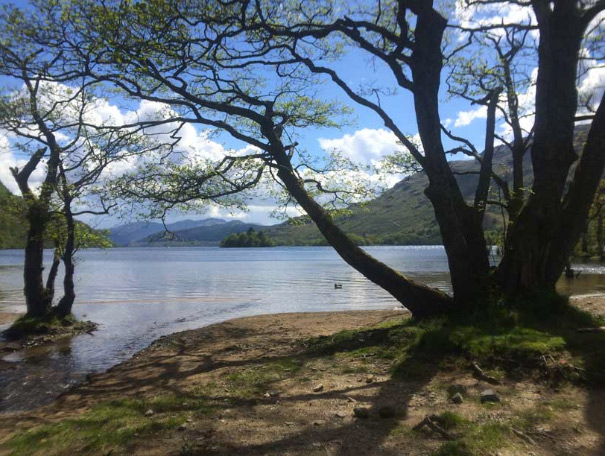
Rest stop by the beach
After this the path diverts away from the loch which by now has narrowed a fair bit and climbs up over a low hill onto moorland. the going here was reasonable and the reward was a spectacular view over the north end of Loch Lomond and the small bothy at Doune. Beautiful though this was I was still concerned that my destination of Inverernan still appeared nowhere in sight and progress according to the map had not been that great. The day was far from over but it was then that the now familiar complaint of ‘nearly there’ began to take effect. Weariness took over quickly and the next few miles felt like ten as the path wound up and down over the moor. A landmark of power lines clearly marked on the map seemed to take forever to pass under and then as the path began its steep descent into Inverernan my knee joints complained bitterly at every step. Far below the river replaced the loch and I knew I couldn’t be that far but I was still aware that I had to get down to the level of the river and that was going to hurt. Suddenly the trees around me cleared and a couple of wooden huts and a gate told me I had reached Inverernan.
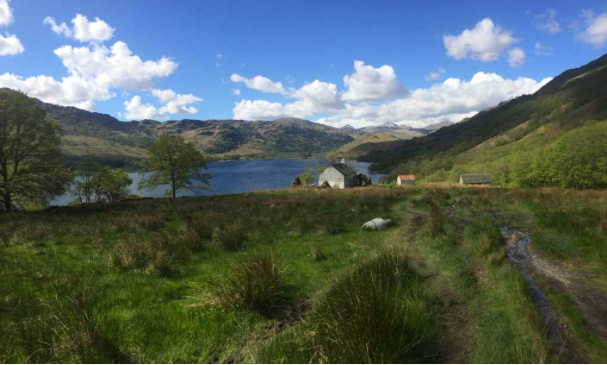
Doune Bothy
The Beinglass Farm campsite at Inverernan is one of a handful featured in the excellent ‘Cool Campsites’ book and it earns its place and then some. After walking this stage its nothing short of a camper’s paradise. Maybe not so much for the purists who like their campsites a little on the spartan side but Inverernan features a pub, and well stocked shop. It was late in the afternoon is a stumbled into the little beer garden outside the pub to be greeted by many faces familiar to me over the course of the day. Almost on automatic pilot I ordered a beer and collapsed down onto a picnic bench outside. As I looked round every face told the same story ‘good grief that was hard!’

A well earned drink!
and this was only day three – how on earth am I going to get up and do this again tomorrow and the next day, and the day after that?
The post A Northward Meandering – Walking the West Highland Way – Part Two. appeared first on ScotClans | Scottish Clans.
]]>The post A Northward Meandering – Walking the West Highland Way – Part One. appeared first on ScotClans | Scottish Clans.
]]>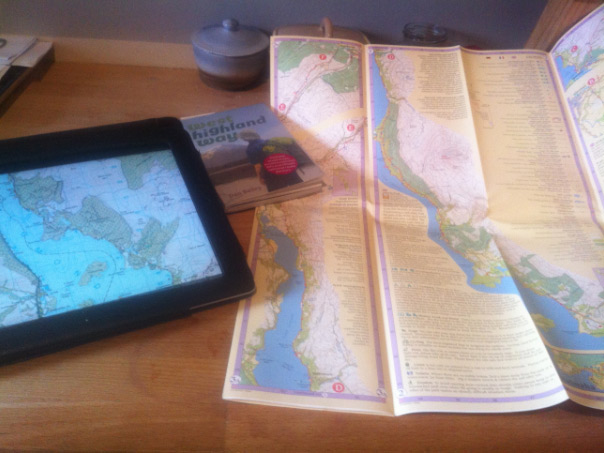
Making Plans
For several years I’ve been planning to walk the West Highland Way, one of Scotland’s best known long distance walks that runs for 96 miles from Milgavie just north of Glasgow all the way to Fort William in the North West Highlands. I have just returned from finally managing to complete this incredible and iconic route, a little bruised a little worn but a lot richer for the experience. During my travels I kept a journal of each day, here along with some of the photos taken along the route is my account of ‘walking the way’.
Prologue: Getting to the starting line.
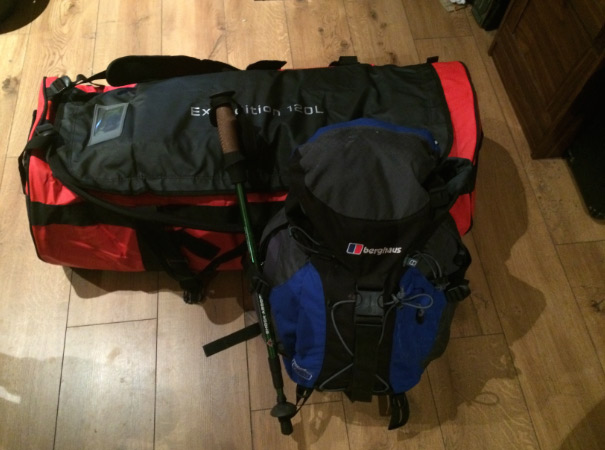
All packed and ready to go
For most people the start of the West Highland Way starts with a train journey. for me it was boarding a train from Edinburgh to Milngavie. For what should be a short hop from east to west central Scotland this is one of those surprisingly long journeys on a train that stops at places even I’m not familiar with despite spending most of my life in the central belt. As the train trundled through Scotland’s former industrial centres I sat with my outrageously large holdall and rucksack and wondered how this week was going to go. Finally as we got into the late afternoon the train came to a halt at the and of the line – Milngavie.

Milngavie
Milngavie (pronounced ‘Mull Guy’) was a once small village that grew rapidly in the industrial revolution, being close to a good water supply this allowed the development of paper mills etc, now it has more or less been swallowed up by the expansion of Greater Glasgow and these days serves as a commuter town. Since the first day was going to be a long one I had decided to get through the day before and stay overnight giving me a chance for an early start the next day. Having hauled my huge bag and myself off the train I afforded myself the luxury of a taxi to the hotel.
My home for the night was a local branch of a budget hotel chain, the size of the hotel in such a small town is testament to just how popular this walk is. In fact its hard to go anywhere in Milngavie without being reminded of it, certainly a boost for the local economy. A small industry has indeed grown up around servicing the 85,000 people who use this route every year (though just a little over 1 in 3 walk the whole way). One of the most welcome of these is the baggage transfer companies who for a modest fee will take your bags to the end of each stage and pick them up the next day allowing you to walk with just what you need for the journey. One of these called ‘ Travel Lite would be custodian if my very large holdall for the week (lucky them).
Unfortunately my last night of luxury was not the best, my excitement about the day ahead leaving me a bit like a kid at Christmas, unable to sleep properly. I found myself up and about at a fairly crazy hour (for me) so ventured down for an early breakfast. once filled with the standard Scots fair of cholesterol I did my final packing, dropped my bag at reception and began the walk to the town centre and beyond…
Day One: Milngavie to Drymen
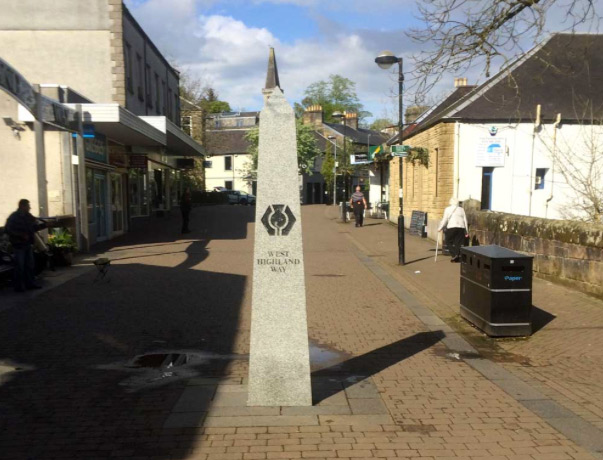
The start of the way
A modest stone obelisk in the town centre marks the start of the way, this is conveniently beside an arch which walkers pass through, leading down to the path by the river and some convenient signs. It was a beautiful spring morning with puffy clouds and little but the sound of birdsong and the hoof beats of joggers out for an early sunday morning workout. The early stages of the way are surprisingly pleasant as it meanders along the Allander water, very quickly you feel that you are leaving the town behind and the adventure is beginning.
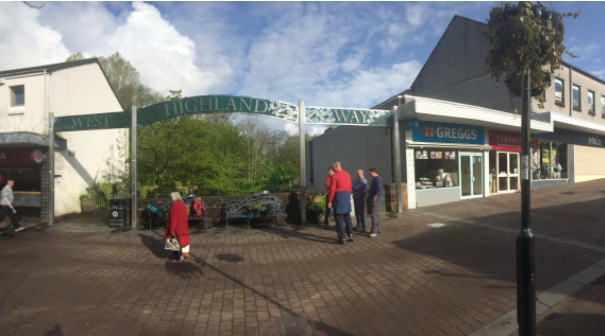
The West Highland Way arch
After a short stroll up river I came to a large ‘diversion’ sign, accompanied with other signs, maps etc explaining that a large section of the way was temporarily closed for work on power lines and a diversion was in place. This diversion sign pointed up what looked like a rather steep hill. Fortunately it was still early and this didn’t feel like too much of an inconvenience. A few minutes later I was beginning to question this decision as I puffed up a relentless incline through the forest. My efforts were rewarded though since this diversion came out right next to Mugdock Castle.
This small but impressive Castle was a Graham stronghold from the mid 13th Century. Mugdock is possibly the birthplace of the most famous of the Grahams – the Marquis of Montrose. The castle has had mixed fortunes (partly down the association with Montrose and partly down to the clans eventual abandonment for the larger Buchanan Old House. The ruin has since been stabilised and now makes a very attractive landmark.
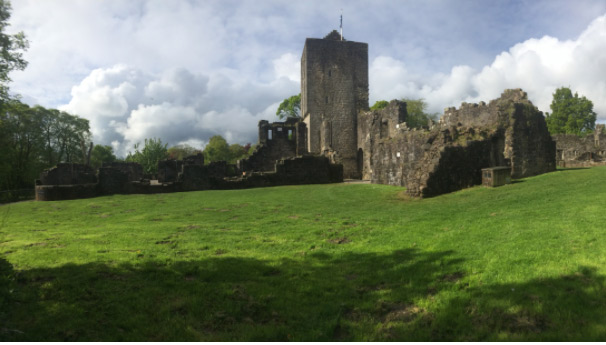
Mugdock Castle
From Mugdock the diversion took me rather appropriately along a fairly well rutted bridle path and an early test for the footwear. This muddy track finally found its way downhill at a place called Carbeth with views across to the famous Carbeth Huts. It would be easy to wander past this little area of painted wooden lodges without giving them a second thought but the Carbeth Huts (and the Hutters who own them) are part of local lore. This area near to the Campsie fells has often been a popular spot for people looking to escape the pollution of the big city (in this case Glasgow) Scout groups, climbers and walkers would all use this area to camp. After the First World War the landowner allowed ex servicemen to build small wooden huts on the land and a community grew up around them. The huts were used as shelters during the great depression and also from the bombs during the Clydebank Blitz. Still the existence of the huts were dependant on the whim of the landowner but in 2010 an agreement was reached and the hutters bought the land in a community buy out.

The Carbeth Huts
Onwards and more or less northwards I went, the small path crossed a minor road and up a little hill. Cresting the hill is quite a surprise as its your first glimpse of what really lies ahead. far in the distance the mountains around loch Lomond form a backdrop to rolling moorland with the Campsie fells flanking to the East. This is the first of many changes of landscape you experience on the way. From here a disused railway line is your guide for a large part of your remaining day. The railway though disused for carrying passengers does have another cargo however; water. Beside the line and partially buried a massive pipe carries the water supply from Loch Lomond all the way to the homes of the people of Glasgow.
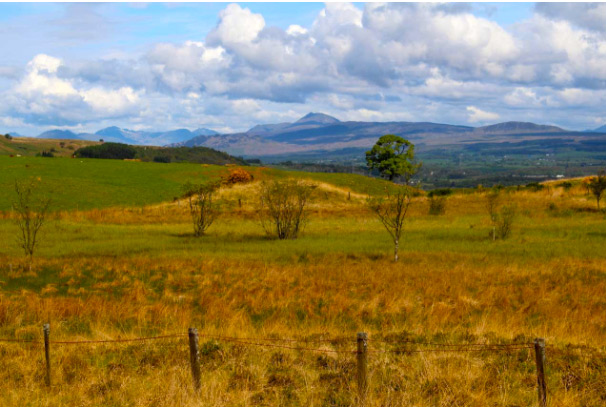
The Highlands ahead!
The monotony of this stage was broken by the view of the Glengoyne Distillery. This pretty distillery sits directly on the ‘highland Line’ and so is unique in that the whisky there is officially distilled in the highlands but matured in sheds on the other side of the road which are classified as being in the lowlands. Glengoyne may look small but produces a million litres of spirit a year, an impressive figure. Tempting though a visit to the distillery was the sight of the Beech Tree Inn right next to the road a few yards further on drew me in. This lovely little pub with an impressive beer garden was the first chance to take the pack off and sit down with a soft drink (it was still Sunday morning after all) and chat to other walkers who had started the journey that day. This is the great thing about the West Highland Way, the camaraderie that builds up as the week progresses, the same familiar faces that pop up as you complete each stage or take a break can sometimes lead to great friendships. Much of the early chat of course is all about how far are you going and what stops you are doing, there is an air of excitement and expectation.
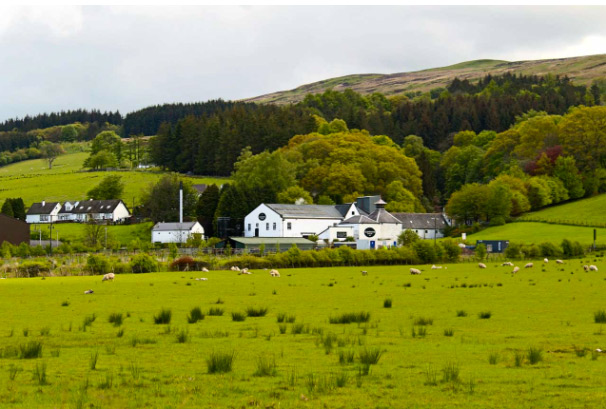
Glengoyne Distillery
From here it was just a few miles to the end of the road for day one. The small town of Drymen and for me the campsite of Easter Drumquassle Farm a mile or so to the south of the town. It was at this point I discovered a phenomena of long distance walking; the attack of the ‘Nearly Theres’. this is a peculiar malaise that effects the feet and leg joints and sometimes the entire body which appears to have made up its mind that the journey is over despite the fact that there are miles to go. the last hour or so then became a slow trudge along country lanes till eventually the campsite came into view.
This farm is a popular first stage for those wishing to camp on the route. Having poured over any research available beforehand I was somewhat concerned as the online reports for this place were not great. Reports of badly sloping pitches and temperamental owners were playing on my mind but all seem to be unfounded. The site was damp but understandable considering the rain we had previously, however the spot I found up by the fence was quite level and the young owner who bounced over to me as I was picking up my bag from the shed acting as a drop off point for the baggage service was charming. Having hauled my pack up to my chosen spot I then began to erect my tent. The tent we have was one Amanda bought for her trip to St Kilda a few years ago, its quite large for hiking and at first is rather complicated to put up. Fortunately despite my slow pace I was the first to arrive so could get on with it in peace. To my surprise the tent went up with very little stress to me or the aluminium poles and was soon sorting out my little home for the night. Fortunate timing too as the rain came thundering down moments later so I amused myself listening to the pounding of the rain and peering from the small flap I’d allowed to stay open with a view over to the Horses in the next paddock. Eventually the rain eased off and boredom set in so despite the miles undertaken I decided to take a walk into the town of Drymen.
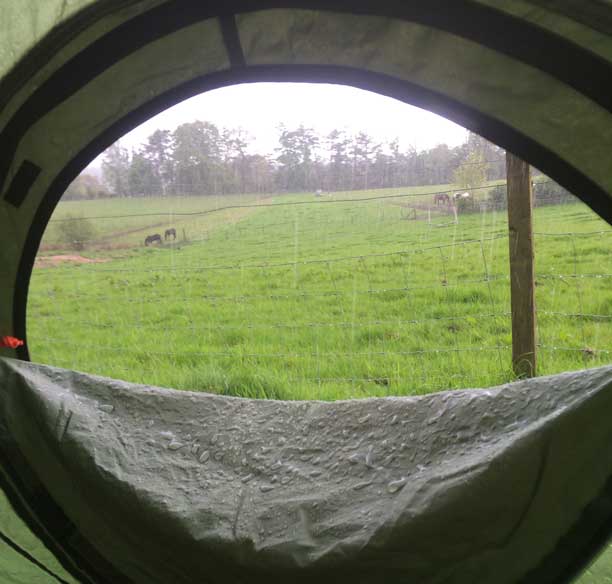
Watching the rain
Drymen is a quaint little village, the name comes from the Gaelic word Druiminn which also happens to be where the family name Drummond comes from. Not only the West Highland Way but the Rob Roy Way passes through here and the village pub the Clachan (which claims to be the oldest in Scotland) was reputed to have connections with the family of the famous outlaw. I decided to pay a visit to the famous Clachan pub, purely for research you understand. and after a short rest stop hobbled back to camp for the night. Tomorrow was going to be a long day with Rowardrennan by Loch Lomondside as my destination…
The post A Northward Meandering – Walking the West Highland Way – Part One. appeared first on ScotClans | Scottish Clans.
]]>The post 10 Handy Tips for Visitors to Scotland appeared first on ScotClans | Scottish Clans.
]]>Ten useful facts you need to know if you are coming to Scotland/UK
1.We drive on the LEFT.
If you are driving be particularly careful turning right at traffic lights and at roundabouts. I remember watching in horror at a large roundabout under the M9 motorway as a car full of Italians in front of us turned right and went round the roundabout anticlockwise and headed up the exit ramp onto the motorway the wrong way!

The Bealach Na Ba, Applecross
Scotland also has a few single-track roads, mostly in the far North. These are very narrow roads, normally through spectacular scenery. Every 50 yards or so there is a passing place where you can squeeze past the tour bus that’s heading towards you while your passengers stare with wild eyed terror at the 200 foot drop that your wheel is caressing the edge of. One really handy passing place tip is that it’s also to let people overtake! Keep an eye on what’s behind you and pull in to let them past as soon as its safe to do so. I’ve spent a good hour stuck behind a tourist round Ardnamuchan flashing lights and peeping my horn as they dodge along at 10 miles per hour. You DO NOT want to know what they were told when they finally did pull over! Also they are called PASSING places (there is a clue in the name) not PARKING places.
2.If you order a Pizza in a fish and chip shop it may well be deep-fried and folded in half.
In fact most things are deep fried, Mars Bars being the infamous example. In the Film ‘So I Married an Axe Murdered’ the character Charlie McKenzie played by Mike Myers said, “I believe all Scottish cuisine is based on a dare”. You should also beware of something called an Aberdeen Buttery. This has been described as 30 croissants covered in lard and compressed in an industrial press. Eat one of these and you may not need to eat for a week!
That being said Scotland actually has some great cuisine. You will get some of the best seafood ever In the highlands and in fact posh London restaurants actually buy water from Scottish sea lochs to cook with.
3.Scotland has two great divides; The highland line and the M8 Motorway.
A geological fault line called the Highland Boundary Fault runs from Arran in the south west up to Stonehaven in the northeast. This line has traditional separated highland from lowland and so very different cultures have emerged. The fault is inactive now so don’t panic about earthquakes but its quite noticeable particularly on the relatively small island of Arran where the scenery north of the port at Brodick is wild compared to the more arable south.
Scotland also has a more recent divide called the M8 corridor. This motorway links Scotland’s capital city of Edinburgh with Scotland’s largest city Glasgow. A fierce rivalry exists between the two cities each considering itself to be superior to the other. We can let you into a secret though, as Residents of Edinburgh I can confirm Edinburgh is OF COURSE the winner.
There is of course that other divide which is based on more religious grounds than geographical ones. This one harks back to the end of the old Stuart dynasty and despite being over 300 years old its still part of Scotland’s less attractive culture. If someone in Scotland asks you which school you went to its not to find out if you are upper class or not, its to find out which ‘foot’ you kick with (whether you are catholic or protestant, most Catholic schools being called ‘saint’ something or other.
4.’Scotch’ is a drink, ‘Scottish’ is a nationality.
Nothing is going to wind a Scotsman up faster than the phrase ‘I just love you SCOTCH people’. Scotch is a drink, a type of clear tape and part of the name of a children’s game. It’s not a way to refer to the locals!
5.The Scots are not tight fisted!
The legendary Scots reputation for thriftiness is a bit of an urban myth. In fact we tend to be quite generous and hospitable. In Scotland these jokes are normally reserved for Aberdonians (residents of Aberdeen). There are some great jokes though such as how wire was invented (two Aberdonians fighting over a penny).
6.If the Eskimos have 50 words for snow, the Scots have 50 words for rain.
In Scotland there’s a great word called ‘Smirr’ it’s a sort of weather that’s not quite rain but a bit more than mist. Normally very cold it’s the sort of weather where you are instantly very wet even though it doesn’t seem to be raining. Other words describe the intensity of the rain and including words like ‘plump or plunk’ which has nothing to do with fat but more a sudden heavy shower ‘its coming doon a plump ootside’ and of course that all purpose Scots word; pish (or pash if you are from the Northeast), ‘its fair pishing doon man’.
All in all the Scots have a dry wit when in comes to most things and weather is no exception. A few months ago when winds of over 100mph hit Scotland the locals gave it the nickname Hurricane Bawbag! This led to the hysterical case of foreign weather reporters innocently picking up on the name and using it, unaware of its use as a term referring to the male scrotum.
7.Its called Football, not Soccer!

Scotland Fans Enjoy a Quiet Game of Football
It’s hard for anyone outside Scotland to understand how we can be so obsessed about a sport we readily accept that we are not very good at. It’s like pygmy tribes being obsessed about basketball! Soccer is some game played by women in America and maybe the odd big European superstar trying to milk the last few pennies from his dying career. Football is a game played in Scotland in the rain on red ash pitches (also known as ‘blaize’ it’s a sort of mining waste product that has the consistency of layered razor blades). If you are good though you get to play on grass!!!
Its safe to say that football is a national obsession and children at an early age can understand the complexity of ‘goal difference’ before they can count to ten. Our national side last qualified for a major tournament in 1998. Which means there are children leaving school now who cant remember what its like to see Scotland in a world cup. Being old enough to remember Argentina 1978 I’m not sure if that’s a good thing or not.
If you find yourself in a crowded pub while a game is on here are a few useful phrases you can use to blend in.
- ‘Go wide!’
- ‘Offside my erse’
- ‘get right intae him’
- ‘just pass it ya big muppet’
8.Scotland invented everything.
Broadcast television, pneumatic tyres, tarmac roads, the telephone, penicillin, Canada, ginger pubic hair. The list is far too long to commit to this article. If it exists it was probably invented or discovered by a Scotsman. Ignore this fact at your peril. I remember a cousin of mine had gone over to Florida and the very helpful bellboy took her bags up to her room “oh your from Scaaatland, that’s great” he then proceeded to explain the rooms many fantastic technological features, like the phone and the TV.
“So do you know how to work these madam?”
“Listen wee man, I should do we bloody invented them’.
9.We like the French but we don’t like the English!
This good natured (mostly) ribbing of our cousins unfortunate enough to be born south of Berwick of course stems from centuries of bloodshed and slaughter. The somewhat strange obsession with the outcome of battles fought 700 years ago have been nurtured by the Hollywood styling’s of a short Australian with a painted face and turned into a massive industry. Not that we are going to knock that since it keeps a lot of us in employment!

The Controversial ‘ABE’ T Shirt
For much of this period of constant battles with the English the Scots formed alliances with the French, known as the ‘Auld Alliance’ it resulted in a lot of French customs becoming part of Scottish Culture, many French phrases formed part of the Scots tongue, the most famous of which was the Edinburgh phrase ‘gardyloo’. Adapted from the French ‘regardez les eau’ or ‘look out for the water’ this was when the woman of the house would empty the ‘chanty pot’ (a receptacle kept in the bed chamber used for the deposit of bodily waste) out the window and into the street below. If you heard the phrase ‘gardyloo’ then locals would duck as far away from the gutter as possible. If you didn’t understand the phrase you were in for a nasty shock.
Now of course our rivalry with England is mostly sporting, in that it’s about supporting ANY team that happens to be playing them. During the last world cup an enterprising person came up with a t-shirt with, in large letters ABE that stood for ‘Anyone but England’ needless to say they sold by the bucket load. The slightly put out English responded with t-shirts saying SDQ (Scotland didn’t qualify) but that’s just stupid, isn’t it?
Never take yourself too seriously.
The Scots are notorious for taking the wind out of the sails of any ‘big blawhard’ (boastful person). We Scots are very good at this and are quite open to having a laugh at ourselves (as long as its us making the joke mind! Anyone else does it and they’ll get the malky). Theres a great story about the late British entertainer Roy Castle. Roy was a famous TV presenter but also a very accomplished musician. One night he was playing the infamous Glasgow Empire theatre, a place where many a star met with the blunt end of a Glaswegians wit. So Roy was reaching the climax of his act. The stage was littered with all types of instruments and Roy frantically ran from one to the other as he played along with the house band; the trumpet, trombone, drums, guitar. The routine was reaching a crescendo as a loud voice from the back of the auditorium boomed out ‘aww Jesus Christ, is there nae end tae his bloody talents’.
So if you happen to be a rather large Texan for example, try not to fall into the trap of banging on about how much bigger everything is in the US of A. this will probably fall on rather unreceptive ears. Just bite your lip say ‘awright wee man, ye fancy another wan in there?’ (would you care for another drink), and you’ve made a friend for life.
Enjoy your visit to Scotland when it comes!
Slainte
The post 10 Handy Tips for Visitors to Scotland appeared first on ScotClans | Scottish Clans.
]]>