The post Clans to take part in the Edinburgh Military Tattoo in August appeared first on ScotClans | Scottish Clans.
]]>
Rallying the Clans together. Chiefs of Clans Bruce, Leslie, Macnab and Carmichael on Salisbury Crags with Edinburgh Castle below.
Clan chiefs have been sending out rallying calls to their Clansmen and Clanswomen all over the world to come and join them at the Edinburgh Tattoo this August. Rather than setting a fire on-top of a hill – this time they’re using the internet.
Back in 2009 many of us remember the epic Clan March up Edinburgh’s Royal Mile to the Castle, Clans walking behind their banners and many with their Clan Chiefs, being cheered on by thousands of onlookers. This was the largest Clan display by far seen in Scotland, Over 125 Scottish Clans took part in the parade . Since then Clans have had their individual gatherings and clusters of Highland games but nothing touching what happened in 2009.
Jamie Macnab – Chief of Clan Macnab said in an interview for The Times .”It was absolutely phenomenal… I don’t think anyone who took part that weekend will ever forget it.”

Clan Douglas at the Clan Parade in 2009
So now in 2017 the Clans will be marching again – this time to the Tattoo. It will be a series of Clan Parades that will take place each night of the Tattoo. This will be a major event within the Clan-themed Events that will be happening throughout this year, backed by the Scottish Clan Event Fund.
There are 25 performances of the Edinburgh Tattoo. Tickets have been put aside for the clans to buy for each performance to make sure that as many tartan-clad clansmen, women and children attend as possible.

The Edinburgh Tattoo
The Tattoo’s Chief, Brigadier David Allfrey approached the Standing Council last August to gain support for his ‘Splash of Tartan’ theme for the Tattoo. This opportunity provides an excellent platform to promote Ancestral Tourism to International audiences. 2017 is Visit Scotland’s year of History, Heritage & Archaeology. The Clans will be playing a large part.
Clan Chiefs have been contacted and have signed up, now it’s all about mustering up support to get people to follow them up the Royal Mile. Currently 53 Clan Chiefs have signed up, so each night there will be 2 Clans in the parade. Some Clans have already got 100 people signed up.
Jamie Macnab explains that this is a great opportunity to reposition the views within Scotland of Clan Heritage. Here especially it can be seen as a bit twee – a shortbread version of Scotland, one that is just for tourists not for the people that live here. Jamie adds:
” My hope is that our involvement in the Tattoo will get some home-based engagement and Scots will don their tartan and go, ‘Right, I’m putting my kilt on and going on my clan night.’ I mean, I think this is the first time the Tattoo has ever done anything like this so hopefully it will generate some interest.”
Clan events have always attracted people from oversees. the Convenor of the Standing Council, Sir Malcolm MacGregor has been over in the US trying to drum up support for this event.
Visit Scotland’s research has shown that history and heritage is the second most popular reason cited by visitors coming to Scotland from overseas. First was landscape and scenery.
So if you’re interested in joining your Clan – please contact your Clan Society and join in, let’s make this a great event!
For full list of clans and dates please see: http://www.scotclans.com/list-of-clans-and-dates-for-tattoo-clan-parade/
The post Clans to take part in the Edinburgh Military Tattoo in August appeared first on ScotClans | Scottish Clans.
]]>The post The Luckenbooth Brooch! appeared first on ScotClans | Scottish Clans.
]]>
The Royal Mile, one of the most famous streets in Edinburgh, runs from the castle all the way down to Holyrood Palace. When Edinburgh castle was first established this was the only accessible route, a natural ramp formed thousands of years ago gave access to a castle otherwise impregnable from the east.
With the establishment of Holyrood palace, or rather the original monastery in the 12th century, the route between the two became an important thoroughfare. Businesses and government offices sprang up as well as several churches such as the magnificent St Giles Cathedral.
 By the 16th century many parts of this route became dedicated to markets and the wide area running down from St Giles towards the Canongate featured some of the city’s first permanent shops. Many of these housed small trade people who made and sold their wares, and among the most popular were the jewellers. The shops themselves were very small and were known as ‘Locked Booths’. From this we get the word ‘Luckenbooth’.
The Luckenbooth brooch became a very popular item in 16th century Scotland. It featured the ‘Heart & Crown of Scotland’ and was romantically linked to the tragic Mary, Queen of Scots as it was the brooch she had given to Lord Darnley.
The style of the Luckenbooth brooch became very popular throughout the UK. By the 18th century the trade in silver to the new world featured the little brooch and many ended up traded with Native Americans, particularly the Iroquois of the Six Nations. As a result of this the Luckenbooth became a popular decorative symbol in their costumes.
The tradition was that the young man would give his lady a Luckenbooth brooch on their wedding day. When their first  child arrived the brooch would then be pinned to the babies shawl to protect it from “evil spirits”. As such it had very similar connotations to the Irish ‘Claddagh’ ring especially with the similar heart shaped theme. This tradition can be carried over to today. A Luckenbooth Brooch makes a fantastic gift for your bride on your wedding day, or a gift for a newborn as a symbol of protection and love. Whatever you pick one up for, it is and always will be an enduring symbol of Edinburgh and of Scotland.

The post The Luckenbooth Brooch! appeared first on ScotClans | Scottish Clans.
]]>The post What is the Sgian Dubh? appeared first on ScotClans | Scottish Clans.
]]>
The Sgian Dubh is a small edged knife, usually 3-4 inches in length, that is worn as part of the traditional Highland dress tucked into the top of the kilt hose with only the handle visible. It’s origins are fairly unclear, although it is now a purely ornamental item, most communally applied with an underage blade, that is an essential part of the full Highland outfit.
The word sgian dubh, pronounced ‘skee-an doo’, translates from Gaelic to ‘black knife’. This is usually derived as meaning a ‘hidden’ blade, with the black being used much the same way as in black market or blackmail. This is further given credence when compared to other Gaelic words, such as dubh-fhacal translated as ‘riddle’ or ‘hidden word’, or dubh-cheist translated as ‘enigma’ or ‘hidden question’.

One theory behind the origins of the sgian dubh is that the knife evolved form another blade carried by the Highlanders, the sgian achlais. Slightly larger than the sgian dubh and likely a close relative of the dirk, the sgian achlais was carried on the upper sleeve or concealed within the jacket. During this time etiquette demanded that a guest would reveal any weapons upon entering their hosts home. As such the knife would instead be placed on display, but still within reach, usually within the top of the hose.
The sgian dubh also has a lot in common with a more practical utility blade, used for cutting fruit. food or for skinning. When the Highland Dress Proscription Act came into effect after the Battle of Culloden, it was made illegal for Highlanders to bear arms of any kind. The relatively small size of the sgian dubh was deemed acceptable and it therefore became a popular utility knife for everyday use.

The early blades varied in construction, some having a “clipped”, such as found on the Bowie knife or “drop” point. The “spear-point” tip has now become universal. The earliest known blades, some housed in the National Museum of Scotland in Edinburgh, are made from German or Scandinavian steel, which was highly prized by the Highlanders. Scalloped filework on the back of the blade is common on all Scottish knives. Most early sgian dubhs are shown to have used stag horn for the construction of the handle, as it was a readily available and hardwearing.
Since the modern sgian dubh is only used in a ceremonial capacity the blades tend to be of a simple construction with a blunted edge and are typically made from stainless steel. The hilts on modern sgian dubhs are made form a variety of materials. The lower quality versions usually utilise a molded resin or plastic, which lowers the price but also the quality. The mid range again dubhs tend to utilise more traditional materials such as real stag horn(generally collected as it is is naturally shed, so no harm is caused to the animals at all), which is renowned for it’s hardiness, or carved wood. On the higher end of the scale full metal handles are used, generally featuring some kind of coloured stone, such as a cairngorm.

Here at ScotClans we sell a fine range of Scottish made sgian dubhs in various styles and finishes and we are sure we will have the right one for you. Something to keep in mind, as with a kilt, is a good sgian dubh will last more than a lifetime and can make a fantastic heirloom to pass down to your children. One of my prized possessions is my fathers sgian dubh.
Come take a look at our full range of sgian dubhs HERE
The post What is the Sgian Dubh? appeared first on ScotClans | Scottish Clans.
]]>The post What is a Quaich? appeared first on ScotClans | Scottish Clans.
]]>

Clan Crest Engraved Large Thistle Handle Quaich
The quaich is a traditional Scottish drinking vessel which was used to offer a guest a cup of welcome and also a farewell drink, usually a dram of whisky. The quaich has a rich heritage in Scotland. Indeed, they are a uniquely Scottish invention, having no apparent connection to any other European drinking vessel.
The word quaich comes from the Gaelic word ‘coach’, meaning cup and is pronounced ‘quake’. To be really accurate the ‘ch’ sound at the end of the word is sounded as in the word ‘loch’, which can be tricky for non Scots.
Quaichs are generally shallow, circular in shape and traditionally made from wood, with a pair of small lug handles projecting horizontally from opposite sides of the rim. The lugs, though functional, are of a unique curved style adding to the character of the quaich.
The making of these cups was an intricate art y which the quiach was either turned from a solid block or built up with tiny staves. The best quaichs, considered to be masterpieces, were built up with light and dark wood staves and bound round with withies or metal bands. The dozen or so staves of alternating woods such as plane-tree or laburnum were coopered together and also ‘feathered’ into each other; This was a technique in which small slivers of wood were split away from the sides of the staves and slotted into equivalent parings cut in the opposite direction.

Clan Crest 3in. Pewter Quaich With Gold Coloured Trim
As use of metals became more common int he late 17th century, so the quaich came to be made form brass, pewter, silver and sometimes a combination of these materials. When making a metal quaich the original design was kept but, where the originals wooden versions had solid, thick bases, metal quaichs were designed with a deeper and more bowl like inner cavity; reducing the overall weight while still retaining the outer shape. Thus the ladies of the era were saved the struggle of drinking elegantly from something that weighed the same as a large rock.
Quaich making became a highly regarded profession in 17th century Scotland. It’s likely quaichmakers made a large variety of different items, but took the name of their profession from their most accomplished and adored work.
Having originated in the Highlands, the quaich didn’t become popular throughout Scotland until around the 1740′s, when quaichs were carried from the north of Scotland with the canteens of the armies of Bonnie Prince Charlie. As a result the quaich was introduced to the Lowlands, making it as far south as Edinburgh. There are even accounts of quaichs being used as far south as Derby. The quaichs used by the Princes army are said to have glass bottoms, allowing those sipping a dram to keep an eye on what was going on around them; surely a sign of treacherous times.

Clan Crest Engraved Pewter Birthstone Quaich
Today quaichs have become a common site during Scottish wedding ceremonies. The newly married couple will each take a hold of one of the handles as they share a drink to symbolise their love, togetherness and trust. They may also pass the quaich around the guests to reinforce the trust and happiness of the couple, the families and all invited.
Many people today still offer welcome toasts to their guests using the quaich, but most give them as a gift to those they hold dear, or to celebrate a joyous occasion, such as a birth or marriage. These beautiful Scottish drinking cups are displayed in homes the world over and are, overwhelmingly, seen as a symbol of love, friendship, admiration and respect.
Take a look at our full range of quaichs HERE or take a peek at some of our favorites below….


The post What is a Quaich? appeared first on ScotClans | Scottish Clans.
]]>The post Francis Alexander Mackinnon, 35th Chief — A Hat-Trick Victim in his Only Test appeared first on ScotClans | Scottish Clans.
]]>
Caisteal Maol
THE MACKINNONS OF MACKINNON
The Caisteal Maol stands near Kyleakin, a picturesque seaside village on the east coast of the Isle of Skye in the Inner Hebrides, Scotland. Till the Battle of Largs in 1263, this quaint Scottish hamlet was ruled by the Norwegian monarchy.
Legend has it that Caisteal Maol, or the castle of Dunakin, was built by a Norwegian princess known as ‘Saucy Mary’. This Nordic lady ruthlessly collected toll from ships that had to pass through the narrow stretch between the castle and the mainland. Only Norse vessels were exempted. She married Findanus, the man who is considered the forefather of the Mackinnon clan. And Casisteal Maol became the original seat of the Mackinnons.
According to the Scottish mythology, the McKinnon clan is supposed to have defeated the Vikings at Goir a’ Bhlair, on the eastern slopes of Beinn na Cailleach, above Broadford. Down the years, in recorded history, the clan played a major role in the Wars of Scottish independence. The early Mackinnons supposedly provided shelter to Robert the Bruce during his escape to Carrick. After Bruce triumphed in the Battle of Bannockburn in 1314, the Mackinnons were rewarded with land on the Isle of Skye.
By the early 19th century, the chieftainship of the clan had passed to William Alexander Mackinnon, the 33rd Mackinnon of Mackinnon. And it was during the time of this patriarch that his grandson Francis Alexander Mackinnon was born on April 9, 1848, three months before the birth of WG Grace. And by the time Francis Alexander Mackinnon passed away on February 27, 1947, he had almost outlasted the career of Don Bradman.
At the time of his death, Francis Alexander Mackinnon, the 35th Mackinnon of Mackinnon, had lived through an eventful 98 years and 324 days, which made him the oldest Test cricketer ever till that time. The record lasted 62 years until Eric Tindill went past him by spending 99 years and 226 days on earth before passing away in 2010. Of course, both these venerable gentlemen have been left behind now by South African fast bowler Norman Gordon, who is still going strong on 102 years and 246 days as we celebrate Mackinnon’s 164th birthday.

Francis Alexander Mackinnon. Photo Courtesy of kentcricket.co.uk
MACKINNON THE CRICKETER
Mackinnon the cricketer was not quite born in the ancient islands of Scotland. He saw the light of day at Acryse Place, Kent and was schooled in Harrow.
As a Harrovian, he did not quite manage to get into the playing eleven. But, by the time he was in St John’s College, Cambridge, he was a good enough player to get his Blues.
In 1870, he was a member of the Cambridge side during their historic encounter with Oxford. That was the match at Lord’s in which Frank Cobden, the Cambridge fast bowler, claimed the last three wickets with a hat-trick to win the match by two runs.
Years later, Mackinnon recalled the game with a sense of mock-vanity, “I really won the match, for I scored two.” Yes, his score in the second innings amounted to the margin of victory. However, he always omitted to say that in the first knock he had scored a very useful unbeaten 17, the second highest score of the innings.
Later, Mackinnon’s only Test match went down to be associated with another famous hat-trick. He played for Kent for a decade from 1875, and was one of the members of the side of Lord Harris that went to Australia in the winter of 1878.
It was not a very happy tour for the batsman. The only decent runs he made were in the matches against the odds teams put together by the local sides. In the Test match at Melbourne, Mackinnon scored a duck and five and on both occasions had his stumps flattened by the demon bowler Fred Spofforth.
In the first innings, on the first day of the Test, he walked in to bat at 26 for five after Spofforth had whisked one past Reverend Vernon Royle. The ball that greeted him was too good for Mackinnon and his stumps were rearranged as well. And then Tom Emmett, one of the two professionals, came in and lofted the first ball down the throat of the long stop. It resulted in the first hat-trick in Test cricket.
Mackinnon continued to play for Kent till 1885, and in his penultimate year he enjoyed his most prolific season. When Australia played Kent that year, he opened the innings and scored 28 and 29 in a fantastic victory, earned mainly through the memorable bowling of Alec Hearne. That same summer he hit 115 against Hampshire and 102 against Yorkhsire, the only two hundreds of his career. He was second in Kent’s averages that year, his 33 following the 41 of Lord Harris.
He ended his career with 2310 runs from 88 matches with two hundreds and an average of 15.71. He never bowled.
THE LONG LIFE
After giving up cricket, Mackinnon was made the President of the Kent County Club in 1889. A Captain in the Royal Kent Yeomanry from 1871 to 1893, he was promoted to Honorary Major in 1886. He was later appointed a Justice of the Peace and Deputy Lieutenant for Kent from 1900 to 1902.
In 1903, his father William Alexander Mackinnon, the 34th head of the clan, passed away. Francis Alexander Mackinnon succeeded him to become the 35th Mackinnon of Mackinnon.
Till ripe old age, Mackinnon remained in close contact with the game. He could be seen meeting old cricketing cronies in the Kent grounds, even after his legs had long called it a day, venturing around the ground leaning on two sticks. Occasionally, he could be glimpsed at Lord’s as well. Generally the I Zingari tie would be proudly worn around his neck. From time to time, he would take peeks at his watch, dangling from a chain decorated with a gold medallion bearing the insignia of crossed bats — a memento from the Australian tour, presented by Lord Harris. He used to regale the audience with hilariously narrated reminiscences of his happy days.
During the Tunbridge Wells Cricket Week in 1946, at the age of 98, Mackinnon watched the cricket from the pavilion, as also the Band of Brothers’ tent. One afternoon during the week, he visited the Rose Hill School, with his daughter and the Marchioness of Abergavenny in tow. It was here that he had sat as a pupil 89 years ago. Now, he embarked on a search for his old desk where he used to sit. He followed it up by inspecting the Sea Scout Troop before giving a talk to the whole school.
A few days later, he presented a picture of a Kent and Sussex match at Hove to the Canterbury pavilion — the painting depicting a century-old match, with Alfred Mynn and Fuller Pilch wearing tall hats.
When a few days later he was called on telephone and asked about his health, Mackinnon cheerfully responded, “I am going into hospital tomorrow — but only for the annual meeting at which I shall preside. I am very well in health — very well indeed. I still do a lot of work in the garden: weeds don’t like me at all.”
On February 27, 1947, Francis Alexander Mackinnon passed away at his home, Drumduan, in Forres, Morayshire, Scotland.
————
Arunabha Sengupta is a cricket historian and Chief Cricket Writer at CricketCountry. He writes about the history and the romance of the game, punctuated often by opinions about modern day cricket, while his post-graduate degree in statistics peeps through in occasional analytical pieces. The author of three novels, he can be followed on Twitter at http://twitter.com/senantix
The post Francis Alexander Mackinnon, 35th Chief — A Hat-Trick Victim in his Only Test appeared first on ScotClans | Scottish Clans.
]]>The post The Legend of Twinlaw Cairns appeared first on ScotClans | Scottish Clans.
]]>
The Twinlaw Cairns, Lammermuir Hills, East Lothian
This weekend I visited my friends in the countryside, as I had heard there was going to be snow. Being from a semi-tropical climate, snow is still quite a big deal for me, so I jumped at the chance of getting even a tiny bit of white gold.
We set out for a walk on Sunday with dogs in tow and thankfully, plenty of snow falling. Over snow dusted fields, across icy streams, through the woods and down into the valley – every old stone wall and wind swept flank we passed seemed to whisper clues to the area’s rich history. I asked my friend if he knew any stories from the surrounding area and he told me a tragic tale from the Lammermuir Hills, about half an hour down the road from where we were.
The Lammermuirs form a natural boundary between Lothian and the Scottish Borders. The name literally means “lambs’ moor”, and sheep farming on the moors have provided the basis for the local economy since earliest times. The Lammemuirs have a rich history – remains of Iron Age forts built by the Celts dot the countryside, and the hills were the scene of many battles between the Scots and English in the 14th Century until the Union of the Crowns in 1603. In yet another piece of wonderful synchronicity between Scotland and my home, The Lammermoor Range in the South Island of New Zealand takes its name from the Lammermuirs in Southern Scotland.
On top of the hill stand two cairns about 100 meters apart from each other. Named the Twinlaw Cairns, the ancient stones are a monument to a pair of mighty twin brothers. Legend goes that there was once an ancient Scottish chief named Edgar who had twin boys. When the twins were infants, Saxon assailants attacked Edgar’s village, killing many and capturing those not killed. The twin’s nurse was able to escape alongside the chief, but only managed to conceal one of the twins from the invaders.
Many years later, old Edgar and his men again came up against invading Saxons, this time upon the hilltop of the Lammermuirs. As the two sides prepared to fight, the Saxon leader challenged one mighty Scottish warrior to a one-on-one battle. Edgar sent forth his son and an epic battle ensued between the two champions who were matched physically. Steel clashed and blood flowed from the Saxon and Scot, but they fought on until finally the Scot set the final blow upon the Saxon.
Lamenting the death of his leader, an aged Saxon let slip the true identity of the fallen Saxon warrior. He was in fact the lost twin brother, captured in infancy then raised Saxon. Frantic with remorse, and suffering heavily from the battle, the Scot tore the bandages from his wounds and died on the body of his long lost brother.
The two armies, aghast at what had happened, worked side by side to raise two large piles of stones. They stood in a line from the burn to the hilltop, and hand by hand passed stones up the hill to build a lasting memorial to the fallen twins.
The legend was also immortalised in an old border ballad, with the final verse appearing on a plaque at the hill summit. Sadly the cairns were used for tank and artillery firing practice during the Second World War. However they have been restored and you can still see the tragic memorial to local lore at the top of the Lammermuirs today.
“And they biggit twa cairns on the heather
And they biggit them round and high
And they stand on the Twinlaw Hill
Where they twa brithers lie.”
The post The Legend of Twinlaw Cairns appeared first on ScotClans | Scottish Clans.
]]>The post Scotland’s Most Inspiring Places: A Personal View appeared first on ScotClans | Scottish Clans.
]]>1. Skye: The Trotternish Peninsula.
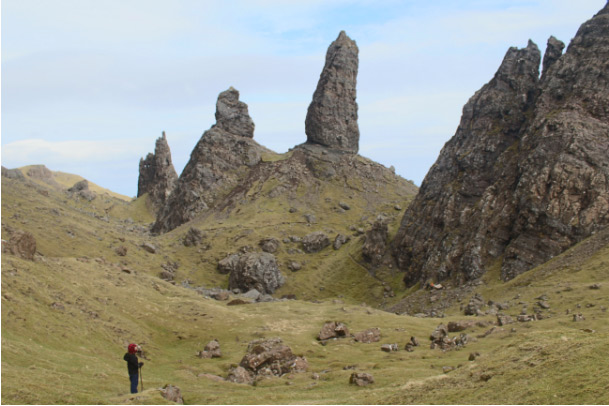
The Old Man of Storr
The Island of Skye is nearly always on peoples ‘bucket list’ and with good reason. The island is very large with so many different things to see its hard to know where to start. Dominated by the brooding ‘Black Cuillins’ a ragged mountain range that sits in its centre the island fans out to a number of peninsulas. All of them have spectacular views and hidden gems to explore but our favourite is the Trotternish peninsula.
Travelling north beyond Portree; the island’s main town a strange jagged ridge comes into view, this ridge features the Old Man of Storr, a giant rock tower that sits at an impossible angle near the rugged Storr cliffs. Further up the Quiraing extends the ridge line, the remnants of an ancient landslide of epic proportions. Walking through this area is like entering another world, the complexity of the landscape and broad vistas as you reach the ridge tops is quite simply astonishing.
What else is like this: In many ways it reminds me of Hadrian’s Wall (yes I know thats in England). Also the sea stacks of Orkney.
2. Glencoe and Rannoch Moor.
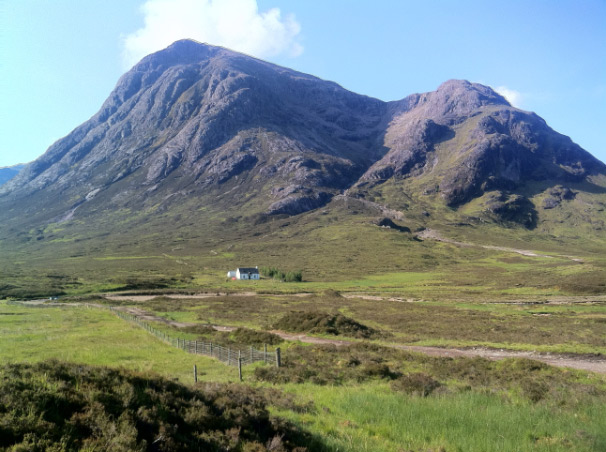
Glencoe
It would be impossible and indeed unforgivable to not include Glencoe in this list but I would extend it a little south to cover Rannoch Moor, an extraordinary landscape of bogland and small lochans that signal your approach to the glen as you venture north. The main road seems to float over the landscape and its hard not to find yourself trying to imagine what it must have felt like in the days before Thomas Telford build the first metalled road here as people picked their way through the moor. It must hold many dark secrets.
Then there is Glencoe. The majestic Buchaille Etive Mor stands guard at the entrance to the glen with her sister peaks lined up beside her, on the other side the Aonach Eagach ridge, the narrowest and most exposed ridge in Britain is a place not for the feint hearted. Handy parking places are scattered along the length of the glen, nearly always packed with tour busses and the odd bagpiper raking in the cash. The real rewards though, come when you take a step or two away from these busy lay byes and out into the glen itself. Despite its fearsome reputation in winter Glencoe has meny less challenging low level walks that get you away from the crowds and give you the space to contemplate life before the ‘quieting of the highlands’ and the tragic events that have been so linked to this place forever more. Caution and a sensible attitude (and footwear) of course goes without staying, this is a wild place that can claim lives in any season.
What else is like this: Scotland has many deep glens like Glencoe though few are so well known. Glenshiel with it towering 5 sisters comes to mind or for a more scaled down version Mennock and Enterkin passes in Dumfriesshire feels like a lowland rural equivalent.
3. The Border Abbeys
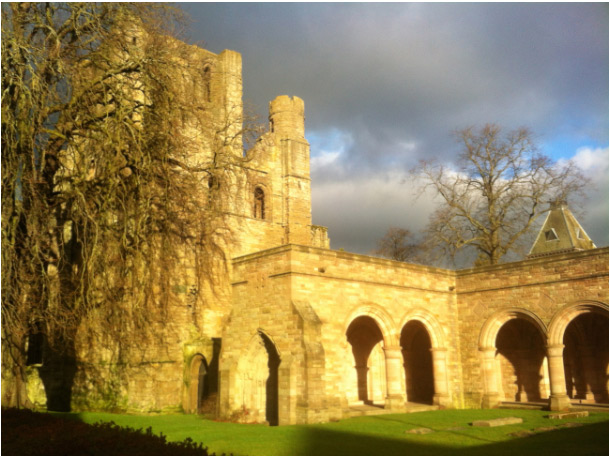
Kelso Abbey
The cluster of small border towns that nestle in the south east part of the Scottish borders feature a ring of magnificent ruined abbeys. In their heyday Monks from the Tironesian, Augustinian, Premonstratensian and Cistercian orders occupied these impressive buildings which became centres of learning and sat at the centre of many small communities. Inevitably though, sitting as they do in the heart of the sometimes lawless border region and with neighbouring England a few hours ride away the abbeys were partly destroyed, much of the damage being done during the ‘Rough wooing’ of King Henry VIII of England.
The violence of that time has long gone now and what is left of the abbeys are preserved as they were left all those centuries ago. Each has its own character and are peaceful places where you can sneak away from a busy market day and try to imagine the sounds of morning prayers being offered up in an echoing chapel.
For people of a fitter disposition it is possible to follow a 5 day walking route that takes in these wonderful buildings. The walk is not too challenging and gives you even more opportunity to explore this often missed part of Scotland.
What else is like this: Our own Holyrood Abbey in Edinburgh of course, Iona (featuring shortly) and Linlithgow Palace certainly have a similar feel in many ways.
4. Arisaig
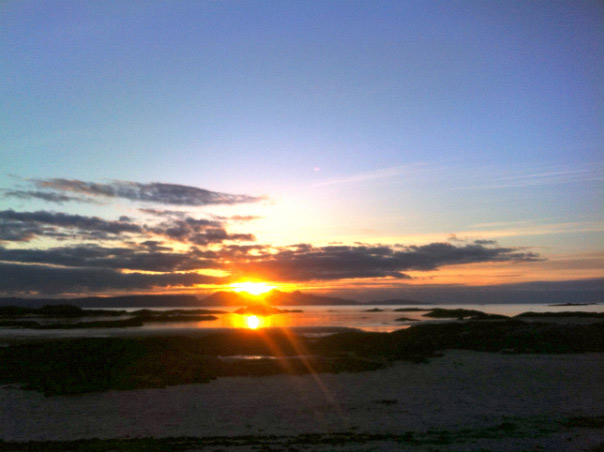
Arisiag at Sunset
As you take the route north to venture into the North West Highlands you hit the town of Fort William, spreading near the foot of Ben Nevis this busy town is an inevitable stop off for a quick snack and a stretch of the legs. Most travellers continue to the north towards Skye and Loch ness but just taking a left turn will lead you on a journey that rewards you with fantastic beaches, scenes from Harry Potter and romantic tales of Bonnie Prince Charlie. This road which was once a twisting and perilous single track is much improved, it takes in the Jacobite monument at Glenfinnan and an added bonus of a view from there of the Glenfinnan Viaduct a victorian marvel of railway engineering that will now forever be known as ‘the Harry Potter Bridge’. If you are very lucky you might catch the steam train that regularly travels this way on tourist trips puffing over the viaduct.
This was where the ‘Young Pretender’ (not the young wizard) first landed on the Scottish mainland in 1745, raised his standard and forever changed the covers of shortbread tins and tea towels, just a few minutes drive away loch Nan Uamh is where he set sail back to Europe a year later, his followers scattered in the highlands or buried in the mass graves at Culloden.
At the small village of Arisaig is what could only be described as a camper’s paradise, a collection of campsites sit along this stretch of coast set into grassy areas beside beaches with impossibly white sand. Its hard to compete with the feeling of settling down to a mug of tea or something stronger watching the waves on the shore as the sun sets over the islands of Rhum and Eigg. A sunset in Arisaig is not just a sunset, its gods own theatre, and he knows how to put on a good show!
For those who want to venture further though this route has one last gift to give, the Malliag ferry to Skye. An altogether gentler and more dignified way to reach our first destination on the list. As the ferry pulls out of Malliag harbour its inevitable that you catch yourself humming the Skye Boat Song to yourself.
What else is like this: The west coast and in particular the islands have incredible beaches, Tiree for example or Durness in the far north, The small island of Eriskay has the connection with Bonnie Prince Charlie too as of course does Culloden.
5. South Uist
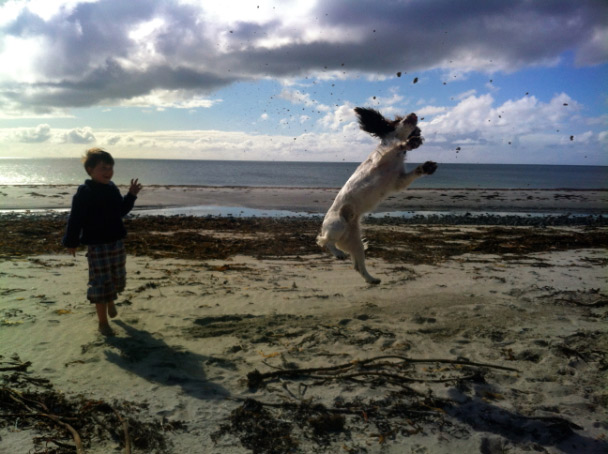
Happy Dog on South Uist!
The island of South Uist forms part of the Outer Hebrides (more of them to feature later). The island stretches from north to south linked by causeways to Benbecula and Eriskay. A modest range of low mountain peaks run like a spine down its east side and to the west is the legendary Machair. The Machair is a low lying coastal plain, formed by millennia of wind blown, calcium rich sand that forms a valuable fertile layer. The habitat is the fragile home to many species of birds and small crofting communities are scattered along the island’s east side.
There is something about the light here that feels like nowhere else on earth. There always seems to be some drama in the sky as another raincloud skids in over the Atlantic to the sound of oystercatchers and gulls.
This is an ancient place too – Settlers have been here since neolithic times and this is the only location in Britain where prehistoric mummies have been found. Looking at the ramshackle collection of little crofts you are reminded that now just as then the people who live here have a relationship with the land and pace of life that many of us would envy (in the summer at least).
What else is like this: Orkney and Shetland certainly have that feel of a link with the prehistoric past though the Machair is peculiar to the Outer Hebrides. also Barra and Vatersay just to the south and further on, the islands of Islay and Jura.
6. St Kilda
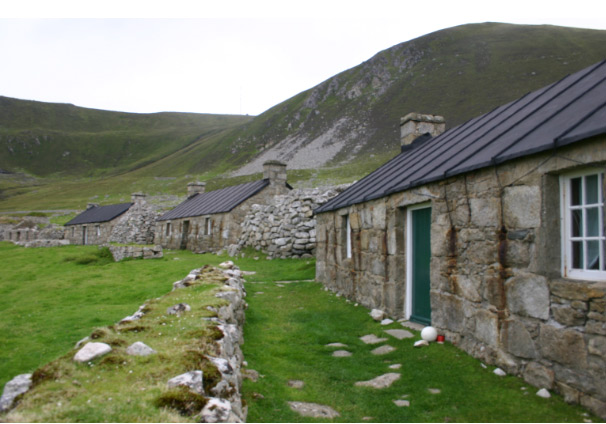
St Kilda
On 29 August 1930, 36 men women and children boarded a boat to the mainland from the island of St Kilda. Breaking a continuous period of settlement that had stretched back over two thousand years. These people were not evicted by harsh landlords, they had asked to be taken away to start a new life elsewhere. For them life in the most remote part of the British Isles had simply become too difficult.
Remote is too simple a word for St Kilda, just getting here is an adventure, and something of a hit and miss affair as the journey over rough seas is not always possible at all. Arriving at the small bay on Hirta, the main island in this small group is like arriving at the edge of the world, the deafening sounds of Gannets, Fulmars and Skuas fills the air and the island itself seems to rise out of the sea to meet you, one second there, one second disappearing as the boat lurches between the waves. As you step onto the shore you step back in time to the moment those last settlers left the island behind. The village street still stands as if trapped in amber, the remains of centuries of island life lie scattered up the hill side.
If you want to come to Scotland and get the feeling of being totally alone try spending a few days here with just the mice for company (and the army personnel who man a nearby base but thankfully never leave their quarters). There is a peculiar feeling to standing on the shore watching the tiny boat head back out into the open sea wondering if it really will be ‘back on Wednesday’ as promised.
Where else is like this: The Monach Islands off the coast of Uist were also until lately inhabited and North Rona is another remote destination. There are also a number of clearance villages such as Bororaig in skye and near Tongue in Sutherland.
7. The Isle of Lewis.
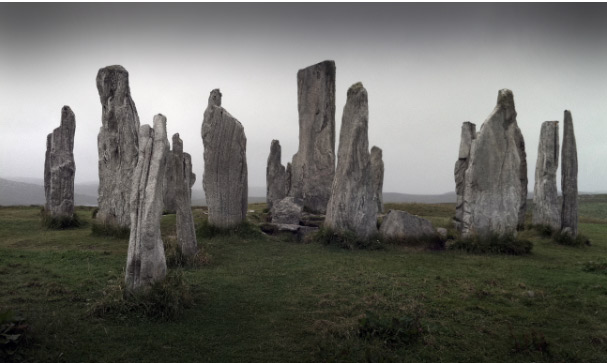
Callanish Standing Stones – Lewis
A few years ago I was on a flight back from Iceland on a clear summer evening. The flight path took us over the Butt of Lewis and as first sights of ‘home’ go, its about as good as it gets (also see entry number 10). Lewis has become a popular destination recently thanks to Peter May’s ‘Black House’ trilogy of books, May’s infectious description of the landscape has also inspired an excellent coffee table photography book. A trip to Lewis inevitably begins with the long ferry journey from Ullapool to Stornoway, passing by the Summer Isles, the setting for the classic British horror movie ‘The Wicker Man. Stornoway is a bustling small town that has a bit of a frontier feel about it, its a bit rough round the edges and can be a bit wild of a Saturday night before the ‘sabbath’ calls a halt to all activity. But before you disappear off to explore the island, stop off at MacLeod’s Butchers and stock up on as much Black Pudding as you can sensibly carry.
The stand out feature of Lewis is the standing stones at Callanish. For nearly 5,000 years these remarkable stones have stood here. Academics still argue over their true purpose, partly as a burial site possibly as a calendar no one can really say for certain. Folk tales say that they were a family of giants who refused to convert to Christianity and Saint Kieran turned them to stone as punishment.
Like many parts of the west coast, Lewis has its fair share of incredible coastal landscapes with wide open beaches and stark cliffs. As you travel south from Stornoway towards the mountains of Harris you pass seemingly endless expanses of peat bog, stacks of freshly cut peat stacked up and drying ready for collection. The smell of peat smoke is the air is a reminder once again that this is a place where people work and live not just a toilet stop and cafe.
What else is like this: Again, Orkney springs to mind for its unrivalled collection of ancient artefacts (the only reason Orkney is not on our list is because we have yet to visit there and this is our personal list). Wick and Thurso in Caithness have a similar frontier feel about them that Stornaway does and the wetlands of Caithness and Sutherland are very much like the Interior of Lewis in some ways.
8. Iona
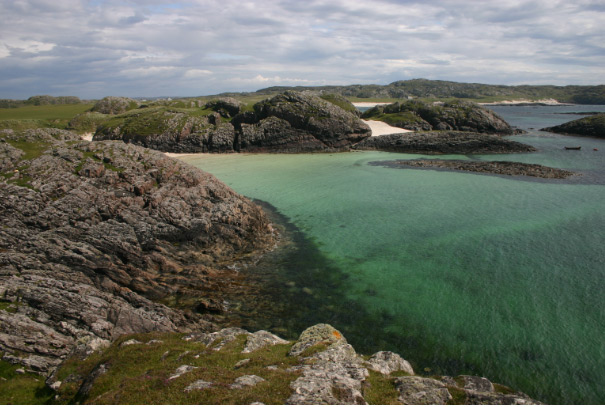
West Coast of Iona
Sometimes the beauty of a place is magnified by the effort it takes to get there. If thats the case then Iona must be one of the most beautiful places on earth! First of all you need to get to the island of Mull, that is either reached via a ferry from Oban or by a couple of smaller ferries and a long drive down towards Ardnamurchan. This is followed by a long drive down the Ross of Mull until you literally ‘run out of island’. From there a small ferry takes mostly foot passengers (theres is not much point in taking the car as theres not really anywhere to drive to) over the short hop to Iona. The famous abbey is immediately visible as you land in the tiny village that sits beside it.
Iona abbey is one of the most famous in Scotland. its by no means the largest and would be dwarfed by the Border abbeys though it is one of the best preserved. St Martins Cross is probably the most photographed and recognisable celtic cross there is and the abbey grounds have more than a few famous interments: Kenneth MacAlpine, Donald II, Malcolm I, Duncan I and Macbeth all lie here, as does the late Labour leader John Smith.
The island is tiny and can be walked round entirely in a day. If you chose to do this there is a good chance you will hardly spot a soul the whole time as pretty much all the tourists flock to the abbey. Their loss is your gain though, the island circuit takes in more sandy beaches on the north shore the rugged west coast with crustal clear waters and small secluded bays, a spouting cave and the remains of an abandoned marble quarry before returning back to the village for a well earned drink while you wait for the ferry back.
What else is like this: Right next to Iona is the small island of Erraid. its tidal so can easily be walked to. There is an incredible campsite at Fidden farm nearby too. Holy isle (in England,,, just) is also very similar and also Inchcolm Abbey in the Forth Estuary.
9. Plockton
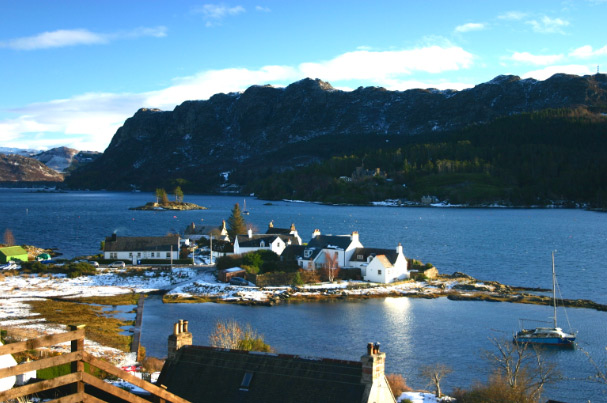
Plockton
The tiny village of Plockton sits at around the same line of latitude as Moscow, yet the little road around the bay is lined with palm trees! These are not made of plastic but thrive here thanks to a phenomena properly known as the Atlantic Conveyor though most of you know it as the Gulf Stream. a current of warmer water that runs North-East from the Gulf of Mexico makes landfall on Scotland’s north west coast leading to a far milder climate than we would expect. Before you pack your bermuda shorts and beach volleyball set though remember this is STILL Scotland.
The small village was a fishing community that sprung up in the 19th and 20th centuries in an attempt to slow down emigration from the highlands. The end result is possibly the most picturesque small village in Scotland. Just like Iona above, getting here is half the fun. There is the long drive skirting within touching distance of the Skye bridge and up the road to the ironically named ‘Stromferry (no ferry)’ , or you can take a more indirect route via Lochcarron, or you can treat yourself to one of the worlds greatest train journeys, travelling north to Inverness and then west via the tiny settlement of Achnasheen through some of the grandest majesty that the highlands can serve up, it might be a long journey but I really wouldn’t bother with a book unless its dark 
For those who like an element of terror on their days out then its not too far from Plockton to the small town of Applecross. The last half hour of your trip will be memorable as you wind up the notorious Bealach na Ba (the pass of the cattle) a single track road that twists steeply up an impossible looking slope before sliding down the other side. On the way back you can reward yourself with an early tea at the excellent seafood cafe at Kishorn, where the seafood is so fresh it answers you back.
What else is like this: Rothsay on the Isle of Bute is also known for its palm trees though its a much larger and busier town. The East Neuk of Fife also has a string of quaint fishing villages and Tobermory on Mull is also very picturesque.
10. Edinburgh
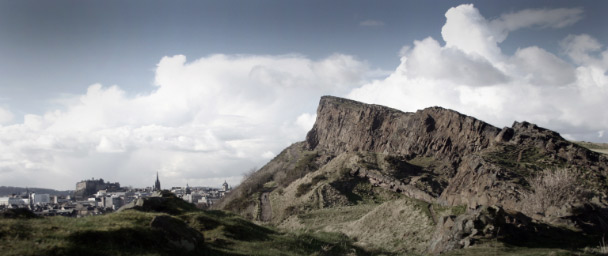
Salisbury Crags, Edinburgh
This comes as no surprise to anyone who knows us, after all its where we live. what can you say about Edinburgh that not already been said. Known as the Athens of the North the city has some of the most impressive architecture in the world covering the Middle ages, and Neo Classical eras in particular. Arriving in Edinburgh by train is one of the great tourist experiences of all time: As the train slips through the outskirts it could be anywhere in Britain, then the train dives into a long tunnel, for a moment you emerge to catch a glimpse of the castle rock and gardens before ducking under the art galleries on the mound and arriving in the station. If you have never been before (or even if its been a while) Then walk up the sloping roadway to emerge on Waverly Bridge. Ahead of you stands the impressive if rather rocket like structure of the Scott Monument, the Classical pillars of the National Gallery and Royal Scottish Academy and behind that Castle rock with the iconic Edinburgh Castle crowning the top. It really is one of the most impressive cityscapes in Europe if not the world.
Edinburgh is bursting to the point of overflowing with history and culture, the compact city centre makes most sites easily walkable (for those who can easily walk), you can take in an art gallery, loose yourself in a museum or scare yourself witless on one of the many ghost tours that run from the high street.
And if all that bustle is too much then in 15 minutes or so on foot you can find yourself at the bottom of the Royal Mile past Holyrood palace and into Holyrood park, Here you can leave the city behind and feel like you are back in the highland wildernesses that I’ve eulogised about above (in fact parts of Arthurs Seat in Holyrood park have been used to represent the wild highlands in film shoots). After half an hour or so of puffing you might find yourself on top of Arthurs seat or nearby Salisbury Crags giving you a reward of an incredible view over the city and down the east coast on one side and up to the Forth bridges on the other.
What else is like this: Glasgow’s west end is for Victorian architecture what Edinburgh is for Georgian. Stirling has its castle too and is handy for Wallace Monument and Bannockburn, Inverness too is worth visiting if only for the beautiful Ness islands and Leakeys bookshop.
Well thats our personal top ten list for now. I’ve set a date in the Calendar to revisit this list same time next year and see what new places we have discovered by then…
Rodger and Amanda Moffet – Scotclans
The post Scotland’s Most Inspiring Places: A Personal View appeared first on ScotClans | Scottish Clans.
]]>The post Incredible Drone Videos of Grandfather Mountain Highland Games appeared first on ScotClans | Scottish Clans.
]]>The Opening Ceremony
2015 GMHG Torch Light Ceremony
The Parade of the Tartans
Massed Bands
2015 GMHG Kirkin’ of the Tartan
2015 GMHG Heavy Athletics
2015 GMHG Festival Teaser
The post Incredible Drone Videos of Grandfather Mountain Highland Games appeared first on ScotClans | Scottish Clans.
]]>The post You and Whose Army? The Story of the Atholl Highlanders appeared first on ScotClans | Scottish Clans.
]]>The Atholl Highlanders are Europe’s only legally recognised private army, although merely a ceremonial regiment and not officially part of the British Army they were awarded colours.

Atholl Highlanders at the 2009 Gathering
The Regiment evolved from the 77th Regiment of the Foot who were raised by the 4th Duke of Atholl in 1777 (not to be confused with an earlier 77th – Mongomeries Highlanders or a later one – the Middlesex Regiment) . This date will be familiar to any scholars of American history since this was a time when the Brits were quite busy attempting to deal with those pesky colonial types on that side of the Atlantic. They were also about to have their already full hands made even fuller by the French and Spanish jumping in too.
Enter the 77th! (sort of)
Unfortunately the regiment didn’t quite make it to the heart of the fighting. Formed as a relief regiment they spent most of their time over in Ireland waiting to be called into the fray. Under the conditions on which the men signed up they were supposed to serve for either three years or the duration of the war with America. In 1781 at the end of their term of service the men were all expecting to return home, however they were transported to England and marched down to Portsmouth ready to embark on a long sea voyage to the West Indies. This was too much for the men of the 77th who promptly mutinied and refused to go. Exasperated their commanders marched them back to Berwick and the regiment was disbanded in 1783, thus ended the less than glorious history of the 77th.
And that would have been the end of it had it not been for, of all people, the Earl of Eglington. In 1839 the Earl had been rather miffed that the year before Queen Victoria’s coronation had been a rather drab affair by normal standards and the traditional banquet had been cancelled after George IV’s coronation nosh up ended in most of the silverware going missing afterwards.
The Earl decided to put on a tournament at Elgington house in Ayrshire. This being the height of the Gothic revival the while thing was to include a medieval jousting competition. Alas this early forerunner of ‘The Gathering’ ran into several problems including the weather and the events own popularity which ended up with most of Ayrshire gridlocked.
Nevertheless one of the ideas planned for the tournament was for a ceremonial guard, The 6th Duke of Atholl, also Lord Glenlyon offered to supply this and the regiment was reborn as the Atholl Highlander’s. As a purely ceremonial guard the regiment performed several duties such as escorting Queen Victoria during her tour of Perthshire in 1844 and while a guest at Blair Castle.
In recognition of the service performed by the Highlanders, All local volunteers raised from around the estate the Queen agreed to award them with colours and this was presented by Lady Glenlyon.
The only private army in Europe have withstood the times and indeed are still there albeit 100 strong when many other famous Scottish Regiments have long since disappeared. Many of those who have volunteered with the regiment have seen active service elsewhere, for instance serving with other regiments during both world wars.
So if you ever get into a standup fight with the Duke of Atholl and feel tempted to utter the phrase ‘oh yeah, you and whose army?’ you might want to rethink that strategy.
The post You and Whose Army? The Story of the Atholl Highlanders appeared first on ScotClans | Scottish Clans.
]]>The post Edinburgh Zoo! appeared first on ScotClans | Scottish Clans.
]]>
On Wednesday 22nd July Edinburgh Zoo celebrated the 102nd anniversary of the day it first opened to the public. Going from strength to strength through the years the zoo has become Scotland’s second largest paid for tourist attraction, only being beaten by Edinburgh castle, and attracting over 600,000 visitors every year. This week we will be taking a look at this marvellous attractions history and a few of the things that make it so special….

The Beginning…
Before there was the zoo there was a charity that was behind the endeavour, the Royal Zoological Society of Scotland, founded in 1909 by Edinburgh lawyer, Thomas Hailing Gillespie and others. The Society’s first president was lawyer and politician Edward Theodore Salvesen, son of the Norwegian merchant Christian Salveson—a connection which would prove significant in later years.
Gillespie set out to build a zoological park and was inspired by the open design of Tierpark Hagenbeck in Hamburg and the New York Zoological Park. The design promoted a more spacious and natural environment for the animals, and stood in stark contrast to the steel cages typical of the menageries built during the Victorian era. All that was needed was a suitable site for the park and Gillespie hoped for a site that could shelter the park and therefore the animals from the cold north and east winds and luckily just such an area was available.
The society secured an option to purchase the 75-acre (30 ha) Corstorphine Hill House estate for £17,000. Unfortunately the society had a fair amount of trouble raising the necessary funds for the purchase and the option to buy was nearing expiry. An unlikely hero came to the rescue in the form of Edinburgh City Council, who purchased the site outright in February 1913. The zoological society was granted full use of the estate in return for a 4 percent annual repayment of the cost. This also meant the funds the society had raised could be put to good use building and stocking the park.
Town planner Patrick Geddes came on board to design the park following Gillespie’s vision of an open design. The Scottish National Zoological Park, as it was initially called, opened to the public with a large collection of gifted and borrowed animals on 22 July 1913, after only 15 weeks of work. The zoo still occupies very much the same area of land today, though the park has, and still is, being extensively redeveloped.
Early History
The Scottish National Zoological Park was opened to the public in 1913 and was incorporated by Royal Charter later that year. In 1948, following a visit by His Majesty King George VI, the Society was granted the privilege of adding the prefix ‘Royal’ to its name. It remains the only zoo with a Royal Charter in the United Kingdom.

Edinburgh Zoo’s long association with penguins began in January 1914, thanks to the zoological society’s connection with the Salvesen family, with the arrival of three king penguins from the Christian Salvesen whaling expedition which docked in Leith. These where the first penguins in the world to be seen outside of the south Atlantic, and the subsequent hatching of a king penguin chick in 1919 was the first penguin ever to be hatched in captivity. Penguins continued to arrive with whaling ships for years afterwards and even today penguins are closely associated with the zoo, as you can see by their logo.

In 1925 a tropical bird and reptile house was added, followed in 1927 by an aquarium and in 1929 an ape house. In 1930, the now famous, penguin pool was constructed, though it has since been rebuilt, in 1990, to include a new under water viewing area. In 1928 the Corstorphine Golf Club evacuated the 47 acres to the north of the estate, allowing the zoo to expand significantly and this new area was completed in 1937.
Hagenbeck’s modern zoo techniques proved effective, and Edinburgh quickly gained a reputation for its good animal conditions. 1934 saw the births in captivity of a sea lion and beaver, and in 1936 a baby chimpanzee followed. A litter of wolves was born in 1938, and soon afterwards the first orangutan to be born in Britain.
The War Years…
Edinburgh Zoo, like most of the Zoos in the UK during the war, was significantly affected even though they would not normally be considered a target. Bombs could fall at any time and the zoos housed animals that would be dangerous to the public if they should escape due to a damaged enclosure. Edinburgh Zoo was bombed twice during the Second World War, but remained mostly unharmed although it was reported that one of the bombs killed a giraffe. In 1941 the recently born wolves had to be euthanized, along with a collection of dangerous snakes in case more bombs hit the zoo and allowed them to escape.
Despite the war the zoo continued to grow, with land to the east being purchased in 1942 and construction of a lake beginning soon afterwards.
Following the War…
It was around 1950 that one of Edinburgh Zoos most famous traditions began, the penguin parade and it was all started by a mistake. One of the zookeepers who had been working in the penguin enclosure had left the gate open on their way out. The penguins followed the zookeeper out of the enclosure and around the park much to the delight of visitors, and from then on it became a regular occurrence up to today, when it occurs every afternoon. The birds have even paraded along Princes Street in 1955 and at the Royal Highland Show for the Queen in 1960. It’s interesting to note that the penguin parade is run on an entirely voluntary basis. The penguins are not encouraged to take part with food or other tricks.

One of the zoo’s famous inhabitants during the post-war period was Voytek, a Syrian brown bear and a member of the Polish army. During the Second World War, Voytek was sold to a group of Polish soldiers who taught him to carry crates of ammunition, and took him in as an unofficial mascot. In 1944 when the Polish II Corps where to sail to Italy along with the British 8th Army, Voytek had to be officially drafted into the Polish army in order to secure him passage on a British transport ship.


The II Corps were demobilised in 1946 and ended up settling in Winfield Camp near Hutton, Berwickshire, Scotland. Voytek retired to Edinburgh Zoo in 1947 and lived there until his death in 1963. During his time in the army Voytek had developed a liking for cigarettes, and this may have contributed to his popularity as an attraction at the zoo.
In 1972 the zoo gained yet more military credentials when king penguin Nils Olav was adopted by the Norwegian King’s Guard. Norway’s connection with Edinburgh’s penguins began with the Salvesen family’s links to the zoo, and renewed interest was sparked when a lieutenant called Nils Egelien visited the zoo with the King’s Guard in 1961. On his return in 1972 Egelien arranged for the unit to adopt one of the penguins. Nils Olav was named after Egelien and in honour of King Olav V of Norway, and given the rank of lance corporal. He died in 1987 and his successor, Nils Olav II, inherited his rank. Nils was visited by the Norwegian King’s Guard on 15 August 2008 and awarded a knighthood. The honour was approved by the King of Norway, King Harald V. During the ceremony a crowd of several hundred people joined the 130 guardsmen at the zoo to hear a citation from King Harald the Fifth of Norway read out, which described Nils as a penguin “in every way qualified to receive the honour and dignity of knighthood”.

Three-year-old polar bear Mercedes was given to the zoo in 1984, after she was rescued in Churchill, Manitoba, Canada. She had begun wandering into the town in search of food. Because of the danger she posed to residents, Mercedes was tagged with a number so she could be tracked. When she could not be persuaded to return to the wild, a decision was taken to shoot her. A member of the Edinburgh Zoological Society collaborated with a cousin in Canada and they were able to rescue Mercedes, finding her a new home at Edinburgh zoo. The bear would become one of the zoo’s most popular attractions.
The Modern Day…
In October 1999 the zoo had begun to explore the possibility of relocating in order to improve its facilities as there was limited room for expansion in the current site. As of February 2000 the zoo had scrapped its plans to relocate, instead announcing a “masterplan” for the redevelopment of the entire site, which continues to today.
The foot-and-mouth scare of 2001 forced the zoo to close to protect the animals from possible infection. Since the zoo could not welcome any visitors, it faced significant financial losses. Questions were posed about the zoo’s future, though in the end the park was able to reopen after only five weeks. The generosity of a former resident of the city was a huge help to the zoo in this difficult time, as in early April they donated £1.9 million just as the zoo reopened.
In 2005 the new Budongo chimp house was unveiled, along with the Living Links to Human Evolution Centre, Britain’s first primate behaviour research site. Named after the Budongo Forest in Uganda, the Budongo Trail is a state-of-the-art facility that houses a troop of common chimpanzees. The main building features viewing galleries, a lecture theatre and interactive games and displays that are designed to teach the public about chimpanzees and their lifestyle, social structure and what threats they face in the wild. The Living Links centre is an area built around a field station and research centre for the study of primate behaviour. The exhibit also features enclosures housing common squirrel monkeys and brown capuchin monkey. In a scientific breakthrough in 2006 chimpanzees at Edinburgh were found to use word-like vocal labels for food.

In 2011, two giant pandas, a male named Yáng Guāng (陽光, meaning “sunshine”) and a female named Tián Tián (甜甜, meaning “sweetie”), were leased by Edinburgh Zoo from the Bifengxia Breeding Centre in China at a cost of $1m a year. An enclosure was constructed especially for the pandas. Both pandas have identical, but separate indoor and outdoor enclosures as giant pandas are entirely solitary animals that only meet during breeding season once a year. The outdoor enclosures feature tree trunks for the pandas to scratch against and climb; large wooden climbing frames and tree houses; caves and ponds. The indoor enclosures, where they often choose to sleep, include raised wooden platforms and hammocks. They will remain at the zoo for a maximum of ten years before being returned to China. Edinburgh Zoo is currently the only zoo in the United Kingdom that houses giant pandas.

Edinburgh Zoo is home to the only four koalas in the UK, Goonaroo, Yabbra, Alinga and the newest arrival, Yoonarah, who was the first koala born in the UK. The koalas are part of the European Breeding Programme. Edinburgh Zoo is the European ‘holding facility’ for male koalas that are either too young to breed or have successfully bred and are now “retired”.

Edinburgh Zoo has recently opened two very unique exhibits, the Wallaby Outback and the Lemur Walkthrough. Both are a new design which allows visitors to enter and follow a trail around the enclosure, getting closer to these species than ever before. Visitors enter via a double-gated entry system and can take a leisurely stroll on a looped pathway and although visitors will not have direct physical contact, the new walkthrough experiences immerse people in the enclosure, offering them an unrestricted view of the animals.

Edinburgh Zoo is now fully interactive on the internet with several live cam feeds, take a look at them below:
The post Edinburgh Zoo! appeared first on ScotClans | Scottish Clans.
]]>