The post The Flodden 500 Service at St Giles, Edinburgh. appeared first on ScotClans | Scottish Clans.
]]>I’d like to continue by reproducing Alaistair Moffat’s reading given at St Giles. It was an excellent account of the battle and the aftermath.
—
FLODDEN ADDRESS. – ALISTAIR MOFFATWhen dawn broke on the morning of 10th September, 1513, the landscape of hell was revealed. On the gently undulating northern ridges of Branxton Hill more than 10,000 men lay dead or dying. In the midst of the carnage were the naked, plundered bodies of King James IV of Scotland, his half-brother, Alexander Stewart, Archbishop of St Andrews, George Hepburn, Bishop of the Isles, two abbots, nine great earls of Scotland, fourteen lords of parliament, innumerable knights and noblemen of lesser degree and many thousands of farmers, ploughmen, weavers and burgesses. It was the appalling aftermath of the battle of Flodden, the greatest military disaster in Scotland’s history.In the grey light of that terrible dawn, sentries posted around the captured Scottish cannon could make out where the brunt of battle had been joined. Below them, at the foot of the slope ran the trickle of a nameless burn now choked with slaughter, a wrack of mangled bodies, broken pikeshafts, shattered shields and everywhere blood and the sickening stench of death, vomit and voided bowels. Not all of the bodies were yet corpses. Through a long dark night the battlefield had not been a silent graveyard. Trapped under lifeless comrades, crippled, hamstrung or horribly mutilated, fatally wounded men still breathed. Bladed weapons rarely kill outright and they were often used to bludgeon men to their knees or into unconsciousness. In the churned mud of the battlefield some men will have lost their footing, fallen and been hacked at before they could get up. Many bled to death, maimed, lacerated by vicious cuts, screaming, fainting and screaming once more in their death agonies. Some will have been put out of their misery by parties of English soldiers scouring the field by torchlight for plunder, stripping the bodies, ransacking them for valuables. But other men will have lingered on inunspeakable pain, praying to their God, passing in and out of consciousness, slowly bleeding to death. The fury of the battle on Flodden field may have been stilled and awash with death and defeat. But all was not yet over. In an instant the plunderers and scavengers looked up and the sentries by the cannon stood to, frantically peering through the morning light. They could hear the rumbling thunder of hoofbeats – and then, suddenly, riders erupted over Barelees Rig. With 800 horsemen at his back, Lord Alexander Home galloped hard across the horrors of the battlefield and up the slopes of Branxton Hill. They had not come back to Flodden to rejoin a lost battle but to rescue their captured ordnance. And they very nearly succeeded. After a sharp skirmish, the English gunners managed to load and get off a volley at Home’s squadron, and they scattered.And so it ended. As the Border horsemen wheeled round and raced out of range, the remnants of the shattered Scottish army were limping across the Tweed at Coldstream. There was no organised pursuit. The victorious English army had taken heavy casualties and the Earl of Surrey and his captains were exhausted. In any event, their bloody work was done. The floors o’ the Forest were a’ wede awa, Flodden was a national disaster, a harbinger of lawlessness in the shape of the Border Reivers, the beginning of a long period of political uncertainty and the last medieval battle in the history of Britain. The last time a king was to die leading his army.It was also an epic. As two huge armies mustered and marched into history, extraordinary scenes had been witnessed. At Ellemford, high in the Lammermuirs above Duns, where sheep now graze on the flanks of the hills, where buzzards hang in the updrafts and an elegant bridge crosses the Whiteadder, King James IV and his army camped. Huge guns were trundled down the hill trails, dragged by oxen, and by 21st August 1513, almost 30,000 men had massed in this beautiful, now lonely valley. Two days later, the largest force ever to leave Scotland crossed the Tweed at the fords below Coldstream. They had declared war, they had entered the realm of the Tudors, of the ferociously ambitious and bull-like Henry VIII.Meanwhile Thomas Howard, Earl of Surrey, and the Bishop of Durham carried the standard of St Cuthbert before their battle-hardened troops. In front of the high altar of the great cathedral, Howard had watched the bishop bless the flag of the Haliwerfolc. The lands of Palatinate, of the Prince-Bishops of Durham, reached to the Tweed and beyond, and in an early definition of Englishness, their people were known as the Holy Man’s Folk, the Haliwerfolc. Ancient allegiances were being roused and summoned.Between 2nd and 9th September two vast armies circled each other in a small corner of North Northumberland, like heavyweight boxers looking for weaknesses or waiting for wrong moves. After the Earl of Surrey had despatched a herald, the Rouge Croix, it was finally agreed that battle would be joined on 9th September. Supplies for almost 70,000 men, horses and camp followers were running dangerously lowand neither army could remain in the field much longer.Realising the strength of the Scots’ entrenched position, Surrey led his men to the east, skirting Flodden Edge and staying out of artillery range. On the morning of the appointed day, he crossed the River Till and took up a position to the north of James IV’s army, barring any retreat to Scotland. And then, on a damp afternoon, the greatest battle ever fought between England and Scotland began.On the left wing of the Scottish host, the Highlanders led by the Earl of Huntly massed in formation with Lord Home’s Borderers, and in the moments before their chiefs roared the claideamh mor, the order to charge, the Gaelic-speaking warriors did something remarkable. They began to summon the army of the dead. They began the sloinneadh, the naming of the names of memory. To bolster his courage, each man began to recite his genealogy. Many waiting to charge could go back 20 generations. As if they were offering up the murmur of prayer, each man remembered why he had come to fight. Is mise mac Iain, mac Ruaridh, mac Domhnuill. I am the son of John, the son of Roderick, the son of Donald. And once their quiet voices stilled, the roar of the claideamh mor rent the air and they broke into the charge. With their broadswords and Lochaber axes, the Highlanders tore into the English ranks, the division led by Edmund Howard, They scattered and a rout was only prevented when Lord Dacre rode to the rescue with his English Borderers. As history rumbled across Branxton Hill, fortune appeared to be smiling on the Scots.At the same time, James IV was about to make a catastrophic decision, a crucial error of judgement. Instead of occupying an elevated position at the rear of his vast army, he chose to lead from the front. His division raced down Branxton Hill and as they reached the lower slopes and much softer ground, many men began to skid and lose their footing. This unsteadiness made it very difficult for them to control their long, 12 foot pikes. The wet ground made them charge out of formation, only engaging piecemeal with the solidly planted ranks of English billmen, With their shorter, more easily handled bills, they began to slice into James IV’s division. And as the men at the back saw the Scottish pikes go down, they hesitated and many of them ran, believing their king to be killed. By leading from the front, James was immediately submerged in the ruck of the fighting, only able to see what was directly in front of him, in no position to direct his forces. The result was disaster.The legacy of Flodden was most immediately and keenly felt in the Borders. North of the Tweed the memory of the battle is kept alive in the fabric of the midsummer common ridings. At Selkirk the ceremony of the casting of the colours is unique in Britain and it is based on the return of a soldier known as Fletcher, traditionally believed to have been the only one of sixty from the town to return. In his bloodied hand he held aloft, in a gesture of desolate defiance, a flag captured from the men of Macclesfield in Cheshire. Many Englishmen had fought and fallen at Flodden. And passions still run high. When the Mayor of Macclesfield recently wrote to the Provost of Selkirk asking for the return of the flag, he was told that he would need to come to the Borders and take it.Flodden is an immense story. Like Culloden in 1746, it signalled the end of a fading, feudal Scotland. And it also ushered in a century of lawlessness, the criminal society controlled by the appalling Border Reivers. Across Europe, renaissance, enlightenment and the reformation were changing lives, forming new ideas and creating the institutions of the modern world. In the first half of the 16th century, central authority broke down in a leaderless nation, and while swords and spears spoke in Scotland, the law was often silent.What is to be learned from all of that suffering and slaughter, from all of those ancient enmities? First that they are ancient and must remain firmly in the past. In 2014 Scotland faces a historic choice and whichever way the people of Scotland vote, it must be a signal lesson of Flodden that enmity, even ancient enmity can have no part. And it is to the credit of politicians on all sides of the argument that it has not reared an ugly head. But it might.And alongside that it mustmbe important to remember, to understand the visceral, bloody realities of whatmwent on on that terrible day 500 years ago. Lest we forget, Flodden should become a place of remembrance and of pilgrimage, a place where the uncomfortable lessons of history can be learned and never forgotten.Two weeks ago, on one of the countless beautiful evenings of this glorious summer, I drove over to Branxton. As the sun threw long shadows across the gently undulating fields, I tried to imagine the 10th of September, 1513, the distant roar of thousands of men, the screams, the fear and feral closeness of hand-to-hand fighting whenmen can smell the breath, smell the sweat of men grunting pushing, hacking, swearing at them, trying to kill them. In a Gaelic phrase, I tried to listen for the music of the thing as it happened. I tried to listen to the slow, sad music of our history. I hope that many in Scotland and England hear it too.
Prior to the sir Malcolm MacGregor (who has admitted that try as he might he can not find a single MacGregor involved in the battle) researched the casualty lists. The following names are clans and families who are known to have fought at Flodden along with notable people who fell in the battle:
From the Highland Clans:
Campbell, Erskine, Fraser, Gordon, Graham, Guthrie, Haldane, Hay, Keith, Leslie, Lindsay, Macaulay, Macfarlane, Mackay, Maclean, Macnab, Menteith, Moncreiff, Moray, Murray, Ogilvy, Oliphant, Ramsay, Rattray, Ross, Ruthven, Seton, Sinclair, Stewart, Forbes, Forsyth, Grant, MacKenzie, MacNaughton, Ross, Skene, Buchanan Of Leny, MacDonald
The Lowland and Border Clans and Families:
Adair, Abercromby, Adam, Anstruther, Baillie, Baird, Balfour, Barclay, Blackadder, Bonar, Boswell, Carnegie, Cathcart, Cleland, Cockburn, Colville, Craig, Crauford, Crichton, Cunningham, Dunbar, Dundas, Edmonstone Of Duntreath, Elphinstone, Fotheringham, Gray, Grierson, Haig, St.Clair Of Roslin, Henderson, Hepburne, Herries, Home, Hoppringle, Houston, Lauder, Liddel, Lockhart, Lumsden, Lyon, Masterson, Maitland, Maule, Maxtone, Maxwell, Melville, Muirhead, Mure, Napier, Rollo, Sempill, Somerville, Spottiswood, Stewart Of Traquair, Allardice, Ballingall, Kerr, Colville, Crammond, Eliott, Ferguson, Fleming, Foreman (Standard Bearer), Inche, Inglis, Johnstone, Kirkcaldy, Knolis, Logan, Montgomery, Morton, Muir, Nelson Of Madinpap, Otterbrun, Pitcarin, Pringle, Reid, Rorison, Savage, Scott, Seton, Tunstall, Vallanche, Wood Of Raik, Kennedy, Douglas, Hamilton, Livingstone, Wemyss, Wallace, MacLellan, MacCulloch, MacDowall
Chief Or Notable Head Of House/Family
King James IV, Archbishop Of St.Andrews (King’s Son), Earl Of Morton ( Grandson Of James 1), Earl Of Glencairn, Douglas Of Drumlanrig, Sir James Dunbar, Dundas, Lord Elphinstone, Lord Erskine, Earl Of Huntly, Earl Of Montrose, Sir Alexander Guthrie, Haig Of Bemersyde, Haldane Of Gleneagles, Earl Of Errol, Earl Of Bothwell, Sir William Keith, Earl Of Cassilis, Earl Of Rothes, Earl Of Crawford, MacDowal, Earl Of Garthland, MacFarlane Of Arrochar, Hector MacLean Of Duart, Maxwell Lord Of Carlaverock, Sir John Moncreiffe Of That Ilk, Moray Of Abercairney, Ramsay Of Dalhousie, Rattray Of That Ilk, Rollo Of Duncrub, Master Of Ruthven, Lord Sempill, Lord Seton, Earl Of Caithness, Earl Of Atholl, Earl Of Lennox, Lord Darnley, Master Of Angus, Anstruther Of That Ilk, Ballingall Of That Ilk, Master Of Eliott, Lord Forbes, Master Of Lovat, Sir Alexander Gordon Of Lochinvar, Sir Alexander Gordon Of Knockenshene, Grant Of Freuchie, John Henderson Of Fordell, Lord Alexander Home, Sir Patrick Houston Of That Ilk, William Johnstone Of That Ilk, Lord Keith, Lord Lorn, Lyon (Sons Of Lord Glamis), MacKenzie Of Kintail, Sir Alexander MacNaughton Of That Ilk, Andrew Pitcairn Of Pitcairn And 7 Sons, Lord Ross, William Ruthven Of That Ilk, Sir Walter Scott Of Buccleuch, Alexander Skene Of That Ilk, Sir David Wemyss, Earl Of Argyll, Lord Kinnaird, Master Of Cathcart, MacDonald Of Lochalsh.
—–
 The St Giles Service…
Just over 40 clan chiefs attended the St Giles service. At the end of the service they mustered for a photograph on the steps. To help you identify who was there we have been given a sketch with a key to the names:
1. Sir Walter Riddell of Riddell 2. The Hon. Elizabeth Fairbairn 3. Madam Pauline Hunter of Hunterston 4. Sir David Bannerman of Elsick 5. Lord Polwarth 6. Andrew Wallace Younger of that Ilk 7. Andrew Dewar Durie of Durie CBE 8. Michael Ancram, Marquess of Lothian 9. Andrew MacThomas of Finegand 10. Earl of Dundee 11. David Campbell of Strachur 12. Roderick Macneil of Barra 13. Sir James McGrigor 14. Earl of Eglinton and Winton 15. Professor David Hannay of Kirkdale and of that Ilk 16. Henry Trotter Younger of Charterhall 17. John MacArthur of that Ilk 18. Duncan Paisley of Westerlea 19. Richard Carmichael of Carmichael 20. Earl of Caithness21. Earl of Lauderdale 22. The Hon. Alexander Leslie 23. Earl of Erroll 24. Lord Napier and Ettrick 25. Madam Arabella Kincaid of Kincaid 26. David Cranstoun of that Ilk 27. Jamie Macnab of Macnab 28. Earl of Wemyss and March 29. Sir Crispin Agnew of Lochnaw 30. The Hon. Kate Nicolson 31. Duke of Montrose 32. The Hon. Peregrine Moncreiffe of that Ilk 33. Martin Haldane of Gleneagles 34. Lord Sempill 35. Andrew Marjoribanks of that Ilk 36. Donald MacLaren of MacLaren 37. Duke of Hamilton 38. Field Marshal the Lord Guthrie of Craigiebank 39. Isla St Clair 40. Marquess of Ailsa 41. Madam Margaret Eliott of Redheugh 42. Sir Malcolm MacGregor of MacGregor 43. Lord Macdonald of Macdonald 44. Richard Oliphant of that Ilk
This image will help you identify the chiefs:

The post The Flodden 500 Service at St Giles, Edinburgh. appeared first on ScotClans | Scottish Clans.
]]>The post The Road to Dere Street appeared first on ScotClans | Scottish Clans.
]]> Just off the A68 on the outskirts of the Scottish Borders, a small sign points towards the remnants of an ancient highway. Known as Dere Street, the road was once a bustling hive of Roman (and later Medieval) activity that connected York with the Firth of Forth. You have to use a fair amount of imagination to picture the bustle – today the road is covered in quaint farmland, with wind turbines dotting the surrounding lowland countryside. On Saturday evening some friends and I undertook a trek to the street, following a glorious day complete with soaring temperatures in sunny Midlothian.
Dere Street was one of the main routes taken by the Romans on their quest to conquer present-day Scotland. Historians point towards the Flavian era of AD 77-86/90 as the road’s conception timeframe, roughly 25 years after the Romans conquered England in AD43. The extensive network of Roman roads throughout Britain at this time connected forts and garrisons across the country, with roads such as Dere venturing out into the northernmost frontier of the Roman Empire. Quarry pits alongside the remains of the road indicate that the Romans dug for gravel to use on the surface of the road.
Not long after the completion of the road the Romans abandoned the north of their new empire, building Hadrian’s Wall in AD 122. In her 2012 book Roman Camps in Scotland, historian Dr Rebecca Jones stated that Scotland hosted the largest number of Roman army camps in Europe, with many found recently by use of archaeological survey flights which hunt for distinctive marks in fields from structures buried beneath crops.
Dr Jones said:
‘For the first time we have a picture of the true extent of the Roman war machine in Scotland. The repeated campaigns to conquer Scotland were bloody, brutal and ultimately unsuccessful for the Roman Empire. They had to deal with tribes unwilling to be conquered, and strained resources, as soldiers were always needed to fight wars elsewhere throughout their vast Empire.’
Throughout Medieval times, the section of Dere Street between Jedburgh and Edinburgh became known as the Via Regia (royal way). The road connected the majority of Scotland with abbeys and other places of religious significance in the Borders. The section of Dere Street we visited was about 200 metres down the road from Soutra Aisle which hosts the remains of the House of the Holy Trinity church, hospital and Augustinian friary. Established in 1164 by Malcolm IV, the complex provided welcome respite for weary pilgrims traveling to and fro religious sites. The remains must measure no more than a double garage, however it’s believed that in it’s time it was the largest medieval hospital in Scotland occupying a walled area of 700m squared. Archeological work in the grounds surrounding the hospital have revealed evidence of rare medicinal seeds including Henbane, Hemlock, East-African cloves and Opium Poppy.

Soutra Aisle on a visit earlier in 2013.
Precariously positioned on the main route from Scotland to the English border, the church and road would have seen their fair share of desolation pass by during the Scottish Wars of Independence. The road became desolate and disused following The War of Rough Wooing and the Scottish Reformation, when many Borders abbeys were destroyed. It became primarily used for driving livestock, and as a passageway for the occasional traveler daring enough to venture into the lawless Border region. Soutra Aisle went on to become the burial vault of Clan Pringle of Soutra, which ultimately saved it from being completely destroyed.
Almost 2000 years after it was built, Dere Street provides the outline for many major roads in Scotland including the A68 and A1. Today the Soutra section of Dere lies buried behind the A68 in grazing land – the pilgrims, soldiers, royals and travelers who once used the road now a mere shadow of a time long gone.
The post The Road to Dere Street appeared first on ScotClans | Scottish Clans.
]]>The post Evil Laird Pringle and the Haunting of Buckholm Tower appeared first on ScotClans | Scottish Clans.
]]>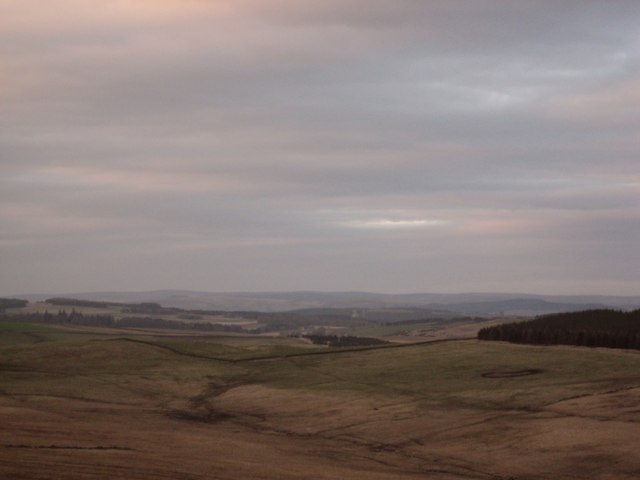
Ladhope Moor near to Buckholm
One evening in the 1680s, as the light was starting to fade and the colour of day drained away turning eveything to grey an ominous dark character can be seen striding over Ladhope Moor with two large dogs. He is seeking covenanters whom he is sure are holiding an assembly meeting somewhere nearby. His shiny black eyes search for tracks as he listens for signs as to where they are hiding. He knows they are there somewhere it’s just a matter of time before he finds them.
He is the renowned Laird Pringle of Buckholm Tower, an ardent Royalist, hater and torturer of covenanters.
His hunch as usual was correct and he finds evidence that this was indeed the spot which the covenanters had used. But it was deserted. They had recently, and in some rush, fled the scene; obviously they had be warned that he was closing in on them. Nearby Pringle spots the body of a man lying hurt on the ground , he recognises him straight away, it’s George Elliot, the well-known covenanter. He had been injured after being thrown from his horse. With him is his son William, who had stayed to look after him. Their faces full of fear watching helplessly as Pringle and his growling dogs approach.
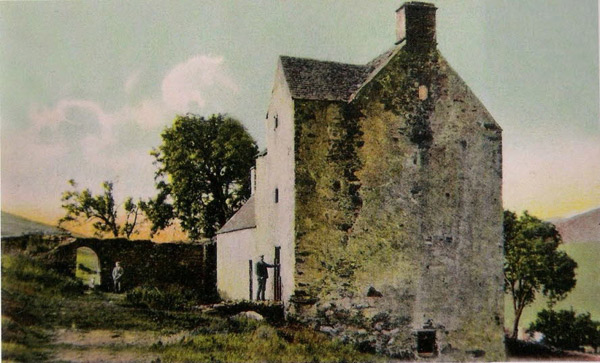
Buckholm Tower, Galashiels
Pringle was ordered not to kill the men on the spot but to take then captive overnight so they could be interrogated the next day. Pringle was furious with this descision. The pair were locked in the cellar of Buckholm. Later that night Pringle was roaring drunk and seething with anger at being made to do this. He wanted their blood, the kill should be his. His rage grew till he decided to take matters into his own hands and stormed the cellars. Pitch dark down the cellar – servants gathered upstairs peering into it to see what all the noise was hearing scuffling, then sreaming, then nothing …. silence.
Meanwhile the wife and mother of the prisoners – Isobel Elliot had arrived at Buckholm demanding to see the men and make sure they were being treated fairly. She knew of Laird Pringle’s blood lust and feared for their safety.
The Laird still covered in the blood of Geordie and William sees her approaching. He desperately wants her to witness the aftermath of his savagery, see what he’s done. He jumps out and drags her down the cellar. In a small pool of light the lifeless bodies of her husband and son hang from meat hooks. Their flesh torn and their bodies beaten to a bloody pulp.
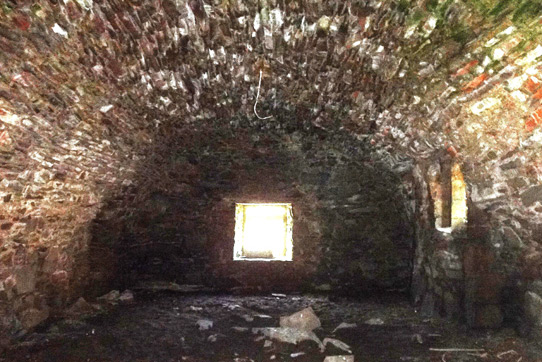
The cellar at Buckholm Tower
During the nights before the first anniversary of his death, the laird’s ghost was seen running towards the tower, with the baying cries of the hounds reverberating behind him. And on the night that he died and every June thereafter, cries and running footsteps were reported to be heard, not outside the tower, but from the depths of the cellar. Had his terrible deeds finally caught up with him?
In nearby Melrose Abbey graveyard stands a stone bearing the name George Pringle, aged 78 years.
The date of death on the headstone reads 5 March 1693, making it possible that this is the laird in question’s grave.
Buckholm Tower today is largely ruined, though the best preserved room is the cellar, where the iron hooks featured in the story can still be seen.
In 2005, paranormal research team Spectre carried out three investigations at Buckholm Tower. The team reported temperature changes, the sound of footsteps and recorded video footage of the iron hooks moving. They also claim to have taken an audio recording of an indistinct voice, and when they asked whether laird Pringle was present, the voice is believed to have said: “I had to” or “I hate you”.
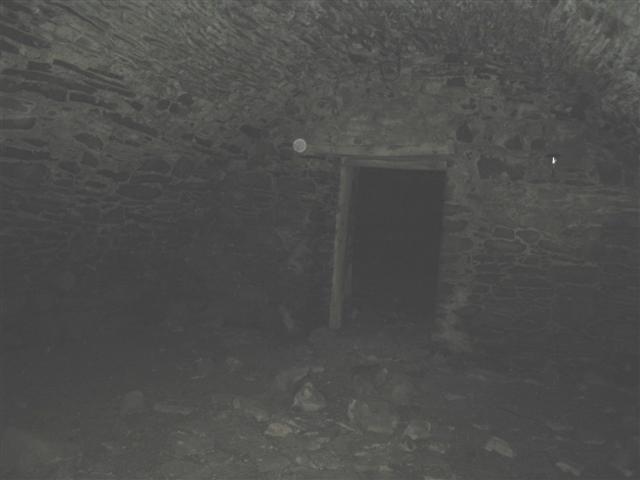
Orb photographed
Buckholm Tower remains a favourite among ghost hunters, many are convinced that something evil lurks in the remains of the tower’s cellar, even claiming that if you look closely you may see faint blood stains on the wall. Maybe the spilled blood of Geordie and William?
The post Evil Laird Pringle and the Haunting of Buckholm Tower appeared first on ScotClans | Scottish Clans.
]]>