The post The Vision of Dark Finlay and the Boy in the Snow appeared first on ScotClans | Scottish Clans.
]]>
The Valtos Peninsula, Isle of Lewis
The MacLeods of Pabbay kept some of their livestock on the fertile lands of the Valtos Peninsula on the Isle of Lewis. The animals would roam graze on the rich grass by the sandy shore. But this was the territory of the MacAulays, another powerful clan at the time.

Old Norman MacLeod, of Pabbay was a brother of the MacLeod clan chief, so carried some weight. Once Old Norman was looking upon his herdsmen as they drove a beast or two onto the boat they used to take livestock to and from the island. A large bull would sometimes be towed along to swim behind, on a calm day. At this time the herdsmen of the MacAulays were also on the shore. One of the MacAulay herdsmen noticed that one of their animals was being herded along with the MacLeod stock. At first he politely asked to see the earmarks, just to make sure. But Old Norman’s eyesight and hearing were not the best and he immediately grew defensive and then aggressive. The MacAulay herdsman had a hand on one horn of the beast and Old Norman MacLeod had his hand on the other. The MacAulay man gave the beast a yank and Old Norman got pulled over and fell to the ground. He arose howling in pain, his mouth full of blood. Two of his teeth had been knocked out.
Old Norman went home to bed, probably after a dram or two. His wife, a strong willed woman was furious, how dare someone accuse her family of being common cattle thieves. After her five sons returned home she demanded that they take revenge for this insult to their father. The strong young men took their longswords and their daggers and crossed the mainland while their father slept. The only light was that of the moon, the men divided themselves as they approached the MacAulay houses. Each house was struck, they targeted the young able men of the clan and slaughtered them as they awoke. The MacAulays were caught completely by surprise and were defenceless. When the light of the new day came up the extent of the massacre was discovered and the MacAulays had no idea why they had been attacked in such brutal way. There was not one able bodied young man of that extended family left alive, in Valtos.
But the brothers had not managed to slay every single MacAulay who could avenge their act. There was one of that family who had been taken away from Valtos, an orphan fostered out to a childless couple at Mealasta, further down the coast.
When Old Norman realised what his son’s had done, he was furious. Norman met with his brother, the chief, fearful that a never ending feud had begun, that would claim more and more lives. They agreed that his murderous sons had forfeited their rights to land and stock. The chief suggested one more thing, the MacAulay lad who had been fostered out to these poor people should be given a proper education. This would be a sign that the elder clan members were not implicated in the deed. The young MacAulay boy would also be taken into their own family and treated with respect. The chief decided that this was the only way to break the cycle of revenge and atone for what had happened.
The fostered boy was called John Roy MacAulay, he was taken into the MacLeod household and cared for while the murderous MacLeod sons had to make their own way in the world. John’s foster father at Mealasta was a man known as Dark Finlay, he truly loved John Roy like a son and was heartbroken at the parting. But he knew that the boy would have far more advantages in life going with the MacLeods, so let him go.
Old Norman doted on the growing lad. John Roy was taught to fish and to herd deer. Old Norman’s wife was bitter and resented the boy who seemed to her to be taking the place of their own sons. When the sons visited they took every chance to mock John Roy and were constantly playing cruel tricks on him. Meanwhile Dark Finlay would lie awake wondering how his foster-son was faring at the hands of the MacLeods.
Old Norman did his best and tried his hardest to make his sons see that the only way they could make amends for their hasty action was to show kindness to young John Roy but his sons weren’t listening. He urged them to take the lad along the next time they went hunting deer. The boy was already strong enough to run with them and could ride a horse and control hunting dogs with the best of them. He also had a keen eye and could use a bow and arrow.
So the brothers took him with them up over the hills beyond Mealasta to hunt deer. There was a small bothy they would usually use at shelter on these hunts. The young boy knew nothing of the history and was happy to be initiated, this hunt would be like a coming of age. Old Norman had them swear to look after him and not place him at risk.
They left with excited dogs and plenty of provisions. The route they took went by the home of Dark Finlay, the previous home of young John Roy. The day was bright but the wind had a chill which promised a flurry of snow. They stayed over night in the bothy with a peat fire to keep them warm, but the murderous sons hatched a plan to rid themselves of this boy who had replaced them. Snow as the wind had predicted fell during the night.
Dark Finlay at his simple house in Mealasta woke from his sleep. Looking out to see the snowfall, he had the strongest feeling that his foster son, John Roy was in danger. His wife urged him to return to the warmth of the bed but he couldn’t shake the feeling. He had the image of the young boy bound outside somewhere, freezing and alone. So strong was this vision that he got up and found warm clothes and skins then milked the cow for fresh, warm milk, then he set off into the frozen night. He was still a fit man for his age. When he came to the snow covered track he walked backwards to suggest to those seeing the footprints that they were coming from the other direction. At last, striding backwards, he came to the bothy. It was there he heard a faint cry. He found the pitiful scene, John Roy had been taken out and bound to a rock, with hardly any clothes on, the by was near death. No doubt the five brothers had planned to return with the story that the young lad had got separated in a blizzard.
Dark Finlay warmed the boy in the skins, the warm milk was placed to his lips to revive him. The the foster-father carried the boy over his shoulder and walked home, retracing the footsteps he had already made. He knew that these murderous young men would stop at nothing. It would seem from the footsteps that the young John Roy had escaped and fled, there would be no clue to where he had gone once the tracks faded under fresh snow fall.

Dark Finlay sought out Old Norman MacLeod. The old man was heart broken at the actions of his sons. They were cast out from MacLeod lands there and then, but both men knew that John Roy would not be safe. Together they arranged for him to be taken by sea to relations on the island of Mull. Here he would receive the best education and learn to speak other languages and to read and write.
John Roy did flourish on Mull, returning from time to time to visit Dark Finlay and his wife. The man who’s dreams and love had saved his life.
This epic tale of revenge is told across The Western Isles, passed on from generation to generation, by word of mouth. How much if anything is true, we will never know. There is a version of it in the Morrison manuscript which says that it was August 1460 when the MacLeod sons committed the massacre.
The post The Vision of Dark Finlay and the Boy in the Snow appeared first on ScotClans | Scottish Clans.
]]>The post 85th Anniversary of St Kilda being evacuated appeared first on ScotClans | Scottish Clans.
]]> August 29th is the 85th anniversary of the last people leaving St Kilda. For most people, St Kilda is remote and mysterious, a windswept outcrop in the North Atlantic which against all odds supported human habitation for more than 2,000 years (some say this is more like 4,000 years). This lonely island sits in the outermost reach of the Outer Hebrides, 110 miles off the west coast of Scotland. Cut-off by stormy seas for up to nine months of the year.

Location of St Kilda
The St Kildans had clung to their basic existence in almost unimaginable conditions in this remote part of the British Isles. Isolated and battered by a hostile climate, they survived largely by scaling sheer cliff faces to catch the plentiful gannets, fulmars and puffins, and farmed meagre crops.
The population decline began in 1852, when 36 people emigrated to Australia, many of them dying on the way. This is coincidental exactly the same number who were on this final boat departing St Kilda.
In 1912 there were acute food shortages and in 1913 an outbreak of influenza.
During the First World War a naval detachment arrived on St Kilda, resulting in regular deliveries of mail and food. But when these services were withdrawn at the end of the war feelings of isolation increased, leading to more emigration and a breakdown of the island economy.
But finally it was the death of one woman and child which was to prove the catalyst for the final 36 people on the island to leave, petitioning the government to come and remove them. This woman was Mary Gillies mother of Norman John who was one of two last surviving people who were born on the island, sadly he died 2 years ago. Norman leaves us with his memories from that time and his family stories which give us a unique insight into this final evacuation. Norman who was only 5 was on this final boat last 36 people evacuated from the island, bringing 2,000 years of habitation to an end.
Memories of leaving by Norman John (Tormod Ian in Gaelic)
Norman John (Tormod Ian in Gaelic) Gillies was born on May 22 1925 in House No 15 to John and Mary Gillies.

Norman Gillies as a baby on St Kilda with his mother Mary and father John (picture copyright Norman Gillies)

mary
Mary Gillies, was pregnant with Norman’s sister when she became gravely ill with appendicitis. Medical care was not available on the island so she was taken in rough seas by ship to hospital in Glasgow after a previous attempt to get her off St Kilda two weeks earlier had failed owing to bad weather.
“I recall her being taken off in a rowing boat with a shawl around her head”, says Mr Gillies. “I remember her waving to me as I stood near the pier and I was waving back. That was the last time I saw her.”
Mary Gillies died on 26 May 1930. The girl she had given birth to died the same day, just 13 days old.
For many years it was assumed that she had died of appendicitis, but her son Norman John Gillies discovered in 1991 that she had in fact died of pneumonia, having given birth to a daughter who also died.

Goodbye St Kilda
It was to be 60 years later, when an uncle died in 1990, and her birth certificate was found among other papers, that Mr Gillies realised he had had a little sister.
“It was just something the family didn’t talk about”, he says.
He adds: “My mother’s death showed the St Kildans the hopelessness of being on the island if someone took really ill.”
This was the final straw for the inhabitants of St Kilda.
His mother’s death had far-reaching consequences for the islanders. “They realised that they were in a hopeless position if anybody took really ill. That was one of the things. All households had to sign that they would leave St Kilda. That happened on 29 August, 1930,” said Mr Gillies.
“For the younger people it was an opportunity to do things which would help their entire lives. To the older inhabitants it was almost as if they had cut off their right hands, to have left their island home.”
On 29 August 1930, the remaining 36 inhabitants were removed to Morvern on the Scottish mainland at their own request.
In all, 36 men, women and children made the 12-hour crossing from Village Bay, with 28 coming ashore at Lochaline, in the Morvern peninsula, while others headed for Oban and on to Inverness, Portree, Fife or Stromeferry.

St. Kildans evacuating the island in 1930
The morning of the evacuation promised a perfect day. The sun rose out of a calm and sparkling sea and warmed the impassive cliffs of Oiseval. The sky was hopelessly blue and the sight of Hirta, green and pleasant as the island of so many careless dreams, made parting all the more difficult. Observing tradition the islanders left an open Bible and a small pile of oats in each house, locked all the doors and at 7 am boarded the Harebell. Although exhausted by the strain and hard work of the last few days, they were reported to have stayed cheerful throughout the operation. But as the long antler of Dun fell back onto the horizon and the familiar outline of the island grew faint, the severing of an ancient tie became a reality and the St Kildans gave way to tears.
At the age of five, the full significance of his first boat trip would not have been obvious to Norman John Gillies.
As he played hide-and-seek with other children on the deck of HMS Harebell, his family and neighbours sat waving goodbye to an island disappearing into the horizon, and to their very way of life.
At the time one resident described looking back from the ship and seeing their abandoned home resemble “an open grave”.
Two days before, the Dunara Castle tourist boat had taken off the sheep and cattle, which were sold. But working dogs were drowned in the bay, as they could not be taken on board.

Waving farewell
Awaiting them on the mainland was a new start after the trauma of leaving behind the ultimately impossible existence on St Kilda.
Norman’s cousin, Rachel Johnson, who is in a nursing home in Glasgow (I am not sure if she is still alive) – clearly recalls seeing the crowd of 200-300 gathered at the shore to see them arrive, as well as her first sighting of a car.
For Norman and his family, as well as other St Kildans, it was also the first time he had seen a tree as, ironically, as they had come to live and work on the Forestry Commission’s 7,000-acre Fiunary Forest. He says: “Looking back, the evacuation was a blessing in disguise. It gave the younger ones greater opportunities to do something with their lives that would not have been possible on St Kilda”.
The newly evacuated St Kildans joined a community of about 500 in Morvern, swapping their two-room cottages for slated, two-storey houses and running water. Although they were more scattered than they wanted, they were still largely together.
Norman, his father and grandmother all at first lived in a small, isolated cottage at Ardness overlooking the Sound of Mull. The cottage got flooded several times and, after complaining to the Scottish Secretary they finally were moved to Larachbeg, where there were other exiled St Kildans.
Morvern resident and historian Iain Thornber says the alien environment, while still remote, had considerably more amenities than St Kilda.
“In those days there were three post offices, providing six daily mail deliveries and collections a week, a doctor, district nurse, two shops, six schools and a public telephone system as well as a direct daily steamer link with Oban.
“Moreover, eight of the men were offered steady employment in the forest at a wage of 38 shillings (just under £2) per 45-hour week, in place of an annual income of around £30 in a good year on St Kilda.”
Mr Thornber saiys the St Kildan men were strong, hard-working people with a keen sense of direction and an in-built ability to predict the weather. They used semaphore, a technique they picked up from the sailors, to communicate with each other when in different work parties several miles apart.
They also showed their climbing skills, acquired from gathering seabirds, in one of their first tasks in planting trees on Aoinneadh Mor, a basalt ridge rising sharply to 1,500ft.
“None of the local forestry workers cared to go anywhere near the place saying it was too dangerous”, says Mr Thornber. “But the islanders, renowned for their cragmanship on some of the highest sea cliffs in Europe, just laughed and said the Aoinneadh Mor rocks were only ‘little hills’ by comparison, and got on with the work.”
He adds: “Although they came as strangers all these years ago, the St Kildans are remembered not so much for the forest they left behind, which still dominates the Morvern landscape, but for their friendliness, hospitality and remarkable way in which they adjusted to life in an unfamiliar land.”

Norman John Gillies was one of the last survivors from the evacuation of St Kilda.

Annie Gillies, Norman Gillies’ grandmother and ‘Queen of St Kilda. (picture copyright Norman Gillies)
The landowner Sir Reginald MacLeod of MacLeod (27th chief of the Scottish clan Clan MacLeod) received requests from other people to live there, but he declined.
He said at the time: “I’m sorry to lose a population that has down its generations been tenants of my family for 1,000 years. But they themselves have a right to go and I cannot blame them.
“I’m strongly opposed to the idea of resettlers. The present population signed a petition for removal which at great trouble and expense has now been carried out. In these circumstances it would be a folly to remove one lot of people who know the island and replace them with a group of strangers.” MacLeod of MacLeod sold the islands in 1931 to the Marquis of Bute, a keen ornithologist. He bequeathed them to The National Trust for Scotland (NTS) in 1957.
Norman returned to his homeland, St Kilda 75 years after its evacuation. He went with his family who were seeing St Kilda for the first time.
In his family home, he was able to trace out the walls of the bedrooms and point to the kitchen where his mother had cooked oatcakes, scones and puffins.
“It’s nice to come home to my little homeland,” he said.

Norman John Gillies: St Kilda evacuee who dedicated himself to preserving its memory
The post 85th Anniversary of St Kilda being evacuated appeared first on ScotClans | Scottish Clans.
]]>The post Top 5: Whisky of the Clans appeared first on ScotClans | Scottish Clans.
]]>1. Dalmore

Dalmore 12 Year Old Whisky
In 1263, an ancestor of Clan Mackenzie saved King Alexander III of Scotland from being gored by a stag whilst out hunting. The grateful King granted the Mackenzies the right to bear a stag’s head, with twelve points to its antlers, signifying a ‘Royal’ in their coat of arms. Today every bottle of the Dalmore single malt is adorned with the clan’s proud emblem. The distillery is located on the northern shores of the Firth of Cromarty overlooking the Black Isle, and was originally established in 1839 by Alexander Matheson, a trader who made his fortune in opium imports. The Mackenzie family bought the distillery in 1866 and have recently begun to use the Mackenzie motto of Luceo Non Uro (I shine, not burn) as the company’s philosophy. The Dalmore Single Highland Malt Collection is matured in a wooden casks (both sherry wood and American white oak) which, along with the years and the climate, contributes to the flavour of each malt.
2. Clan MacGregor

Clan MacGregor Blended Whisky
Clan MacGregor blended whisky takes its name from the highland clan, honouring one the descendents of ancient Celtic royalty as proclaimed in the motto ‘Royal is my Race’. The blend is made from 15 malt and grain whiskies from the heart of Scotland, blended to create a delicate, sweet aroma and smooth, mellow taste. The bottles proudly carry the Clan MacGregor badge and motto, and with his kind permission, the personal crest of the 24th Clan Chief, Sir Malcolm MacGregor of MacGregor. The Clan badge, a crowned lion’s head on a wreath encircled with a belt and buckle, signifies the unity and loyalty of the clan who suffered two centuries worth of oppression. It is enjoyed in over 60 countries around the world, from the USA to Venezuela and the Middle East to Thailand.
3. Talisker

Talisker 10 Year Old
My personal favourite, this wee gem of single malt is produced at the Talisker distillery on the shores of Loch Harport on the Isle of Skye. It’s the only distillery on the isle, with the distillery’s seaside home giving it a deep peaty character followed by a hint of sweet. The distillery was built in 1831 by brothers Hugh and Kenneth MacAskil after they acquired the lease of Talisker House from the chief of Clan MacLeod. When a new lease for the distillery was negotiated with the chief in 1892 the annual payment was to be £23.12s and a ten-gallon cask of best-quality Talisker. Today the single malt continues to be the preferred dram of clan chiefs – the MacNeil of Barra leases their seat of Kisimul Castle to Historic Scotland at a cost of £1 per annum and a bottle of Talisker. In 2007 Talisker 18 year old won ‘Best Single Malt in the World’ at the World Whiskies Awards and was one of three whiskies described by poet Robert Louis Stevenson as “The king o’ drinks, as I conceive it” in his poem The Scotsman’s Return From Abroad.
4. Clan Campbell

Clan Campbell Blended Whisky
While the link between this blended whisky and the actual clan is unclear, the whisky takes it names from the clan who have 14 million descendents around the globe. Clan Campbell is one of the largest clans in Scotland and renowned for its bravery and influence over the country’s history since the 13th century. The whisky is distilled, blended and aged in the Highlands, combining Scotch grain and malt whiskies that have aged in oak casks for at least three years. The present clan chief, Torquhil Ian, combines his duties as Duke or Argyll, chief and landowner with a consultant role with Pernod Ricard, promoting Scotch Whiskies including Chivas Regal and Glenlivet.
5. Drambuie and Glayva

Drambuie Liqueur

Glayva Liqueur
Technically not a Whisky, Drambuie is a sweet golden coloured liqueur made from malt whisky, honey, herbs and spices. Produced in Broxburn, West Lothian, Drambuie derives its name from the Gaelic phrase an dram buidheach, (the drink that satisfies). After the Battle of Culloden in 1746, Prince Charles Edward Stuart fled to the isle of Skye. There, he was given sanctuary by Captain John MacKinnon of Clan MacKinnon. According to family legend, after staying with the captain, the prince rewarded him with this prized drink recipe. This version of events is disputed by historians who believe it to be a story concocted to boost sales of the drink. The MacKinnon family produce the liqueur to this day. A similar liqueur is Glayva, produced in Leith since 1947. It made from a blend of aged Scotch whiskies, herbs, anise, cloves, almonds, heather honey, and citrus fruits. Legend has it that when Bonnie Prince Charlie was served a whisky based liqueur, he looked at his host, held up the glass and spoke the Gaelic “Gle mhath!”(very good) thus giving the drink the name it carries to this day.
The post Top 5: Whisky of the Clans appeared first on ScotClans | Scottish Clans.
]]>The post The Red Wedding and the Dwarf Assassin. Not ‘Game of Thrones’ But Everyday Clan Warfare appeared first on ScotClans | Scottish Clans.
]]>
The Red Wedding in Game of Thrones
The Island of Islay is a beautiful jewel in the inner Hebrides. A gentle low lying island of pastoral lands, expansive sandy beaches and more than a few whisky distilleries. The local population are among the friendliest you will ever meet so it seems surprising that such intrigue could play out in such an idyllic place. Read on…

Finlaggan
The Island was once the power base of the MacDonald Lords of the Isles. From their castle at Finlaggan the new lords were appointed and Islay was clan Donald’s spiritual home. However clan Donald had, to put it mildly, an uneasy relationship with the crown and in 1493 after various misdemeanours their lands had become forfeit.
Such was the extent of MacDonald lands that it took the crown accountants 20 years to take stock of all their estates. The estates were distributed among those loyal to the Scottish crown; mostly clan Campbell and the MacIan’s of Ardnamurchan, a branch of Clan Donald who were related to Campbell’s through marriage.
An area of Islay known as ‘The Rinns’, the part of the island running out to the north west that includes Port Charlotte and Portnehevan was granted to the MacLeans of Duart, a powerful clan from Mull. With so many large clans sharing such a small area it was inevitable that tensions would spill over, nevertheless an uneasy peace was maintained. but it wasn’t to last long…
In 1567 Angus MacDonald succeeded as chief of the MacDonalds of Islay. Angus had a bitter rival in the young Lachlan MacLean of Duart and when Lachlan came of age the authorities realised it was just a matter of time before matters would get out of hand. In an effort to spare bloodshed the king commanded that Angus was to marry Lachlan’s sister. By all accounts the marriage went as planned, however when Angus decided to go to Mull to visit the ‘in-laws’ things took a dramatic turn for the worse.
Despite the forfeiture of the Rinns, Angus had never officially signed the papers over to the MacLeans and they were determined to get their land. When the newlyweds arrived at Duart castle Angus was taken prisoner until he signed away his rights to the Rinns. Even after signing the deeds the MacLeans rightly mistrusted Angus and so kept his brother and his son James as hostages.
So having signed away a part of his clan’s spiritual home Angus and his wife returned to Islay. Angus though was determined that the MacLeans would not be enjoying their new territory any time soon but nevertheless kept his own council playing a much longer game. Eventually Lachlan in triumphant mood arrived on Islay to look over his new possessions. he brought with him 86 of his clansmen and the young James MacDonald as a token of conciliation. Angus welcomed them with a lavish banquet but mid way though the meal the mood turned suddenly very ugly and on Angus’ cue a horde of heavily armed MacDonald’s burst into the room and took the MacLeans captive.
News of the capture of Lachlan and his MacLean kinsmen made it’s way back to Mull. Terrible news for most of the clan but not so for Alan MacLean a rival to Lachlan’s chiefship and uses Lachlan’s absence as an opportunity. Realising it would be in his best interests if Lachlan never returned he leaked out a lie that Angus’ brother, still a captive at Duart had been put to death. Alan MacLeans subterfuge almost worked and Angus began to put to death two captives a day until all 86 had been executed – all that remained was Lachlan himself and Angus was on the way to watch his rival’s demise when news reached Islay that the story was false.By all accounts Lachlan’s neck was saved with minutes to spare.
Giving new meaning to the phrase ‘thats a bit awkward’ the MacDonald’s now had a fairly angry Lachlan as a captive they would much prefer not to have. Once again the Crown intervened and sent a Campbell representative to broker a hostage exchange and some peace. Peace however was not in the vocabulary of these two clans… As soon as Lachlan returned to Duart (and dealt with his scheming kinsman). He put together a raiding party to take revenge on Islay. Angus in return laid waste to settlements on Mull and Tiree. During another raid while Angus was mustering forces on the south of Kerrera, the party were ambushed by MacLean men and MacDonald of Sleat, Macleod of Lewis and and MacFee of Colonsay were all captured.
Once again the crown intervened and while most of the hostages were returned Angus MacDonald refuse to hand over his – as a result Angus was outlawed. As it was Lachlan was not much better at keeping his word and he too refused to return some of his captives. he had also been hatching his own particularly dark revenge…
in 1588 Macian of Ardnamurchan arranged to marry Lachlan’s mother. with the MacIan being a branch of clan Donald it was hoped that this marriage bond would help force a peace between them. This wasn’t Lachlan’s plan though… as the wedding festivities progressed Lachlan’s men stormed the reception and ordered all the MacDonalds present to be massacred. Only the bridegroom was spared.
Game of Thrones fans will be able to picture this scene well since the ‘red wedding’ is a pivotal moment in the series (the same events were played out with the Douglas Clan so its clearly not an uncommon occurrence) . This was not the end of Lachlan’s bloody crusade though and he then set off on a murder tour of a number of small islands including Rhum, Eigg, Muck and Canna. With assistance from some Spanish mercenaries who had survived the disastrous wrecks of the Spanish Armada they set about all but exterminating the population of these islands.
Angus’ revenge was taken out on the settlements of Mull and in this he was in turn assisted by English mercenaries. By 1589 the King had lost all patience with his warring subjects and both parties are summoned to Edinburgh.
On arrival both were arrested and held prisoner until they finally agree to behave. As a token of his willingness to comply Angus left his son James at the Royal court, the young man proved himself to be very popular and received a knighthood. And so peace descended on Islay again, but not for long. in 1592 a revolt of Scottish Nobles threatened the position of the King.
While he was otherwise occupied the MacLeans and MacDonalds saw the distraction as an opportunity to have another go at each other and war broke out again. This time it led to charges of treason being laid against both parties and this very serious threat calmed them both down. Now during all this time the Rinns of Islay (remember the Rinns?) had still never officially been handed over by the devious Angus so he agreed to make settlement including any arrears. Still, after 6 years of making promises Angus had still not officially made settlement so his son Sir James, now very much ‘in’ with the royal court decided to bring his father to book.
On James’ invitation Angus visited Cambletown, staying at Askomel House, James was lodged nearby. Angus and his son met and dined with each other with no hint of James’ plan. After one such meeting Angus returned to Askomel and was awakened in the night by some 300 men at James’ command , armed to the teeth and demanding that Angus give himself up. Angus understandably refused and so James decided to set light to the house with his mother and father inside. In making his escape though Angus is burned quite badly and ends up fleeing in only his nightshirt. James was cunning though and had set traps of felled logs around the grounds of the house and Angus tripped and fell and so was captured. He was then taken in chains to Dumbarton.
James returned to Edinburgh expecting a heroes welcome for finally taking care of his warmongering father but his over zealous methods didn’t go down at all well and such was the outrage that Angus had to be pardoned. James was now the outlaw and Angus got his revenge on his son 5 years later when he captured him on Islay, He was promptly delivered to the Campbells and taken to Perth to answer charges of fire raising and treason. Somehow though (and this does make you wonder about the level of security in the 16th century prison system) James managed to escape and fled back to Islay.
Now while all this in fighting has been going on Lachlan had been busy… Seeing his advantage Lachlan gathered a huge force with the aim of sending the MacDonalds to the afterlife once and for all. He sailed for Islay and the two sides squared up for battle at Traigh Ghruineart (Gruinard Bay) in August 1598.
As the MacLeans were preparing for battle Lachlan was approached by a dark skinned hunchback dwarf, the ‘Dubh Sith’ was half human and half fairy; his father being a Shaw from Jura and his mother from the other realm. This deformed dwarf offered the services of himself and his no doubt enchanted crossbow to Lachlan who laughed at him and considering himself to be far superior in numbers sent him on his way.
The dwarf hobbled off to the MacDonald camp and made the same offer to Sir James who gratefully accepted. The dwarf said to James ‘you take care of the rest of the MacLeans and I’ll take care of Lachlan’ and then promptly scurried away and climbed into nearby Rowan tree. And so battle commenced on a hot August day. During a lull in the fighting Lachlan was overcome with thirst and so went to a nearby stream, he removed his helmet and knelt down to drink – right in range of the lurking dwarf who with one shot of his crossbow found his target on the back of Lachlan’s neck – the point of the crossbow bolt exiting his eye and killing him instantly.
With Lachlan dead the MacLeans lost heart and fled the field. The MacDonald’s pursued them to a church at Kilnave and with the surviving MacLeans barricaded in the church the MacDonalds set light to the thatch roof of the church killing all inside. Except one. One man; a MacMhurich (clan Currie) was able to escape from the church and fled into Loch Gruinard. As the bloodthirsty MacDonalds searched the land he hid under the waters of the bay using a hollow reed to breath through.
The story goes that after dark he made his escape and was taken in by some locals and it is said that his descendants live in the village of Bowmore on Islay to this day.
And so what became of our principal characters in this dark play? Well Lachlan was dead and buried at Kilchoman, Angus grew old and died naturally on Rothsay. Sir James had a more troubled future though; when James VI became king of a united England and Scotland he was determined to put behind him the reputation of his warring barbaric Scottish ancestry and so set about ‘cleaning up’ the Scots nobility. James was brought to justice, his possessions forfeited and charged with treason. He was condemned to death but managed to escape in 1615 (prison security had still not improved). James fled to Spain until 1620 when the King decided to offer him a royal pardon. He was forbidden from returning to Scotland though so lived out his few remaining years in London.
Apologies for anyone expecting dragons to feature at some point but you can’t have everything!
The post The Red Wedding and the Dwarf Assassin. Not ‘Game of Thrones’ But Everyday Clan Warfare appeared first on ScotClans | Scottish Clans.
]]>The post Map Reveals Scots Modern-Day Surnames appeared first on ScotClans | Scottish Clans.
]]>
The Uncertainty of Identity project maps Great Britain’s most popular surnames by area.
A map of Great Britain’s most popular surnames shows the dominance that clan areas still hold in Scotland, while other areas show the effects of modern-day immigration. Created by experts from three English Universities, Uncertainty of Identity uses surnames listed on the electoral roll to find the three most popular names in each electoral ward.
Mackay and Sutherland are the most popular names in the North Highlands, echoing the ancient territories and stronghold of the clans. Mackenzie, Fraser and Ross are the most popular in the area North of Inverness, while MacLeod and MacDonald dominate the Western Isles – data that directly corresponds with clan territory maps.
In the Northern Isles Halcrow, Drever and Flett survive as the third most common surnames, while Shetland still boasts a diverse mix of Spences, Rendalls and Sinclairs. Carole Hough, professor of onomastics – the study of name origins – at Glasgow University, said the surnames of Orkney and Shetland differ from much of mainland Scotland due to naming traditions.
“Shetland and Orkney are unique in that they have a much higher proportion of surnames from local place names, which makes them quite distinctive. Place names tend to cluster around their origin, which is surprising given how mobile people are,” she added
The English derived surname Smith is the most dominant across the whole of Great Britain with a considerable stronghold in the lowlands and east of Scotland. Modern-day immigration shows in areas such a Glasgow’s Pollokshield’s East, with Ahmed, Ali and Singh popular surnames. Jones, Davies and Williams dominate in Wales.
Looking to the future, a resurgence in the popularity of traditional Scottish forenames in recent years is likely to combat Anglicisation, said Hough.
“Far more Gaelic and Celtic-derived personal names are being chosen by parents in Scotland, which can be a way of affirming national identity,” she says. “Gaelic-derived forenames that are in the top 100 names in Scotland at the moment include Aiden, Callum and Finlay. Cameron is originally a clan name, and Lewis, Evan and Isla are all place names.”
You can view a map of Scotland’s most popular surnames at Tartan Footprint.
The post Map Reveals Scots Modern-Day Surnames appeared first on ScotClans | Scottish Clans.
]]>The post From Norway with Love appeared first on ScotClans | Scottish Clans.
]]>
The Nidelva River, with Nidaros Cathedral in the background. Trondheim, Norway.
When asked to give the name of his nearest mainline rail station on a Parliamentary expenses questionnaire, former liberal MP for Orkney Jo Grimond gave his reply as Bergen, Norway. This facetious response turned out to be correct, as Bergen’s rail station is situated 340km from the Orkney constituency, compared with the Highland Main Line station at Inverness 420km away. This geographical closeness between Norway and Scotland has provided the grounds for a lasting relationship between the two countries, with Scandinavian culture and language leaving an indelible mark upon Scotland.
From about the 8th century onwards, the North Sea was awash with Vikings, setting sail by longship on their infamous plundering invasions. Initially attracted by gold and treasures held within monasteries in the north of Scotland, Vikings could reach the Islands of Shetland in less than 24 hours by longship under good seafaring conditions. Over the centuries, Hebrides and Caithness would come under Norse rule, with Orkney and the Shetlands remaining Norwegian earldoms until 1468. Nowhere is Norwegian influence more prevalent than in the northern isles, with almost half of all people on Shetland and 30% on Orkney claiming Viking ancestry.
These days the longships have been swapped for short-haul planes, as direct flights operate between Edinburgh and Oslo. I’m writing this blog entry from Trondheim, Norway’s ancient capital. It’s a beautiful little town about a third of the way up Norway; with continuous streets of wooden houses painted in an array of different colours, Gothic architecture intertwined with modernity and innovation, and of course, snow covering everything. The city was founded in 997 as a trading post by Viking King Olav Tryggvasson, and remained the capital throughout the Viking age until 1217. The magnificent Nidaros Cathedral is located in the middle of the city, and at over 1000 years old has an impressive history, changing religious hands from Catholic to Lutheran during the protestant reformation in 1537.
My Norwegian essentially consists of one word – ‘takk’, so while watching a film last night with Norwegian subtitles I was trying to match up the words as I saw them on screen with what I could hear. I came across the Norwegian word for toddler – ‘barn’, which I thought resembled the Scots word ‘bairn’. Turns out ‘bairn’ is a direct derivative of Old Norse, along with many other Scots words including midden (rubbish dump), muckle (large) and even kilt, from the verb ‘kjalta’ (to fold).
Scandinavian heritage is also evident amongst Clans, with some being able to trace their roots back to Norse Kings. Clan MacLeod and Clan MacLeod of Lewis claim their descent from Leòd, who lived in the 13th Century. It was thought that Leòd was a son of Olaf the Black, the Viking sea-king who ruled the Isle of Mann. However this genealogy has been contested, with articles recently published in the MacLeod Clan magazine suggesting that Leòd was in fact a distant cousin of Magnus, the Last King of Mann. The name Leod is the anglicised version of the Gaelic name Leòd, which is thought to have derived from the Old Norse name Ljótr, meaning ugly. Mac is the Gaelic word for son, therefore MacLeod stands for Son of Leod. Clan Gunn in the North and Clan MacDonald of the Isles can also trace their lineage to Norse descendents.
Cultural similarities also exist in modern times, with each country sharing an interest in gloomy, gritty crime drama. The success of Norwegian detective writers like Jo Nesbø and Karin Fossum echoes that of the ‘Tartan Noir’ writers including Ian Rankin, Val McDermid and William McIlvanney. In an interview with the BBC, Ian Rankin suggested that the similarities in each countries fiction hint at something deep rooted in the national characteristic. “In countries where it’s dark half the year, you do tend to have a great tradition of storytelling … Both sides tend to share quite a dark view of the human condition, and are certainly a long way from the Agatha Christie school of crime writing.”
One thing that isn’t so similar is the price of living, in particular alcohol. On my first night here I was mortified when I went to pay for one bottle of beer, at almost £14 a pop. Punitive taxes placed on alcohol by the Government, combined with the strength of the Krone make for very expensive nights out.
—
You can read more about the return of Orkney and Shetland to Scotland here
The post From Norway with Love appeared first on ScotClans | Scottish Clans.
]]>The post The Wars of the One Eyed Woman appeared first on ScotClans | Scottish Clans.
]]>
 In the western isles of Scotland two great clans were locked in a long running feud. The MacLeod’s who occupied parts of Skye and Harris and their neighbouring MacDonalds from Skye and Uist. Over centuries the two clans had a number of pitched battles as dominance of the area swung to and fro. These ‘tit for tat’ atrocities had reached a head 23 years earlier when almost the entire MacDonald population of the island of Eigg were wiped out by the MacLeods. A reprisal attack was launched by the MacDonald men a few years later at Trumpan church on Skye, the church full of worshiping MacLeods was barricaded and set alight killing all inside but not before one girl mortally wounded managed to raise the alarm. The MacLeods rose up and pursued the MacDonald perpetrators and killed them all at Ardmore bay. The bodies were buried in a turf dyke and so this battle became known as ‘the battle of the spoiling of the dyke’.
Both sides realised that this could not go on. and so some attempt was made to broker a peace between the two warring clans. Unfortunately this would end up making matters a whole lot worse!
Around 1600 a ‘Romeo and Juliet’ style romance blossomed between the Margaret, sister of the chief of the MacLeods and Donald Gorm Mor MacDonald the son of the MacDonald chief. surely such a match would see an end to war between the clans? err not exactly!
It was tradition in the highlands that a form of marriage contract called ‘hand fasting’ could be entered into. This contract was in all respects similar to marriage except that it could have certain ‘conditions’ that could be agreed beforehand, in this instance that Margaret would produce a male heir. Unfortunately for Margaret and Donald a son was not forthcoming and to make matters worse Margaret somehow managed to loose sight in one eye during the first year of the handfasting.
Donald was now intent on ending his contract with Margaret and so his father decided to send her home to Skye. Unfortunately the old chief had never forgotten the old feud and could not resist the opportunity to stir things up again. Margaret was landed back on skye and sent to Dunvegan sitting backwards on a one eyed horse, accompanied by a one eyed servant and a one eyed dog. This had the desired effect of enraging Rory, the MacLeod chief and war was back on again.
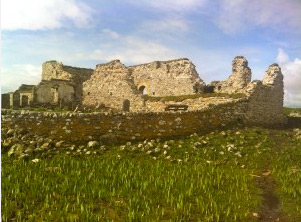
Trinity Temple, North Uist
Rory sent his cousin, Donald Glas MacLeod along with a party of 40 men over to the island of North Uist to exact revenge and raid the land taking any livestock they could lay hands on. The locals had been warned of the approaching MacLeods and had gathered up any goods they had and stored them at the Trinity Temple and Carinish. The Macleods soon found out and headed there, breaking the sanctity of the temple in doing so. The MacLeods now camped out there were were surprised by twelve MacDonalds led by Donald MacIain ‘ic Sheumais (Donald, son of John, son of James) of Clan Ranald. Clearly outnumbering the MacDonalds the MacLeod men pursued them but this had been a carefully planned ambush drawing them into open ground. A fierce battle ensued which by all accounts lasted most of the day. At one point the leaders of both forces faced each other and all other fighting stopped as Donald Glas and Donald MacIan traded sword blows, neither giving an inch of ground. This fight carried on for some time, many MacLeods had already been killed and those observing this titan battle were mostly Macdonalds. On seeing that their leader was gradually loosing ground to MacLeod some of them rushed in to assist. MacLeod was said to have killed two of them instantly but another landed a sword blow which mortally wounded him.
Donald MacIan survived the engagement but had received an arrow in the foot during the battle and his foster mother removed the arrow, tradition has it that she sang a song to drown out his cries of pain, the translation from the Gaelic was:
Son in Iain, my Darling
Soon you heard the wailing
You saved the shore on the paling day
You struck terror into the seed of the stallion (Macleod)
The seed of the white faced lame mare
The result was a victory for the MacDonalds but at a high cost and with the entire party of MacLeods wiped out the bodies littered the small field, the nearby ‘Feith na Fala’ or ‘Ditch of Blood’ attests to this.
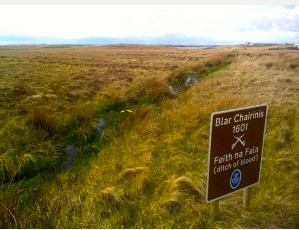
The Ditch of Blood
This has been said to be the last battle fought in Scotland using only traditional weapons (swords and arrows) but it wasn’t the end of the feud, later that year the MacDonalds headed for Skye. They raided the north of the island, driving cattle down towards Glen Brittle. The Macleods who had been busy attempting to get support from Campbell of Argyll against the MacDonalds were surprised but pursued their enemy to Coire Na Creiche. Rory MacLeod’s brother Alastair led the attack on the MacDonalds and this battle lasted for a day and well into the night. Alas it did not go well for the MacLeods who were defeated once again by the MacDonalds with 30 MacLeods including Alastair being taken prisoner.
For Scotland’s Privy council though this had gone too far and they decided to intervene. Both leaders were ordered to surrender; MacDonald to Gordon of Huntly and MacLeod to Campbell of Argyll. Both sides agreed to release their prisoners and call an end to all hostility. Peace between the clans was celebrated with a party at Dunvegan castle that lasted 3 weeks and since then (more or less) The MacLeods and MacDonalds have lived together peacefully!
The post The Wars of the One Eyed Woman appeared first on ScotClans | Scottish Clans.
]]>The post The Beaches of Arisaig – Sunset Capital of Britain? appeared first on ScotClans | Scottish Clans.
]]>
The Glenfinnan Monument
This is a sleepy part of Scotland; nothing happens in much of a hurry here and the pace of life is delightful. As you drive up this winding coastline you are taken aback by the breathtaking beaches, some of the best on mainland Britain with pure white sand and a scattering of small rocky islands. This beauty has not gone unnoticed by everyone and every little cove seems to shelter a campsite of caravan park. There are literally dozens along this stretch, so close together they almost join into a single ribbon of white fibreglass and coloured canvas.

Camping on the Beach by Arisaig
You really cannot blame them for coming here though, if only for one reason; the sunsets! Sitting on the beach here the sun drops down behind the little islands of Rum Eigg and Muck. Known as the ‘Small Isles’ each has its own character; Rum with its sharp volcanic peaks and wild landscape. Eigg, the most populated island looks like something from ‘The Land the Time Forgot’ with its huge basalt cliffs. The island was also the site of a horrific massacre in 1577 when a force of Macleods from Skye slaughtered over 390 MacDonalds in one murderous act with only one family from the island escaping. By contrast to the other two the tiny island of Muck is a little arable oasis where cows graze by the beach.
And so as evening begins the campers who flock to this stretch of coast make their way down to the beach, camera in one hand and a drink of choice in the other and get ready for the show and for many night if the year they are not disappointed! The sky becomes awash with fiery reds and deep blues, its a painters dream! You can’t help but feel spiritual in a place like this.

The Sunset Over Rum
Whenever the time comes to meet my maker I really must congratulate him on the excellent works he’s done at Arisaig!
The post The Beaches of Arisaig – Sunset Capital of Britain? appeared first on ScotClans | Scottish Clans.
]]>The post Preservation Award for Medieval Western Isles Church appeared first on ScotClans | Scottish Clans.
]]> The Teampull na Trionaid a ruined church on Uist in the Western Isles has been given a grant of £200,000 in order to make it safe for visitors. The building was founded in 1200 as a college for Priests. The site also contains a graveyard called Teampull Clann a’Phiocair (Church of the MacVicars) where this clan are reported to have buried their dead after the church fell into disrepair.
Near to this spot is the site of the The Battle of Cairinis in 1601. It has been said that this was the last battle fought in Scotland using traditional weapons. The Battle was the result of a dispute between Clan MacDonald and Clan MacLeod from Harris. One of the MacDonalds had decided to divorce his wife, a MacLeod. This angered the MacLeods and the formed a raiding party to Uist to attack the MacDonalds. Initially the MacDonalds attempted to use the Teampull na Trionaid as a sanctuary but later achieved the upper hand and won the day. Indeed a nearby feature known as the “ditch of blood’ testifies to the ferocity of the encounter
The post Preservation Award for Medieval Western Isles Church appeared first on ScotClans | Scottish Clans.
]]>The post Massacre Cave – The MacDonalds of Clanranald and The MacLeods appeared first on ScotClans | Scottish Clans.
]]>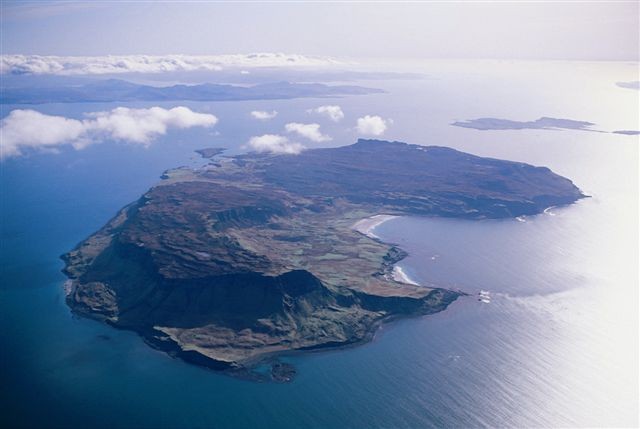
Isle of Eigg
The Isle of Eigg is situated in the heart of Clanranald country, this small island has very bloody history being involved in every MacDonald rebellion against the crown and in a good many feuds. A lengthy feud between the MacDonalds and the MacLeods in the 16th Century led to the death of 395 MacDonalds in 1577, the island’s entire population, in “Uamha Fhraing” (Cave of Frances, aka Massacre Cave) The Clanranald residents of the island took refuge in a cave on the south coast and they were suffocated by a fire lit at the entrance by a party of MacLeods in what apparently was a revenge attack. The feud was finally ended some years later by the marriage of Alan of Moidart to the daughter of MacLeod of MacLeod. Hugh Miller visited this notorious cave three centuries later, in 1844, and described in his book, “The Cruise Of The Betsy,” seeing the bones of adults and children in family groups with the charred remains of their straw mattresses and small household objects. All were finally removed for burial in hallowed ground.
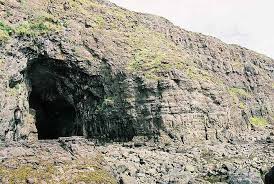
“Uamha Fhraing” (Cave of Frances, aka Massacre Cave), Isle of Eigg
The post Massacre Cave – The MacDonalds of Clanranald and The MacLeods appeared first on ScotClans | Scottish Clans.
]]>