The post List of Clans and Dates for Tattoo Clan Parade appeared first on ScotClans | Scottish Clans.
]]>Updated 16.1.17 1
Here is the latest list of what Clans are marching on what days for The Touch of Tartan.
There will be a series of Clan Parades that will take place each night of the Tattoo. This will be a major event within the Clan-themed events that will be happening throughout this year, backed by the Scottish Clan Event Fund.
There are 25 performances of the Edinburgh Tattoo. Tickets have been put aside for the clans to buy for each performance to make sure that as many tartan-clad clansmen, women and children attend as possible. Each Clan has seats allocated at the Tattoo.
For more information please contact info@clanchiefs.org.uk
| 1 | Thursday | 03-Aug | 9pm (Press Preview) | Macnab | Hay | |
| 2 | Friday | 04-Aug | 9pm | Arthur | Murray | |
| 3 | Saturday | 05-Aug | 7.30 pm | Gunn | Fraser | |
| 4 | Saturday | 05-Aug | 10.30 pm | Macdonald | Hunter | |
| 5 | Monday | 07-Aug | 9pm | MacMillan | Macaulay | |
| 6 | Tuesday | 08-Aug | 9pm | Macpherson | Ewing | |
| 7 | Wednesday | 09-Aug | 9pm | Wood | Broun | Maclean |
| 8 | Thursday | 10-Aug | 9pm | Henderson | Napier | |
| 9 | Friday | 11-Aug | 9pm | Moffat | Leslie | |
| 10 | Saturday | 12-Aug | 7.30 pm | Oliphant | Donnaichaidh (Robertson) | |
| 11 | Saturday | 12-Aug | 10.30 pm | Macneil | Marjoribanks | |
| 12 | Monday | 14-Aug | 9pm (BBC Filming) | Forbes | Wallace | |
| 13 | Tuesday | 15-Aug | 9pm (BBC Filming) | Mackenzie | Macleod | |
| 14 | Wednesday | 16-Aug | 9pm (BBC Filming) | Sinclair | Campbell | |
| 15 | Thursday | 17-Aug | 9pm | Borthwick | Skene | |
| 16 | Friday | 18-Aug | 9pm | Graham | Stewart | |
| 17 | Saturday | 19-Aug | 7.30 pm | Colquhoun | Matheson | |
| 18 | Saturday | 19-Aug | 10.30 pm | MacLea (Livingstone) | Currie | |
| 19 | Monday | 21-Aug | 9pm | MacGregor | Hannay | Buchanan |
| 20 | Tuesday | 22-Aug | 9pm | Kincaid | Maclaine | |
| 21 | Wednesday | 23-Aug | 9pm | Eliott | Agnew | |
| 22 | Thursday | 24-Aug | 9pm | Carmichael | MacThomas | |
| 23 | Friday | 25-Aug | 9pm | Bruce | Durie | |
| 24 | Saturday | 26-Aug | 7.30 pm | MacIntyre | Jardine | MacLennan |
| 25 | Saturday | 26-Aug | 10.30 pm | Cameron | Clan Ranald | Maclaren |
The post List of Clans and Dates for Tattoo Clan Parade appeared first on ScotClans | Scottish Clans.
]]>The post The Curious Case of Dubh Sith appeared first on ScotClans | Scottish Clans.
]]>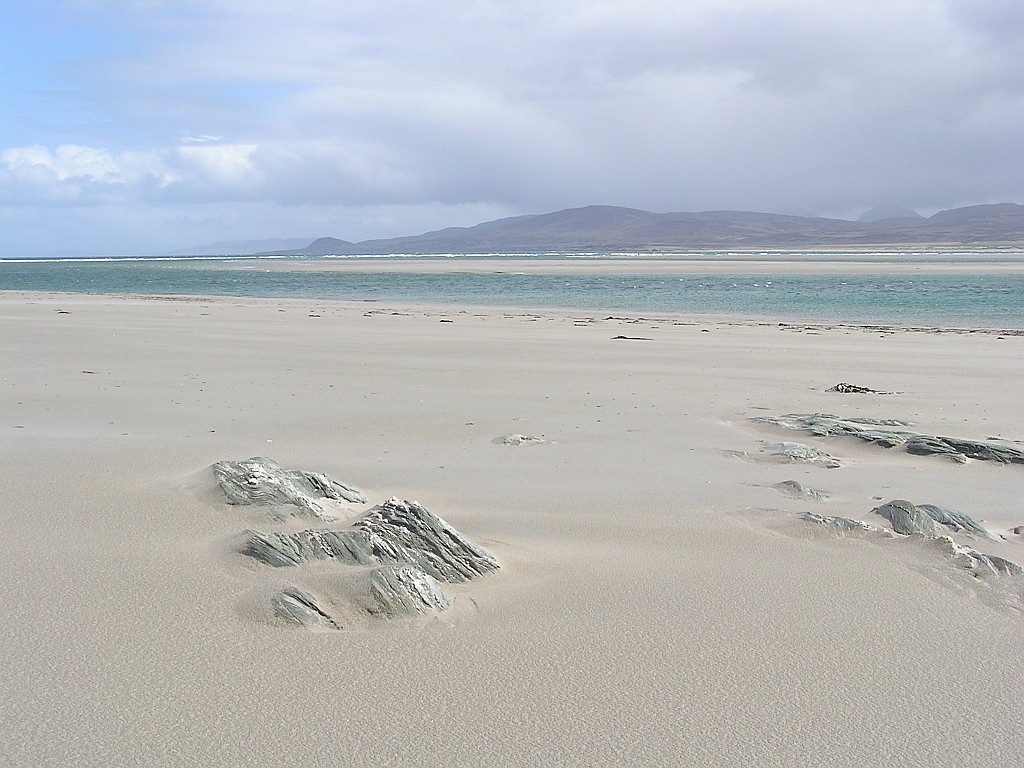
Loch Ghruinneart, Isle of Islay
If you picture troops involved in a 14th Century clan battle, fairies are the last thing you would expect to find among the ranks. However according to legend, a fairy is said to have appeared at the Battle of Traigh Ghruinneart, fought between Clan MacDonald and Clan MacLean in 1598. Although it wasn’t the kind of sweet, tinkerbell-esque fairy you’re probably imagining. According to legend, Dubh Sith (Black Fairy) was named after his dark skin and hairy body, and was an excellent archer. But the thing to remember about fairies is that they make great enemies – so you should never, ever cross a fairy.
In 1598 the Isle of Islay in the Inner Hebrides was held by Clan MacDonald, much to the annoyance of the chief of Clan MacLean, Sir Lachlan Mor MacLean. Sir Lachlan claimed that part of the Isle – the Rhinns – were part of the dowry given to his wife in 1566 by her brother Angus MacDonald, chief of Clan MacDonald. However Angus had also promised the Rhinns to Brian Vicar MacKay, lieutenant to the MacDonalds. For years Sir Lachlan had contested this, and in 1598 he finally decided to seek the lands that he claimed were rightfully his from his nephew, the new chief Sir James MacDonald.
In those days a battle was never fought without consulting a ban-fhaidh (wise woman), so Sir Lachlan sought out words of advice before embarking on his campaign. The ban-fhaidh told him under no circumstances should he go to Islay. Sir Lachlan replied that he was honour-bound to do so, and he must go, so the woman gave him three warnings to heed:
1.) Do not land at Islay on a Thursday
2.) Do not fight on the shores of Loch Ghruinneart
3.) Do not drink from the well known as Tobar Niall Neonaich
Three easy pieces of advice to follow to ensure a MacLean victory. However, upon arrival in Islay it wasn’t as easy to take heed of the ban-fhaidh’s warning. After assembling his forces of about 800-1000 men, Sir Lachlan set sail for Islay on a Wednesday. Unfortunately for him, bad weather meant the ship could not land until Thursday. Sir James rode to meet his uncle on the shores of Loch Ghruinneart and pleaded with him for peace, offering the MacLeans half of the island for Lachlan’s lifetime. Sir Lachlan had since learned he had double the men of Clan MacDonald, and was in no mood to compromise, instead demanding Sir James give him the entire island.
And so the troops from each clan lined up to battle at Traigh Ghruinneart (traigh meaning shoreline), which must have sent shivers down Sir Lachlan’s spine. Just before the battle the fairy from Jura known as Dubh Sith approached Sir Lachlan and offered his services as an archer during the battle. Sir Lachlan laughed in the fairy’s mutilated face, turning his back on the creature. Dubh Sith then approached Sir James, who received the fairy with open arms. Dubh Sith told Sir James to look after the battle, and he would take care of Sir Lachlan.
Unseen by the busy troops, Dubh Sith hid and waited in a Rowan tree near Tobar Niall Neonaich. The battle ensued under the hot August sun, and during a lull Sir Lachlan stopped at the well to take a drink. On removing his helmet, Dubh Sith jumped at the chance and shot Sir Lachlan through the eye with an arrow, killing him instantly.
The battle continued, with MacLean men full of rage upon hearing the news of the death of their chief. The MacDonald forces feigned retreat toward the setting sun then turned around to fight with the sun in the eyes of their enemy. The MacDonalds were victorious and chased the remaining MacLeans back to their boats, with some seeking refuge in the Chapel of Kilnave. The chapel was burnt to the ground, killing all but one of the men inside. According to local legend, this man was a aMacMhuirich (Currie) who managed to climb through a hole in the roof when the burning thatch collapsed. He eventually found refuge on the island, with his ancestors still there today.
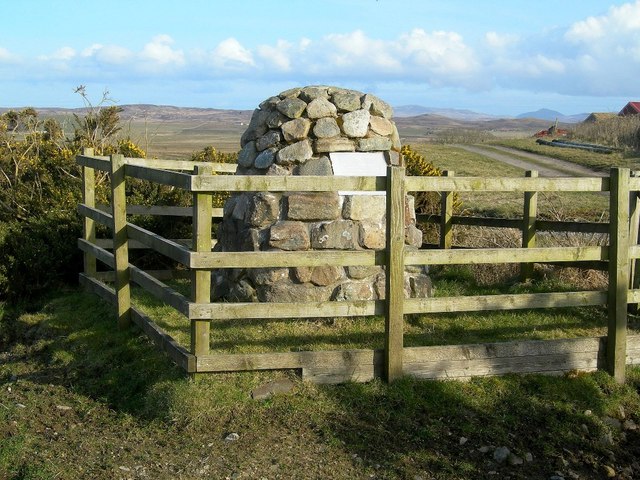
Cairn marking the spot where Sir Lachlan MacLean fell
Sir Lachlan’s foster mother heard of his death and came to collect the body shortly after the battle. She made a cairn beside the well where he was shot, and carried the body by cart to the church at Kilchoman where she buried him inside the church. When the new church was built on the old site, it was a smaller building, so today Sir Lachlan lies in the grounds outside the church.
It is not known what became of the mysterious Dubh Sith. Following the battle James VI and I awarded the MacDonald lands of Islay to Clan Campbell, leading to an extension of the feud. Clan MacDonald’s reign in Islay came to an end in 1612 when Angus MacDonald, 8th of Dunnyveg, sold his land holdings to Sir John Campbell of Cawdor of Clan Campbell.
The post The Curious Case of Dubh Sith appeared first on ScotClans | Scottish Clans.
]]>The post The Red Wedding and the Dwarf Assassin. Not ‘Game of Thrones’ But Everyday Clan Warfare appeared first on ScotClans | Scottish Clans.
]]>
The Red Wedding in Game of Thrones
The Island of Islay is a beautiful jewel in the inner Hebrides. A gentle low lying island of pastoral lands, expansive sandy beaches and more than a few whisky distilleries. The local population are among the friendliest you will ever meet so it seems surprising that such intrigue could play out in such an idyllic place. Read on…

Finlaggan
The Island was once the power base of the MacDonald Lords of the Isles. From their castle at Finlaggan the new lords were appointed and Islay was clan Donald’s spiritual home. However clan Donald had, to put it mildly, an uneasy relationship with the crown and in 1493 after various misdemeanours their lands had become forfeit.
Such was the extent of MacDonald lands that it took the crown accountants 20 years to take stock of all their estates. The estates were distributed among those loyal to the Scottish crown; mostly clan Campbell and the MacIan’s of Ardnamurchan, a branch of Clan Donald who were related to Campbell’s through marriage.
An area of Islay known as ‘The Rinns’, the part of the island running out to the north west that includes Port Charlotte and Portnehevan was granted to the MacLeans of Duart, a powerful clan from Mull. With so many large clans sharing such a small area it was inevitable that tensions would spill over, nevertheless an uneasy peace was maintained. but it wasn’t to last long…
In 1567 Angus MacDonald succeeded as chief of the MacDonalds of Islay. Angus had a bitter rival in the young Lachlan MacLean of Duart and when Lachlan came of age the authorities realised it was just a matter of time before matters would get out of hand. In an effort to spare bloodshed the king commanded that Angus was to marry Lachlan’s sister. By all accounts the marriage went as planned, however when Angus decided to go to Mull to visit the ‘in-laws’ things took a dramatic turn for the worse.
Despite the forfeiture of the Rinns, Angus had never officially signed the papers over to the MacLeans and they were determined to get their land. When the newlyweds arrived at Duart castle Angus was taken prisoner until he signed away his rights to the Rinns. Even after signing the deeds the MacLeans rightly mistrusted Angus and so kept his brother and his son James as hostages.
So having signed away a part of his clan’s spiritual home Angus and his wife returned to Islay. Angus though was determined that the MacLeans would not be enjoying their new territory any time soon but nevertheless kept his own council playing a much longer game. Eventually Lachlan in triumphant mood arrived on Islay to look over his new possessions. he brought with him 86 of his clansmen and the young James MacDonald as a token of conciliation. Angus welcomed them with a lavish banquet but mid way though the meal the mood turned suddenly very ugly and on Angus’ cue a horde of heavily armed MacDonald’s burst into the room and took the MacLeans captive.
News of the capture of Lachlan and his MacLean kinsmen made it’s way back to Mull. Terrible news for most of the clan but not so for Alan MacLean a rival to Lachlan’s chiefship and uses Lachlan’s absence as an opportunity. Realising it would be in his best interests if Lachlan never returned he leaked out a lie that Angus’ brother, still a captive at Duart had been put to death. Alan MacLeans subterfuge almost worked and Angus began to put to death two captives a day until all 86 had been executed – all that remained was Lachlan himself and Angus was on the way to watch his rival’s demise when news reached Islay that the story was false.By all accounts Lachlan’s neck was saved with minutes to spare.
Giving new meaning to the phrase ‘thats a bit awkward’ the MacDonald’s now had a fairly angry Lachlan as a captive they would much prefer not to have. Once again the Crown intervened and sent a Campbell representative to broker a hostage exchange and some peace. Peace however was not in the vocabulary of these two clans… As soon as Lachlan returned to Duart (and dealt with his scheming kinsman). He put together a raiding party to take revenge on Islay. Angus in return laid waste to settlements on Mull and Tiree. During another raid while Angus was mustering forces on the south of Kerrera, the party were ambushed by MacLean men and MacDonald of Sleat, Macleod of Lewis and and MacFee of Colonsay were all captured.
Once again the crown intervened and while most of the hostages were returned Angus MacDonald refuse to hand over his – as a result Angus was outlawed. As it was Lachlan was not much better at keeping his word and he too refused to return some of his captives. he had also been hatching his own particularly dark revenge…
in 1588 Macian of Ardnamurchan arranged to marry Lachlan’s mother. with the MacIan being a branch of clan Donald it was hoped that this marriage bond would help force a peace between them. This wasn’t Lachlan’s plan though… as the wedding festivities progressed Lachlan’s men stormed the reception and ordered all the MacDonalds present to be massacred. Only the bridegroom was spared.
Game of Thrones fans will be able to picture this scene well since the ‘red wedding’ is a pivotal moment in the series (the same events were played out with the Douglas Clan so its clearly not an uncommon occurrence) . This was not the end of Lachlan’s bloody crusade though and he then set off on a murder tour of a number of small islands including Rhum, Eigg, Muck and Canna. With assistance from some Spanish mercenaries who had survived the disastrous wrecks of the Spanish Armada they set about all but exterminating the population of these islands.
Angus’ revenge was taken out on the settlements of Mull and in this he was in turn assisted by English mercenaries. By 1589 the King had lost all patience with his warring subjects and both parties are summoned to Edinburgh.
On arrival both were arrested and held prisoner until they finally agree to behave. As a token of his willingness to comply Angus left his son James at the Royal court, the young man proved himself to be very popular and received a knighthood. And so peace descended on Islay again, but not for long. in 1592 a revolt of Scottish Nobles threatened the position of the King.
While he was otherwise occupied the MacLeans and MacDonalds saw the distraction as an opportunity to have another go at each other and war broke out again. This time it led to charges of treason being laid against both parties and this very serious threat calmed them both down. Now during all this time the Rinns of Islay (remember the Rinns?) had still never officially been handed over by the devious Angus so he agreed to make settlement including any arrears. Still, after 6 years of making promises Angus had still not officially made settlement so his son Sir James, now very much ‘in’ with the royal court decided to bring his father to book.
On James’ invitation Angus visited Cambletown, staying at Askomel House, James was lodged nearby. Angus and his son met and dined with each other with no hint of James’ plan. After one such meeting Angus returned to Askomel and was awakened in the night by some 300 men at James’ command , armed to the teeth and demanding that Angus give himself up. Angus understandably refused and so James decided to set light to the house with his mother and father inside. In making his escape though Angus is burned quite badly and ends up fleeing in only his nightshirt. James was cunning though and had set traps of felled logs around the grounds of the house and Angus tripped and fell and so was captured. He was then taken in chains to Dumbarton.
James returned to Edinburgh expecting a heroes welcome for finally taking care of his warmongering father but his over zealous methods didn’t go down at all well and such was the outrage that Angus had to be pardoned. James was now the outlaw and Angus got his revenge on his son 5 years later when he captured him on Islay, He was promptly delivered to the Campbells and taken to Perth to answer charges of fire raising and treason. Somehow though (and this does make you wonder about the level of security in the 16th century prison system) James managed to escape and fled back to Islay.
Now while all this in fighting has been going on Lachlan had been busy… Seeing his advantage Lachlan gathered a huge force with the aim of sending the MacDonalds to the afterlife once and for all. He sailed for Islay and the two sides squared up for battle at Traigh Ghruineart (Gruinard Bay) in August 1598.
As the MacLeans were preparing for battle Lachlan was approached by a dark skinned hunchback dwarf, the ‘Dubh Sith’ was half human and half fairy; his father being a Shaw from Jura and his mother from the other realm. This deformed dwarf offered the services of himself and his no doubt enchanted crossbow to Lachlan who laughed at him and considering himself to be far superior in numbers sent him on his way.
The dwarf hobbled off to the MacDonald camp and made the same offer to Sir James who gratefully accepted. The dwarf said to James ‘you take care of the rest of the MacLeans and I’ll take care of Lachlan’ and then promptly scurried away and climbed into nearby Rowan tree. And so battle commenced on a hot August day. During a lull in the fighting Lachlan was overcome with thirst and so went to a nearby stream, he removed his helmet and knelt down to drink – right in range of the lurking dwarf who with one shot of his crossbow found his target on the back of Lachlan’s neck – the point of the crossbow bolt exiting his eye and killing him instantly.
With Lachlan dead the MacLeans lost heart and fled the field. The MacDonald’s pursued them to a church at Kilnave and with the surviving MacLeans barricaded in the church the MacDonalds set light to the thatch roof of the church killing all inside. Except one. One man; a MacMhurich (clan Currie) was able to escape from the church and fled into Loch Gruinard. As the bloodthirsty MacDonalds searched the land he hid under the waters of the bay using a hollow reed to breath through.
The story goes that after dark he made his escape and was taken in by some locals and it is said that his descendants live in the village of Bowmore on Islay to this day.
And so what became of our principal characters in this dark play? Well Lachlan was dead and buried at Kilchoman, Angus grew old and died naturally on Rothsay. Sir James had a more troubled future though; when James VI became king of a united England and Scotland he was determined to put behind him the reputation of his warring barbaric Scottish ancestry and so set about ‘cleaning up’ the Scots nobility. James was brought to justice, his possessions forfeited and charged with treason. He was condemned to death but managed to escape in 1615 (prison security had still not improved). James fled to Spain until 1620 when the King decided to offer him a royal pardon. He was forbidden from returning to Scotland though so lived out his few remaining years in London.
Apologies for anyone expecting dragons to feature at some point but you can’t have everything!
The post The Red Wedding and the Dwarf Assassin. Not ‘Game of Thrones’ But Everyday Clan Warfare appeared first on ScotClans | Scottish Clans.
]]>The post Battlefield to Become ‘Park and Ride’ Interchange appeared first on ScotClans | Scottish Clans.
]]>
Pitreavie Battlefield, next to Rosyth Train Station
Fife Council have been given the green light to build a transport hub on the site of one of Scotland’s decisive battlefields. The Battle of Pitreavie (1651), was one of the key battles during the War of the Three Kingdoms. It marked the end of Scotland’s last hold-out against subjugation by Oliver Cromwell’s New Model Army, where Cromwell attempted to quell unrest north of the border.
It is though the bodies of 2000 soldiers are buried on the site, with one last search for human remains currently being prepared for the site at Rosyth, near Dunfermline. The council is seeking tenders for archaeological surveys which will test for the presence of human remains. It is likely there are a number of mass burial pits, although only two have ever been found, during ditch-digging in the 1850s.

Maclean Memorial Cairn near Pitreavie Battlefield
A test excavation due to take place soon will reveal if any battlefield deposits remain, with the results informing any more detailed archaeological work that may be required to preserve the site by record before development. The battlefield is largely uncommemorated although a small cairn was erected a few years ago to mark the 500 members of the Clan Maclean who perished at Cromwell’s hands.
Historic Scotland included the site on the Inventory of Historic Battlefields, which lists Scotland’s 28 most important battlefields, but have not objected to the council’s plans. A council report confirmed, “Inclusion of a site within the battlefield inventory does not confer any new legal restrictions on the area identified by the inventory maps. Instead, Historic Scotland assumes that inventory sites will be given more particular consideration in the planning process.”
On July 17, 1651, a 1600-strong Cromwellian force of cavalry and infantry began an assault on the Scottish cannon battery on the top of the Ferryhills, which had stopped Cromwell crossing the Forth.
“Cromwell had been trying to cross the Forth since his victory at Dunbar almost a year earlier but he knew that attempting a crossing in the teeth of the cannon battery would have been suicidal,” said Fife Council archaeologist, Douglas Speirs.
The English forces successfully stormed the batteries, encouraging Cromwell to quickly send over another 4000 troops. A Scottish force of some 5500 engaged them but it was quickly routed. Speirs added: “They retreated some four kilometres before regrouping on open ground just to the south of Pitreavie Castle but they were no match for Cromwell’s vastly superior professional New Model Army and in less than two hours, the Scottish army was all but annihilated.
“There is no single contemporary record that can be relied upon for an accurate body count but from piecing various bits of historical information together it appears likely that between 1500 and 2000 Scots soldiers died.
“The battle at Pitreavie, which witnessed a great loss of life, was an incredibly important national event which, although little remembered in the national consciousness, deserves to be up there with Culloden, Bannockburn and Pinkie.
“It was truly a seminal battle in defining the future and the political landscape of Scotland, defining every aspect of Scotland from 1651 until the Restoration in 1660.”
The post Battlefield to Become ‘Park and Ride’ Interchange appeared first on ScotClans | Scottish Clans.
]]>The post The Flodden 500 Service at St Giles, Edinburgh. appeared first on ScotClans | Scottish Clans.
]]>I’d like to continue by reproducing Alaistair Moffat’s reading given at St Giles. It was an excellent account of the battle and the aftermath.
—
FLODDEN ADDRESS. – ALISTAIR MOFFATWhen dawn broke on the morning of 10th September, 1513, the landscape of hell was revealed. On the gently undulating northern ridges of Branxton Hill more than 10,000 men lay dead or dying. In the midst of the carnage were the naked, plundered bodies of King James IV of Scotland, his half-brother, Alexander Stewart, Archbishop of St Andrews, George Hepburn, Bishop of the Isles, two abbots, nine great earls of Scotland, fourteen lords of parliament, innumerable knights and noblemen of lesser degree and many thousands of farmers, ploughmen, weavers and burgesses. It was the appalling aftermath of the battle of Flodden, the greatest military disaster in Scotland’s history.In the grey light of that terrible dawn, sentries posted around the captured Scottish cannon could make out where the brunt of battle had been joined. Below them, at the foot of the slope ran the trickle of a nameless burn now choked with slaughter, a wrack of mangled bodies, broken pikeshafts, shattered shields and everywhere blood and the sickening stench of death, vomit and voided bowels. Not all of the bodies were yet corpses. Through a long dark night the battlefield had not been a silent graveyard. Trapped under lifeless comrades, crippled, hamstrung or horribly mutilated, fatally wounded men still breathed. Bladed weapons rarely kill outright and they were often used to bludgeon men to their knees or into unconsciousness. In the churned mud of the battlefield some men will have lost their footing, fallen and been hacked at before they could get up. Many bled to death, maimed, lacerated by vicious cuts, screaming, fainting and screaming once more in their death agonies. Some will have been put out of their misery by parties of English soldiers scouring the field by torchlight for plunder, stripping the bodies, ransacking them for valuables. But other men will have lingered on inunspeakable pain, praying to their God, passing in and out of consciousness, slowly bleeding to death. The fury of the battle on Flodden field may have been stilled and awash with death and defeat. But all was not yet over. In an instant the plunderers and scavengers looked up and the sentries by the cannon stood to, frantically peering through the morning light. They could hear the rumbling thunder of hoofbeats – and then, suddenly, riders erupted over Barelees Rig. With 800 horsemen at his back, Lord Alexander Home galloped hard across the horrors of the battlefield and up the slopes of Branxton Hill. They had not come back to Flodden to rejoin a lost battle but to rescue their captured ordnance. And they very nearly succeeded. After a sharp skirmish, the English gunners managed to load and get off a volley at Home’s squadron, and they scattered.And so it ended. As the Border horsemen wheeled round and raced out of range, the remnants of the shattered Scottish army were limping across the Tweed at Coldstream. There was no organised pursuit. The victorious English army had taken heavy casualties and the Earl of Surrey and his captains were exhausted. In any event, their bloody work was done. The floors o’ the Forest were a’ wede awa, Flodden was a national disaster, a harbinger of lawlessness in the shape of the Border Reivers, the beginning of a long period of political uncertainty and the last medieval battle in the history of Britain. The last time a king was to die leading his army.It was also an epic. As two huge armies mustered and marched into history, extraordinary scenes had been witnessed. At Ellemford, high in the Lammermuirs above Duns, where sheep now graze on the flanks of the hills, where buzzards hang in the updrafts and an elegant bridge crosses the Whiteadder, King James IV and his army camped. Huge guns were trundled down the hill trails, dragged by oxen, and by 21st August 1513, almost 30,000 men had massed in this beautiful, now lonely valley. Two days later, the largest force ever to leave Scotland crossed the Tweed at the fords below Coldstream. They had declared war, they had entered the realm of the Tudors, of the ferociously ambitious and bull-like Henry VIII.Meanwhile Thomas Howard, Earl of Surrey, and the Bishop of Durham carried the standard of St Cuthbert before their battle-hardened troops. In front of the high altar of the great cathedral, Howard had watched the bishop bless the flag of the Haliwerfolc. The lands of Palatinate, of the Prince-Bishops of Durham, reached to the Tweed and beyond, and in an early definition of Englishness, their people were known as the Holy Man’s Folk, the Haliwerfolc. Ancient allegiances were being roused and summoned.Between 2nd and 9th September two vast armies circled each other in a small corner of North Northumberland, like heavyweight boxers looking for weaknesses or waiting for wrong moves. After the Earl of Surrey had despatched a herald, the Rouge Croix, it was finally agreed that battle would be joined on 9th September. Supplies for almost 70,000 men, horses and camp followers were running dangerously lowand neither army could remain in the field much longer.Realising the strength of the Scots’ entrenched position, Surrey led his men to the east, skirting Flodden Edge and staying out of artillery range. On the morning of the appointed day, he crossed the River Till and took up a position to the north of James IV’s army, barring any retreat to Scotland. And then, on a damp afternoon, the greatest battle ever fought between England and Scotland began.On the left wing of the Scottish host, the Highlanders led by the Earl of Huntly massed in formation with Lord Home’s Borderers, and in the moments before their chiefs roared the claideamh mor, the order to charge, the Gaelic-speaking warriors did something remarkable. They began to summon the army of the dead. They began the sloinneadh, the naming of the names of memory. To bolster his courage, each man began to recite his genealogy. Many waiting to charge could go back 20 generations. As if they were offering up the murmur of prayer, each man remembered why he had come to fight. Is mise mac Iain, mac Ruaridh, mac Domhnuill. I am the son of John, the son of Roderick, the son of Donald. And once their quiet voices stilled, the roar of the claideamh mor rent the air and they broke into the charge. With their broadswords and Lochaber axes, the Highlanders tore into the English ranks, the division led by Edmund Howard, They scattered and a rout was only prevented when Lord Dacre rode to the rescue with his English Borderers. As history rumbled across Branxton Hill, fortune appeared to be smiling on the Scots.At the same time, James IV was about to make a catastrophic decision, a crucial error of judgement. Instead of occupying an elevated position at the rear of his vast army, he chose to lead from the front. His division raced down Branxton Hill and as they reached the lower slopes and much softer ground, many men began to skid and lose their footing. This unsteadiness made it very difficult for them to control their long, 12 foot pikes. The wet ground made them charge out of formation, only engaging piecemeal with the solidly planted ranks of English billmen, With their shorter, more easily handled bills, they began to slice into James IV’s division. And as the men at the back saw the Scottish pikes go down, they hesitated and many of them ran, believing their king to be killed. By leading from the front, James was immediately submerged in the ruck of the fighting, only able to see what was directly in front of him, in no position to direct his forces. The result was disaster.The legacy of Flodden was most immediately and keenly felt in the Borders. North of the Tweed the memory of the battle is kept alive in the fabric of the midsummer common ridings. At Selkirk the ceremony of the casting of the colours is unique in Britain and it is based on the return of a soldier known as Fletcher, traditionally believed to have been the only one of sixty from the town to return. In his bloodied hand he held aloft, in a gesture of desolate defiance, a flag captured from the men of Macclesfield in Cheshire. Many Englishmen had fought and fallen at Flodden. And passions still run high. When the Mayor of Macclesfield recently wrote to the Provost of Selkirk asking for the return of the flag, he was told that he would need to come to the Borders and take it.Flodden is an immense story. Like Culloden in 1746, it signalled the end of a fading, feudal Scotland. And it also ushered in a century of lawlessness, the criminal society controlled by the appalling Border Reivers. Across Europe, renaissance, enlightenment and the reformation were changing lives, forming new ideas and creating the institutions of the modern world. In the first half of the 16th century, central authority broke down in a leaderless nation, and while swords and spears spoke in Scotland, the law was often silent.What is to be learned from all of that suffering and slaughter, from all of those ancient enmities? First that they are ancient and must remain firmly in the past. In 2014 Scotland faces a historic choice and whichever way the people of Scotland vote, it must be a signal lesson of Flodden that enmity, even ancient enmity can have no part. And it is to the credit of politicians on all sides of the argument that it has not reared an ugly head. But it might.And alongside that it mustmbe important to remember, to understand the visceral, bloody realities of whatmwent on on that terrible day 500 years ago. Lest we forget, Flodden should become a place of remembrance and of pilgrimage, a place where the uncomfortable lessons of history can be learned and never forgotten.Two weeks ago, on one of the countless beautiful evenings of this glorious summer, I drove over to Branxton. As the sun threw long shadows across the gently undulating fields, I tried to imagine the 10th of September, 1513, the distant roar of thousands of men, the screams, the fear and feral closeness of hand-to-hand fighting whenmen can smell the breath, smell the sweat of men grunting pushing, hacking, swearing at them, trying to kill them. In a Gaelic phrase, I tried to listen for the music of the thing as it happened. I tried to listen to the slow, sad music of our history. I hope that many in Scotland and England hear it too.
Prior to the sir Malcolm MacGregor (who has admitted that try as he might he can not find a single MacGregor involved in the battle) researched the casualty lists. The following names are clans and families who are known to have fought at Flodden along with notable people who fell in the battle:
From the Highland Clans:
Campbell, Erskine, Fraser, Gordon, Graham, Guthrie, Haldane, Hay, Keith, Leslie, Lindsay, Macaulay, Macfarlane, Mackay, Maclean, Macnab, Menteith, Moncreiff, Moray, Murray, Ogilvy, Oliphant, Ramsay, Rattray, Ross, Ruthven, Seton, Sinclair, Stewart, Forbes, Forsyth, Grant, MacKenzie, MacNaughton, Ross, Skene, Buchanan Of Leny, MacDonald
The Lowland and Border Clans and Families:
Adair, Abercromby, Adam, Anstruther, Baillie, Baird, Balfour, Barclay, Blackadder, Bonar, Boswell, Carnegie, Cathcart, Cleland, Cockburn, Colville, Craig, Crauford, Crichton, Cunningham, Dunbar, Dundas, Edmonstone Of Duntreath, Elphinstone, Fotheringham, Gray, Grierson, Haig, St.Clair Of Roslin, Henderson, Hepburne, Herries, Home, Hoppringle, Houston, Lauder, Liddel, Lockhart, Lumsden, Lyon, Masterson, Maitland, Maule, Maxtone, Maxwell, Melville, Muirhead, Mure, Napier, Rollo, Sempill, Somerville, Spottiswood, Stewart Of Traquair, Allardice, Ballingall, Kerr, Colville, Crammond, Eliott, Ferguson, Fleming, Foreman (Standard Bearer), Inche, Inglis, Johnstone, Kirkcaldy, Knolis, Logan, Montgomery, Morton, Muir, Nelson Of Madinpap, Otterbrun, Pitcarin, Pringle, Reid, Rorison, Savage, Scott, Seton, Tunstall, Vallanche, Wood Of Raik, Kennedy, Douglas, Hamilton, Livingstone, Wemyss, Wallace, MacLellan, MacCulloch, MacDowall
Chief Or Notable Head Of House/Family
King James IV, Archbishop Of St.Andrews (King’s Son), Earl Of Morton ( Grandson Of James 1), Earl Of Glencairn, Douglas Of Drumlanrig, Sir James Dunbar, Dundas, Lord Elphinstone, Lord Erskine, Earl Of Huntly, Earl Of Montrose, Sir Alexander Guthrie, Haig Of Bemersyde, Haldane Of Gleneagles, Earl Of Errol, Earl Of Bothwell, Sir William Keith, Earl Of Cassilis, Earl Of Rothes, Earl Of Crawford, MacDowal, Earl Of Garthland, MacFarlane Of Arrochar, Hector MacLean Of Duart, Maxwell Lord Of Carlaverock, Sir John Moncreiffe Of That Ilk, Moray Of Abercairney, Ramsay Of Dalhousie, Rattray Of That Ilk, Rollo Of Duncrub, Master Of Ruthven, Lord Sempill, Lord Seton, Earl Of Caithness, Earl Of Atholl, Earl Of Lennox, Lord Darnley, Master Of Angus, Anstruther Of That Ilk, Ballingall Of That Ilk, Master Of Eliott, Lord Forbes, Master Of Lovat, Sir Alexander Gordon Of Lochinvar, Sir Alexander Gordon Of Knockenshene, Grant Of Freuchie, John Henderson Of Fordell, Lord Alexander Home, Sir Patrick Houston Of That Ilk, William Johnstone Of That Ilk, Lord Keith, Lord Lorn, Lyon (Sons Of Lord Glamis), MacKenzie Of Kintail, Sir Alexander MacNaughton Of That Ilk, Andrew Pitcairn Of Pitcairn And 7 Sons, Lord Ross, William Ruthven Of That Ilk, Sir Walter Scott Of Buccleuch, Alexander Skene Of That Ilk, Sir David Wemyss, Earl Of Argyll, Lord Kinnaird, Master Of Cathcart, MacDonald Of Lochalsh.
—–
 The St Giles Service…
Just over 40 clan chiefs attended the St Giles service. At the end of the service they mustered for a photograph on the steps. To help you identify who was there we have been given a sketch with a key to the names:
1. Sir Walter Riddell of Riddell 2. The Hon. Elizabeth Fairbairn 3. Madam Pauline Hunter of Hunterston 4. Sir David Bannerman of Elsick 5. Lord Polwarth 6. Andrew Wallace Younger of that Ilk 7. Andrew Dewar Durie of Durie CBE 8. Michael Ancram, Marquess of Lothian 9. Andrew MacThomas of Finegand 10. Earl of Dundee 11. David Campbell of Strachur 12. Roderick Macneil of Barra 13. Sir James McGrigor 14. Earl of Eglinton and Winton 15. Professor David Hannay of Kirkdale and of that Ilk 16. Henry Trotter Younger of Charterhall 17. John MacArthur of that Ilk 18. Duncan Paisley of Westerlea 19. Richard Carmichael of Carmichael 20. Earl of Caithness21. Earl of Lauderdale 22. The Hon. Alexander Leslie 23. Earl of Erroll 24. Lord Napier and Ettrick 25. Madam Arabella Kincaid of Kincaid 26. David Cranstoun of that Ilk 27. Jamie Macnab of Macnab 28. Earl of Wemyss and March 29. Sir Crispin Agnew of Lochnaw 30. The Hon. Kate Nicolson 31. Duke of Montrose 32. The Hon. Peregrine Moncreiffe of that Ilk 33. Martin Haldane of Gleneagles 34. Lord Sempill 35. Andrew Marjoribanks of that Ilk 36. Donald MacLaren of MacLaren 37. Duke of Hamilton 38. Field Marshal the Lord Guthrie of Craigiebank 39. Isla St Clair 40. Marquess of Ailsa 41. Madam Margaret Eliott of Redheugh 42. Sir Malcolm MacGregor of MacGregor 43. Lord Macdonald of Macdonald 44. Richard Oliphant of that Ilk
This image will help you identify the chiefs:

The post The Flodden 500 Service at St Giles, Edinburgh. appeared first on ScotClans | Scottish Clans.
]]>The post A Cannonball, a Sheepskin and a Loch Village appeared first on ScotClans | Scottish Clans.
]]>
The Mingary Castle cannonball
What – Cannonball
Era – Most likely 1644
Found – Wedged in the wall of Mingary Castle, Lochaber, West Highlands.
Fired almost 350 years ago, this cannonball was found during restoration work currently taking place at Mingary Castle. The cannonball was found sitting in an 18 inch hole in one of the castle’s sea facing walls, embedded a foot into the wall. A ship was lost in the attack on the castle during tensions between clans and Covenanters.
The remains of the ship were discovered in 1999 and relate to the siege of Mingary Castle by by Archibald Campbell, 8th Earl of Argyll, the castle’s former owner, recorded in a diary written by John Weir in 1644. Weir was a Puritan imprisoned in Mingary Castle by Major-General Alasdair MacDonald.
Originally built for the Clan MacDonald of Ardnamurchan (also known as MacIain of Ardnamurchan), the castle has had many different occupants over the years including Clan MacDonald of Lochalsh, Clan Campbell, Clan MacLean and King James IV of Scotland who used it as a stronghold for fighting off Clan Donald in the late 15th century.

Archaeologists at the burial excavation site in Sutherland
What – Burial cist with sheepskin and human remains
Era – Bronze Age
Found – A back garden near the village of Spinningdale, Sutherland, North Highlands.
Discovered by accident when a septic tank was being installed in a back garden, the sheepskin and human remains are said to be at least 4000 years old. The sheepskin was found wrapped around the left arm bone of the skeleton of the middle aged female whose crouched body was contained within the burial cist.
It is believed to be the first known example of sheepskin from the Bronze Age found in Britain.
A spokesman for the archaeology company said: “A radiocarbon date of 2051-1911 BC and 2151-2018 BC was obtained from bone and charcoal fragments, placing the cist in the early Bronze Age period. The radiocarbon dating of the cist corresponds with the date of the food vessel urn buried with the body. The vessel contained carbonised material of non-botanical origin, unidentified cremated bone and a fragment of a small ring. These were probably placed there to assist the individual’s journey into the next world and indicate belief in the afterlife, which appears to have been a concept only adopted in Scotland.”
“The preservation of organic material, such as sheepskin or wool, also supports the view of a elaborate burial rites being carried out in the vicinity of the Dornoch Firth during the early Bronze Age.”
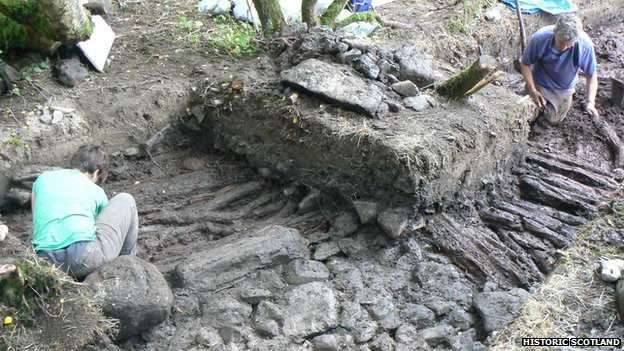
The loch village revealed
What – Loch Village
Era – Iron Age
Found – Wigtownshire, Dumfries and Galloway
Experts are calling this remarkable find ‘Scotland’s Glastonbury’, in reference to Somerset’s famous lake village after discovering the first loch village in Scotland. What originally began as a small scale excavation of a crannog (a singular loch dwelling) turned into a fully fledged dig when archaeologists found evidence of multiple structures on the site. The site is one of 55 archaeology projects to receive more than £1m in funding from Historic Scotland for 2013/14.
What initially appeared to be one of a small group of mounds before excavation was revealed to be a massive stone hearth complex at the centre of a roundhouse. The timber structure of the house has been preserved, with beams radiating out from the hearth forming the foundation, while the outer wall consists of a double-circuit of stakes. The most surprising discovery was that the house was not built on top of an artificial foundation, but directly over the fen peat which had gradually filled in the loch.
Graeme Cavers, of AOC Archaeology, who is the co-director of the site, said that because the land was abandoned after the Iron Age, the buildings were well preserved.
“Waterlogged wood also offers the opportunity to date the structure very accurately using dendrochronology – or tree-ring counting – to give a date accurate to within a few years or even months, rather than the decades or centuries usually provided by radiocarbon dating,” he added.
The post A Cannonball, a Sheepskin and a Loch Village appeared first on ScotClans | Scottish Clans.
]]>The post 21st Century Clan Chiefs: MacLean appeared first on ScotClans | Scottish Clans.
]]>The post 21st Century Clan Chiefs: MacLean appeared first on ScotClans | Scottish Clans.
]]>The post The Beaton Doctors of Mull appeared first on ScotClans | Scottish Clans.
]]>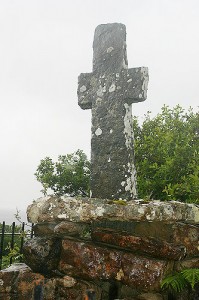
The cairn and cross memorial to the Beaton doctors
The Beatons of Mull, the famous ‘Ollamnh Muileach’, were a family of doctors, whose origins can be traced back to Béthune in France, and are said to have been very talented with a rather unique medical ability.
They family were hereditary physicians first to the Lords of the Isles, and then to the MacLeans of Duart, but they also performed an informal medical service to the people throughout the whole area.
It is claimed that the very first Beaton doctor, a young man who assisted a highly skilled Irish doctor, gained his ability as a medical practitioner by accident. Whilst helping create a magical potion, which included brewing a white snake and a hazel stick brought from Mull, a drop fell onto his hand and immediately this young Beaton transformed into a talented doctor.
It is also said that this Beaton managed to save the life of a chief of Lochbuie in a rather unique way who was suffering from a particularly serious throat abcess. He put together a potion in the presence of the chief which had a very unpleasant potent taste to it, and asked some people who were also present to taste it. The facial expressions of each one who tasted the mixture caused the chief to go into an uncontrollable fit of laughter which strained his throat enough for the abcess to be broken up, and save his life.
It is said that only once was this doctor unable to diagnose a medical problem. Unfortunately for him it was his daughter who was ill, and despite Beaton’s ability he could not prevent her death. A post-mortem was carried out, and the girl’s death was put down to the live frog found in her stomach. The frog was kept alive and fed a number of different foods which were non-harmful to humans to see what effects they would have on it, in an attempt to find a treatment for any future cases. The frog eventually died when one day it was fed some nettle soup; a simple cure which left the doctor distraught because he did not think to try it when treating his daughter.
However, it is said that he managed to save another young girls life with this treatment after she swallowed a tadpole which went on to grow into an adult frog. Legend has it that he was able to diagnose the condition simply by the tone of her singing voice.
From Campbell‘s West Highland Tales it tells of three brothers, Gilleadh, Fergus, and John. Gilleadh was an expert herbalist, Fergus specialised on Islay, and John, whose grave is on Iona, was said to be the most talented doctor, and was Mull’s chief practitioner. People were aware of John’s ability all around Scotland, and news of it even reached the king in Edinburgh who demanded to meet with him. The king had invited all of the country’s best doctors to the capital where he would test them and see which one was superior to the rest.
In order to assess them the king did one simple test: he feigned an illness and challenged the doctors present to identify what was wrong with him, and then prescribe an appropriate remedy. All the doctors took the task with extreme seriousness except from John Beaton who could see through the king’s act and correctly called his bluff. The king, so impressed with Beaton’s intuitiveness immediately proclaimed him the best doctor in the whole of Scotland. Jealous, John’s rivals slipped some poison into his food whilst he was heading back to Mull. However, these rivals completely respected John’s talent as a doctor, and so to make sure that the poison took its full effect, they removed anything from his possession that they thought could be used to create some sort of antidote. The poisoning was successful and John was unable to doing anything about it.
Not far from the Free Church at Pennyghael on the Isle of Mull is a monument in the form of a cairn with a stone cross mounted on top to commemorate the famous Beaton doctors of Mull. Inscribed onto the side is ‘GMB 1582 DMB’. Apparently these are the initals of the most prominent Beaton doctors.
Adapted from Peter Macnab’s “Traditional Tales of Mull”.
The post The Beaton Doctors of Mull appeared first on ScotClans | Scottish Clans.
]]>The post A MacLean tale Lady’s Rock and their only bad chief appeared first on ScotClans | Scottish Clans.
]]>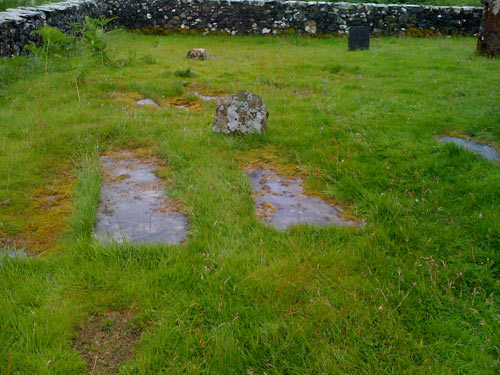
These are perhaps the graves of the one “bad” Duart chief and his wife.
Lady Rock off Mull, originally uploaded by Amanda@ScotClans.
The post A MacLean tale Lady’s Rock and their only bad chief appeared first on ScotClans | Scottish Clans.
]]>The post Tragedy Rock – A sad tale from Mull appeared first on ScotClans | Scottish Clans.
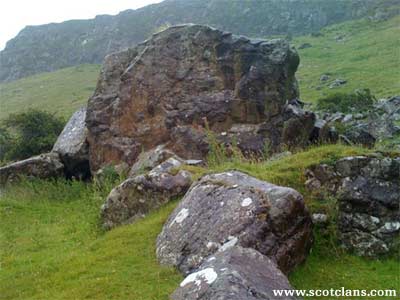
]]>At the foot of the 1,000ft cliffs of Gribun stands Clach na Leannan, the Stone of the Courting Couple. The stone is just 50 yards inland from a road where it passes the first farm coming from Salen direction, with a windbliwn elder tree at the gable. This stretch of road on the south side of Lich na Keal can be extremey terrifying, with the overhanging cliffs on one side and a drop into the sea below. There are many occurancs of rock avalanches after heavy rain or a passing sheep dislodging a stone.
In about the year 1700, in the autumn, a young man named John, a local shepherd was betrothed to Rona, daughter of a local blacksmith. The couple had been fortunate in obtaining a small but cosy cot- house that stood on a piece of flat land at the foot of the cliffs of Gribun. Their new home was situated opposite where the wedding was taking place.
The wedding celebrations went on until dawn in the barn of an old farmhouse. A storm had been threatening all day and broke in the night, a great wind came roaring in from the sea accompanied by torrents if rain. As time went on, the neawly-weds slipped out unoriced and hurried over to their little home. With the noise of the storm, pipes and celebrations, no-one heard the dreadful sound in the night when a great outcrop split, and a huge section rolled down, coming to rest on and completely flattening the cot-house with the young couple inside.
There they lie to this day with just a few flowers springing up against the rock in their memory.
It is told on Mull how people remembered the ends of some if the rafters were still to be seen sticking out from the bolder up to 2 centuries later.
tragedy-rock
The post Tragedy Rock – A sad tale from Mull appeared first on ScotClans | Scottish Clans.
]]>