The post The MacLaren’s reminder of the Gaelic roots of Scottish clans appeared first on ScotClans | Scottish Clans.
]]> In a recent Not Your Father’s Gaelic blog post I began to explore the topic of Gaelic influence on today’s Scottish clan and family system. The point being that despite giving lip service to the Gaelic roots of this most active and influential of Scottish heritage communities, we really understand very little about how and why the clans and families that we know today were forged.
We know that the clans grew from the Gaelic culture that had been present in Scotland since Roman days and had come to influence if not dominate most of what we know as Scotland by the 11th century. Yet today the colorful manifestations of Scottish clan heritage that we see at highland games across America carry few markers that would belie Gaelic roots. In the blog, I suggested that Scottish clans and families should become more inquisitive about these ancient Gaelic roots and more supportive of Gaelic based heritage and cultural initiatives lest the whole thing be lost forever and the Gaels eventually relegated to the dark historical closet where the Picts hide.
Part of the tragedy of loss of Gaelic culture must be laid at the feet of the clan chiefs themselves – mostly the ones that lived hundreds of years ago. Many of today’s clan societies enjoy a close and robust relationship with today’s hereditary clan chiefs. Where the chief goes, so goes the clan. Some of today’s chiefs recognize and celebrate their ancient Gaelic roots while others do not. As we know, over the course of a few centuries, many clan chiefs shelved their Gaelic-ness – and that of their clan – in favor of the more contemporary introduced Anglo-Norman culture that flowed northward out of England and the Scottish borders. Feudalism brought economic, political and social advantages that Gaeldom could no longer provide or possibly never did. Shift happens. Language and cultural shift – happens (Ghil’ad Zuckermann, 2015).
The largest and by far most significant and enduring Scottish heritage event of our time occurred in Edinburgh in 2009 and it drew many Scottish clan chiefs. The infamous 2009 Gathering of the Clans is today almost universally esteemed by the Scottish clan community as a near perfect international heritage event. Many discussions and much thought have been contributed since 2009 to trying to figure out how to successfully replicate it. By many accounts it was a “life changing” event; but on the whole, like the modern highland games from which the concept was drawn, the 2009 Gathering did not emphasize Gaelic culture.
The Gathering took place over the course of several days and included collective events in Edinburgh and a few coordinated individual clan events in traditional clan and family lands. One of most memorable Edinburgh events was a Clan Convention, held in the Scottish Parliament debating chamber. We are extremely fortunate to have a very good video record of those proceedings and they are definitely worth a watch. But before you do, here is a bit of advice on where to begin.
The proceedings of the 2009 Clan Convention were remarkable and even ground breaking in many ways. By far the most entertaining and perhaps insightful were comments by The MacLaren – Donald MacLaren, chief of Clan MacLaren – delivered near the end of the morning session of the first day of the event. He spoke on behalf of the Standing Council of Scottish Chiefs. Aside from these comments, the subject of Gaelic heritage – and the tragic loss thereof – was little acknowledged at the Clan Convention. But Donald MacLaren is one of those chiefs who understands his heritage and the Gaelic genesis of his people and he chose not to avoid the chiefs’ distant Gaelic heritage.
MacLaren’s understanding may come partially because his clan, founded by an Abbot in the early 13th century, actually refused the Anglo-Norman temptations of land and power and took little part in the feudal craze that eventually swept away most of the rest of the Gaelic clan system. Clan MacLaren chose to retain it’s Gaelic clan traditions instead of participating in the feudal re-allocation of land, titles and power in post 11th century Scotland. Thus, until Donald’s father matriculated arms in 1957, the clan was considered “chiefless and landless” by Scottish – Anglo feudal institutions and tradition. Today, Clan MacLaren – represented by the Clan MacLaren Society - is one of the closest and most successful Scottish clan groups around. Due partly to a steadfast retention of Gaelic character? Hard to say, but it is a strong clan society and a model for others to follow.
Back to 2009. Not only were Donald MacLaren’s remarks very entertaining and delivered with the skill of a seasoned storyteller (and an accomplished piper as well), but they were an isolated and not so gentle nudge to that esteemed not-very-Gaelic Convention, reminding them that in the rush to become great Scots, something of great value has been left behind. Take a moment to watch and listen to a great performance by a true highland chief. If you have a moment, listen thoughtfully to what Donald MacLaren of MacLaren had to say in 2009. You will not be disappointed.
The post The MacLaren’s reminder of the Gaelic roots of Scottish clans appeared first on ScotClans | Scottish Clans.
]]>The post The Sword of Donald Robertson of Woodsheal appeared first on ScotClans | Scottish Clans.
]]>Further to presenting a talk at Culloden House in April of this year on the topic of Scottish Swords of Legend, I was advised that the Clan Donnachaidh Museum housed a sword with Culloden provenance.
As this was on the return route to Edinburgh, stopping in to study the sword was a natural choice. Upon viewing the sword, I was struck by certain manufactured form and detail that I found of great interest and was inspired to subsequently make some fascinating historic connections.
My work involves hand-crafting historically accurate European edged weaponry of all forms from Bronze Age to present day. Over the years, Scottish basket hilted swords have been one area of personal interest that has become more prominent in my armoury studies. Every basket hilted sword has particular identifying form and characteristics as unique as a fingerprint and every one provides a fascinating insight into historical craftsmanship, functional form and martial swordsmanship.
The sword of Donald Robertson revealed remarkable similarities to another sword and one currently in my custodianship, that of Rob Roy MacGregor. The Macgregor sword was passed from him to his landlord (a MacLaren) on his deathbed and remained in this family line until a couple of generations ago, when it was bought by a family from my own homeland in Moidart.
My first visit to study the Robertson sword only sparked further burning questions and closer study was necessary. The museum was extremely helpful when upon my second visit I was granted access to examine the sword closely and also directly alongside that of MacGregor for direct comparison.

Sword of Donald Robertson of Woodsheal (Targe by Graeme Biggerstaff at Alba Targes)
It may be simpler to first account for the differences in both swords. The grip material and form is different, with MacGregor’s having a wooden grip (Caledonian pine) filed deeply to originally secure wire over a leather or shark-skin grip covering (now lost to expose only wooden grip). Robertson’s sword unusually bears a grip made from stag antler (red deer).
This is an unusual grip material choice but the form feels remarkably comfortable in the hand. It is always possible that the antler has been a later addition to possibly replace a badly cracked or perished wooden grip, but the top of the pommel shows no signs of re-working in recent years.
Robertson’s sword also carries a pommel somewhat smaller and squatter than MacGregor’s. This is not too surprising as MacGregor’s blade is slightly broader. This results in a slightly heavier blade overall, which requires balancing out with a larger pommel.
Both swords bear distinctly broad double edged blades of excellent temper. The origin of blades without specific marks of makers or country of origin might always be debatable, but we might assess something as much from what markings they do not carry.
Jacobite swordsmen often privately purchased their side-arms, and they certainly knew the value of a good quality blade. Examples of Jacobite swords for example invariably carry blades of far higher quality than the standard “munition quality” swords issued to British Government troops of the day.
The best quality sword blades manufactured in great numbers were from Solingen and Passau in Germany, and these were often imported to Scotland throughout the late C17th – mid C18th to be mounted by local makers as basket hilted swords. The “running wolf” mark was common to German blade-smiths and can often be found on quality Jacobite swords.

Running Wolf maker’s mark on a Solingen manufactured sword blade.
Neither MacGregor’s or Robertson’s blades display a running wolf mark. Both blades are double edged and centrally fullered. The fullers or grooved channels running down the length of a blade serve a simple purpose and that is to reduce weight where possible without compromising blade strength or flexibility. They are not “blood grooves” as popular gory myth might imply.
Robertson’s blade appears to have some lettering inside the fullering, which could not be easily discerned in the low light conditions. Further dedicated study may here reveal greater detail. The blade of MacGregor’s is stamped with the legend ANDRIA FARARA.
Andrea Fararra was an Italian swordsmith working in Belluno between 1550 – 1583. It is believed he also lived and worked in Scotland for a number of years. He was renowned for the exceptional quality of his steel and blades, so much so that his name continued to be stamped in various spellings on blades far beyond his death throughout the C17th and C18th.

Andria Farara blade stamping on MacGregor’s sword blade fullers.
The hilt forms of both swords are similar in form and detail. Both have been constructed according to the same pattern, one which could date from as early as 1680 – 1690. One particular construction consistency between both swords is the section and dimensions of connecting bars.
These are noticeably square in section, which is unusual as most Highland basket hilt connecting bars are round in section. More-so, these connecting bars are incised their length on the outside faces with a shallow central channel. The side panels are near identical in form and detail, featuring exactly the same pattern of filed channels and positions of pierced holes and hearts. The same bears true for the forward-most panel or knucklebow, which reflects the pattern and detail of the side panels.
The main difference in the hilts lies in the square “Saltire panels”. Each sword has two of these square panels, which provide a significant part of the basket hilt protection for hand and knuckles. MacGregor’s sword features a repeating pattern of pierced circular holes and rectangular slots. Robertson’s features four hearts on each panel, filed in the same form as the forward and side panel detail.

MacGregor and Robertson swords hilts side view comparison

MacGregor and Robertson sword hilts front view comparison
Such similar form and details are indicative of being crafted by the same hand, or at very least the same armoury. So where could these swords of provenance have originated?
Earlier this year I was directed on a path of research after reading about a legendary Highland armoury. This was the armoury at Innerwick, Glen Lyon, which was operated by no less than 14 generations of the MacFarlane Clan.
The MacFarlanes were renowned for their skill in making quality arms and certainly were in production here through the C17th and C18th. This clan also had close ties with the MacGregors of Roro and provided them with arms for many years.
Tying the clan association together with geography (Rob Roy was usually living approximately 20 miles South West of Innerwick and Robertson approximately 20 miles to the East), the armourers of Glen Lyon would appears to be the likely candidates for the manufacture of these unique swords of provenance.
I recently visited the location of the Innerwick armoury. The building is now gone, but its original place is known and lies directly beside a small burn still known today as Muileann nam Biodag or the Mill of the Dirks.
It was a special visit to rediscover this ancient site where once sparks and hammers flew daily to craft some of the best quality blades and arms in the Highlands. Clansmen would have revered these, carried them with pride, swore by them and staked their very Honour and Lives upon them.

The author with Rob Roy MacGregor’s Sword by the Mill of the Dirks at Innerwick, Glen Lyon
Further research is now currently being conducted in order to determine the characteristics of Glen Lyon patterns of basket hilted swords. Such studies have only been made possible by the original connections made between two swords of distinct legend, that of Donald Robertson of Woodsheal and that of Rob Roy MacGregor.
Every original sword is unique and bears its own character, much like those of the original makers and owners. These old seasoned veterans talk to us yet and we need only listen closely and ask the right questions to see more clearly into the mists of time.
And like any great historic adventure, the more questions that are answered, the more are raised. Let us see what further discoveries and paths of research might yet arise from these initial findings by the sword.
Paul Macdonald is originally from Moidart and has long held a fascination in Scottish martial archaeology. He is a professional custom sword and knife maker and historical fencing master and runs Macdonald Armouries (www.macdonaldarms.com/armoury) and the Macdonald Academy of Arms (www.macdonaldarms.com) based in Edinburgh.
The post The Sword of Donald Robertson of Woodsheal appeared first on ScotClans | Scottish Clans.
]]>The post Clan Event Fund Recipients Announced appeared first on ScotClans | Scottish Clans.
]]>Enterprise and Tourism Minister Fergus Ewing announced that all ten applicants to the fund have been offered grants to support the staging of clan events across the country. In October last year the £200,000 fund was put in place to provide support for activities promoting clan tourism outside of Edinburgh and Galsgow over the next three years. Such events are a major attraction to the hundreds of thousands from across the globe who visit Scotland to explore their ancestry.
The 2014 recipients are:
- Clan Munro Association – 10th International Clan Munro Gathering.
Foulis Castle, Evanton. Awarded £5000. - Clan Lachlan Gathering & Strathlachlan Community Festival.
Castle Lachlan, Strathlachlan. Awarded £5000. - MacDougall of Dunollie Preservation Trust – Clan MacDougall International Gathering 2014.
Dunollie House plus various local locations. Oban, Argyll. Awarded £5000. - Clan MacThomas Society – 2014 Diamond Jubilee Gathering.
Perth and Kinross, Pitlochry/Glenshee/Kirkmichael. Awarded £1070. - Clan Gregor Society – International Clan Gregor Gathering 2014.
Based at Stirling University then at Dalmally, Argyllshire. Awarded £1750. - Clan MacLaren – Clan MacLaren at the Lochearnhead Highland Games and Gathering.
Balquhidder and Strathyre. Awarded £1000. - Clan Hay Society – Tartan Ties 2014.
Stirling and Aberdeen. Awarded £2500. - Clan Lamont Society – Clan Lamont Family Fun Day.
Toward Castle, Dunoon. Awarded £3000. - Clan Moffat UK – Clan Moffat International Gathering.
Moffat. Awarded £1000. - Clan Donnachaidh – Society Gathering.
Killiecrankie Hall, Pitlochry, and Clan Centre at Bruar. Awarded £1000.
Mr Ewing said he was delighted to announce the initial allocation of funding, saying clan events generate income and provide a colourful spectacle in communities where they take place. He said: “This is the year that Scotland gives a warm welcome to visitors from around the world as we showcase the history and traditions of Scottish Clans during our second year of Homecoming.”
“Not only will the Scottish Clan Event Fund help support activities during this year’s celebrations, but will also provide a legacy by supporting Clan events through to our planned Year of History, Heritage and Archaeology in 2017.”
The post Clan Event Fund Recipients Announced appeared first on ScotClans | Scottish Clans.
]]>The post The Flodden 500 Service at St Giles, Edinburgh. appeared first on ScotClans | Scottish Clans.
]]>I’d like to continue by reproducing Alaistair Moffat’s reading given at St Giles. It was an excellent account of the battle and the aftermath.
—
FLODDEN ADDRESS. – ALISTAIR MOFFATWhen dawn broke on the morning of 10th September, 1513, the landscape of hell was revealed. On the gently undulating northern ridges of Branxton Hill more than 10,000 men lay dead or dying. In the midst of the carnage were the naked, plundered bodies of King James IV of Scotland, his half-brother, Alexander Stewart, Archbishop of St Andrews, George Hepburn, Bishop of the Isles, two abbots, nine great earls of Scotland, fourteen lords of parliament, innumerable knights and noblemen of lesser degree and many thousands of farmers, ploughmen, weavers and burgesses. It was the appalling aftermath of the battle of Flodden, the greatest military disaster in Scotland’s history.In the grey light of that terrible dawn, sentries posted around the captured Scottish cannon could make out where the brunt of battle had been joined. Below them, at the foot of the slope ran the trickle of a nameless burn now choked with slaughter, a wrack of mangled bodies, broken pikeshafts, shattered shields and everywhere blood and the sickening stench of death, vomit and voided bowels. Not all of the bodies were yet corpses. Through a long dark night the battlefield had not been a silent graveyard. Trapped under lifeless comrades, crippled, hamstrung or horribly mutilated, fatally wounded men still breathed. Bladed weapons rarely kill outright and they were often used to bludgeon men to their knees or into unconsciousness. In the churned mud of the battlefield some men will have lost their footing, fallen and been hacked at before they could get up. Many bled to death, maimed, lacerated by vicious cuts, screaming, fainting and screaming once more in their death agonies. Some will have been put out of their misery by parties of English soldiers scouring the field by torchlight for plunder, stripping the bodies, ransacking them for valuables. But other men will have lingered on inunspeakable pain, praying to their God, passing in and out of consciousness, slowly bleeding to death. The fury of the battle on Flodden field may have been stilled and awash with death and defeat. But all was not yet over. In an instant the plunderers and scavengers looked up and the sentries by the cannon stood to, frantically peering through the morning light. They could hear the rumbling thunder of hoofbeats – and then, suddenly, riders erupted over Barelees Rig. With 800 horsemen at his back, Lord Alexander Home galloped hard across the horrors of the battlefield and up the slopes of Branxton Hill. They had not come back to Flodden to rejoin a lost battle but to rescue their captured ordnance. And they very nearly succeeded. After a sharp skirmish, the English gunners managed to load and get off a volley at Home’s squadron, and they scattered.And so it ended. As the Border horsemen wheeled round and raced out of range, the remnants of the shattered Scottish army were limping across the Tweed at Coldstream. There was no organised pursuit. The victorious English army had taken heavy casualties and the Earl of Surrey and his captains were exhausted. In any event, their bloody work was done. The floors o’ the Forest were a’ wede awa, Flodden was a national disaster, a harbinger of lawlessness in the shape of the Border Reivers, the beginning of a long period of political uncertainty and the last medieval battle in the history of Britain. The last time a king was to die leading his army.It was also an epic. As two huge armies mustered and marched into history, extraordinary scenes had been witnessed. At Ellemford, high in the Lammermuirs above Duns, where sheep now graze on the flanks of the hills, where buzzards hang in the updrafts and an elegant bridge crosses the Whiteadder, King James IV and his army camped. Huge guns were trundled down the hill trails, dragged by oxen, and by 21st August 1513, almost 30,000 men had massed in this beautiful, now lonely valley. Two days later, the largest force ever to leave Scotland crossed the Tweed at the fords below Coldstream. They had declared war, they had entered the realm of the Tudors, of the ferociously ambitious and bull-like Henry VIII.Meanwhile Thomas Howard, Earl of Surrey, and the Bishop of Durham carried the standard of St Cuthbert before their battle-hardened troops. In front of the high altar of the great cathedral, Howard had watched the bishop bless the flag of the Haliwerfolc. The lands of Palatinate, of the Prince-Bishops of Durham, reached to the Tweed and beyond, and in an early definition of Englishness, their people were known as the Holy Man’s Folk, the Haliwerfolc. Ancient allegiances were being roused and summoned.Between 2nd and 9th September two vast armies circled each other in a small corner of North Northumberland, like heavyweight boxers looking for weaknesses or waiting for wrong moves. After the Earl of Surrey had despatched a herald, the Rouge Croix, it was finally agreed that battle would be joined on 9th September. Supplies for almost 70,000 men, horses and camp followers were running dangerously lowand neither army could remain in the field much longer.Realising the strength of the Scots’ entrenched position, Surrey led his men to the east, skirting Flodden Edge and staying out of artillery range. On the morning of the appointed day, he crossed the River Till and took up a position to the north of James IV’s army, barring any retreat to Scotland. And then, on a damp afternoon, the greatest battle ever fought between England and Scotland began.On the left wing of the Scottish host, the Highlanders led by the Earl of Huntly massed in formation with Lord Home’s Borderers, and in the moments before their chiefs roared the claideamh mor, the order to charge, the Gaelic-speaking warriors did something remarkable. They began to summon the army of the dead. They began the sloinneadh, the naming of the names of memory. To bolster his courage, each man began to recite his genealogy. Many waiting to charge could go back 20 generations. As if they were offering up the murmur of prayer, each man remembered why he had come to fight. Is mise mac Iain, mac Ruaridh, mac Domhnuill. I am the son of John, the son of Roderick, the son of Donald. And once their quiet voices stilled, the roar of the claideamh mor rent the air and they broke into the charge. With their broadswords and Lochaber axes, the Highlanders tore into the English ranks, the division led by Edmund Howard, They scattered and a rout was only prevented when Lord Dacre rode to the rescue with his English Borderers. As history rumbled across Branxton Hill, fortune appeared to be smiling on the Scots.At the same time, James IV was about to make a catastrophic decision, a crucial error of judgement. Instead of occupying an elevated position at the rear of his vast army, he chose to lead from the front. His division raced down Branxton Hill and as they reached the lower slopes and much softer ground, many men began to skid and lose their footing. This unsteadiness made it very difficult for them to control their long, 12 foot pikes. The wet ground made them charge out of formation, only engaging piecemeal with the solidly planted ranks of English billmen, With their shorter, more easily handled bills, they began to slice into James IV’s division. And as the men at the back saw the Scottish pikes go down, they hesitated and many of them ran, believing their king to be killed. By leading from the front, James was immediately submerged in the ruck of the fighting, only able to see what was directly in front of him, in no position to direct his forces. The result was disaster.The legacy of Flodden was most immediately and keenly felt in the Borders. North of the Tweed the memory of the battle is kept alive in the fabric of the midsummer common ridings. At Selkirk the ceremony of the casting of the colours is unique in Britain and it is based on the return of a soldier known as Fletcher, traditionally believed to have been the only one of sixty from the town to return. In his bloodied hand he held aloft, in a gesture of desolate defiance, a flag captured from the men of Macclesfield in Cheshire. Many Englishmen had fought and fallen at Flodden. And passions still run high. When the Mayor of Macclesfield recently wrote to the Provost of Selkirk asking for the return of the flag, he was told that he would need to come to the Borders and take it.Flodden is an immense story. Like Culloden in 1746, it signalled the end of a fading, feudal Scotland. And it also ushered in a century of lawlessness, the criminal society controlled by the appalling Border Reivers. Across Europe, renaissance, enlightenment and the reformation were changing lives, forming new ideas and creating the institutions of the modern world. In the first half of the 16th century, central authority broke down in a leaderless nation, and while swords and spears spoke in Scotland, the law was often silent.What is to be learned from all of that suffering and slaughter, from all of those ancient enmities? First that they are ancient and must remain firmly in the past. In 2014 Scotland faces a historic choice and whichever way the people of Scotland vote, it must be a signal lesson of Flodden that enmity, even ancient enmity can have no part. And it is to the credit of politicians on all sides of the argument that it has not reared an ugly head. But it might.And alongside that it mustmbe important to remember, to understand the visceral, bloody realities of whatmwent on on that terrible day 500 years ago. Lest we forget, Flodden should become a place of remembrance and of pilgrimage, a place where the uncomfortable lessons of history can be learned and never forgotten.Two weeks ago, on one of the countless beautiful evenings of this glorious summer, I drove over to Branxton. As the sun threw long shadows across the gently undulating fields, I tried to imagine the 10th of September, 1513, the distant roar of thousands of men, the screams, the fear and feral closeness of hand-to-hand fighting whenmen can smell the breath, smell the sweat of men grunting pushing, hacking, swearing at them, trying to kill them. In a Gaelic phrase, I tried to listen for the music of the thing as it happened. I tried to listen to the slow, sad music of our history. I hope that many in Scotland and England hear it too.
Prior to the sir Malcolm MacGregor (who has admitted that try as he might he can not find a single MacGregor involved in the battle) researched the casualty lists. The following names are clans and families who are known to have fought at Flodden along with notable people who fell in the battle:
From the Highland Clans:
Campbell, Erskine, Fraser, Gordon, Graham, Guthrie, Haldane, Hay, Keith, Leslie, Lindsay, Macaulay, Macfarlane, Mackay, Maclean, Macnab, Menteith, Moncreiff, Moray, Murray, Ogilvy, Oliphant, Ramsay, Rattray, Ross, Ruthven, Seton, Sinclair, Stewart, Forbes, Forsyth, Grant, MacKenzie, MacNaughton, Ross, Skene, Buchanan Of Leny, MacDonald
The Lowland and Border Clans and Families:
Adair, Abercromby, Adam, Anstruther, Baillie, Baird, Balfour, Barclay, Blackadder, Bonar, Boswell, Carnegie, Cathcart, Cleland, Cockburn, Colville, Craig, Crauford, Crichton, Cunningham, Dunbar, Dundas, Edmonstone Of Duntreath, Elphinstone, Fotheringham, Gray, Grierson, Haig, St.Clair Of Roslin, Henderson, Hepburne, Herries, Home, Hoppringle, Houston, Lauder, Liddel, Lockhart, Lumsden, Lyon, Masterson, Maitland, Maule, Maxtone, Maxwell, Melville, Muirhead, Mure, Napier, Rollo, Sempill, Somerville, Spottiswood, Stewart Of Traquair, Allardice, Ballingall, Kerr, Colville, Crammond, Eliott, Ferguson, Fleming, Foreman (Standard Bearer), Inche, Inglis, Johnstone, Kirkcaldy, Knolis, Logan, Montgomery, Morton, Muir, Nelson Of Madinpap, Otterbrun, Pitcarin, Pringle, Reid, Rorison, Savage, Scott, Seton, Tunstall, Vallanche, Wood Of Raik, Kennedy, Douglas, Hamilton, Livingstone, Wemyss, Wallace, MacLellan, MacCulloch, MacDowall
Chief Or Notable Head Of House/Family
King James IV, Archbishop Of St.Andrews (King’s Son), Earl Of Morton ( Grandson Of James 1), Earl Of Glencairn, Douglas Of Drumlanrig, Sir James Dunbar, Dundas, Lord Elphinstone, Lord Erskine, Earl Of Huntly, Earl Of Montrose, Sir Alexander Guthrie, Haig Of Bemersyde, Haldane Of Gleneagles, Earl Of Errol, Earl Of Bothwell, Sir William Keith, Earl Of Cassilis, Earl Of Rothes, Earl Of Crawford, MacDowal, Earl Of Garthland, MacFarlane Of Arrochar, Hector MacLean Of Duart, Maxwell Lord Of Carlaverock, Sir John Moncreiffe Of That Ilk, Moray Of Abercairney, Ramsay Of Dalhousie, Rattray Of That Ilk, Rollo Of Duncrub, Master Of Ruthven, Lord Sempill, Lord Seton, Earl Of Caithness, Earl Of Atholl, Earl Of Lennox, Lord Darnley, Master Of Angus, Anstruther Of That Ilk, Ballingall Of That Ilk, Master Of Eliott, Lord Forbes, Master Of Lovat, Sir Alexander Gordon Of Lochinvar, Sir Alexander Gordon Of Knockenshene, Grant Of Freuchie, John Henderson Of Fordell, Lord Alexander Home, Sir Patrick Houston Of That Ilk, William Johnstone Of That Ilk, Lord Keith, Lord Lorn, Lyon (Sons Of Lord Glamis), MacKenzie Of Kintail, Sir Alexander MacNaughton Of That Ilk, Andrew Pitcairn Of Pitcairn And 7 Sons, Lord Ross, William Ruthven Of That Ilk, Sir Walter Scott Of Buccleuch, Alexander Skene Of That Ilk, Sir David Wemyss, Earl Of Argyll, Lord Kinnaird, Master Of Cathcart, MacDonald Of Lochalsh.
—–
 The St Giles Service…
Just over 40 clan chiefs attended the St Giles service. At the end of the service they mustered for a photograph on the steps. To help you identify who was there we have been given a sketch with a key to the names:
1. Sir Walter Riddell of Riddell 2. The Hon. Elizabeth Fairbairn 3. Madam Pauline Hunter of Hunterston 4. Sir David Bannerman of Elsick 5. Lord Polwarth 6. Andrew Wallace Younger of that Ilk 7. Andrew Dewar Durie of Durie CBE 8. Michael Ancram, Marquess of Lothian 9. Andrew MacThomas of Finegand 10. Earl of Dundee 11. David Campbell of Strachur 12. Roderick Macneil of Barra 13. Sir James McGrigor 14. Earl of Eglinton and Winton 15. Professor David Hannay of Kirkdale and of that Ilk 16. Henry Trotter Younger of Charterhall 17. John MacArthur of that Ilk 18. Duncan Paisley of Westerlea 19. Richard Carmichael of Carmichael 20. Earl of Caithness21. Earl of Lauderdale 22. The Hon. Alexander Leslie 23. Earl of Erroll 24. Lord Napier and Ettrick 25. Madam Arabella Kincaid of Kincaid 26. David Cranstoun of that Ilk 27. Jamie Macnab of Macnab 28. Earl of Wemyss and March 29. Sir Crispin Agnew of Lochnaw 30. The Hon. Kate Nicolson 31. Duke of Montrose 32. The Hon. Peregrine Moncreiffe of that Ilk 33. Martin Haldane of Gleneagles 34. Lord Sempill 35. Andrew Marjoribanks of that Ilk 36. Donald MacLaren of MacLaren 37. Duke of Hamilton 38. Field Marshal the Lord Guthrie of Craigiebank 39. Isla St Clair 40. Marquess of Ailsa 41. Madam Margaret Eliott of Redheugh 42. Sir Malcolm MacGregor of MacGregor 43. Lord Macdonald of Macdonald 44. Richard Oliphant of that Ilk
This image will help you identify the chiefs:

The post The Flodden 500 Service at St Giles, Edinburgh. appeared first on ScotClans | Scottish Clans.
]]>The post The Lion and the Clans appeared first on ScotClans | Scottish Clans.
]]> The image of the lion in art and culture dates back to pre history and cave paintings. Our ancient ancestors who’s story began in Africa would have admired these powerful beasts and they would become symbols of noble savagery. As society advanced the symbolism became stronger; In ancient Egypt the lioness was merged with the human to create the sphinx.
In almost every other culture the lion was also present. Hittites, Assyrians, Babylonians, Persian and many early islamic cultures. Its not hard to understand, after all the lioness is a dedicated mother and ruthless hunter, the male lion a majestic animal that defends his pride with fury. a good role model for early civilisations.
The lion probably entered early Christian culture via a manuscript called the ‘Physiologus’. This document probably dates back to around the 2nd century AD and consists of a number of descriptions of animals and birds as characters in a series of moral tales. In the opening story a lioness gives birth to stillborn cubs but the lioness brings them to life by breathing upon them, this and other similar stories are a direct reference to the idea of Christ’s resurrection and the redemption of man. The Physiologicus also gives us the story of the Pelican wounding herself to feed her young, an image that can be seen on the Stewart crest.
In the middle ages the manuscript was translated into latin and spread through central Europe and was adapted into several ‘Bestiaries’ With such strong links to these moral tales such animals would naturally form the cornerstone of heraldic symbolism where they would become like ‘moral flash cards’.
 Such tales established the idea of the lion as the ‘king of the beasts’ and so its understandable that heraldic art would take on this concept of using the lion as a symbol of the ruling elite. This symbol entered Scottish heraldry with King William I. Known as William the Lion this tag did not come from his appearance of character but simply from his adoption of the lion as part of his own standard. His successor Alexander II took the same red lion rampant on a yellow ground and made this the royal symbol that would become the well known Royal Standard of Scotland.
I have used the phrase ‘rampant’ above. this refers to the attitude that the animal adopts, in this case raised up on hind legs and paws raised to strike (the lion can stand on either one or two legs depending on tradition although in British heraldry it tends to be one with the other also poised to strike). There are many other attitudes that animals such as lions, wildcats etc can assume; ‘Passant’ is walking with one fore paw raised, ‘Statant’ is standing with all paws on the ground, ‘Salient’ is leaping, ‘Sejant’ means in a sitting position and so on. Other phrases you may hear are ‘Guardant’ or ‘Affrontee’, where the animal faces the viewer and ‘Regardant’ where the animal looks to its rear.
With such strong links to Scottish royalty its no surprise that the Scots nobility would incorporate the lion into their own arms, some such as MacGregor make no secret of this with a lions head and the motto which translates as ‘Regal is my Race’. Here are the clans and Scottish armigerous families we know of that use the lion symbol in their crests.
Baxter (A Lion Passant)
Broun (Rampant)
Bruce (Statant)
Chalmers (Head and Neck)
Cumming (Rampant)
Dundas (Head, Guardant)
Fairlie (Head Couped)
Farquharson (Rampant)
Heron (Demi Lion Rampant)
Home / Hume (Head)
Inglis (Demi Lion Rampant)
Little (Demi Lion Rampant)
Lundin (Demi Lion Rampant)
MacDowall (Lion’s Paw)
MacDuff (Rampant)
MacGregor (Head)
MacLaren (Head)
MacPhee (Demi Lion Rampant)
Maitland (Sejant, Affrontee)
Middleton (Demi Lion Rampant)
Moncrieffe (Demi Lion Rampant)
Moubray (Demi Lion Rampant)
Newton (Demi Lion Rampant)
Nicolson (Demi Lion Rampant)
Pentland (Head)
Primrose (Demi Lion Rampant)
Stuart of Bute (Demi Lion Rampant)
Vans (Rampant)
Young (Demi Lion Rampant)
Its easy to be confused about how an animal native to Africa could have such a profound symbolic influence in Europe, we should also remember that lions though not native or wild would have been brought over with invading Romans who would have kept the creatures for games or even as status symbols. Personally though I prefer to believe that it was not these poor caged beasts that influence the heralds of early mediaeval Europe but the lion tales of old that were seen as symbols of the ancient code of chivalry.
The post The Lion and the Clans appeared first on ScotClans | Scottish Clans.
]]>The post Lochearnhead Highland Games 2011 appeared first on ScotClans | Scottish Clans.
]]>There were a lot of events, ranging from the usual dancing, heavy events, and clan parade to a hill race from the games field to the top of a hill at the mouth of Glen Ogle and back. The winner of the race managed to finish in just 27 minutes and 5 seconds; a new record. It was impressive to see someone run up and down such a steep hill so quickly. I walked the same route earlier in the day to take some pictures and it almost killed me.
There was an excellent turnout from both Clan MacLaren and Clan MacGregor at the event, with clan members from all over the world present. Both had tents with stories and pieces of information about the clan outside them.
It was a great day for everyone, and hopefully we’ll be back next year.
Here are some pictures from the games – just click on the image to see a bigger version.

Loch Earn and the games

A piper competing

Front of the MacLarens in parade

MacGregor flag in parade

The Clan MacGregor tent

Clan MacLaren badge outside their tent

The games from above
The post Lochearnhead Highland Games 2011 appeared first on ScotClans | Scottish Clans.
]]>The post The Cameron Men appeared first on ScotClans | Scottish Clans.
]]>
Cameron of Lochiel Clan Crest
The name Cameron originates from the Gaelic words ‘cam’, meaning wry or crooked, and ‘sron’ meaning nose, suggesting that the progenitor of the Clan Cameron had a crooked nose!
Cameron is one of the most popular in the Highlands, and the name of Lochiel, the Chief of the Clan, has always stood for everything that is honourable and good.
The home of clan Cameron is in Lochaber, in Inverness-shire, and is part of the beautiful, rugged, and wild region of Scotland which is littered with glens, and mountains, and lochs.
It is very common in the Highlands to connect a family name with the places they are from: for example the MacDonalds with Glencoe; the Stewarts and Appin; and the MacGregors, MacNabs, and the MacLarens with Balquhidder. It’s no different with the Camerons and Lochaber.
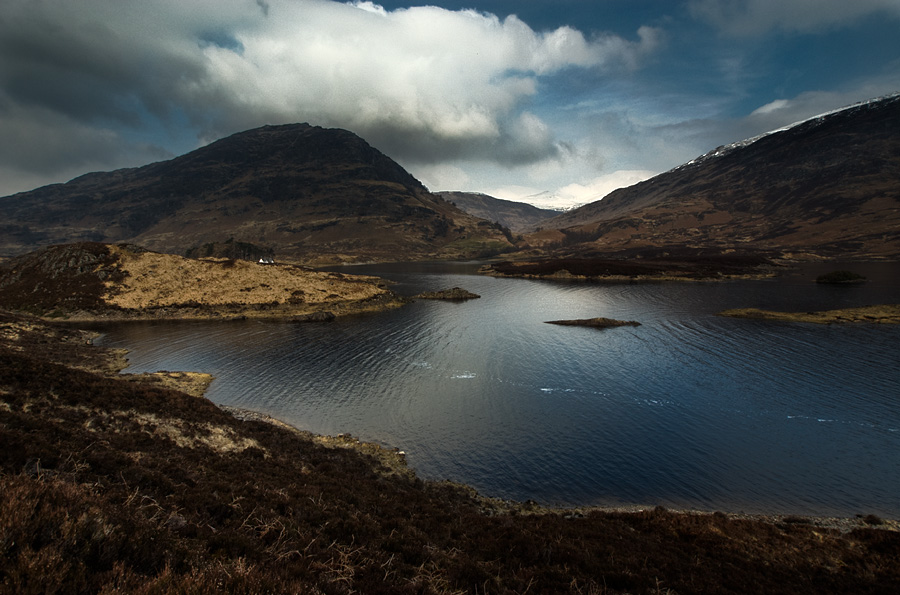
Loch Treig – Land of Clan Cameron
There are many great lochs in Lochaber, including the isolated Loch Treig which has a small islet in it which is called Council Island. It was on this island where the Chief of the Camerons would meet other chiefs, in particular with the MacKintoshes, to settle any dispute. Council Island was an ideal meeting place because the two chiefs could meet without risk of one setting an ambush for the other. The Cameron Chief would be escorted by his men to the meeting, and then on a hillside, overlooking the loch, is the Watch Rock, a large boulder where the Cameron sentinels would keep an eye on the meeting and their Chief.
Fort William was a fort built during the times of Oliver Cromwell, and was used as headquarters for the English troops who had been sent north to keep the Camerons in order. It is said that even long after the other local clans had submitted to the English forces, the Camerons held strong, resulting in many a fierce skirmish between to them and the invaders. On one particular occasion Lochiel and his men found themselves in a tight spot when defending one end of a mountain pass, another band of English soldiers started to advance on them from the other end. To most it would have seemed that capture was inevitable, but not to these Camerons. They carefully, and in formation, retreated, walking backwards to remain facing their enemy, up the steep, snow covered hillside, leaving the English looking on in amazement, unwilling to follow.
Highland soldiers were very much accustomed to many hardships, particularly when at war. One story tells of a Cameron fighter who felt disgraced by the actions of one of his sons one night when sleeping outdoors during the campaign against Cromwell’s men. It was wintertime, and snow covered ground. The Cameron son decided to make a pillow out of a large snowball. On seeing this, the Cameron father flew into a rage, kicking the snowball from under the sons head, saying, “Are you become so like a woman that you cannot sleep without such luxury?”
The Camerons were devoted followers of the Stewarts. They fought at the 1689 Battle of Killiecrankie in support of James VII against the government troops supporting William of Orange. At the battle, which saw victory for the Jacobeans, it was Lochiel’s tactics to “fight immediately while the men were in good heart” which proved to have been successful.
Ewen Cameron
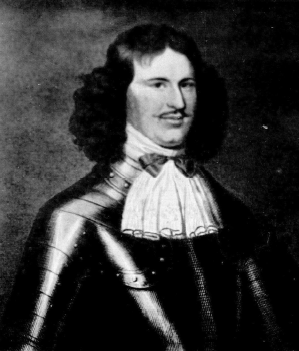
They also supported the 1715 Jacobite rebellion. By this point the Cameron chief, Sir Ewen of Lochiel was an old man of 86, but his son Allan accompanied the Old Pretender, James Francis Edward Stuart, when he landed in Scotland from France. It is claimed that on the morning that the Old Pretender landed in Peterhead, Sir Ewen Cameron awoke from his sleep at his home in Lochaber, and shouted to his wife, Jean Barclay, Lady Cameron, “Wife, wife! The King has landed! The King has landed – and our son Allan is with him!”
Lady Cameron told him that it was just a dream, but Sir Ewen repeated what he said, and insisted that a large bonfire was built. Then the best alcohol in the house was brought out so that all his ‘lads’ – his affectionate term for his clansmen – and friends could drink to the King’s health.
Despite thinking that he was foolish acting so rashly because of a dream, Lady Cameron followed her husbands instructions in helping to organise festivities to celebrate the landing of the James Stuart. And so everyone in the area was invited to celebration, which, in true Highland fashion, last for a number of days.
After a few days had passed, news finally began to filter through to Lochaber that Prince James had in fact landed in Scotland, along with Allan Cameron, at around the exact same time that Sir Ewen Cameron awoke and made the announcement to his wife.
Donald Cameron, known as the ‘Gentle Lochiel’, was grandson of Sir Ewen and he was one of the first nobles to called

Donald Cameron: ‘Gentle Lochiel’
upon when Bonnie Prince Charlie arrived in Scotland. Cameron could see that the Prince’s campaign was essentially futile, as he had neither the money nor the resources that would be needed, and pleaded with Charles to wait until he had some more definite support. However, the Young Pretender was impatient, and angrily said, ‘In a few days, with the few friends that I have, I will erect the Royal Standard and proclaim to the people of Britain that Charles Stuart has come over to claim the crown of his ancestors. And Lochiel may stay at home and from the newspapers learn the fate of his Prince!’
However, Lochiel responded, ‘No! I’ll share the fate of my Prince, and so shall every man over whom Nature and Fortune has given me power!’
So, in 1745, when Charles, and his 150 followers, went to erect his standard at Loch Shiel in Glenfinnan he was devastated to see the place deserted. But then the distant sound of pipes could be heard, and they were getting nearer and nearer, and soon the notes of a Cameron pibroch could be clearly heard, along with the regular tramp of feet, and a line of tartan could be seen coming down the hill. Before too long the line of men, which was eight hundred strong, arranged into regular formation. It was the Cameron men, much to the relief of the Prince. Then, and only then did he give the Marquis of Tullibardine his banner to unfurl, and so began the great ‘Rising of the Forty-Five’.
Lochiel kept his promise to Bonnie Prince Charlie, giving his all in service to his Prince and to the cause; even getting wounded at the battle of Culloden in 1746. Sir Donald Cameron accompanied Charles back to France, where they failed in persuading King Louis XV to attempt another rebellion. Donald never returned to Scotland. He later took charge of a French regiment in 1747, and died in Flanders the following year.
Quick Links to Clan Cameron Products from The Clan Shop
- Cameron Tartan Tie
- Cameron Tartan Pocket Square Handkerchief
- Cameron Tartan Scarves
- Cameron Tartan Kilts
- Cameron Clan Crest Badge
- Cameron Clan Crest Mug
- Cameron Clan Crest T-Shirts
- Cameron Clan Crest Belt Buckle
- Cameron Phone Covers
- Cameron Tartan
- Cameron Clan Crest Crystal Glasses
- Cameron Clan Crest Cufflinks
- Cameron Clan Crest Sgain Dubh
- Cameron Clan Crest Kilt Pin
- Cameron Clan Crest Plaques
The post The Cameron Men appeared first on ScotClans | Scottish Clans.
]]>The post Clan Feud Over Digging up Rob Roy appeared first on ScotClans | Scottish Clans.
]]>
Liam Neeson as Rob Roy
An old Clan feud has resurfaced after plans were announced that the remains of Rob Roy MacGregor were to be dug up. The legendary outlaw is believed to have been buried in Balquhidder, Stirlingshire. But the chief of Clan MacLaren now plans to exhume a body for DNA testing, proving once and for all if it is truely the Scottish folk hero. Donald MacLaren claimed Rob Roy really lies in an unmarked plot several miles away stating “MacGregor properganda lives on long and hard. It would be suprising if he was buried in what was a MacLaren kirkyard. I’m not hugely in favour of bus parties standing around looking at the grave and putting little posies on it. If he’s not there, this myth would stop.’
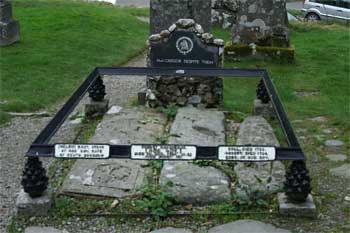
Rob Roys Grave, Balquidder, Stirlingshire – Or is it?
Rob Roy is thought to have been buried with his wife Mary and his two sons in 1734. Peter Lawrie, of the Clan Gregor society, called the move ‘desecration’, adding: “How would you feel if we suggested digging up the MacLaren graves? As far as we are conncerned, Rob Roy is buried in that grave.”
The post Clan Feud Over Digging up Rob Roy appeared first on ScotClans | Scottish Clans.
]]>