The post Drumnacoub – A Bloody Battle in the Far North appeared first on ScotClans | Scottish Clans.
]]>
The Kyle of Tongue
This battle was an internal feud among the men of Clan MacKay but also involved some Sutherland men. A disastrous battle, it led to the loss of many senior members of the clan and most of the belligerents on both sides.
The origins of the battle begin with an ongoing feud between the MacKays and their neighbours the Sutherland Clan. In 1370 the MacKay chief had been murdered by the Sutherlands in Dingwall. This had led to considerable acrimony between both clans as you can imagine and finally in 1426 Angus Du MacKay and his son Neil marched into Sutherland lands to take revenge. They met the Sutherland clan at Harpisdale.
The battle was more or less fought to a stalemate with no clear winner and considerable slaughter on either side. News of the conflict reached James I in Edinburgh. James wasn’t exactly having the easiest of times and frustrated by yet another inter-clan war he rode north to Inverness and demanded that the clan leaders submit to him. Angus duly complied and volunteered his son as a hostage to guarantee his clan’s good behaviour. Neil was taken to the Bass rock. an island prison in the outer Firth of Forth. During his imprisonment he was given the nickname ‘Vass’ a phonetic spelling of ‘Bass’
While this was going on three cousins of Angus Du: the brothers Thomas Mackay, Morgan Mackay, and Neil Neilson Mackay had a dispute with the Laird of Freswick – a man by the name of Mowat. Thomas pursued him to the chapel of St Duffus in the town of Tain. Mowat claimed sanctuary at the chapel but Thomas killed him anyway and burned down the chapel for good measure. As anyone who has followed the fortunes of Robert the Bruce will know murdering someone in a house of worship was a serious breach of etiquette and burning it down was even worse, so once again James I was forced to intervene so he denounced and outlawed Thomas, promising his land and possessions as a reward for his capture dead or alive.
Angus Moray (of Clan Sutherland) apprehended Thomas and handed him over to the law, however there was clear suspicion that Thomas’ own brothers; Morgan and Neil Neilson had assisted Angus Murray for a share of the spoils. Thomas was carted off to Inverness and executed and this apparent betrayal within the clan (made even worse by conspiring with a Sutherland) split the clan.
The Earl of Sutherland – seeing a good opportunity to break the power of the MacKay clan further supported Morgan and Neil Neilson by offering his own daughters in marriage (though they had already married Moray’s daughters). As well as helping them make a bid for the MacKay lands.
Back in Caithness Angus Du and his illegitimate son John Aberach Mackay were in a tight spot. Angus was by now an old man and had no will to fight, preferring to make some sort of settlement with his cousins. He offered all his land apart from Strathnaver but they refused the deal, intending to take all of MacKay lands for themselves. At this point Angus’ illegitimate second son John Aberach Mackay stepped in to advise the elderly chief and offered to defend the MacKay lands or die trying.
Some time between 1427 and 1433 (exact dates are unclear) the two sides met at Drumnacoub (Druim na coub, Drum-ne-coub) a few miles from the coastal village of Tongue on the North East coast.
The battle was a long and terrible one with both sides suffering heavy losses, by the end of the day Neil Mackay, Morgan Mackay and Angus Moray were all dead, John Aberach Mackay was severely wounded (possibly loosing an arm) and lay critical on the battlefield and very few from around 3,000 men (around 1,500 on either side by some estimates) were left standing.
Angus Du in despair asked to be carried to the battlefield to search for his son John but an opportunistic Sutherland archer spotted him and killed him with a well aimed arrow.
Shortly after the battle the remaining MacKay clan had to consider who would succeed as chief. Many supported John despite his illegitimacy but as fortune would have it Neil ‘Vass’ MacKay escaped from imprisonment at the Bass rock and made his way back north (it turned out the governor was married to a MacKay and she possibly helped him break out). John deferred to the legitimate heir and Neil was made chief. John was given lands around Lochnaver.
Neil pursued the Sutherlands who had supported the potential usurpers and a year later took revenge at the Battle of Sandside Chase. The widow of Neil Neilson and his son were given fairly rough treatment at the hands of those loyal to Angus Du’s side and for their own safety the moved to Olrig in Caithness. John dropped the name MacKay and became known as John Bain, progenitor of the Bain Family.
The post Drumnacoub – A Bloody Battle in the Far North appeared first on ScotClans | Scottish Clans.
]]>The post The Flodden 500 Service at St Giles, Edinburgh. appeared first on ScotClans | Scottish Clans.
]]>I’d like to continue by reproducing Alaistair Moffat’s reading given at St Giles. It was an excellent account of the battle and the aftermath.
—
FLODDEN ADDRESS. – ALISTAIR MOFFATWhen dawn broke on the morning of 10th September, 1513, the landscape of hell was revealed. On the gently undulating northern ridges of Branxton Hill more than 10,000 men lay dead or dying. In the midst of the carnage were the naked, plundered bodies of King James IV of Scotland, his half-brother, Alexander Stewart, Archbishop of St Andrews, George Hepburn, Bishop of the Isles, two abbots, nine great earls of Scotland, fourteen lords of parliament, innumerable knights and noblemen of lesser degree and many thousands of farmers, ploughmen, weavers and burgesses. It was the appalling aftermath of the battle of Flodden, the greatest military disaster in Scotland’s history.In the grey light of that terrible dawn, sentries posted around the captured Scottish cannon could make out where the brunt of battle had been joined. Below them, at the foot of the slope ran the trickle of a nameless burn now choked with slaughter, a wrack of mangled bodies, broken pikeshafts, shattered shields and everywhere blood and the sickening stench of death, vomit and voided bowels. Not all of the bodies were yet corpses. Through a long dark night the battlefield had not been a silent graveyard. Trapped under lifeless comrades, crippled, hamstrung or horribly mutilated, fatally wounded men still breathed. Bladed weapons rarely kill outright and they were often used to bludgeon men to their knees or into unconsciousness. In the churned mud of the battlefield some men will have lost their footing, fallen and been hacked at before they could get up. Many bled to death, maimed, lacerated by vicious cuts, screaming, fainting and screaming once more in their death agonies. Some will have been put out of their misery by parties of English soldiers scouring the field by torchlight for plunder, stripping the bodies, ransacking them for valuables. But other men will have lingered on inunspeakable pain, praying to their God, passing in and out of consciousness, slowly bleeding to death. The fury of the battle on Flodden field may have been stilled and awash with death and defeat. But all was not yet over. In an instant the plunderers and scavengers looked up and the sentries by the cannon stood to, frantically peering through the morning light. They could hear the rumbling thunder of hoofbeats – and then, suddenly, riders erupted over Barelees Rig. With 800 horsemen at his back, Lord Alexander Home galloped hard across the horrors of the battlefield and up the slopes of Branxton Hill. They had not come back to Flodden to rejoin a lost battle but to rescue their captured ordnance. And they very nearly succeeded. After a sharp skirmish, the English gunners managed to load and get off a volley at Home’s squadron, and they scattered.And so it ended. As the Border horsemen wheeled round and raced out of range, the remnants of the shattered Scottish army were limping across the Tweed at Coldstream. There was no organised pursuit. The victorious English army had taken heavy casualties and the Earl of Surrey and his captains were exhausted. In any event, their bloody work was done. The floors o’ the Forest were a’ wede awa, Flodden was a national disaster, a harbinger of lawlessness in the shape of the Border Reivers, the beginning of a long period of political uncertainty and the last medieval battle in the history of Britain. The last time a king was to die leading his army.It was also an epic. As two huge armies mustered and marched into history, extraordinary scenes had been witnessed. At Ellemford, high in the Lammermuirs above Duns, where sheep now graze on the flanks of the hills, where buzzards hang in the updrafts and an elegant bridge crosses the Whiteadder, King James IV and his army camped. Huge guns were trundled down the hill trails, dragged by oxen, and by 21st August 1513, almost 30,000 men had massed in this beautiful, now lonely valley. Two days later, the largest force ever to leave Scotland crossed the Tweed at the fords below Coldstream. They had declared war, they had entered the realm of the Tudors, of the ferociously ambitious and bull-like Henry VIII.Meanwhile Thomas Howard, Earl of Surrey, and the Bishop of Durham carried the standard of St Cuthbert before their battle-hardened troops. In front of the high altar of the great cathedral, Howard had watched the bishop bless the flag of the Haliwerfolc. The lands of Palatinate, of the Prince-Bishops of Durham, reached to the Tweed and beyond, and in an early definition of Englishness, their people were known as the Holy Man’s Folk, the Haliwerfolc. Ancient allegiances were being roused and summoned.Between 2nd and 9th September two vast armies circled each other in a small corner of North Northumberland, like heavyweight boxers looking for weaknesses or waiting for wrong moves. After the Earl of Surrey had despatched a herald, the Rouge Croix, it was finally agreed that battle would be joined on 9th September. Supplies for almost 70,000 men, horses and camp followers were running dangerously lowand neither army could remain in the field much longer.Realising the strength of the Scots’ entrenched position, Surrey led his men to the east, skirting Flodden Edge and staying out of artillery range. On the morning of the appointed day, he crossed the River Till and took up a position to the north of James IV’s army, barring any retreat to Scotland. And then, on a damp afternoon, the greatest battle ever fought between England and Scotland began.On the left wing of the Scottish host, the Highlanders led by the Earl of Huntly massed in formation with Lord Home’s Borderers, and in the moments before their chiefs roared the claideamh mor, the order to charge, the Gaelic-speaking warriors did something remarkable. They began to summon the army of the dead. They began the sloinneadh, the naming of the names of memory. To bolster his courage, each man began to recite his genealogy. Many waiting to charge could go back 20 generations. As if they were offering up the murmur of prayer, each man remembered why he had come to fight. Is mise mac Iain, mac Ruaridh, mac Domhnuill. I am the son of John, the son of Roderick, the son of Donald. And once their quiet voices stilled, the roar of the claideamh mor rent the air and they broke into the charge. With their broadswords and Lochaber axes, the Highlanders tore into the English ranks, the division led by Edmund Howard, They scattered and a rout was only prevented when Lord Dacre rode to the rescue with his English Borderers. As history rumbled across Branxton Hill, fortune appeared to be smiling on the Scots.At the same time, James IV was about to make a catastrophic decision, a crucial error of judgement. Instead of occupying an elevated position at the rear of his vast army, he chose to lead from the front. His division raced down Branxton Hill and as they reached the lower slopes and much softer ground, many men began to skid and lose their footing. This unsteadiness made it very difficult for them to control their long, 12 foot pikes. The wet ground made them charge out of formation, only engaging piecemeal with the solidly planted ranks of English billmen, With their shorter, more easily handled bills, they began to slice into James IV’s division. And as the men at the back saw the Scottish pikes go down, they hesitated and many of them ran, believing their king to be killed. By leading from the front, James was immediately submerged in the ruck of the fighting, only able to see what was directly in front of him, in no position to direct his forces. The result was disaster.The legacy of Flodden was most immediately and keenly felt in the Borders. North of the Tweed the memory of the battle is kept alive in the fabric of the midsummer common ridings. At Selkirk the ceremony of the casting of the colours is unique in Britain and it is based on the return of a soldier known as Fletcher, traditionally believed to have been the only one of sixty from the town to return. In his bloodied hand he held aloft, in a gesture of desolate defiance, a flag captured from the men of Macclesfield in Cheshire. Many Englishmen had fought and fallen at Flodden. And passions still run high. When the Mayor of Macclesfield recently wrote to the Provost of Selkirk asking for the return of the flag, he was told that he would need to come to the Borders and take it.Flodden is an immense story. Like Culloden in 1746, it signalled the end of a fading, feudal Scotland. And it also ushered in a century of lawlessness, the criminal society controlled by the appalling Border Reivers. Across Europe, renaissance, enlightenment and the reformation were changing lives, forming new ideas and creating the institutions of the modern world. In the first half of the 16th century, central authority broke down in a leaderless nation, and while swords and spears spoke in Scotland, the law was often silent.What is to be learned from all of that suffering and slaughter, from all of those ancient enmities? First that they are ancient and must remain firmly in the past. In 2014 Scotland faces a historic choice and whichever way the people of Scotland vote, it must be a signal lesson of Flodden that enmity, even ancient enmity can have no part. And it is to the credit of politicians on all sides of the argument that it has not reared an ugly head. But it might.And alongside that it mustmbe important to remember, to understand the visceral, bloody realities of whatmwent on on that terrible day 500 years ago. Lest we forget, Flodden should become a place of remembrance and of pilgrimage, a place where the uncomfortable lessons of history can be learned and never forgotten.Two weeks ago, on one of the countless beautiful evenings of this glorious summer, I drove over to Branxton. As the sun threw long shadows across the gently undulating fields, I tried to imagine the 10th of September, 1513, the distant roar of thousands of men, the screams, the fear and feral closeness of hand-to-hand fighting whenmen can smell the breath, smell the sweat of men grunting pushing, hacking, swearing at them, trying to kill them. In a Gaelic phrase, I tried to listen for the music of the thing as it happened. I tried to listen to the slow, sad music of our history. I hope that many in Scotland and England hear it too.
Prior to the sir Malcolm MacGregor (who has admitted that try as he might he can not find a single MacGregor involved in the battle) researched the casualty lists. The following names are clans and families who are known to have fought at Flodden along with notable people who fell in the battle:
From the Highland Clans:
Campbell, Erskine, Fraser, Gordon, Graham, Guthrie, Haldane, Hay, Keith, Leslie, Lindsay, Macaulay, Macfarlane, Mackay, Maclean, Macnab, Menteith, Moncreiff, Moray, Murray, Ogilvy, Oliphant, Ramsay, Rattray, Ross, Ruthven, Seton, Sinclair, Stewart, Forbes, Forsyth, Grant, MacKenzie, MacNaughton, Ross, Skene, Buchanan Of Leny, MacDonald
The Lowland and Border Clans and Families:
Adair, Abercromby, Adam, Anstruther, Baillie, Baird, Balfour, Barclay, Blackadder, Bonar, Boswell, Carnegie, Cathcart, Cleland, Cockburn, Colville, Craig, Crauford, Crichton, Cunningham, Dunbar, Dundas, Edmonstone Of Duntreath, Elphinstone, Fotheringham, Gray, Grierson, Haig, St.Clair Of Roslin, Henderson, Hepburne, Herries, Home, Hoppringle, Houston, Lauder, Liddel, Lockhart, Lumsden, Lyon, Masterson, Maitland, Maule, Maxtone, Maxwell, Melville, Muirhead, Mure, Napier, Rollo, Sempill, Somerville, Spottiswood, Stewart Of Traquair, Allardice, Ballingall, Kerr, Colville, Crammond, Eliott, Ferguson, Fleming, Foreman (Standard Bearer), Inche, Inglis, Johnstone, Kirkcaldy, Knolis, Logan, Montgomery, Morton, Muir, Nelson Of Madinpap, Otterbrun, Pitcarin, Pringle, Reid, Rorison, Savage, Scott, Seton, Tunstall, Vallanche, Wood Of Raik, Kennedy, Douglas, Hamilton, Livingstone, Wemyss, Wallace, MacLellan, MacCulloch, MacDowall
Chief Or Notable Head Of House/Family
King James IV, Archbishop Of St.Andrews (King’s Son), Earl Of Morton ( Grandson Of James 1), Earl Of Glencairn, Douglas Of Drumlanrig, Sir James Dunbar, Dundas, Lord Elphinstone, Lord Erskine, Earl Of Huntly, Earl Of Montrose, Sir Alexander Guthrie, Haig Of Bemersyde, Haldane Of Gleneagles, Earl Of Errol, Earl Of Bothwell, Sir William Keith, Earl Of Cassilis, Earl Of Rothes, Earl Of Crawford, MacDowal, Earl Of Garthland, MacFarlane Of Arrochar, Hector MacLean Of Duart, Maxwell Lord Of Carlaverock, Sir John Moncreiffe Of That Ilk, Moray Of Abercairney, Ramsay Of Dalhousie, Rattray Of That Ilk, Rollo Of Duncrub, Master Of Ruthven, Lord Sempill, Lord Seton, Earl Of Caithness, Earl Of Atholl, Earl Of Lennox, Lord Darnley, Master Of Angus, Anstruther Of That Ilk, Ballingall Of That Ilk, Master Of Eliott, Lord Forbes, Master Of Lovat, Sir Alexander Gordon Of Lochinvar, Sir Alexander Gordon Of Knockenshene, Grant Of Freuchie, John Henderson Of Fordell, Lord Alexander Home, Sir Patrick Houston Of That Ilk, William Johnstone Of That Ilk, Lord Keith, Lord Lorn, Lyon (Sons Of Lord Glamis), MacKenzie Of Kintail, Sir Alexander MacNaughton Of That Ilk, Andrew Pitcairn Of Pitcairn And 7 Sons, Lord Ross, William Ruthven Of That Ilk, Sir Walter Scott Of Buccleuch, Alexander Skene Of That Ilk, Sir David Wemyss, Earl Of Argyll, Lord Kinnaird, Master Of Cathcart, MacDonald Of Lochalsh.
—–
 The St Giles Service…
Just over 40 clan chiefs attended the St Giles service. At the end of the service they mustered for a photograph on the steps. To help you identify who was there we have been given a sketch with a key to the names:
1. Sir Walter Riddell of Riddell 2. The Hon. Elizabeth Fairbairn 3. Madam Pauline Hunter of Hunterston 4. Sir David Bannerman of Elsick 5. Lord Polwarth 6. Andrew Wallace Younger of that Ilk 7. Andrew Dewar Durie of Durie CBE 8. Michael Ancram, Marquess of Lothian 9. Andrew MacThomas of Finegand 10. Earl of Dundee 11. David Campbell of Strachur 12. Roderick Macneil of Barra 13. Sir James McGrigor 14. Earl of Eglinton and Winton 15. Professor David Hannay of Kirkdale and of that Ilk 16. Henry Trotter Younger of Charterhall 17. John MacArthur of that Ilk 18. Duncan Paisley of Westerlea 19. Richard Carmichael of Carmichael 20. Earl of Caithness21. Earl of Lauderdale 22. The Hon. Alexander Leslie 23. Earl of Erroll 24. Lord Napier and Ettrick 25. Madam Arabella Kincaid of Kincaid 26. David Cranstoun of that Ilk 27. Jamie Macnab of Macnab 28. Earl of Wemyss and March 29. Sir Crispin Agnew of Lochnaw 30. The Hon. Kate Nicolson 31. Duke of Montrose 32. The Hon. Peregrine Moncreiffe of that Ilk 33. Martin Haldane of Gleneagles 34. Lord Sempill 35. Andrew Marjoribanks of that Ilk 36. Donald MacLaren of MacLaren 37. Duke of Hamilton 38. Field Marshal the Lord Guthrie of Craigiebank 39. Isla St Clair 40. Marquess of Ailsa 41. Madam Margaret Eliott of Redheugh 42. Sir Malcolm MacGregor of MacGregor 43. Lord Macdonald of Macdonald 44. Richard Oliphant of that Ilk
This image will help you identify the chiefs:

The post The Flodden 500 Service at St Giles, Edinburgh. appeared first on ScotClans | Scottish Clans.
]]>The post Òrain Gàidhlig – Scottish Gaelic Song appeared first on ScotClans | Scottish Clans.
]]>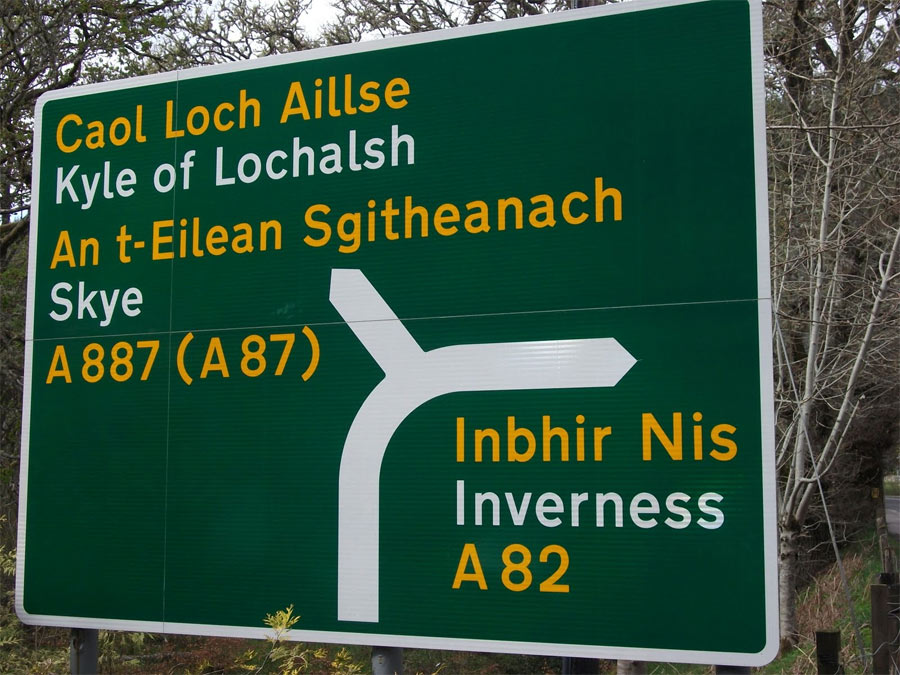
Bilingual Scottish Road Sign
One of the experiences that stood out the most on my Highland adventure a few months back was the amount of Scottish Gaelic I encountered. From road and railway station signs, to the greeting displayed on the entrance to McDonalds in Inverness, this was my first encounter with Scotland’s oldest surviving spoken language. It’s something you don’t really come across in Edinburgh, either because the language is spoken by less than 2% of the Scottish population, or because Lowland Scots has been the traditional form of speech in the south.
Sadly Scottish Gaelic has been in steady decline for quite some time. 100 years ago the amount of bilingual Scots numbered 183,998. At the time of the last census in 2001, only 58,652 people were registered as bilingual in Gaelic. Nevertheless, the language is in the midst of a government supported revival. BBC’s Gaelic television station Alba reportedly gets on average 530,000 viewers per week, and Edinburgh’s Gaelic primary school is currently at full capacity, prompting a relocation to a larger campus later in the year.
Apart from place names, I had never spoken a word of Gaelic in my life until last Friday when I attended a Gaelic harmony singing workshop. Held at the Scottish Storytelling Centre on Edinburgh’s Royal Mile, I arrived a little early and sat trying to figure out how to pronounce the lyrics on the handout I’d received. I have never encountered a language quite like it before – the words are pronounced entirely differently to how you would expect them to sound. This makes reading Gaelic when beginning to learn a little bit perplexing. I found it much easier to watch and listen to how it looks and sounds, mimicking rather than trying to read.
The workshop was lead by well-known Gaelic singer Gillie Mackenzie. Gillie grew up in Lewis but now lives in the Lothians, and has been singing ever since she can remember. Family ceilidhs instilled an early understanding of vocal harmony and she fondly told us how her and her sisters would sing and harmonise together in Gaelic while doing the dishes at home. Gillie currently teaches Gaelic song and conducts the Gaelic choir at Bunsgoil Crois na Cìse (the Gaelic medium unit at Edinburgh’s Tollcross Primary School), and recently began a Gaelic choir at James Gillespie’s High School. She released her first solo album entitled Griais in 2012 and is currently touring with her band.
We began by singing two traditional songs (Tobair Tobair Siolaidh and ‘S Toigh Leam Fhin Buntat ‘s ìm); first as a group, then combined with different vocal harmonies, and finally in round. It sounded absolutely glorious and I wondered if the tourists just outside the window walking up and down the high street could hear us singing in ancient Scottish tongue. The first few times we went through the song I felt completely lost with the language, but as we repeated the song my mouth was slowly becoming accustomed to this new way of speaking. We then learnt a beautiful song called Gleanna Gollaidh by Robert Donn (1714-78). Donn was a well-known bard hailing from Sutherland (Mackay country), with this particular song praising a glen in his district:
Gleann-a-Gallaidh, Gleann-a-Gallaidh, (Glen Gollaidh, Glen Gollaidh)
Gleann-a-Gallaidh nan craobh, (Glen Gollaidh of our trees)
Cò a chì e nach mol e, (Who can see it without praising it?)
Gleann-a-Gallaidh nan craobh. (Glen Gollaidh of our trees)Ri faicinn crìoch àrdain (Seeing the abutment of its elevation)
Ga mo bhreugadh gu taobh, (Drew me aside)
‘S ann a smuainich mi fanadh (Indeed I thought of staying in)
An Gleann-a-Gallaidh nan craobh. (Glen Gollaidh of the trees)Chan àill leam bhur n-airgead (I don’t desire your money)
‘S ri bhur n-arm cha bhi mi, (And I’ll never join your army)
Cha diùlt mi bhur drama (I won’t refuse your dram)
Ach ri tuilleadh cha bhì. (But I’ll do no more than that)Ged a gheibhinn gu m’ àilgheas (Though I might get to my desire)
Ceann-t-sàile MhicAoidh, (Mackay’s Kintail)
‘S mòr a b’ annsa leam fanadh (More I fancy staying)
An Gleann-a-Gallaidh nan craobh. (In Glen Gollaidh of the trees)Fonn diasach, ‘s mòr a b’ fhiach e (Bountiful land, much of its value)
Gu fiadhach ‘s gu nì, (For stalking and cattle)
Aite sìobhalt ri doineann (An agreeable place in time of storm)
Is nach criothnaich a’ ghaoth. (In which the wind will not shudder).
Coincidentally, Donn was writing poetry around the same time as the 1745 Jacobite Rising. An ardent Jacobite supporter, Dunn upset the Hanoverian chief of Clan Mackay by writing this poem about the rising:
Now, young Charles StewartEvery clan places its hope in youThat sought to crown youAnd set the country alight;They’re like hidden snakesWhich cast their skins last yearBut are making ready their fangs
To arise on the day of your coming

Waulking in Iochdar, South Uist, June 1970
We finished the workshop with an Isle of Lewis waulking song called Bodachan Cha Phòs mi. These songs were traditionally sung by women waulking cloth and were an institution in female Gaelic society. This practice involved a group of women beating newly woven tweed rhythmically against a table or similar surface to soften it. As the singers worked the cloth, they gradually shifted it to the left so as to work it thoroughly. Typically one person would sing the verse, while the others joined in the chorus. A night at a waulking was a tremendous social outlet for women. The songs have a strong element of gossip in them, of exchanging secrets, of comments on men, good and bad. Although some songs were light-hearted and trivial, many were intimate, frank, intensely vivid, and expressive statements of women’s experiences.
A week since the workshop, I’m suprised at how well I have remembered the melody and the language I learnt. I have quite often found myself humming the songs, especially the beautiful Gleanna Gollaidh. Sadly the only statistics I can find online regarding Scotland’s Gaelic speakers date from 2001, but I would love to know if efforts since have increased the number of speakers of this fascinating language.
——-
You can listen to Gleanna Golaidh by visiting the BBC’s Year of Song website here, and they also have a great ‘teach yourself Gaelic’ website for absolute beginners called Beag air Bheag.
Another great resource for Scottish oral recordings is Tobar an Dualchais where you can hear many Gaelic recordings.
The post Òrain Gàidhlig – Scottish Gaelic Song appeared first on ScotClans | Scottish Clans.
]]>The post Hugh William Mackay, Chief of Clan Mackay Dies appeared first on ScotClans | Scottish Clans.
]]>
Lord Reay 1937-2013
Clan Mackay. A distinguished parliamentarian, Mackay served in the House of Lords, held office for a short time in the Thatcher government and later sat for six years in the European Parliament. Mackay died in London on May 10 2013 aged 75 following a short illness. One of two Scottish elected hereditary peers who survived Blair’s Parliamentary reforms of 1999, Mackay’s death has triggered a rare by-election to appoint his successor in the House of Lords.
Born on July 19 1937 in Edinburgh, Mackay was the only son of Aeneas Alexander Mackay, 13th Lord Reay, and his wife Charlotte (née Younger). Mackay was educated at Eton College and Christ Church in Oxford where his sharp dress sense was first noted. He was living in Holland when his father died in 1963, inheriting the titles of Lord, Chief, Baronet of Farm (a Nova Scotia title originally bestowed on an ancestor by James VI) and the Barony of Ophemert and Zennewijnen (created in 1822 by King William I of Netherlands). With this latter title came the picturesque 16th-century manor house, Ophemert Castle in the Netherlands.

The Chief and his lady Victoria at the Gathering in 2009
Lady Elizabeth Fairbairn, Hugh’s sister and president of the Clan Mackay Society, said her brother spoke with authority on a number of subjects related to the north of Scotland – especially the Highland Clearances. Mackay attended the Clan Gathering in Edinburgh 2009, walking the Royal Mile parade in Mackay tartan, and later spoke enthusiastically at the Mackay tent of the work being done at the Clan Mackay Room at the Strathnaer Museum in Sutherland. He also spoke of his love for Edinburgh, saying: “I have always had a soft spot for Edinburgh, the place of my birth and still managing to hold its place as, in my opinion, the most beautiful city in the United Kingdom. I feel honoured to be amongst you. Clansmen, Clanswomen. I ask you to raise your glasses to Clan Mackay.”
Mackay entered the House of Lords as a cross-bencher and played a prominent role in the abolition of capital punishment in 1965, joining the Liberals soon afterwards. However, disapproving of the party’s standing as a genuinely ‘national’ party he returned to the cross-benchers before joining the Conservatives in 1971. Upon the UK’s entry to the Common Market in 1973, Mackay was one of eight peers nominated to serve in the European Parliament. After the Parliament’s first public election in 1979, he was nominated to the Council of Europe which he served in until 1986. During this time his increasingly hawkish attitude on defence issues attracted the attention of Margaret Thatcher who appointed him as a Lord-in-Waiting or junior whip. Thatcher’s successor John Major appointed Mackay as Parliamentary Under Secretary of State to the Department of Trade and Industry (DTI), however he decided to leave Parliament less than a year later. He joined the Select Committee on the European Communities, also chairing its food and agriculture subcommittee, until 1999. Mackay stayed a member of the House of Lords until 2013.
During his political career Mackay’s support of environmental issues was mixed – On behalf of the Department of the Environment he had to oppose pressure for the phasing out of CFC gases, however one of his first announcements at the DTI was a package of grants for recycling. As recently as May 2012 Mackay sponsored legislation to define minimum distances between wind turbines and residential premises, however during a debate on renewable energy he dismissed wind power as a pointless gesture towards an economically crippling green ideology. Mackay was also strongly against further EU integration, gay marriage and caused controversy when he suggested that Britain recognised the Dalai Lama as a spiritual (rather than a political) leader only.
Mackay married Annabel Therese Fraser in 1964, youngest daughter of the 17th Lord of Lovat, and had two sons and daughters. They divorced in 1978, and in 1980 Mackay married Victoria Warrender, daughter of the 1st Lord of Bruntsfield, having two daughters. His elder son, Aeneas Simon Mackay – Master of Reay, born in 1965, succeeds the titles including the chieftainship of Clan Mackay. The funeral is likely to be on the 23rd of May in Lancashire with a Memorial Service in London to be held at a later date.
The post Hugh William Mackay, Chief of Clan Mackay Dies appeared first on ScotClans | Scottish Clans.
]]>The post Map Reveals Scots Modern-Day Surnames appeared first on ScotClans | Scottish Clans.
]]>
The Uncertainty of Identity project maps Great Britain’s most popular surnames by area.
A map of Great Britain’s most popular surnames shows the dominance that clan areas still hold in Scotland, while other areas show the effects of modern-day immigration. Created by experts from three English Universities, Uncertainty of Identity uses surnames listed on the electoral roll to find the three most popular names in each electoral ward.
Mackay and Sutherland are the most popular names in the North Highlands, echoing the ancient territories and stronghold of the clans. Mackenzie, Fraser and Ross are the most popular in the area North of Inverness, while MacLeod and MacDonald dominate the Western Isles – data that directly corresponds with clan territory maps.
In the Northern Isles Halcrow, Drever and Flett survive as the third most common surnames, while Shetland still boasts a diverse mix of Spences, Rendalls and Sinclairs. Carole Hough, professor of onomastics – the study of name origins – at Glasgow University, said the surnames of Orkney and Shetland differ from much of mainland Scotland due to naming traditions.
“Shetland and Orkney are unique in that they have a much higher proportion of surnames from local place names, which makes them quite distinctive. Place names tend to cluster around their origin, which is surprising given how mobile people are,” she added
The English derived surname Smith is the most dominant across the whole of Great Britain with a considerable stronghold in the lowlands and east of Scotland. Modern-day immigration shows in areas such a Glasgow’s Pollokshield’s East, with Ahmed, Ali and Singh popular surnames. Jones, Davies and Williams dominate in Wales.
Looking to the future, a resurgence in the popularity of traditional Scottish forenames in recent years is likely to combat Anglicisation, said Hough.
“Far more Gaelic and Celtic-derived personal names are being chosen by parents in Scotland, which can be a way of affirming national identity,” she says. “Gaelic-derived forenames that are in the top 100 names in Scotland at the moment include Aiden, Callum and Finlay. Cameron is originally a clan name, and Lewis, Evan and Isla are all place names.”
You can view a map of Scotland’s most popular surnames at Tartan Footprint.
The post Map Reveals Scots Modern-Day Surnames appeared first on ScotClans | Scottish Clans.
]]>The post Clan Murray Chief, John Murray, 11th Duke of Atholl, dies aged 83 appeared first on ScotClans | Scottish Clans.
]]>
The 11th Duke of Atholl, centre, in his role as Colonel-in-Chief of the Atholl Highlanders
John Murray, the Chief of the Murray clans and 11th Duke of Atholl has died in a South African hospital on Tuesday, 15th May after suffering a stroke. He was 83.
The Johannesburg born Murray became Clan Chief and inherited the Dukedom after his cousin George Murray, 10th Duke of Atholl passed away unmarried in 1996.
Murray, the 4x great-grandson of John Murray, 3rd Duke of Atholl, was born in South Africa in 1929, the only child of Major George Murray and his wife Joan Eastwood. His father was killed in 1940 in active service during the Second World War.
A land surveyor by profession, John married Margaret ‘Peggy’ Leach in 1956 and had three children together: Lady Jennifer Murray; Bruce Murray, Marquess of Tullibardine; and Lord Craig Murray. The eldest son, Bruce, will now become the 12th Duke of Atholl.
A spokesperson at the Atholl Estates in Perthshire announced the death of the Duke and said that his standard would be flown at half-mast out of respect. He added,
“The Duke was Colonel-in-Chief of the Atholl Highlanders and over the years had become a well known figure on Atholl Estates. He visited Scotland every year for the Atholl Highlander’s parade and gathering held at the end of May.
“As he would have wished, the parade will be held this year as usual, at Blair Castle on Saturday May 26 and the Gathering on Sunday 27.
“A service of remembrance will be held at Blair Castle when the Atholl Highlanders and local friends will have a chance to remember the Duke.”
Andrew Bruce Wooton, the general manager at Blair Castle said,
”He was in his 80s and had a full and fantastic life. His family are feeling the sorrow but are thankful he had such an interesting and varied life. He was such a happy and joyful man.”
Apparently, it has been confirmed that Bruce Murray, the new Duke, will visit Blair Atholl to inspect the Highlanders at the next coming parade and gathering.
The 11th Duke was well liked around the estate, and made many friends. Edna Mackay, a former employee at Blair Castle, and good friend, who spent much time with Duke and Duchess, both in Scotland and South Africa, was very saddened by the news of Murray’s death. She went on to say,
“He was proud to be the Duke of Atholl and he carried out his duties very well. We are a small community and he will be greatly missed by the many friends he made here.”
The post Clan Murray Chief, John Murray, 11th Duke of Atholl, dies aged 83 appeared first on ScotClans | Scottish Clans.
]]>The post All hail to the female chiefs appeared first on ScotClans | Scottish Clans.
]]>
Madam Arabella Kincaid
Chief of Clan Kincaid, Madam Arabella Kincaid says: ‘When I became chief it was almost like being a mother for the first time. I get letters all the time, mainly from the US, and we’ve had an active clan association for more than 50 years.’
Flora Fraser, Lady Saltoun Chief of Clan Fraser is not only a female Clan Chief but is currently the only female holder of a lordship who also holds a seat in the House of Lords as an elected hereditary peer. Now that’s impressive.
To celebrate this and upcoming Mother’s Day I have started to put together a list:
- Clan Elliot : Madam Margaret Elliot of Redheugh
- Clan Fraser: Rt Hon. The Lady Saltoun
- Clan Grierson: Sarah Grierson of Lag
- Clan Hunter: Madam Pauline Hunter of Hunterson
- Clan Kincaid: Madam Arabella Kincaid of Kincaid
- Clan MacDougall: Morag MacDougall of MacDougall
- Clan MacKay: The Hon. Elizabeth Fairbairn
- Clan MacKinnon: Madam Ann MacKinnon of MacKinnon
- Clan Mar: Margaret of Mar, 31st Countess of Mar
- Clan Moffat: Madam Jean Moffat of that ilk
The post All hail to the female chiefs appeared first on ScotClans | Scottish Clans.
]]>The post Virtual Clan Gathering appeared first on ScotClans | Scottish Clans.
]]>
Strathnaver Museum
Getting Clan members together is extremely difficult, generations have scattered to every corner of the world. A small remote museum in the Highlands is planning an inventive way to get the member’s of the MacKay Clan together, it has organised a virtual clan gathering.
The museum has invited members of Clan MacKay to send in photos of themselves. The photos will form exhibition called ‘Clan Mackay Goes Global’ which will be exhibited at the museum on the 2nd of May. This exhibition will also be available online.
As well as being quite interesting to see how far afield the Clan has spread there is also a poignant message behind this exhibition. Strathnaver was an area affected by the Highland Clearances in the 18th Century. This exhibition shows the joining of the clan after this dispersion at the place where the Clearances happened.
We will keep you updated with how this event goes, I imaging it will inspire some other clans to do something similar.
The post Virtual Clan Gathering appeared first on ScotClans | Scottish Clans.
]]>