The post The Benbecula Mermaid. appeared first on ScotClans | Scottish Clans.
]]> While touring recently around the islands of the Outer Hebrides we came upon this strange story.
In 1830 people were busy cutting seaweed at Sgeir na Duchadh near Grimnis on the west coat of the island of Benbecula. One woman spotted a creature several yards out in the water. The creature looked like a woman in miniature. Alarmed she called to the others working on the shore who also saw this strange sight. Men went into the water to try to catch the creature but she evaded them. A boy aimed a rock at her which struck her on the back, she cried out in pain and disappeared beneath the waves.
A few days later a creature was washed up dead on the beach at Culle bay near the township of Nunton which lies a few miles north of this spot. The creature was said to have the upper shape of a well developed woman but was around the size of a 4 year old girl. She had long dark glossy hair and white skin, however her lower half was described as being ‘like a salmon’ but without the scales.
As the crowds gathered on the beach they all agreed that this was the body of a mermaid.
The factor for the chief of MacDonald of Clanranald who was also the local sherif was called. On seeing the creature he called for a shroud and coffin to be brought to the beach and the creature was layer into this and buried in the nearby churchyard. It was said that the funeral for this creature was one of the largest attended on the island and was carried out like any proper christian burial.
No grave marker related to the incident can be seen at the churchyard and others have said that the creature was buried near the dunes and not in the churchyard at all, in fact a recent survey of a large stone near the south end of the bay was carried out, suspecting that this may indeed be the resting lave of the mermaid but this was inconclusive.

Culla Bay, Benbecula
So what do you think? evidence of mermaids or another ‘fishy tale’ from the islands. Certainly mermaid stories like this do bring in the tourists who were beginning to find their way to the islands in the mid 19th century. Many other tales of mermaids exist on the islands. A crofter from Barra called Colin Campbell spotted what looked like an otter fishing near the shore, he was about to shoot it but decided to check it though a telescope only to see what he described as a woman carrying a small baby in her arms. the creature then spotted him on the shore and disappeared. Whatever the truth is they do make great stories.
The post The Benbecula Mermaid. appeared first on ScotClans | Scottish Clans.
]]>The post ScotClans on the Road to the Isles appeared first on ScotClans | Scottish Clans.
]]>I don’t think there is anywhere on earth that can compete with it, it’s a magical place.

Walking in the Rain near Tyndrum
Last week we packed up our camper van and began our journey North-West. We decided to take a two day rest stop on the way by Tyndrum. This scattering of houses on the road north is a popular stop; the West Highland Way has it’s halfway point here and the famous Green Welly stop has become an institution for those travelling along this way. We drove through blazing sunshine all the way and within minutes of arriving the skies darkened over and rain began to fall… typical!
Never mind though, the Real Food Cafe in Tyndrum which serves the best fish and chips in the highlands was a short walk from our camping spot and we spent our free day taking a walk up through the woods to explore the path to Ben Lui.
With the van batteries charged and ready to cope with a few days of rough camping we set off for Arisaig. The journey to this remote part of the North-West highlands is like a history lesson in tarmac. From Tyndrum the road climbs up towards Rannoch Moor and then into Glencoe. Several miles of twisting road opens out at Fort William, a sprawling highland town that was once part of the government’s ‘quieting’ of the highlands but is now an economic and tourist hub for the area. Breaking away from the main route to Inverness you venture into a Jacobite story book; The Glenfinnan monument where Charles Edward Stuart raised the standard and lit the blue touch paper of the rebellion of 1745 and just a few miles further on Loch Nan Uamh where the Jacobite adventure both began and ended on mainland Scotland.

A Picnic Spot at Loch Eilt
On the way we found a quiet lay by to stop for a short picnic. Loch Eilt is a beautiful location and one that might be familiar with Harry Potter fans. A small island in the loch featured as the site of Dumbledore’s grave. There are even more obvious links to the boy wizard on this route too of course, the Glenfinnan viaduct made famous in the second movie and you are almost guaranteed to spot the steam train that takes tourists from Fort William to Mallaig at some point – the train that doubled for the Hogwarts Express.
By the afternoon we had left the main road and we were bumping up and down over the twisting beach road to the site of Arisaig Games.

The Beaches by Arisaig
As locations go Arisaig has one of the best for a highland games you could imagine. From the back of the field you can look over stunning beaches to the Cuillins of Skye and the island of Eigg. This is a useful feature; when the island of Eigg disappears as it often does its time to find shelter!
With every campsite in the area full (and there are many of them) we were fortunate to be allowed to camp on the corner of the games area. ScotClans would be running a stand at the games a few days later. For now though we had a very interesting engagement to attend, the Clanranald barbecue.
On the map Castle Tioram looks like a short hop, even faster by boat but a twisting route along single track roads. Our ageing camper van struggled valiantly over the difficult terrain and after a bone shaking last few miles we arrived at the castle, well not quite the castle but the mainland across from it. Tioram sits on a tidal island and is cut off for a few hours at high tide, unfortunately the tide was coming in so ourselves and many guests had to take off socks and shoes to wade across to the island. in time several boats arrived with more guests and others were ferried over as the gathering began.

Guests Arrive by Boat
In my time I’ve met a lot of clans folk from the highlands and the lowlands, I’ve passed the time of day with many a clan chief but the Clanranald MacDonalds are from a mould that was broken a long time ago. They are welcoming, gracious but absolutely bonkers! Refreshing, hedonistic and above all great fun to be around.
under the presence of the magnificent castle a marquee had been erected. with the sun starting to go down I was keen to explore around the castle and was rewarded with some great shots in the fading light. Tioram is a fantastic ruin but still well preserved in its structural integrity, so much so that restoring the castle would not be impossible or prohibitively expensive. Imagine being the first to spend a night there in a wind and watertight dwelling in nearly 300 years!

Castle Tioram
The night soon fell and the tide once again revealed the sandy causeway back to the mainland and guests began to drift away, Fortunately for us our home for the night was just a short walk as we made use of the fact we had brought the camper van and spent the night in the small car park. While helping to clear up and taking back the camping chairs we had loaned for the night Amanda and I had discovered a large unsmoked cigar tucked in the cup holder. With the kids safely tucked in we stole an hour sharing a cigar and watching the last of the light fade behind the castle. We felt like a couple of naughty kids!
The next day we took a stroll along the beach and helped take down the marquee on the island before retracing our bone shaking journey back to Arisaig. There was more work to do here with another marquee to erect but in no time all was nearly ready for the games.

Arisaig Games
The wonderful thing about small highland games is the way they involve the community, everyone and his dog lends a hand and things may look chaotic but this is very deceptive. There is a method in the madness and in no time everything comes together. ScotClans had been asked here to take part in a new venture for these games, to provide an area that was more focussed on ancestry and heritage. With our experience of Grandfather Mountain Games we decided to replicate much of what COSCA does there and provide assistance tracing peoples clan roots. We also set up a small stall of clan merchandise in the hope that a few sales would at least cover our fuel costs.

The ScotClans Stand, Somewhere in There
The few hours we had there were well spent and the stand was busy right up to the end of the day. We had erected a large world map and invited visitors to place a sticker where they had come from. by the and of the day our map had stickers from Canada to Samoa and many interesting and unusual places in between. It was incredible to imagine how people from so many far flung lands had all descended on this little field beside a beach in the highlands of Scotland and for us it was a symbol of just how far our great Scottish Diaspora have travelled from these shores.
Hopefully our experiment worked and in a few months time we will be replicating this at Cowal Gathering at Dunoon. Our next stop though will be Killin games in a few day time as guests of Clan MacNab.
If you happen to be in that part of Perthshire please drop in and say hello.
To see more photos from our trip please visit our Flikr Gallery
The post ScotClans on the Road to the Isles appeared first on ScotClans | Scottish Clans.
]]>The post The Flodden 500 Service at St Giles, Edinburgh. appeared first on ScotClans | Scottish Clans.
]]>I’d like to continue by reproducing Alaistair Moffat’s reading given at St Giles. It was an excellent account of the battle and the aftermath.
—
FLODDEN ADDRESS. – ALISTAIR MOFFATWhen dawn broke on the morning of 10th September, 1513, the landscape of hell was revealed. On the gently undulating northern ridges of Branxton Hill more than 10,000 men lay dead or dying. In the midst of the carnage were the naked, plundered bodies of King James IV of Scotland, his half-brother, Alexander Stewart, Archbishop of St Andrews, George Hepburn, Bishop of the Isles, two abbots, nine great earls of Scotland, fourteen lords of parliament, innumerable knights and noblemen of lesser degree and many thousands of farmers, ploughmen, weavers and burgesses. It was the appalling aftermath of the battle of Flodden, the greatest military disaster in Scotland’s history.In the grey light of that terrible dawn, sentries posted around the captured Scottish cannon could make out where the brunt of battle had been joined. Below them, at the foot of the slope ran the trickle of a nameless burn now choked with slaughter, a wrack of mangled bodies, broken pikeshafts, shattered shields and everywhere blood and the sickening stench of death, vomit and voided bowels. Not all of the bodies were yet corpses. Through a long dark night the battlefield had not been a silent graveyard. Trapped under lifeless comrades, crippled, hamstrung or horribly mutilated, fatally wounded men still breathed. Bladed weapons rarely kill outright and they were often used to bludgeon men to their knees or into unconsciousness. In the churned mud of the battlefield some men will have lost their footing, fallen and been hacked at before they could get up. Many bled to death, maimed, lacerated by vicious cuts, screaming, fainting and screaming once more in their death agonies. Some will have been put out of their misery by parties of English soldiers scouring the field by torchlight for plunder, stripping the bodies, ransacking them for valuables. But other men will have lingered on inunspeakable pain, praying to their God, passing in and out of consciousness, slowly bleeding to death. The fury of the battle on Flodden field may have been stilled and awash with death and defeat. But all was not yet over. In an instant the plunderers and scavengers looked up and the sentries by the cannon stood to, frantically peering through the morning light. They could hear the rumbling thunder of hoofbeats – and then, suddenly, riders erupted over Barelees Rig. With 800 horsemen at his back, Lord Alexander Home galloped hard across the horrors of the battlefield and up the slopes of Branxton Hill. They had not come back to Flodden to rejoin a lost battle but to rescue their captured ordnance. And they very nearly succeeded. After a sharp skirmish, the English gunners managed to load and get off a volley at Home’s squadron, and they scattered.And so it ended. As the Border horsemen wheeled round and raced out of range, the remnants of the shattered Scottish army were limping across the Tweed at Coldstream. There was no organised pursuit. The victorious English army had taken heavy casualties and the Earl of Surrey and his captains were exhausted. In any event, their bloody work was done. The floors o’ the Forest were a’ wede awa, Flodden was a national disaster, a harbinger of lawlessness in the shape of the Border Reivers, the beginning of a long period of political uncertainty and the last medieval battle in the history of Britain. The last time a king was to die leading his army.It was also an epic. As two huge armies mustered and marched into history, extraordinary scenes had been witnessed. At Ellemford, high in the Lammermuirs above Duns, where sheep now graze on the flanks of the hills, where buzzards hang in the updrafts and an elegant bridge crosses the Whiteadder, King James IV and his army camped. Huge guns were trundled down the hill trails, dragged by oxen, and by 21st August 1513, almost 30,000 men had massed in this beautiful, now lonely valley. Two days later, the largest force ever to leave Scotland crossed the Tweed at the fords below Coldstream. They had declared war, they had entered the realm of the Tudors, of the ferociously ambitious and bull-like Henry VIII.Meanwhile Thomas Howard, Earl of Surrey, and the Bishop of Durham carried the standard of St Cuthbert before their battle-hardened troops. In front of the high altar of the great cathedral, Howard had watched the bishop bless the flag of the Haliwerfolc. The lands of Palatinate, of the Prince-Bishops of Durham, reached to the Tweed and beyond, and in an early definition of Englishness, their people were known as the Holy Man’s Folk, the Haliwerfolc. Ancient allegiances were being roused and summoned.Between 2nd and 9th September two vast armies circled each other in a small corner of North Northumberland, like heavyweight boxers looking for weaknesses or waiting for wrong moves. After the Earl of Surrey had despatched a herald, the Rouge Croix, it was finally agreed that battle would be joined on 9th September. Supplies for almost 70,000 men, horses and camp followers were running dangerously lowand neither army could remain in the field much longer.Realising the strength of the Scots’ entrenched position, Surrey led his men to the east, skirting Flodden Edge and staying out of artillery range. On the morning of the appointed day, he crossed the River Till and took up a position to the north of James IV’s army, barring any retreat to Scotland. And then, on a damp afternoon, the greatest battle ever fought between England and Scotland began.On the left wing of the Scottish host, the Highlanders led by the Earl of Huntly massed in formation with Lord Home’s Borderers, and in the moments before their chiefs roared the claideamh mor, the order to charge, the Gaelic-speaking warriors did something remarkable. They began to summon the army of the dead. They began the sloinneadh, the naming of the names of memory. To bolster his courage, each man began to recite his genealogy. Many waiting to charge could go back 20 generations. As if they were offering up the murmur of prayer, each man remembered why he had come to fight. Is mise mac Iain, mac Ruaridh, mac Domhnuill. I am the son of John, the son of Roderick, the son of Donald. And once their quiet voices stilled, the roar of the claideamh mor rent the air and they broke into the charge. With their broadswords and Lochaber axes, the Highlanders tore into the English ranks, the division led by Edmund Howard, They scattered and a rout was only prevented when Lord Dacre rode to the rescue with his English Borderers. As history rumbled across Branxton Hill, fortune appeared to be smiling on the Scots.At the same time, James IV was about to make a catastrophic decision, a crucial error of judgement. Instead of occupying an elevated position at the rear of his vast army, he chose to lead from the front. His division raced down Branxton Hill and as they reached the lower slopes and much softer ground, many men began to skid and lose their footing. This unsteadiness made it very difficult for them to control their long, 12 foot pikes. The wet ground made them charge out of formation, only engaging piecemeal with the solidly planted ranks of English billmen, With their shorter, more easily handled bills, they began to slice into James IV’s division. And as the men at the back saw the Scottish pikes go down, they hesitated and many of them ran, believing their king to be killed. By leading from the front, James was immediately submerged in the ruck of the fighting, only able to see what was directly in front of him, in no position to direct his forces. The result was disaster.The legacy of Flodden was most immediately and keenly felt in the Borders. North of the Tweed the memory of the battle is kept alive in the fabric of the midsummer common ridings. At Selkirk the ceremony of the casting of the colours is unique in Britain and it is based on the return of a soldier known as Fletcher, traditionally believed to have been the only one of sixty from the town to return. In his bloodied hand he held aloft, in a gesture of desolate defiance, a flag captured from the men of Macclesfield in Cheshire. Many Englishmen had fought and fallen at Flodden. And passions still run high. When the Mayor of Macclesfield recently wrote to the Provost of Selkirk asking for the return of the flag, he was told that he would need to come to the Borders and take it.Flodden is an immense story. Like Culloden in 1746, it signalled the end of a fading, feudal Scotland. And it also ushered in a century of lawlessness, the criminal society controlled by the appalling Border Reivers. Across Europe, renaissance, enlightenment and the reformation were changing lives, forming new ideas and creating the institutions of the modern world. In the first half of the 16th century, central authority broke down in a leaderless nation, and while swords and spears spoke in Scotland, the law was often silent.What is to be learned from all of that suffering and slaughter, from all of those ancient enmities? First that they are ancient and must remain firmly in the past. In 2014 Scotland faces a historic choice and whichever way the people of Scotland vote, it must be a signal lesson of Flodden that enmity, even ancient enmity can have no part. And it is to the credit of politicians on all sides of the argument that it has not reared an ugly head. But it might.And alongside that it mustmbe important to remember, to understand the visceral, bloody realities of whatmwent on on that terrible day 500 years ago. Lest we forget, Flodden should become a place of remembrance and of pilgrimage, a place where the uncomfortable lessons of history can be learned and never forgotten.Two weeks ago, on one of the countless beautiful evenings of this glorious summer, I drove over to Branxton. As the sun threw long shadows across the gently undulating fields, I tried to imagine the 10th of September, 1513, the distant roar of thousands of men, the screams, the fear and feral closeness of hand-to-hand fighting whenmen can smell the breath, smell the sweat of men grunting pushing, hacking, swearing at them, trying to kill them. In a Gaelic phrase, I tried to listen for the music of the thing as it happened. I tried to listen to the slow, sad music of our history. I hope that many in Scotland and England hear it too.
Prior to the sir Malcolm MacGregor (who has admitted that try as he might he can not find a single MacGregor involved in the battle) researched the casualty lists. The following names are clans and families who are known to have fought at Flodden along with notable people who fell in the battle:
From the Highland Clans:
Campbell, Erskine, Fraser, Gordon, Graham, Guthrie, Haldane, Hay, Keith, Leslie, Lindsay, Macaulay, Macfarlane, Mackay, Maclean, Macnab, Menteith, Moncreiff, Moray, Murray, Ogilvy, Oliphant, Ramsay, Rattray, Ross, Ruthven, Seton, Sinclair, Stewart, Forbes, Forsyth, Grant, MacKenzie, MacNaughton, Ross, Skene, Buchanan Of Leny, MacDonald
The Lowland and Border Clans and Families:
Adair, Abercromby, Adam, Anstruther, Baillie, Baird, Balfour, Barclay, Blackadder, Bonar, Boswell, Carnegie, Cathcart, Cleland, Cockburn, Colville, Craig, Crauford, Crichton, Cunningham, Dunbar, Dundas, Edmonstone Of Duntreath, Elphinstone, Fotheringham, Gray, Grierson, Haig, St.Clair Of Roslin, Henderson, Hepburne, Herries, Home, Hoppringle, Houston, Lauder, Liddel, Lockhart, Lumsden, Lyon, Masterson, Maitland, Maule, Maxtone, Maxwell, Melville, Muirhead, Mure, Napier, Rollo, Sempill, Somerville, Spottiswood, Stewart Of Traquair, Allardice, Ballingall, Kerr, Colville, Crammond, Eliott, Ferguson, Fleming, Foreman (Standard Bearer), Inche, Inglis, Johnstone, Kirkcaldy, Knolis, Logan, Montgomery, Morton, Muir, Nelson Of Madinpap, Otterbrun, Pitcarin, Pringle, Reid, Rorison, Savage, Scott, Seton, Tunstall, Vallanche, Wood Of Raik, Kennedy, Douglas, Hamilton, Livingstone, Wemyss, Wallace, MacLellan, MacCulloch, MacDowall
Chief Or Notable Head Of House/Family
King James IV, Archbishop Of St.Andrews (King’s Son), Earl Of Morton ( Grandson Of James 1), Earl Of Glencairn, Douglas Of Drumlanrig, Sir James Dunbar, Dundas, Lord Elphinstone, Lord Erskine, Earl Of Huntly, Earl Of Montrose, Sir Alexander Guthrie, Haig Of Bemersyde, Haldane Of Gleneagles, Earl Of Errol, Earl Of Bothwell, Sir William Keith, Earl Of Cassilis, Earl Of Rothes, Earl Of Crawford, MacDowal, Earl Of Garthland, MacFarlane Of Arrochar, Hector MacLean Of Duart, Maxwell Lord Of Carlaverock, Sir John Moncreiffe Of That Ilk, Moray Of Abercairney, Ramsay Of Dalhousie, Rattray Of That Ilk, Rollo Of Duncrub, Master Of Ruthven, Lord Sempill, Lord Seton, Earl Of Caithness, Earl Of Atholl, Earl Of Lennox, Lord Darnley, Master Of Angus, Anstruther Of That Ilk, Ballingall Of That Ilk, Master Of Eliott, Lord Forbes, Master Of Lovat, Sir Alexander Gordon Of Lochinvar, Sir Alexander Gordon Of Knockenshene, Grant Of Freuchie, John Henderson Of Fordell, Lord Alexander Home, Sir Patrick Houston Of That Ilk, William Johnstone Of That Ilk, Lord Keith, Lord Lorn, Lyon (Sons Of Lord Glamis), MacKenzie Of Kintail, Sir Alexander MacNaughton Of That Ilk, Andrew Pitcairn Of Pitcairn And 7 Sons, Lord Ross, William Ruthven Of That Ilk, Sir Walter Scott Of Buccleuch, Alexander Skene Of That Ilk, Sir David Wemyss, Earl Of Argyll, Lord Kinnaird, Master Of Cathcart, MacDonald Of Lochalsh.
—–
 The St Giles Service…
Just over 40 clan chiefs attended the St Giles service. At the end of the service they mustered for a photograph on the steps. To help you identify who was there we have been given a sketch with a key to the names:
1. Sir Walter Riddell of Riddell 2. The Hon. Elizabeth Fairbairn 3. Madam Pauline Hunter of Hunterston 4. Sir David Bannerman of Elsick 5. Lord Polwarth 6. Andrew Wallace Younger of that Ilk 7. Andrew Dewar Durie of Durie CBE 8. Michael Ancram, Marquess of Lothian 9. Andrew MacThomas of Finegand 10. Earl of Dundee 11. David Campbell of Strachur 12. Roderick Macneil of Barra 13. Sir James McGrigor 14. Earl of Eglinton and Winton 15. Professor David Hannay of Kirkdale and of that Ilk 16. Henry Trotter Younger of Charterhall 17. John MacArthur of that Ilk 18. Duncan Paisley of Westerlea 19. Richard Carmichael of Carmichael 20. Earl of Caithness21. Earl of Lauderdale 22. The Hon. Alexander Leslie 23. Earl of Erroll 24. Lord Napier and Ettrick 25. Madam Arabella Kincaid of Kincaid 26. David Cranstoun of that Ilk 27. Jamie Macnab of Macnab 28. Earl of Wemyss and March 29. Sir Crispin Agnew of Lochnaw 30. The Hon. Kate Nicolson 31. Duke of Montrose 32. The Hon. Peregrine Moncreiffe of that Ilk 33. Martin Haldane of Gleneagles 34. Lord Sempill 35. Andrew Marjoribanks of that Ilk 36. Donald MacLaren of MacLaren 37. Duke of Hamilton 38. Field Marshal the Lord Guthrie of Craigiebank 39. Isla St Clair 40. Marquess of Ailsa 41. Madam Margaret Eliott of Redheugh 42. Sir Malcolm MacGregor of MacGregor 43. Lord Macdonald of Macdonald 44. Richard Oliphant of that Ilk
This image will help you identify the chiefs:

The post The Flodden 500 Service at St Giles, Edinburgh. appeared first on ScotClans | Scottish Clans.
]]>The post Shining in History – Five Scottish Heroines appeared first on ScotClans | Scottish Clans.
]]>Dr. Elsie Inglis – Surgeon and Suffragette
16 August 1864 – 26 November 1917
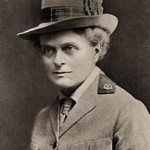
Dr Elsie Inglis
Elsie Inglis had the good fortune of having enlightened parents who considered the education of their daughter just as important as that of their sons. Upon the family’s return to Scotland from India, Elsie enrolled at the Edinburgh School of Medicine for Women in 1886 under Dr Sophia Jex-Blake. At the time women were barred from admission to Scottish universities. Upon qualification Inglis was appalled at the general standard of care and lack of specialisation in the needs of female patients. This prompted her to establish a medical practice, followed soon after by a maternity hospital in Edinburgh’s slums and a midwifery resource centre. Inglis often waived fees for patients and would also pay for her patients to recuperate by the seaside.
Inglis was an active suffrage campaigner in Scotland – by 1900 she was speaking at up to four meetings a week throughout Scotland, and in 1909 was made secretary of the Federation of Scottish Suffrage Socieites.
On the outbreak of World War One, Inglis suggested to the war office that women’s medical units be allowed to serve on the Western Front, to which the office famously replied – “My good lady, go home and sit still.” However other allies were desperate for help, with France and Serbia accepting her offer. The first unit left for France in November 1914, and by 1916 units had been stationed in Serbia, Corsica, Salonika, Romania, Russia and Malta. Inglis went with the teams sent to Serbia, where her work was instrumental in restricting the spread of typhus.
During active service in Russia in 1917, Inglis was taken ill with cancer and died a day after returning home. A memorial plaque hangs on the wall of St Gile’s Cathedral in Edinburgh, and from 2009 Elsie’s image appeared on £50 notes issued by the Clydesdale Bank.
Flora MacDonald – Jacobite Heroine
1722 – 1790
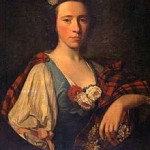
Flora MacDonald
Perhaps the most well known of Scottish Heroines, Flora MacDonald’s story has been immortalised in many Jacobite ballads and legends. Bought up under the care of the chief of the MacDonalds of Clanraid, Flora was living on the island of Benbecula in the Outer Hebrides when Prince Charlie sought refuge there following his defeat at Culloden. The island was controlled by the Hanoverian Government, but the MacDonalds were secretly sympathetic to the Jacobite cause.
After some hesitation Flora agreed to help the Prince escape the island by disguising him as the Irish spinning maid, ‘Betty Burke’. She obtained permission for her party to leave the island, and set sail to Skye on 27 June, 1746. Flora and her party hid overnight in a cottage and then traveled over the next few days overland to Portree, at one point narrowly avoiding government soldiers. Charles eventually escaped to France, however Flora was arrested after one of the boatmen had talked about the strange maid who had traveled with them to Skye. She was imprisoned, first in Dunstaffnage Castle, then in the Tower of London, where she was allowed to live nearby “on parole”. Flora was later released under the Indemnity Act of 1747.
Three years later Flora married Allan MacDonald of Kingsburgh, and in 1774 they emigrated to North Carolina. Allan was captured while fighting for the British in the American Revolutionary War. They returned to Skye following Allan’s release in 1779. It is said that Flora was buried in a bed sheet used by Prince Charlie during his stay in Benbecula.
Captain Betsy Miller – Sea Captain and Businesswoman
11 June 1792 – 12 May 1864

Captain Betsy Miller
Captain Elizabeth (Betsy) Miller achieved the distinction of being the first woman to be certified as a ships captain by the Board of Trade. Born in Saltcoats on the Ayrshire Coast, Betsy was employed in the family shipping business as an office assistant. Her brother Hugh was in line to take over the seafaring side of the business, but tragically drowned in a shipping accident. When the increasingly elderly Captain Miller succumbed to an illness that left him bedridden, the business rapidly started running up debts.
Approaching 40, Betsy stepped in to take command of the family’s brig Clytus and 14 man crew, soon gaining a reputation as a fine seawoman capable of handling the brig in the stormiest of conditions. Betsy came to be known as ‘The Queen of Saltcoats’, and was mentioned in the House of Commons during a debate on the provisions of the Merchant Shipping Act 1834.
For more than three decades Betsy sailed between Ayrshire and Ireland, also becoming well-known as a shrewd businesswoman. She expanded the cargo of goods shipped by the business to Ireland to include limestone and coal, reinstating the family name and making her fortune. She retired at the age of 70 and died two years later, leaving her younger sister Hannah to continue where she had left off.
Black Agnes Randolph – Countess of Dunbar and March
1312 – 1369
She kept a stir in tower and trench,
That brawling, boisterous Scottish wench,
Came I early, came I late,
I found Agnes at the gate.
- From a ballad attributed to the Earl of Salisbury
Named after her flowing black hair, Black Agnes was married to Patrick Dunbar, 9th Earl of Dunbar and 2nd Earl of March and keeper of Dunbar Castle. Situated near Berwick in South-East Scotland, the castle was considered the key to Scotland and was the scene of many battles during the Scottish Wars of Independence. Edward III was determined to conquer Scotland and sent the Earl of Sailsbury to take Dunbar Castle. With Patrick away on military duties, William considered the castle easy pickings with only Agnes and a handful of men keeping guard.
On 13th January 1338, Sailsbury presented himself and his army in front of the castle, demanding that Agnes surrender. To his suprise she refused and stayed in the castle, stating “Of Scotland’s King I haud my house, He pays me meat and fee, And I will keep my gude and house, While my house will keep me.” Sailsbury ordered his army to fire catapults loaded with lead and rocks at the castle walls. Lady Agnes responded by having her maids dress in their Sunday best; leading them to the outer walls, where with their handkerchiefs they nonchalantly and slightingly dusted away the damage from the bombardment.
Sailsbury’s next attempt at taking the castle was by battering ram. Agnes gave the signal to her men as the ram approached the gate, and they dropped over the castle wall a boulder captured on the earlier assault, smashing the battering ram and dispersing the English troops. Over the coming five months, Sailsbury attempted many methods to force Agnes to leave the castle, including forcing the occupants out by starvation. However, he knew nothing of the secret door, partly underwater, that lay off the unguarded rocky side of the castle. Under cover of darkness, Sir Alexander Ramsay of Dalhousie arrived with men and supplies and delivered them through the concealed entrance. Salisbury was none too pleased when a few days later, Agnes sent him down a fresh loaf of bread and some fine wine. On 10 June 1338, Sailsbury was ordered to withdraw from Dunbar, leaving Agnes in sole possession of the castle.
Anne Farquharson, Lady MacKintosh – The Beautiful Rebel
1723 – 1787
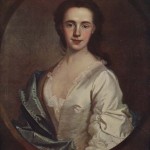
Anne Farquharson, Lady Mackintosh
Lady Anne was a Jacobite of Clan Farquharson and wife of Angus, chief of Clan MacKintosh. Despite her husband fighting for the Government during the ’45 Rising, Anne raised around 300 men from Clan MacKintosh and Clan Chattan to fight for Bonnie Prince Charlie. As women could not command in the field, the command of the regiment was given to MacGillivray of Dunmaglass. The regiment joined the Prince at Bannockburn in January 1746, twelve days before the Battle of Falkirk.
One month later, the Prince was staying at Moy Hall, Lady Anne’s home when Anne received a message from her mother-in-law that Lord Loudon’s men (including her husband’s company) were planning a night raid to steal the Prince. Anne sent five of her staff out with guns to crash about and shout clan battle cries to trick the government forces into thinking they were about to face the Jacobite army. The ploy worked and the government army fled. The event became known as ‘The Rout of Moy’.
The next month her husband and 300 of Loudon’s men were captured north of Inverness. The Prince paroled Captain MacKintosh into the custody of his wife, Lady Anne, commenting “he could not be in better security, or more honourably treated.” She famously greeted him with the words, “Your servant, captain” to which he replied, “your servant, colonel” thereby giving her the nickname “Colonel Anne”. She was also called La Belle Rebelle (the beautiful rebel) by the Prince.
After the Battle of Culloden, Lady Anne was arrested and turned over to the care of her mother-in-law for a time. She later met the Duke of Cumberland at a social event in London with her husband. He asked her to dance to a pro-Government tune and she returned the favour by asking him to dance to a Jacobite tune.
The post Shining in History – Five Scottish Heroines appeared first on ScotClans | Scottish Clans.
]]>The post The Wars of the One Eyed Woman appeared first on ScotClans | Scottish Clans.
]]>
 In the western isles of Scotland two great clans were locked in a long running feud. The MacLeod’s who occupied parts of Skye and Harris and their neighbouring MacDonalds from Skye and Uist. Over centuries the two clans had a number of pitched battles as dominance of the area swung to and fro. These ‘tit for tat’ atrocities had reached a head 23 years earlier when almost the entire MacDonald population of the island of Eigg were wiped out by the MacLeods. A reprisal attack was launched by the MacDonald men a few years later at Trumpan church on Skye, the church full of worshiping MacLeods was barricaded and set alight killing all inside but not before one girl mortally wounded managed to raise the alarm. The MacLeods rose up and pursued the MacDonald perpetrators and killed them all at Ardmore bay. The bodies were buried in a turf dyke and so this battle became known as ‘the battle of the spoiling of the dyke’.
Both sides realised that this could not go on. and so some attempt was made to broker a peace between the two warring clans. Unfortunately this would end up making matters a whole lot worse!
Around 1600 a ‘Romeo and Juliet’ style romance blossomed between the Margaret, sister of the chief of the MacLeods and Donald Gorm Mor MacDonald the son of the MacDonald chief. surely such a match would see an end to war between the clans? err not exactly!
It was tradition in the highlands that a form of marriage contract called ‘hand fasting’ could be entered into. This contract was in all respects similar to marriage except that it could have certain ‘conditions’ that could be agreed beforehand, in this instance that Margaret would produce a male heir. Unfortunately for Margaret and Donald a son was not forthcoming and to make matters worse Margaret somehow managed to loose sight in one eye during the first year of the handfasting.
Donald was now intent on ending his contract with Margaret and so his father decided to send her home to Skye. Unfortunately the old chief had never forgotten the old feud and could not resist the opportunity to stir things up again. Margaret was landed back on skye and sent to Dunvegan sitting backwards on a one eyed horse, accompanied by a one eyed servant and a one eyed dog. This had the desired effect of enraging Rory, the MacLeod chief and war was back on again.
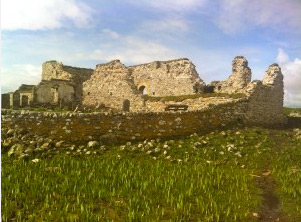
Trinity Temple, North Uist
Rory sent his cousin, Donald Glas MacLeod along with a party of 40 men over to the island of North Uist to exact revenge and raid the land taking any livestock they could lay hands on. The locals had been warned of the approaching MacLeods and had gathered up any goods they had and stored them at the Trinity Temple and Carinish. The Macleods soon found out and headed there, breaking the sanctity of the temple in doing so. The MacLeods now camped out there were were surprised by twelve MacDonalds led by Donald MacIain ‘ic Sheumais (Donald, son of John, son of James) of Clan Ranald. Clearly outnumbering the MacDonalds the MacLeod men pursued them but this had been a carefully planned ambush drawing them into open ground. A fierce battle ensued which by all accounts lasted most of the day. At one point the leaders of both forces faced each other and all other fighting stopped as Donald Glas and Donald MacIan traded sword blows, neither giving an inch of ground. This fight carried on for some time, many MacLeods had already been killed and those observing this titan battle were mostly Macdonalds. On seeing that their leader was gradually loosing ground to MacLeod some of them rushed in to assist. MacLeod was said to have killed two of them instantly but another landed a sword blow which mortally wounded him.
Donald MacIan survived the engagement but had received an arrow in the foot during the battle and his foster mother removed the arrow, tradition has it that she sang a song to drown out his cries of pain, the translation from the Gaelic was:
Son in Iain, my Darling
Soon you heard the wailing
You saved the shore on the paling day
You struck terror into the seed of the stallion (Macleod)
The seed of the white faced lame mare
The result was a victory for the MacDonalds but at a high cost and with the entire party of MacLeods wiped out the bodies littered the small field, the nearby ‘Feith na Fala’ or ‘Ditch of Blood’ attests to this.
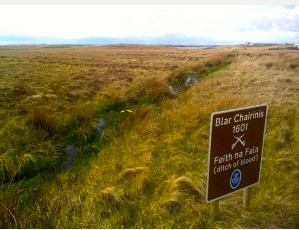
The Ditch of Blood
This has been said to be the last battle fought in Scotland using only traditional weapons (swords and arrows) but it wasn’t the end of the feud, later that year the MacDonalds headed for Skye. They raided the north of the island, driving cattle down towards Glen Brittle. The Macleods who had been busy attempting to get support from Campbell of Argyll against the MacDonalds were surprised but pursued their enemy to Coire Na Creiche. Rory MacLeod’s brother Alastair led the attack on the MacDonalds and this battle lasted for a day and well into the night. Alas it did not go well for the MacLeods who were defeated once again by the MacDonalds with 30 MacLeods including Alastair being taken prisoner.
For Scotland’s Privy council though this had gone too far and they decided to intervene. Both leaders were ordered to surrender; MacDonald to Gordon of Huntly and MacLeod to Campbell of Argyll. Both sides agreed to release their prisoners and call an end to all hostility. Peace between the clans was celebrated with a party at Dunvegan castle that lasted 3 weeks and since then (more or less) The MacLeods and MacDonalds have lived together peacefully!
The post The Wars of the One Eyed Woman appeared first on ScotClans | Scottish Clans.
]]>The post The Beaches of Arisaig – Sunset Capital of Britain? appeared first on ScotClans | Scottish Clans.
]]>
The Glenfinnan Monument
This is a sleepy part of Scotland; nothing happens in much of a hurry here and the pace of life is delightful. As you drive up this winding coastline you are taken aback by the breathtaking beaches, some of the best on mainland Britain with pure white sand and a scattering of small rocky islands. This beauty has not gone unnoticed by everyone and every little cove seems to shelter a campsite of caravan park. There are literally dozens along this stretch, so close together they almost join into a single ribbon of white fibreglass and coloured canvas.

Camping on the Beach by Arisaig
You really cannot blame them for coming here though, if only for one reason; the sunsets! Sitting on the beach here the sun drops down behind the little islands of Rum Eigg and Muck. Known as the ‘Small Isles’ each has its own character; Rum with its sharp volcanic peaks and wild landscape. Eigg, the most populated island looks like something from ‘The Land the Time Forgot’ with its huge basalt cliffs. The island was also the site of a horrific massacre in 1577 when a force of Macleods from Skye slaughtered over 390 MacDonalds in one murderous act with only one family from the island escaping. By contrast to the other two the tiny island of Muck is a little arable oasis where cows graze by the beach.
And so as evening begins the campers who flock to this stretch of coast make their way down to the beach, camera in one hand and a drink of choice in the other and get ready for the show and for many night if the year they are not disappointed! The sky becomes awash with fiery reds and deep blues, its a painters dream! You can’t help but feel spiritual in a place like this.

The Sunset Over Rum
Whenever the time comes to meet my maker I really must congratulate him on the excellent works he’s done at Arisaig!
The post The Beaches of Arisaig – Sunset Capital of Britain? appeared first on ScotClans | Scottish Clans.
]]>The post Massacre Cave – The MacDonalds of Clanranald and The MacLeods appeared first on ScotClans | Scottish Clans.
]]>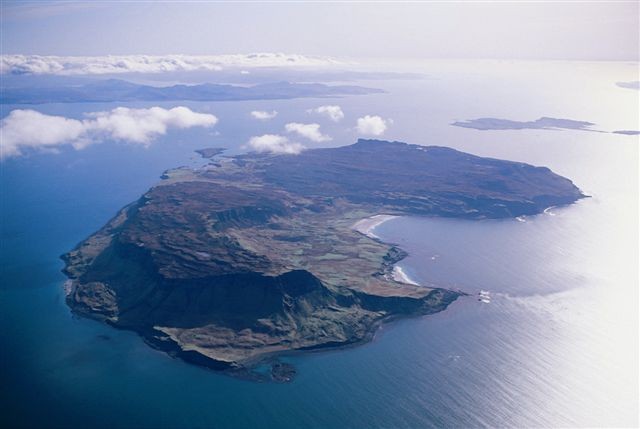
Isle of Eigg
The Isle of Eigg is situated in the heart of Clanranald country, this small island has very bloody history being involved in every MacDonald rebellion against the crown and in a good many feuds. A lengthy feud between the MacDonalds and the MacLeods in the 16th Century led to the death of 395 MacDonalds in 1577, the island’s entire population, in “Uamha Fhraing” (Cave of Frances, aka Massacre Cave) The Clanranald residents of the island took refuge in a cave on the south coast and they were suffocated by a fire lit at the entrance by a party of MacLeods in what apparently was a revenge attack. The feud was finally ended some years later by the marriage of Alan of Moidart to the daughter of MacLeod of MacLeod. Hugh Miller visited this notorious cave three centuries later, in 1844, and described in his book, “The Cruise Of The Betsy,” seeing the bones of adults and children in family groups with the charred remains of their straw mattresses and small household objects. All were finally removed for burial in hallowed ground.
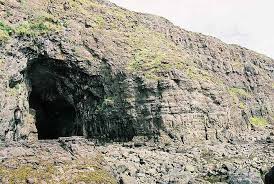
“Uamha Fhraing” (Cave of Frances, aka Massacre Cave), Isle of Eigg
The post Massacre Cave – The MacDonalds of Clanranald and The MacLeods appeared first on ScotClans | Scottish Clans.
]]>