The post The Punishment of Lady Lindsay appeared first on ScotClans | Scottish Clans.
]]>
Lady Lindsay
Around 1489 Alexander, Master of Lindsay, and his brother John, sons of the fifth Earl of Crawford, quarrelled and fought at Inverqueich Castle, in Lower Strathardle.
Alexander was severely wounded, he should have recovered had his wife not helped him on his way by smothering him with a down pillow as he lay in bed weak from loss of blood.
She was Lady Janet Gordon, daughter of George, Earl of Huntly and his wife, Princess Annabella daughter of King James I. No sooner has she got rid of Lindsay then she took a second husband and married Patrick, son of Lord Grey. Coincidentally he died soon after they were married. Then without waiting she was married a third time, this time to Halberston of Southwood.

Inverqueich Castle is still talked about as ‘Lady Lindsay’s Castle’. It doesn’t exist today.
Her crime had gone unpunished but in 1500 she was brought to trial and found guilty for the murder of the Master of Lindsay. Her punishment was to be imprisoned for the rest of her life on the top of Craig-an-Fhithiche (The Raven’s Rock), an impressive cliff that rises about 300 feet above the River Ericht; and here every day before she was allowed to eat and drink, she had to spin a thread long enough to reach from her prison down till it reached the water of the river, and there she lingered on, spinning her daily thread to an extreme old age. She is said to have lived to be over a hundred years of age.
Here history stops but as usual local tradition steps in, and draws aside the veil of time, and tells us how:
“Lady Lindsay sat on the Raven’s Rock,
An weary spun the lee lang day,
Tho’ her fingers were worn, they aye bore the stain
O’ the blood o’er her first lurve, the lycht Lindsay,”

1843 engraving from an old book called Perthshire Illustrated of the dramatic cliffs leading down to River Ericht
Then at last her shrivelled fingers were worn by the constant friction of the thread to mere stumps, and then she died. But as local legend tells us there was no rest for this murderess, for there her ghost was seen to sit and spin, and often a fisherman as he fished in the clear waters below Raven Rock was startled to see a shadowy thread coming slowly down from above till it touched the water when it instantly disappeared and the scared fisherman knew that the Lady Lindsay’s task was at least over for that day. So the thread of time was spun.

River Ericht – watch out when fishing
The post The Punishment of Lady Lindsay appeared first on ScotClans | Scottish Clans.
]]>The post The Gordons at Otterburn appeared first on ScotClans | Scottish Clans.
]]>
Otterburn Battle
On the 5th of August, 1388, the Battle of Otterburn took place. This was a skirmish between Scotland’s James, 2nd Earl of Douglas, and England’s Henry “Hotspur” Percy, the son of the Earl of Northumberland. This battle was part of continuous Anglo-Scottish border conflicts that were quite common at the time. It was a decisive Scottish victory, but was also a relatively bloody affair, with thousands of casualties, mainly on the English side.
Since it was a border fight, many of the lowland clans fought along with the Earl of Douglas. Some of these families included Clan Lindsay, Clan Johnstone, Clan Montgomery, Clan Graham, and Clan Gordon. Since it was such a decisive and famous victory several ballads were written about it, including a ballad called The Battle of Otterburn.
In the ballad a number of the families get mention, including the Gordons on a couple of occasions.
The ballad begins:
It fell about the Lammas tide
When the muir men win their hay,
The doughty Earl of Douglas rode
Into England to catch a prey.
It then continues to mention some of the clans there:
He chose the Gordons and the Graemes,
With them the Lindsays light and gay -
Later on in the ballad it goes on to claim that the Scots proved to have been quite blood thirsty, particularly the Gordons, and slayed a lot of their enemy.
The moon was clear, the day drew near,
The spears in flinders flew,
But mony a gallant Englishman
Ere day the Scotsmen slew.
The Gordons good in English blood
They steeped their hose and shoon.
There were also a number of Scottish casualties too, including, unfortunately for the Gordons, their leader, and father of Sir Adam Gordon, who also went on to give his life for his country.
The post The Gordons at Otterburn appeared first on ScotClans | Scottish Clans.
]]>The post The Flodden 500 Service at St Giles, Edinburgh. appeared first on ScotClans | Scottish Clans.
]]>I’d like to continue by reproducing Alaistair Moffat’s reading given at St Giles. It was an excellent account of the battle and the aftermath.
—
FLODDEN ADDRESS. – ALISTAIR MOFFATWhen dawn broke on the morning of 10th September, 1513, the landscape of hell was revealed. On the gently undulating northern ridges of Branxton Hill more than 10,000 men lay dead or dying. In the midst of the carnage were the naked, plundered bodies of King James IV of Scotland, his half-brother, Alexander Stewart, Archbishop of St Andrews, George Hepburn, Bishop of the Isles, two abbots, nine great earls of Scotland, fourteen lords of parliament, innumerable knights and noblemen of lesser degree and many thousands of farmers, ploughmen, weavers and burgesses. It was the appalling aftermath of the battle of Flodden, the greatest military disaster in Scotland’s history.In the grey light of that terrible dawn, sentries posted around the captured Scottish cannon could make out where the brunt of battle had been joined. Below them, at the foot of the slope ran the trickle of a nameless burn now choked with slaughter, a wrack of mangled bodies, broken pikeshafts, shattered shields and everywhere blood and the sickening stench of death, vomit and voided bowels. Not all of the bodies were yet corpses. Through a long dark night the battlefield had not been a silent graveyard. Trapped under lifeless comrades, crippled, hamstrung or horribly mutilated, fatally wounded men still breathed. Bladed weapons rarely kill outright and they were often used to bludgeon men to their knees or into unconsciousness. In the churned mud of the battlefield some men will have lost their footing, fallen and been hacked at before they could get up. Many bled to death, maimed, lacerated by vicious cuts, screaming, fainting and screaming once more in their death agonies. Some will have been put out of their misery by parties of English soldiers scouring the field by torchlight for plunder, stripping the bodies, ransacking them for valuables. But other men will have lingered on inunspeakable pain, praying to their God, passing in and out of consciousness, slowly bleeding to death. The fury of the battle on Flodden field may have been stilled and awash with death and defeat. But all was not yet over. In an instant the plunderers and scavengers looked up and the sentries by the cannon stood to, frantically peering through the morning light. They could hear the rumbling thunder of hoofbeats – and then, suddenly, riders erupted over Barelees Rig. With 800 horsemen at his back, Lord Alexander Home galloped hard across the horrors of the battlefield and up the slopes of Branxton Hill. They had not come back to Flodden to rejoin a lost battle but to rescue their captured ordnance. And they very nearly succeeded. After a sharp skirmish, the English gunners managed to load and get off a volley at Home’s squadron, and they scattered.And so it ended. As the Border horsemen wheeled round and raced out of range, the remnants of the shattered Scottish army were limping across the Tweed at Coldstream. There was no organised pursuit. The victorious English army had taken heavy casualties and the Earl of Surrey and his captains were exhausted. In any event, their bloody work was done. The floors o’ the Forest were a’ wede awa, Flodden was a national disaster, a harbinger of lawlessness in the shape of the Border Reivers, the beginning of a long period of political uncertainty and the last medieval battle in the history of Britain. The last time a king was to die leading his army.It was also an epic. As two huge armies mustered and marched into history, extraordinary scenes had been witnessed. At Ellemford, high in the Lammermuirs above Duns, where sheep now graze on the flanks of the hills, where buzzards hang in the updrafts and an elegant bridge crosses the Whiteadder, King James IV and his army camped. Huge guns were trundled down the hill trails, dragged by oxen, and by 21st August 1513, almost 30,000 men had massed in this beautiful, now lonely valley. Two days later, the largest force ever to leave Scotland crossed the Tweed at the fords below Coldstream. They had declared war, they had entered the realm of the Tudors, of the ferociously ambitious and bull-like Henry VIII.Meanwhile Thomas Howard, Earl of Surrey, and the Bishop of Durham carried the standard of St Cuthbert before their battle-hardened troops. In front of the high altar of the great cathedral, Howard had watched the bishop bless the flag of the Haliwerfolc. The lands of Palatinate, of the Prince-Bishops of Durham, reached to the Tweed and beyond, and in an early definition of Englishness, their people were known as the Holy Man’s Folk, the Haliwerfolc. Ancient allegiances were being roused and summoned.Between 2nd and 9th September two vast armies circled each other in a small corner of North Northumberland, like heavyweight boxers looking for weaknesses or waiting for wrong moves. After the Earl of Surrey had despatched a herald, the Rouge Croix, it was finally agreed that battle would be joined on 9th September. Supplies for almost 70,000 men, horses and camp followers were running dangerously lowand neither army could remain in the field much longer.Realising the strength of the Scots’ entrenched position, Surrey led his men to the east, skirting Flodden Edge and staying out of artillery range. On the morning of the appointed day, he crossed the River Till and took up a position to the north of James IV’s army, barring any retreat to Scotland. And then, on a damp afternoon, the greatest battle ever fought between England and Scotland began.On the left wing of the Scottish host, the Highlanders led by the Earl of Huntly massed in formation with Lord Home’s Borderers, and in the moments before their chiefs roared the claideamh mor, the order to charge, the Gaelic-speaking warriors did something remarkable. They began to summon the army of the dead. They began the sloinneadh, the naming of the names of memory. To bolster his courage, each man began to recite his genealogy. Many waiting to charge could go back 20 generations. As if they were offering up the murmur of prayer, each man remembered why he had come to fight. Is mise mac Iain, mac Ruaridh, mac Domhnuill. I am the son of John, the son of Roderick, the son of Donald. And once their quiet voices stilled, the roar of the claideamh mor rent the air and they broke into the charge. With their broadswords and Lochaber axes, the Highlanders tore into the English ranks, the division led by Edmund Howard, They scattered and a rout was only prevented when Lord Dacre rode to the rescue with his English Borderers. As history rumbled across Branxton Hill, fortune appeared to be smiling on the Scots.At the same time, James IV was about to make a catastrophic decision, a crucial error of judgement. Instead of occupying an elevated position at the rear of his vast army, he chose to lead from the front. His division raced down Branxton Hill and as they reached the lower slopes and much softer ground, many men began to skid and lose their footing. This unsteadiness made it very difficult for them to control their long, 12 foot pikes. The wet ground made them charge out of formation, only engaging piecemeal with the solidly planted ranks of English billmen, With their shorter, more easily handled bills, they began to slice into James IV’s division. And as the men at the back saw the Scottish pikes go down, they hesitated and many of them ran, believing their king to be killed. By leading from the front, James was immediately submerged in the ruck of the fighting, only able to see what was directly in front of him, in no position to direct his forces. The result was disaster.The legacy of Flodden was most immediately and keenly felt in the Borders. North of the Tweed the memory of the battle is kept alive in the fabric of the midsummer common ridings. At Selkirk the ceremony of the casting of the colours is unique in Britain and it is based on the return of a soldier known as Fletcher, traditionally believed to have been the only one of sixty from the town to return. In his bloodied hand he held aloft, in a gesture of desolate defiance, a flag captured from the men of Macclesfield in Cheshire. Many Englishmen had fought and fallen at Flodden. And passions still run high. When the Mayor of Macclesfield recently wrote to the Provost of Selkirk asking for the return of the flag, he was told that he would need to come to the Borders and take it.Flodden is an immense story. Like Culloden in 1746, it signalled the end of a fading, feudal Scotland. And it also ushered in a century of lawlessness, the criminal society controlled by the appalling Border Reivers. Across Europe, renaissance, enlightenment and the reformation were changing lives, forming new ideas and creating the institutions of the modern world. In the first half of the 16th century, central authority broke down in a leaderless nation, and while swords and spears spoke in Scotland, the law was often silent.What is to be learned from all of that suffering and slaughter, from all of those ancient enmities? First that they are ancient and must remain firmly in the past. In 2014 Scotland faces a historic choice and whichever way the people of Scotland vote, it must be a signal lesson of Flodden that enmity, even ancient enmity can have no part. And it is to the credit of politicians on all sides of the argument that it has not reared an ugly head. But it might.And alongside that it mustmbe important to remember, to understand the visceral, bloody realities of whatmwent on on that terrible day 500 years ago. Lest we forget, Flodden should become a place of remembrance and of pilgrimage, a place where the uncomfortable lessons of history can be learned and never forgotten.Two weeks ago, on one of the countless beautiful evenings of this glorious summer, I drove over to Branxton. As the sun threw long shadows across the gently undulating fields, I tried to imagine the 10th of September, 1513, the distant roar of thousands of men, the screams, the fear and feral closeness of hand-to-hand fighting whenmen can smell the breath, smell the sweat of men grunting pushing, hacking, swearing at them, trying to kill them. In a Gaelic phrase, I tried to listen for the music of the thing as it happened. I tried to listen to the slow, sad music of our history. I hope that many in Scotland and England hear it too.
Prior to the sir Malcolm MacGregor (who has admitted that try as he might he can not find a single MacGregor involved in the battle) researched the casualty lists. The following names are clans and families who are known to have fought at Flodden along with notable people who fell in the battle:
From the Highland Clans:
Campbell, Erskine, Fraser, Gordon, Graham, Guthrie, Haldane, Hay, Keith, Leslie, Lindsay, Macaulay, Macfarlane, Mackay, Maclean, Macnab, Menteith, Moncreiff, Moray, Murray, Ogilvy, Oliphant, Ramsay, Rattray, Ross, Ruthven, Seton, Sinclair, Stewart, Forbes, Forsyth, Grant, MacKenzie, MacNaughton, Ross, Skene, Buchanan Of Leny, MacDonald
The Lowland and Border Clans and Families:
Adair, Abercromby, Adam, Anstruther, Baillie, Baird, Balfour, Barclay, Blackadder, Bonar, Boswell, Carnegie, Cathcart, Cleland, Cockburn, Colville, Craig, Crauford, Crichton, Cunningham, Dunbar, Dundas, Edmonstone Of Duntreath, Elphinstone, Fotheringham, Gray, Grierson, Haig, St.Clair Of Roslin, Henderson, Hepburne, Herries, Home, Hoppringle, Houston, Lauder, Liddel, Lockhart, Lumsden, Lyon, Masterson, Maitland, Maule, Maxtone, Maxwell, Melville, Muirhead, Mure, Napier, Rollo, Sempill, Somerville, Spottiswood, Stewart Of Traquair, Allardice, Ballingall, Kerr, Colville, Crammond, Eliott, Ferguson, Fleming, Foreman (Standard Bearer), Inche, Inglis, Johnstone, Kirkcaldy, Knolis, Logan, Montgomery, Morton, Muir, Nelson Of Madinpap, Otterbrun, Pitcarin, Pringle, Reid, Rorison, Savage, Scott, Seton, Tunstall, Vallanche, Wood Of Raik, Kennedy, Douglas, Hamilton, Livingstone, Wemyss, Wallace, MacLellan, MacCulloch, MacDowall
Chief Or Notable Head Of House/Family
King James IV, Archbishop Of St.Andrews (King’s Son), Earl Of Morton ( Grandson Of James 1), Earl Of Glencairn, Douglas Of Drumlanrig, Sir James Dunbar, Dundas, Lord Elphinstone, Lord Erskine, Earl Of Huntly, Earl Of Montrose, Sir Alexander Guthrie, Haig Of Bemersyde, Haldane Of Gleneagles, Earl Of Errol, Earl Of Bothwell, Sir William Keith, Earl Of Cassilis, Earl Of Rothes, Earl Of Crawford, MacDowal, Earl Of Garthland, MacFarlane Of Arrochar, Hector MacLean Of Duart, Maxwell Lord Of Carlaverock, Sir John Moncreiffe Of That Ilk, Moray Of Abercairney, Ramsay Of Dalhousie, Rattray Of That Ilk, Rollo Of Duncrub, Master Of Ruthven, Lord Sempill, Lord Seton, Earl Of Caithness, Earl Of Atholl, Earl Of Lennox, Lord Darnley, Master Of Angus, Anstruther Of That Ilk, Ballingall Of That Ilk, Master Of Eliott, Lord Forbes, Master Of Lovat, Sir Alexander Gordon Of Lochinvar, Sir Alexander Gordon Of Knockenshene, Grant Of Freuchie, John Henderson Of Fordell, Lord Alexander Home, Sir Patrick Houston Of That Ilk, William Johnstone Of That Ilk, Lord Keith, Lord Lorn, Lyon (Sons Of Lord Glamis), MacKenzie Of Kintail, Sir Alexander MacNaughton Of That Ilk, Andrew Pitcairn Of Pitcairn And 7 Sons, Lord Ross, William Ruthven Of That Ilk, Sir Walter Scott Of Buccleuch, Alexander Skene Of That Ilk, Sir David Wemyss, Earl Of Argyll, Lord Kinnaird, Master Of Cathcart, MacDonald Of Lochalsh.
—–
 The St Giles Service…
Just over 40 clan chiefs attended the St Giles service. At the end of the service they mustered for a photograph on the steps. To help you identify who was there we have been given a sketch with a key to the names:
1. Sir Walter Riddell of Riddell 2. The Hon. Elizabeth Fairbairn 3. Madam Pauline Hunter of Hunterston 4. Sir David Bannerman of Elsick 5. Lord Polwarth 6. Andrew Wallace Younger of that Ilk 7. Andrew Dewar Durie of Durie CBE 8. Michael Ancram, Marquess of Lothian 9. Andrew MacThomas of Finegand 10. Earl of Dundee 11. David Campbell of Strachur 12. Roderick Macneil of Barra 13. Sir James McGrigor 14. Earl of Eglinton and Winton 15. Professor David Hannay of Kirkdale and of that Ilk 16. Henry Trotter Younger of Charterhall 17. John MacArthur of that Ilk 18. Duncan Paisley of Westerlea 19. Richard Carmichael of Carmichael 20. Earl of Caithness21. Earl of Lauderdale 22. The Hon. Alexander Leslie 23. Earl of Erroll 24. Lord Napier and Ettrick 25. Madam Arabella Kincaid of Kincaid 26. David Cranstoun of that Ilk 27. Jamie Macnab of Macnab 28. Earl of Wemyss and March 29. Sir Crispin Agnew of Lochnaw 30. The Hon. Kate Nicolson 31. Duke of Montrose 32. The Hon. Peregrine Moncreiffe of that Ilk 33. Martin Haldane of Gleneagles 34. Lord Sempill 35. Andrew Marjoribanks of that Ilk 36. Donald MacLaren of MacLaren 37. Duke of Hamilton 38. Field Marshal the Lord Guthrie of Craigiebank 39. Isla St Clair 40. Marquess of Ailsa 41. Madam Margaret Eliott of Redheugh 42. Sir Malcolm MacGregor of MacGregor 43. Lord Macdonald of Macdonald 44. Richard Oliphant of that Ilk
This image will help you identify the chiefs:

The post The Flodden 500 Service at St Giles, Edinburgh. appeared first on ScotClans | Scottish Clans.
]]>The post The Duchess and I appeared first on ScotClans | Scottish Clans.
]]>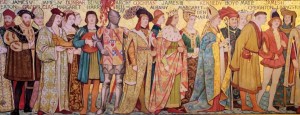
Scottish National Portrait Gallery Frieze
As you enter the main hall of the Scottish National Portrait Gallery, 150 titans of Scottish history gaze down at you, providing a dramatic introduction to the subjects awaiting you inside the galleries. This impressive chronological frieze by William Hole begins in the stone age, carrying right through till the late 17th century when the painting was completed.
Situated on the upper floor of the hall amongst the frieze and historical murals sits an interactive exhibit that calculates which figure from Scottish history you are most alike. By entering a series of personality traits and physical attributes, the computer programme will trawl through the gallery’s collection to find you your very own Scottish historical counterpart.
After entering my traits and characteristics, the computer whirred into life and reported back that I am most like Jane Gordon, Duchess of Gordon (c. 1749-1812). The Duchess was a hugely ambitious, outspoken, witty woman who was perhaps most well-known for hosting exquisite and exclusive parties for the Tories. Maybe there was a glitch in the matching system on the day I visited – I’m a rather softly-spoken, creative leftie who would never be caught dead hosting a Tory event.
Jane, Duchess of Gordon and son George – George Romney 1778
‘She looks as fierce as a dragon and contents herself with spending her breath upon politics, and ringing a daily peal in the ears of her poor husband, with whom, Lord William says, she squabbles more than ever.’
- Lady Louisa Stuart on the Duchess of Gordon

Lady Jane Maxwell was born in either 1748 or 1749 to Sir William Maxwell, 3rd Baronet of Monreith, and his wife Magdalene Blair. Sir Maxwell was a drunk who sold most of his 30,000 acre estate in order to make ends meet while Magdalene raised and educated Jane and her other two daughters in a rented flat on Hynford’s Close just off Edinburgh’s Royal Mile. It was quite normal at the time for titled, land-owning Scottish families to send their daughters to Edinburgh where they could receive further education and be launched upon Edinburgh society.
Lady Jane is said to have been a rather boisterous child, with reports stating she would ride on the backs of pigs set loose in the wynds of Edinburgh’s Old Town. At the age of 14, while playing in the High Street in Edinburgh Jane got her finger caught in the wheel of a cart, tearing it clean off. From then on she wore gloves wherever possible with a wooden finger inside. At the age of 16, Jane is said to have been so beautiful that songs were composed in her honour, including Bonnie Jennie of Monreith, the Flower of Galloway. It was around this time that Lady Jane fell in love with a young Fraser officer. Soon after they met, he was shipped to America with his regiment where he was reportedly killed.
In 1767 at 24 years of age Jane married Alexander Gordon, 4th Duke of Gordon and chief of Clan Gordon. It was on their honeymoon that Jane received a note from her lost love stating that he was in fact still alive, asking for her hand in marriage. She is said to have fainted upon reading the note. This episode provided the basis of Ciji Ware’s 1989 book Island of the Swans, based loosely on the life and loves of the Duchess. The couple would go on to become one of Britain’s most well-known power couples of the time, influencing politics, fashion and the upper echelons of British society. They had seven children together, however their marriage quickly proved to be a loveless one, with the Duke and Duchess partaking in multiple affairs.

Gordon Castle circa Jane Gordon’s tenure
The Duchess entertained on a lavish scale at her residence in Edinburgh and the family home of Gordon Castle, one of the largest homes in Scotland. She was the authority of fashion in Edinburgh, regularly hosting soirée evenings where up and coming artists were asked to entertain. It was in her drawing room that Robert Burns first read his poetry to Edinburgh society, with the duchess becoming his chief sponsor and also purchasing all his early published works. In 1780 the Duchess and her family moved to London where she continued to host parties for the Tories with a distinctly Scottish flavour. She championed wearing tartan, which at the time was still outlawed. Friends in high places meant she was able to get away with it – even King George was said to be a big fan of the Duchess.

Gordon Highlanders
Perhaps the most well-known tale of the Jane’s exploits is the part she played in the raising of the Gordon Highlanders. In 1793 the French Revolutionary Government declared war on Britain, however the British Army was largely short of recruits, so the Duke of Gordon was tasked with raising a Scottish highland regiment. The Duchess waged a bet with the Prince Regent, the future King George IV, that she could raise more men than him, and set about her task by employing a rather unusual recruiting drive. Aged 45, Jane traveled about the Gordon estates in Scotland dressed in a military uniform and a large black highland bonnet. Recruits were offered a King’s shilling for joining, with Jane enticing them even more by offering the shilling from her lips in the form of a kiss. The Duchess raised over 940 men, with the regiment existing until 1994.
Despite the unhappiness in her marriage the Duchess took great joy in seeking the best marriage matches for her children. She managed to arrange for three of her five daughters to marry Dukes and even took one of her daughters to Paris to try and secure a marriage with Emperor Josephine’s son. General Cornwallis’ son Lord Brome was considered a suitable match for Louisa, the fourth Gordon daughter. However the General refused to approve the marriage citing madness in the Gordon family. The Duchess is said to have allayed his fears by saying there was not one drop of Gordon blood in this particular daughter – with historians suggesting Jane’s lost love Captain Fraser was the father. Louisa and Lord Brome were married in London in April 1795.
By 1805 the marriage between the Duke and Duchess was officially over, after a lengthy separation during which the duke moved his mistress Jane Christie into Gordon Castle. A financial agreement was reached where the Duke would provide a house and financial security to the Duchess, however he failed to keep his word once he ran into financial strife. The Duchess was forced to live in hotels in the later part of her life and died in 1812 at Poultney’s Hotel, Piccadilly, London, surrounded by her four daughters and surviving son. Her body was taken north to be buried at the old Celtic Chapel by the banks of the Spey at Kinrara. There her husband carried out her final wish and erected a monument to her on which were recorded the marriages of her children.
The post The Duchess and I appeared first on ScotClans | Scottish Clans.
]]>The post Mingulay: 100 years of abandonement. appeared first on ScotClans | Scottish Clans.
]]> The island of Mingulay forms part of the Bishop Islands, a small collection of islands that lie off the south coast of Barra at the bottom of the Hebrides chain. Its an island of incredible drama; some of the tallest sea cliffs in Europe, sea stacks and arches, one tiny sheltered sandy bay and spectacular views across to its sister islands such as Pabbay and Berneray. Just at the end of the last ice age when the massive European ice sheets retreated from the Western Isles Mingulay would have been connected to the rest of the outer Hebrides, but as sea levels rose it was eventually cut off. There are traces of settlements dating back to the Iron Age and until that day in 1912 the island had been almost continually inhabited.
The sea around the island is dangerous and unpredictable, sailing out from Mingulay could be a one way trip and it was not uncommon for the island to be completely unreachable for months on end. One story that illustrates this concerns two friends who had left the island, one on a trip to Barra and the other who was heading to America to seek his fortune. The friends said their goodbyes at the quayside at Castlebay on Barra. Many months later the one who had made his way to America returned after deciding the new world was no for him. He was surprised to bump into his friend back in Castlebay. The poor man had been stuck on Barra all that time still unable to return home.
Up until the Mid 13th century the islands were under Norse control and indeed the name Mingulay is derived from the old Norse ‘Mikil -ay’ which means ‘big island’. When the Norse invaders finally gave up control of the western isles around 1266 the islands passed to the Lords of the Isles and then to the MacNeils of Barra, in fact it is the rocks of Builacraig on Mingulay that are featured on the crest of Clan MacNeil of Barra.
Although the islands had been long converted to christianity it was a version tempered with a mix of many other older beliefs. Islanders firmly believed in the faery folk and in many other supernatural creatures. Their belief could it times prove disastrous; one example occured during the early tenure of The MacNeils. The chief had grown concerned having not heard from the residents of Mingulay for many months. He sent a ship over to the island and one man called MacPhee was sent ashore. he searched the island and discovered all the inhabitants had died of disease. His crewmates fearing an outbreak of plague left him on the island where he was exiled for a year, climbing the hill every day to look out for rescue. When the boat finally returned to repopulate the island he was granted land there and the lookout hill was named MacPhee’s hill in his honour.
Alas MacNeil sold the island in 1840 along with the other Barra islands to Colonel John Gordon of Aberdeenshire. Gordon had little concern or charity for the islanders and proceeded to clear his new property to make way for sheep though oddly during the height of the clearances the population actually increased as many islanders from nearby Barra fled to the more remote Mingulay rather than make the perilous journey to Nova Scotia. around this time the island population peaked at around 150 inhabitants.

The Old School House on Mingulay
Gradually though the population began to decline, one theory was that it was sparked by a disaster that befell the residents of nearby Pabbay. A boat from the neighbouring island had sunk loosing all 5 hands on board. On such a small island as Pabbay this equated to half the male population. For the residents of Mingulay this brought home the fragility of their own existence and as knowledge of the world beyond their island began to improve many began to realise there were altogether safer and more prosperous ways to make a living away from this tiny outcrop.
From the start if the 1900s islanders began to abandon Migulay, some headed to nearby Vatersay and Sandray where they illegally occupied land there. in 1910 there were only six families living on the island and in 1912 the decision was reached to abandon the island for good.
Since 1912 the island has passed through a few owners who had used it for grazing land until it was finally taken over by the National Trust for Scotland in 2000. The island is now a home to an impressive seabird population.
This weekend the NTS will mark the centenary of the final abandonment of Mingulay with a series of events. A time to reflect on the fragile communities that have existed along the Hebridean chain.
The post Mingulay: 100 years of abandonement. appeared first on ScotClans | Scottish Clans.
]]>The post The Wars of the One Eyed Woman appeared first on ScotClans | Scottish Clans.
]]>
 In the western isles of Scotland two great clans were locked in a long running feud. The MacLeod’s who occupied parts of Skye and Harris and their neighbouring MacDonalds from Skye and Uist. Over centuries the two clans had a number of pitched battles as dominance of the area swung to and fro. These ‘tit for tat’ atrocities had reached a head 23 years earlier when almost the entire MacDonald population of the island of Eigg were wiped out by the MacLeods. A reprisal attack was launched by the MacDonald men a few years later at Trumpan church on Skye, the church full of worshiping MacLeods was barricaded and set alight killing all inside but not before one girl mortally wounded managed to raise the alarm. The MacLeods rose up and pursued the MacDonald perpetrators and killed them all at Ardmore bay. The bodies were buried in a turf dyke and so this battle became known as ‘the battle of the spoiling of the dyke’.
Both sides realised that this could not go on. and so some attempt was made to broker a peace between the two warring clans. Unfortunately this would end up making matters a whole lot worse!
Around 1600 a ‘Romeo and Juliet’ style romance blossomed between the Margaret, sister of the chief of the MacLeods and Donald Gorm Mor MacDonald the son of the MacDonald chief. surely such a match would see an end to war between the clans? err not exactly!
It was tradition in the highlands that a form of marriage contract called ‘hand fasting’ could be entered into. This contract was in all respects similar to marriage except that it could have certain ‘conditions’ that could be agreed beforehand, in this instance that Margaret would produce a male heir. Unfortunately for Margaret and Donald a son was not forthcoming and to make matters worse Margaret somehow managed to loose sight in one eye during the first year of the handfasting.
Donald was now intent on ending his contract with Margaret and so his father decided to send her home to Skye. Unfortunately the old chief had never forgotten the old feud and could not resist the opportunity to stir things up again. Margaret was landed back on skye and sent to Dunvegan sitting backwards on a one eyed horse, accompanied by a one eyed servant and a one eyed dog. This had the desired effect of enraging Rory, the MacLeod chief and war was back on again.
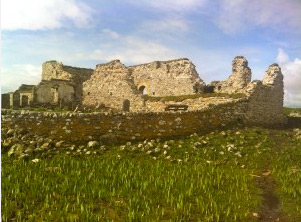
Trinity Temple, North Uist
Rory sent his cousin, Donald Glas MacLeod along with a party of 40 men over to the island of North Uist to exact revenge and raid the land taking any livestock they could lay hands on. The locals had been warned of the approaching MacLeods and had gathered up any goods they had and stored them at the Trinity Temple and Carinish. The Macleods soon found out and headed there, breaking the sanctity of the temple in doing so. The MacLeods now camped out there were were surprised by twelve MacDonalds led by Donald MacIain ‘ic Sheumais (Donald, son of John, son of James) of Clan Ranald. Clearly outnumbering the MacDonalds the MacLeod men pursued them but this had been a carefully planned ambush drawing them into open ground. A fierce battle ensued which by all accounts lasted most of the day. At one point the leaders of both forces faced each other and all other fighting stopped as Donald Glas and Donald MacIan traded sword blows, neither giving an inch of ground. This fight carried on for some time, many MacLeods had already been killed and those observing this titan battle were mostly Macdonalds. On seeing that their leader was gradually loosing ground to MacLeod some of them rushed in to assist. MacLeod was said to have killed two of them instantly but another landed a sword blow which mortally wounded him.
Donald MacIan survived the engagement but had received an arrow in the foot during the battle and his foster mother removed the arrow, tradition has it that she sang a song to drown out his cries of pain, the translation from the Gaelic was:
Son in Iain, my Darling
Soon you heard the wailing
You saved the shore on the paling day
You struck terror into the seed of the stallion (Macleod)
The seed of the white faced lame mare
The result was a victory for the MacDonalds but at a high cost and with the entire party of MacLeods wiped out the bodies littered the small field, the nearby ‘Feith na Fala’ or ‘Ditch of Blood’ attests to this.
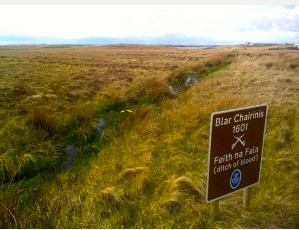
The Ditch of Blood
This has been said to be the last battle fought in Scotland using only traditional weapons (swords and arrows) but it wasn’t the end of the feud, later that year the MacDonalds headed for Skye. They raided the north of the island, driving cattle down towards Glen Brittle. The Macleods who had been busy attempting to get support from Campbell of Argyll against the MacDonalds were surprised but pursued their enemy to Coire Na Creiche. Rory MacLeod’s brother Alastair led the attack on the MacDonalds and this battle lasted for a day and well into the night. Alas it did not go well for the MacLeods who were defeated once again by the MacDonalds with 30 MacLeods including Alastair being taken prisoner.
For Scotland’s Privy council though this had gone too far and they decided to intervene. Both leaders were ordered to surrender; MacDonald to Gordon of Huntly and MacLeod to Campbell of Argyll. Both sides agreed to release their prisoners and call an end to all hostility. Peace between the clans was celebrated with a party at Dunvegan castle that lasted 3 weeks and since then (more or less) The MacLeods and MacDonalds have lived together peacefully!
The post The Wars of the One Eyed Woman appeared first on ScotClans | Scottish Clans.
]]>