The post Lady Grange’s Letters from St Kilda appeared first on ScotClans | Scottish Clans.
]]>
Letters of Lady Grange
The letters of Rachel Erskine, Lady Grange, who was exiled to St Kilda by her husband have now been made public by The Edinburgh University Image Collections.
The letters were smuggled to Lady Grange’s solicitor in Edinburgh and offer an incredible insight into the suffering and hardships she endured on the island.
Lady Grange spent nine years on St Kilda and was then moved on to various locations in the Western Isles including Harris, Uist and Skye.

St Kilda, photo taken from the boat when I was on my way there to camp for 5 days
St Kilda is the remotest part of the British Isles, it lies 41 miles (66 kilometres) west of Benbecula in Scotland’s Outer Hebrides.
The Story of Lady Grange
Lady Grange (Rachel Chiesley, 1682-1745) was married to James Erskine, the Scottish Lord Advocate. James was the second son of Charles, tenth Earl of Mar. After he was raised to the bench in March 1707, he took the name Lord Grange, and in 1710 became Lord Justice-Clerk. His wife was Rachel Cheisley, sister of Major Cheisley of Dalry, an area of Edinburgh. After James and Rachel had eight children together. After they had been married 20 years James is said to have taken a ‘insuperable aversion’ to her and they agreed to live separately. But James considered his estranged wife to be of danger to him and his standing in society saying she would spy on him and may have the means of implicating him with the Government (whether this means as a Jacobite sympathizer there is very little evidence). James concluded that he needed to get rid of her. Others around them said that Rachel was very jealous of his ‘irregularities’ and had a ‘fierce and revengeful’ temper and was the ‘victim of intemperance’.
It is believed that the plan of kidnapping her off to some remote place in the North was hatched, on her disappearance they were to circulate reports of her death. This went ahead and as her funeral was staged in Edinburgh she was abducted and imprisoned on North Uist before being taken, in 1734, to Hirta, the largest island in the St Kilda archipelago. While there she was not completely isolated – she had a constant supply of provisions and a woman to wait on her. She managed to alert friends to her circumstances by sending a letter to Edinburgh but they were unable to rescue her. After eight years she was eventually moved to Skye.
Dr Johnson is said to have told McLeod, the landlord of St Kilda that if he “would let it be known that he had such a place for naughty ladies, he might make it a very profitable island” (in Boswell’s “Journal of a Tour to the Hebrides”)
This plan involved Simon Fraser, Lord Lovat. He denied having any connection with this. Letters exist to his cousin Thomas where he wrote:
“As to this story about my Lady Grange, it is a much less surprise to me, because they said ten times worse of me when that damn’d woman went from Edinburgh than they can say now; for they said, it was all my contrivance, and that it was my servants that took her away; but I def’d them then, as I do now, and do declare to you, upon honour that I do not know what is become of that woman, where she is, or who takes care of her; but if I had contrived, and assisted and saved my Lord Grange from that devil, who threatened every day to murder him and his children, I would not think shame of it before God, or man; and where she is, I wish and hope she may never be seen again, to torment my worthy friend.”
Lady Grange in her statement dated 1741, is documented as saying:
“One of Lord Lovat’s lyes, which he said to John MacLeod, the young man of Dynwick, that I was going to kill my husband – you know that a lye.”
“I hear Alexander M’Donald in the Hasker is dead: His wife has since married .. she knows ’twas Lord Lovat and Roderick M’Leod that stole me. The minister’s daughters saw me taken out of Me M’Lean‘s house by Rod. M’leod.”
A letter to her Solicitor
A letter to her solicitor on January 20th 1738 gives an account of her treatment.
I have copied this out to the best of my ability, keeping the spelling mistakes and incorrect punctuation in. It is quite difficult to piece together, but does give a wonderful insight into her situation.
 SIR, – It is a great blessing and happiness to a nation when the King imployeth such a nab as you are to Act and do for him who I’m perswadid his the aw and fear of God on him. Job was a just man and a perfect and the cause that he know not he searched out to deliver the poor and oppressed and him that had none to help him, a Patterne for on in your office. I have the Honour to be your Relation and I know you have much interest with Lord Greange if you can make Peace for me you know the promices that is to the Peace maker, you know I’m not guilty of envy crime except of loveing my husband to to much, he knowes very well that he was idol and now God his made him a rode to Scoureth me… you know he took a dislike and a hatred to poor unfortunate me …. we lived 25 years together few or non I thought soo happy there is no person but his a fault … ought he not to forgive me as he desires or expects to be forgiven of God …”

“… I would give a particular account but I must be short and I have a bad pin upon the 22nd of Jan 1732 I lodged in Margaret M’Lean house and a little before twelve at night some servants of Lovats and his Cousin Roderich Macleod he is a writer to the Signet they there had me down upon the floor in a Barbarous manner I cried murther murther then they stopp my mouth I puled out the cloth and told Rod Macleod I knew him, there hard rude hands belled and abased my face all below my eyes they dung out some of my teeth and tore my cloth of my head and tore out some of my hair. I wrestled and defend my self with my hands then Rod: ordered to tye down my hands and covered my face with a cloath and stop my mouth again they had westl’d so long with me that it was all I could breath, then they carr’d me down stairs…. I could not cry they carried me off very quickly with out the Ports, when they open’d the Chair and took the cloath off my head I saw I was near to the mutters of hill it being moonlight I then show’d them that all the linnins about me were covered with blood. they had there about 6 or 7 horses they set me on a horse behind was Mr Foster and tyed me fast with a cloath … we rode all night it being Saturday we met no body or day breake. They took me in to a house which belongs to …MacLeod advocate a little beyond Lithgow..”
“..they had a sloop waiting there for me… he ordered him to take me home to his own house and keep me till farther orders… on Sep 30 we can to the Isle it belongs to Sir Alexander MacDonald and this man is the tannent, after I was some time there he thought it a sin to keep me he said he would let me go for tho Sir Alex: should take the Isle from him he could not take his life. I sent a man for a boat and he ran away with my money. In June 1734 Rod: sent for the tenant of this Isle his name Alex. MacDonald to come to the Captain of Clan Ronalds house he told him I was to be taken with him, on the14 of June. John Macleod and his Brother Norman came with their Galley to the Husker for me they were very rude and hurt me sore. Oh alas much have I suffer’d often my skin mead black a blew, they took me to St Kilda. John Macleod is called Stewart of the Island he left me in a few days, no body lives in it but the poor natives it is a poor Isle. I was in great misery in the Husker but it ten times worse and worse here, the Society sent a minister here.”
End extract from this letter:
“I have given him a much fuller account then this and he writ it down. you may be sure I have much more to tell than this. When this coms to you if you hear I’m alive do me juster and relieve me, I beg you make all hast but if you hear I’m dead do what you think right before God.”
The solicitor forwarded this letter on and made people aware of Lady Grange’s situation on St Kilda.


Rankeilor’s Letter telling of Lady Grange’s situation to The Right Honorable Charles Erskine, Lord advocate
In 1741 measures were taken for her release. This resulted in her being moved to Assint in Sutherland, and from there to the Skye where she ended her says in May 1745. Lord Grange lived out the later part of his life on London and died there on January 24 1754 at 75
Several of the letters have been digitised and can be accessed on our images website: http://images.is.ed.ac.uk/luna/servlet/s/qesrl7

lady-grange-portrait

Lady Grange’s House on St Kilda, photo taken when I camped on St Kilda
This cleit (a beehive-type dwelling) is said to be the house in which Lady Grange was confined while banished to the island of Hirta. However, there is no evidence to support this. The date of her death is given variously as 1742 and 1746.

Gravestone of Lady Grange – Inscription says “R.I.P.
RACHEL
WIFE OF
THE HON JAMES ERSKINE
LORD GRANGE
DIED AD 1745″ In Trumpan churchyard
If you’re interested – my photos from my trip to St Kilda:

The post Lady Grange’s Letters from St Kilda appeared first on ScotClans | Scottish Clans.
]]>The post The Flodden 500 Service at St Giles, Edinburgh. appeared first on ScotClans | Scottish Clans.
]]>I’d like to continue by reproducing Alaistair Moffat’s reading given at St Giles. It was an excellent account of the battle and the aftermath.
—
FLODDEN ADDRESS. – ALISTAIR MOFFATWhen dawn broke on the morning of 10th September, 1513, the landscape of hell was revealed. On the gently undulating northern ridges of Branxton Hill more than 10,000 men lay dead or dying. In the midst of the carnage were the naked, plundered bodies of King James IV of Scotland, his half-brother, Alexander Stewart, Archbishop of St Andrews, George Hepburn, Bishop of the Isles, two abbots, nine great earls of Scotland, fourteen lords of parliament, innumerable knights and noblemen of lesser degree and many thousands of farmers, ploughmen, weavers and burgesses. It was the appalling aftermath of the battle of Flodden, the greatest military disaster in Scotland’s history.In the grey light of that terrible dawn, sentries posted around the captured Scottish cannon could make out where the brunt of battle had been joined. Below them, at the foot of the slope ran the trickle of a nameless burn now choked with slaughter, a wrack of mangled bodies, broken pikeshafts, shattered shields and everywhere blood and the sickening stench of death, vomit and voided bowels. Not all of the bodies were yet corpses. Through a long dark night the battlefield had not been a silent graveyard. Trapped under lifeless comrades, crippled, hamstrung or horribly mutilated, fatally wounded men still breathed. Bladed weapons rarely kill outright and they were often used to bludgeon men to their knees or into unconsciousness. In the churned mud of the battlefield some men will have lost their footing, fallen and been hacked at before they could get up. Many bled to death, maimed, lacerated by vicious cuts, screaming, fainting and screaming once more in their death agonies. Some will have been put out of their misery by parties of English soldiers scouring the field by torchlight for plunder, stripping the bodies, ransacking them for valuables. But other men will have lingered on inunspeakable pain, praying to their God, passing in and out of consciousness, slowly bleeding to death. The fury of the battle on Flodden field may have been stilled and awash with death and defeat. But all was not yet over. In an instant the plunderers and scavengers looked up and the sentries by the cannon stood to, frantically peering through the morning light. They could hear the rumbling thunder of hoofbeats – and then, suddenly, riders erupted over Barelees Rig. With 800 horsemen at his back, Lord Alexander Home galloped hard across the horrors of the battlefield and up the slopes of Branxton Hill. They had not come back to Flodden to rejoin a lost battle but to rescue their captured ordnance. And they very nearly succeeded. After a sharp skirmish, the English gunners managed to load and get off a volley at Home’s squadron, and they scattered.And so it ended. As the Border horsemen wheeled round and raced out of range, the remnants of the shattered Scottish army were limping across the Tweed at Coldstream. There was no organised pursuit. The victorious English army had taken heavy casualties and the Earl of Surrey and his captains were exhausted. In any event, their bloody work was done. The floors o’ the Forest were a’ wede awa, Flodden was a national disaster, a harbinger of lawlessness in the shape of the Border Reivers, the beginning of a long period of political uncertainty and the last medieval battle in the history of Britain. The last time a king was to die leading his army.It was also an epic. As two huge armies mustered and marched into history, extraordinary scenes had been witnessed. At Ellemford, high in the Lammermuirs above Duns, where sheep now graze on the flanks of the hills, where buzzards hang in the updrafts and an elegant bridge crosses the Whiteadder, King James IV and his army camped. Huge guns were trundled down the hill trails, dragged by oxen, and by 21st August 1513, almost 30,000 men had massed in this beautiful, now lonely valley. Two days later, the largest force ever to leave Scotland crossed the Tweed at the fords below Coldstream. They had declared war, they had entered the realm of the Tudors, of the ferociously ambitious and bull-like Henry VIII.Meanwhile Thomas Howard, Earl of Surrey, and the Bishop of Durham carried the standard of St Cuthbert before their battle-hardened troops. In front of the high altar of the great cathedral, Howard had watched the bishop bless the flag of the Haliwerfolc. The lands of Palatinate, of the Prince-Bishops of Durham, reached to the Tweed and beyond, and in an early definition of Englishness, their people were known as the Holy Man’s Folk, the Haliwerfolc. Ancient allegiances were being roused and summoned.Between 2nd and 9th September two vast armies circled each other in a small corner of North Northumberland, like heavyweight boxers looking for weaknesses or waiting for wrong moves. After the Earl of Surrey had despatched a herald, the Rouge Croix, it was finally agreed that battle would be joined on 9th September. Supplies for almost 70,000 men, horses and camp followers were running dangerously lowand neither army could remain in the field much longer.Realising the strength of the Scots’ entrenched position, Surrey led his men to the east, skirting Flodden Edge and staying out of artillery range. On the morning of the appointed day, he crossed the River Till and took up a position to the north of James IV’s army, barring any retreat to Scotland. And then, on a damp afternoon, the greatest battle ever fought between England and Scotland began.On the left wing of the Scottish host, the Highlanders led by the Earl of Huntly massed in formation with Lord Home’s Borderers, and in the moments before their chiefs roared the claideamh mor, the order to charge, the Gaelic-speaking warriors did something remarkable. They began to summon the army of the dead. They began the sloinneadh, the naming of the names of memory. To bolster his courage, each man began to recite his genealogy. Many waiting to charge could go back 20 generations. As if they were offering up the murmur of prayer, each man remembered why he had come to fight. Is mise mac Iain, mac Ruaridh, mac Domhnuill. I am the son of John, the son of Roderick, the son of Donald. And once their quiet voices stilled, the roar of the claideamh mor rent the air and they broke into the charge. With their broadswords and Lochaber axes, the Highlanders tore into the English ranks, the division led by Edmund Howard, They scattered and a rout was only prevented when Lord Dacre rode to the rescue with his English Borderers. As history rumbled across Branxton Hill, fortune appeared to be smiling on the Scots.At the same time, James IV was about to make a catastrophic decision, a crucial error of judgement. Instead of occupying an elevated position at the rear of his vast army, he chose to lead from the front. His division raced down Branxton Hill and as they reached the lower slopes and much softer ground, many men began to skid and lose their footing. This unsteadiness made it very difficult for them to control their long, 12 foot pikes. The wet ground made them charge out of formation, only engaging piecemeal with the solidly planted ranks of English billmen, With their shorter, more easily handled bills, they began to slice into James IV’s division. And as the men at the back saw the Scottish pikes go down, they hesitated and many of them ran, believing their king to be killed. By leading from the front, James was immediately submerged in the ruck of the fighting, only able to see what was directly in front of him, in no position to direct his forces. The result was disaster.The legacy of Flodden was most immediately and keenly felt in the Borders. North of the Tweed the memory of the battle is kept alive in the fabric of the midsummer common ridings. At Selkirk the ceremony of the casting of the colours is unique in Britain and it is based on the return of a soldier known as Fletcher, traditionally believed to have been the only one of sixty from the town to return. In his bloodied hand he held aloft, in a gesture of desolate defiance, a flag captured from the men of Macclesfield in Cheshire. Many Englishmen had fought and fallen at Flodden. And passions still run high. When the Mayor of Macclesfield recently wrote to the Provost of Selkirk asking for the return of the flag, he was told that he would need to come to the Borders and take it.Flodden is an immense story. Like Culloden in 1746, it signalled the end of a fading, feudal Scotland. And it also ushered in a century of lawlessness, the criminal society controlled by the appalling Border Reivers. Across Europe, renaissance, enlightenment and the reformation were changing lives, forming new ideas and creating the institutions of the modern world. In the first half of the 16th century, central authority broke down in a leaderless nation, and while swords and spears spoke in Scotland, the law was often silent.What is to be learned from all of that suffering and slaughter, from all of those ancient enmities? First that they are ancient and must remain firmly in the past. In 2014 Scotland faces a historic choice and whichever way the people of Scotland vote, it must be a signal lesson of Flodden that enmity, even ancient enmity can have no part. And it is to the credit of politicians on all sides of the argument that it has not reared an ugly head. But it might.And alongside that it mustmbe important to remember, to understand the visceral, bloody realities of whatmwent on on that terrible day 500 years ago. Lest we forget, Flodden should become a place of remembrance and of pilgrimage, a place where the uncomfortable lessons of history can be learned and never forgotten.Two weeks ago, on one of the countless beautiful evenings of this glorious summer, I drove over to Branxton. As the sun threw long shadows across the gently undulating fields, I tried to imagine the 10th of September, 1513, the distant roar of thousands of men, the screams, the fear and feral closeness of hand-to-hand fighting whenmen can smell the breath, smell the sweat of men grunting pushing, hacking, swearing at them, trying to kill them. In a Gaelic phrase, I tried to listen for the music of the thing as it happened. I tried to listen to the slow, sad music of our history. I hope that many in Scotland and England hear it too.
Prior to the sir Malcolm MacGregor (who has admitted that try as he might he can not find a single MacGregor involved in the battle) researched the casualty lists. The following names are clans and families who are known to have fought at Flodden along with notable people who fell in the battle:
From the Highland Clans:
Campbell, Erskine, Fraser, Gordon, Graham, Guthrie, Haldane, Hay, Keith, Leslie, Lindsay, Macaulay, Macfarlane, Mackay, Maclean, Macnab, Menteith, Moncreiff, Moray, Murray, Ogilvy, Oliphant, Ramsay, Rattray, Ross, Ruthven, Seton, Sinclair, Stewart, Forbes, Forsyth, Grant, MacKenzie, MacNaughton, Ross, Skene, Buchanan Of Leny, MacDonald
The Lowland and Border Clans and Families:
Adair, Abercromby, Adam, Anstruther, Baillie, Baird, Balfour, Barclay, Blackadder, Bonar, Boswell, Carnegie, Cathcart, Cleland, Cockburn, Colville, Craig, Crauford, Crichton, Cunningham, Dunbar, Dundas, Edmonstone Of Duntreath, Elphinstone, Fotheringham, Gray, Grierson, Haig, St.Clair Of Roslin, Henderson, Hepburne, Herries, Home, Hoppringle, Houston, Lauder, Liddel, Lockhart, Lumsden, Lyon, Masterson, Maitland, Maule, Maxtone, Maxwell, Melville, Muirhead, Mure, Napier, Rollo, Sempill, Somerville, Spottiswood, Stewart Of Traquair, Allardice, Ballingall, Kerr, Colville, Crammond, Eliott, Ferguson, Fleming, Foreman (Standard Bearer), Inche, Inglis, Johnstone, Kirkcaldy, Knolis, Logan, Montgomery, Morton, Muir, Nelson Of Madinpap, Otterbrun, Pitcarin, Pringle, Reid, Rorison, Savage, Scott, Seton, Tunstall, Vallanche, Wood Of Raik, Kennedy, Douglas, Hamilton, Livingstone, Wemyss, Wallace, MacLellan, MacCulloch, MacDowall
Chief Or Notable Head Of House/Family
King James IV, Archbishop Of St.Andrews (King’s Son), Earl Of Morton ( Grandson Of James 1), Earl Of Glencairn, Douglas Of Drumlanrig, Sir James Dunbar, Dundas, Lord Elphinstone, Lord Erskine, Earl Of Huntly, Earl Of Montrose, Sir Alexander Guthrie, Haig Of Bemersyde, Haldane Of Gleneagles, Earl Of Errol, Earl Of Bothwell, Sir William Keith, Earl Of Cassilis, Earl Of Rothes, Earl Of Crawford, MacDowal, Earl Of Garthland, MacFarlane Of Arrochar, Hector MacLean Of Duart, Maxwell Lord Of Carlaverock, Sir John Moncreiffe Of That Ilk, Moray Of Abercairney, Ramsay Of Dalhousie, Rattray Of That Ilk, Rollo Of Duncrub, Master Of Ruthven, Lord Sempill, Lord Seton, Earl Of Caithness, Earl Of Atholl, Earl Of Lennox, Lord Darnley, Master Of Angus, Anstruther Of That Ilk, Ballingall Of That Ilk, Master Of Eliott, Lord Forbes, Master Of Lovat, Sir Alexander Gordon Of Lochinvar, Sir Alexander Gordon Of Knockenshene, Grant Of Freuchie, John Henderson Of Fordell, Lord Alexander Home, Sir Patrick Houston Of That Ilk, William Johnstone Of That Ilk, Lord Keith, Lord Lorn, Lyon (Sons Of Lord Glamis), MacKenzie Of Kintail, Sir Alexander MacNaughton Of That Ilk, Andrew Pitcairn Of Pitcairn And 7 Sons, Lord Ross, William Ruthven Of That Ilk, Sir Walter Scott Of Buccleuch, Alexander Skene Of That Ilk, Sir David Wemyss, Earl Of Argyll, Lord Kinnaird, Master Of Cathcart, MacDonald Of Lochalsh.
—–
 The St Giles Service…
Just over 40 clan chiefs attended the St Giles service. At the end of the service they mustered for a photograph on the steps. To help you identify who was there we have been given a sketch with a key to the names:
1. Sir Walter Riddell of Riddell 2. The Hon. Elizabeth Fairbairn 3. Madam Pauline Hunter of Hunterston 4. Sir David Bannerman of Elsick 5. Lord Polwarth 6. Andrew Wallace Younger of that Ilk 7. Andrew Dewar Durie of Durie CBE 8. Michael Ancram, Marquess of Lothian 9. Andrew MacThomas of Finegand 10. Earl of Dundee 11. David Campbell of Strachur 12. Roderick Macneil of Barra 13. Sir James McGrigor 14. Earl of Eglinton and Winton 15. Professor David Hannay of Kirkdale and of that Ilk 16. Henry Trotter Younger of Charterhall 17. John MacArthur of that Ilk 18. Duncan Paisley of Westerlea 19. Richard Carmichael of Carmichael 20. Earl of Caithness21. Earl of Lauderdale 22. The Hon. Alexander Leslie 23. Earl of Erroll 24. Lord Napier and Ettrick 25. Madam Arabella Kincaid of Kincaid 26. David Cranstoun of that Ilk 27. Jamie Macnab of Macnab 28. Earl of Wemyss and March 29. Sir Crispin Agnew of Lochnaw 30. The Hon. Kate Nicolson 31. Duke of Montrose 32. The Hon. Peregrine Moncreiffe of that Ilk 33. Martin Haldane of Gleneagles 34. Lord Sempill 35. Andrew Marjoribanks of that Ilk 36. Donald MacLaren of MacLaren 37. Duke of Hamilton 38. Field Marshal the Lord Guthrie of Craigiebank 39. Isla St Clair 40. Marquess of Ailsa 41. Madam Margaret Eliott of Redheugh 42. Sir Malcolm MacGregor of MacGregor 43. Lord Macdonald of Macdonald 44. Richard Oliphant of that Ilk
This image will help you identify the chiefs:

The post The Flodden 500 Service at St Giles, Edinburgh. appeared first on ScotClans | Scottish Clans.
]]>The post Braemar Castle appeared first on ScotClans | Scottish Clans.
]]>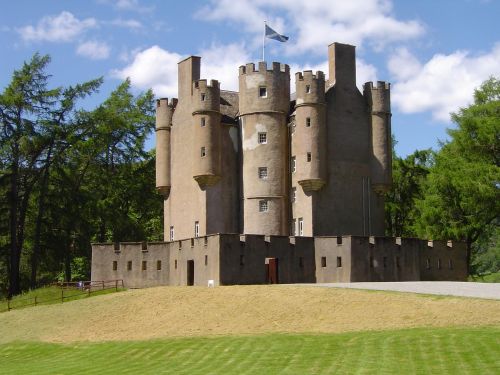
Braemar Castle
Braemar Castle in Aberdeenshire was first built by the 18th Earl of Mar, John Erskine in 1628, using it as a hunting lodge and strong hold against the powerful neighbouring Farquharson family. The castle replaced the nearby Kindrochit Castle, which is said to have been built sometime in the 11th century.
In 1689, John Farquharson, the Black Colonel of Inverey, led an attack on Braemar Castle, leaving it burnt and damaged.
John Erskine, 22nd Earl of Mar, was a noted Jacobite, particularly at the time of the 1715 Rebellion. Because of his role in the uprising, the castle was confiscated by the Crown. Braemar Castle and its lands were then bought by John Farquharson, 9th Laird of Invercauld, but the castle was left in ruins until 1748 when it was leased to the Government for £14 per annum, serving as a Hanoverian garrison. The garrison was eventually withdrawn, and in 1831 the castle was returned to the Farquharsons.
Braemar Castle was renovated into a family home, which was started by the 12th Laird of Invercauld, who also entertained Queen Victoria when she visited for the Braemar Games, which were held in the grounds of the castle. The castle remained as a family home to the Farquharsons for over 100 years.
The castle is now open to the public, and is visited by people from all over the world. The Farquharsons leased Braemar Castle in 2007 to the Braemar community for 50 years, so it can continue to be open as a visitor attraction, and is ran by the charity Braemar Community Limited. The castle is in need of urgent repairs to the roof and the charity is trying to raise the money.
Doreen Wood, part of the Braemar Castle Team, kindly sent us these photos of the castle.
The post Braemar Castle appeared first on ScotClans | Scottish Clans.
]]>