The post The Battle of Baugé appeared first on ScotClans | Scottish Clans.
]]>
Battle of Baugé
Background:
The Battle was part of the ‘Hundred Years War’ between England and France. In 1419 King Henry V of England had turned the course of the war at Agincourt, a battle that has become synonymous with Anglo French ‘sparring’ ever since. There had been a formal alliance between France and Scotland since 1295, known as the ‘Auld Alliance’ though the ties between the two nations goes back much further, indeed the tradition of a ‘Guarde Eccosais’ goes back to the time of Charlemagne.
After Agincourt the French were in disarray. Charles VI of France was mad, and his heir, the future Charles VII, was only sixteen. Normandy was lost to the English and the Dukes of Burgundy were taking Paris. With the situation getting desperate the Dauphin appealed to Scotland for help.
King James I of Scotland was imprisoned by the English and the country was being ruled in his place by Robert Stewart, first duke of Albany. Albany decided to send a force of 6,000 volunteers to France under the command of Archibald Douglas, earl of Wigtown and Albany’s second son John Steward, third earl of Buchan. A fleet of ships from Castile reached Scotland in September 1419, and on 29 October 1419 the Scottish army reached the Dauphin’s court at Bourges.
The Scots made up by far the largest component of the Dauphin’s defensive forces in the Loire Valley. The English army still recording successes in France was commanded by Henry V’s oldest brother Thomas of Lancaster, duke of Clarence. Estimates of the strength of this force vary from between 7,000 to 12,000 men, a considerable number of which were drawn from the English nobility.
In March 1421 Clarence led a series of raids through the Anjou and Maine and by Good Friday they were camped near the little town of Vieil-Baugé where their progress was halted by the Franco-Scots army who had also arrived in the area. Clarence was keen to engage them but some of his forces were dispersed and also Easter Sunday was unthinkable as a date to start a battle. The following day a party of English who had been on a foraging mission returned to their camp with some captured Scots soldiers, The party had stumbled upon the Scot’s forces and Clarence keen to press his advantage of surprise and also to avoid a conflict on a holy day decided to engage despite his weakened force.
The Battle

Carmichael Clan Crest
Clarence made the fateful decision to attack immediately with a small force of mounted men-at-arms, leaving The earl of Salisbury to gather the other troops who were still out foraging on their return. Clarence headed for the bridge at Baugé, the only crossing available to reach the Scots. It would appear he was desperate to match the exploits of his brother at Agincourt. The Franco-Scots army were largely unprepared for the attack, many were at morning prayers or playing sports. As they attempted to cross the Bridge a small Scottish force nearby raised the alarm and the English were immediately held by a rain of arrows. It took them some time to force a crossing of the river. In his haste he had not brought his own archers and the remainder of this initial force were stretched back along the road.
Despite this Clarence still pressed forward towards the village, only to be met by the main bulk of the Scots and French who were concealed behind a ridge on the approach. The Scots came over the crest and charged headlong at the English army. Clarence was an early casualty. John Carmichael of Douglasdale unhorsed him, breaking his lance in the process – an event which is immortalised in the crest of clan Carmichael. The battle was reduced to a vicious hand to hand melee and its unclear who stuck the final blow that finished off Clarence. Alexander Makcaustelayn (a Lennox highlander), the lord of Fontaines, Charles le Bouteiller and William de Swinton have all been credited with finishing off the King’s brother.
Aftermath
The result was a crushing defeat for the English which set them back on the course of the war, Henry was forced to return to France but he contracted an illness and died during the campaign. Many of the English who had never even made it to the battle were able to escape and the war raged on for many years to come with victories and defeats on both sides.
The Scots Army in France who had been largely criticised by many French before the battle were now seen in an altogether different light and this French guard in later years formed the core of the Royal Scots – the oldest regiment in the British army, honoured for their antiquity by their nickname ‘Pontius Pilate’s Bodyguard’
The post The Battle of Baugé appeared first on ScotClans | Scottish Clans.
]]>The post The Flodden 500 Service at St Giles, Edinburgh. appeared first on ScotClans | Scottish Clans.
]]>I’d like to continue by reproducing Alaistair Moffat’s reading given at St Giles. It was an excellent account of the battle and the aftermath.
—
FLODDEN ADDRESS. – ALISTAIR MOFFATWhen dawn broke on the morning of 10th September, 1513, the landscape of hell was revealed. On the gently undulating northern ridges of Branxton Hill more than 10,000 men lay dead or dying. In the midst of the carnage were the naked, plundered bodies of King James IV of Scotland, his half-brother, Alexander Stewart, Archbishop of St Andrews, George Hepburn, Bishop of the Isles, two abbots, nine great earls of Scotland, fourteen lords of parliament, innumerable knights and noblemen of lesser degree and many thousands of farmers, ploughmen, weavers and burgesses. It was the appalling aftermath of the battle of Flodden, the greatest military disaster in Scotland’s history.In the grey light of that terrible dawn, sentries posted around the captured Scottish cannon could make out where the brunt of battle had been joined. Below them, at the foot of the slope ran the trickle of a nameless burn now choked with slaughter, a wrack of mangled bodies, broken pikeshafts, shattered shields and everywhere blood and the sickening stench of death, vomit and voided bowels. Not all of the bodies were yet corpses. Through a long dark night the battlefield had not been a silent graveyard. Trapped under lifeless comrades, crippled, hamstrung or horribly mutilated, fatally wounded men still breathed. Bladed weapons rarely kill outright and they were often used to bludgeon men to their knees or into unconsciousness. In the churned mud of the battlefield some men will have lost their footing, fallen and been hacked at before they could get up. Many bled to death, maimed, lacerated by vicious cuts, screaming, fainting and screaming once more in their death agonies. Some will have been put out of their misery by parties of English soldiers scouring the field by torchlight for plunder, stripping the bodies, ransacking them for valuables. But other men will have lingered on inunspeakable pain, praying to their God, passing in and out of consciousness, slowly bleeding to death. The fury of the battle on Flodden field may have been stilled and awash with death and defeat. But all was not yet over. In an instant the plunderers and scavengers looked up and the sentries by the cannon stood to, frantically peering through the morning light. They could hear the rumbling thunder of hoofbeats – and then, suddenly, riders erupted over Barelees Rig. With 800 horsemen at his back, Lord Alexander Home galloped hard across the horrors of the battlefield and up the slopes of Branxton Hill. They had not come back to Flodden to rejoin a lost battle but to rescue their captured ordnance. And they very nearly succeeded. After a sharp skirmish, the English gunners managed to load and get off a volley at Home’s squadron, and they scattered.And so it ended. As the Border horsemen wheeled round and raced out of range, the remnants of the shattered Scottish army were limping across the Tweed at Coldstream. There was no organised pursuit. The victorious English army had taken heavy casualties and the Earl of Surrey and his captains were exhausted. In any event, their bloody work was done. The floors o’ the Forest were a’ wede awa, Flodden was a national disaster, a harbinger of lawlessness in the shape of the Border Reivers, the beginning of a long period of political uncertainty and the last medieval battle in the history of Britain. The last time a king was to die leading his army.It was also an epic. As two huge armies mustered and marched into history, extraordinary scenes had been witnessed. At Ellemford, high in the Lammermuirs above Duns, where sheep now graze on the flanks of the hills, where buzzards hang in the updrafts and an elegant bridge crosses the Whiteadder, King James IV and his army camped. Huge guns were trundled down the hill trails, dragged by oxen, and by 21st August 1513, almost 30,000 men had massed in this beautiful, now lonely valley. Two days later, the largest force ever to leave Scotland crossed the Tweed at the fords below Coldstream. They had declared war, they had entered the realm of the Tudors, of the ferociously ambitious and bull-like Henry VIII.Meanwhile Thomas Howard, Earl of Surrey, and the Bishop of Durham carried the standard of St Cuthbert before their battle-hardened troops. In front of the high altar of the great cathedral, Howard had watched the bishop bless the flag of the Haliwerfolc. The lands of Palatinate, of the Prince-Bishops of Durham, reached to the Tweed and beyond, and in an early definition of Englishness, their people were known as the Holy Man’s Folk, the Haliwerfolc. Ancient allegiances were being roused and summoned.Between 2nd and 9th September two vast armies circled each other in a small corner of North Northumberland, like heavyweight boxers looking for weaknesses or waiting for wrong moves. After the Earl of Surrey had despatched a herald, the Rouge Croix, it was finally agreed that battle would be joined on 9th September. Supplies for almost 70,000 men, horses and camp followers were running dangerously lowand neither army could remain in the field much longer.Realising the strength of the Scots’ entrenched position, Surrey led his men to the east, skirting Flodden Edge and staying out of artillery range. On the morning of the appointed day, he crossed the River Till and took up a position to the north of James IV’s army, barring any retreat to Scotland. And then, on a damp afternoon, the greatest battle ever fought between England and Scotland began.On the left wing of the Scottish host, the Highlanders led by the Earl of Huntly massed in formation with Lord Home’s Borderers, and in the moments before their chiefs roared the claideamh mor, the order to charge, the Gaelic-speaking warriors did something remarkable. They began to summon the army of the dead. They began the sloinneadh, the naming of the names of memory. To bolster his courage, each man began to recite his genealogy. Many waiting to charge could go back 20 generations. As if they were offering up the murmur of prayer, each man remembered why he had come to fight. Is mise mac Iain, mac Ruaridh, mac Domhnuill. I am the son of John, the son of Roderick, the son of Donald. And once their quiet voices stilled, the roar of the claideamh mor rent the air and they broke into the charge. With their broadswords and Lochaber axes, the Highlanders tore into the English ranks, the division led by Edmund Howard, They scattered and a rout was only prevented when Lord Dacre rode to the rescue with his English Borderers. As history rumbled across Branxton Hill, fortune appeared to be smiling on the Scots.At the same time, James IV was about to make a catastrophic decision, a crucial error of judgement. Instead of occupying an elevated position at the rear of his vast army, he chose to lead from the front. His division raced down Branxton Hill and as they reached the lower slopes and much softer ground, many men began to skid and lose their footing. This unsteadiness made it very difficult for them to control their long, 12 foot pikes. The wet ground made them charge out of formation, only engaging piecemeal with the solidly planted ranks of English billmen, With their shorter, more easily handled bills, they began to slice into James IV’s division. And as the men at the back saw the Scottish pikes go down, they hesitated and many of them ran, believing their king to be killed. By leading from the front, James was immediately submerged in the ruck of the fighting, only able to see what was directly in front of him, in no position to direct his forces. The result was disaster.The legacy of Flodden was most immediately and keenly felt in the Borders. North of the Tweed the memory of the battle is kept alive in the fabric of the midsummer common ridings. At Selkirk the ceremony of the casting of the colours is unique in Britain and it is based on the return of a soldier known as Fletcher, traditionally believed to have been the only one of sixty from the town to return. In his bloodied hand he held aloft, in a gesture of desolate defiance, a flag captured from the men of Macclesfield in Cheshire. Many Englishmen had fought and fallen at Flodden. And passions still run high. When the Mayor of Macclesfield recently wrote to the Provost of Selkirk asking for the return of the flag, he was told that he would need to come to the Borders and take it.Flodden is an immense story. Like Culloden in 1746, it signalled the end of a fading, feudal Scotland. And it also ushered in a century of lawlessness, the criminal society controlled by the appalling Border Reivers. Across Europe, renaissance, enlightenment and the reformation were changing lives, forming new ideas and creating the institutions of the modern world. In the first half of the 16th century, central authority broke down in a leaderless nation, and while swords and spears spoke in Scotland, the law was often silent.What is to be learned from all of that suffering and slaughter, from all of those ancient enmities? First that they are ancient and must remain firmly in the past. In 2014 Scotland faces a historic choice and whichever way the people of Scotland vote, it must be a signal lesson of Flodden that enmity, even ancient enmity can have no part. And it is to the credit of politicians on all sides of the argument that it has not reared an ugly head. But it might.And alongside that it mustmbe important to remember, to understand the visceral, bloody realities of whatmwent on on that terrible day 500 years ago. Lest we forget, Flodden should become a place of remembrance and of pilgrimage, a place where the uncomfortable lessons of history can be learned and never forgotten.Two weeks ago, on one of the countless beautiful evenings of this glorious summer, I drove over to Branxton. As the sun threw long shadows across the gently undulating fields, I tried to imagine the 10th of September, 1513, the distant roar of thousands of men, the screams, the fear and feral closeness of hand-to-hand fighting whenmen can smell the breath, smell the sweat of men grunting pushing, hacking, swearing at them, trying to kill them. In a Gaelic phrase, I tried to listen for the music of the thing as it happened. I tried to listen to the slow, sad music of our history. I hope that many in Scotland and England hear it too.
Prior to the sir Malcolm MacGregor (who has admitted that try as he might he can not find a single MacGregor involved in the battle) researched the casualty lists. The following names are clans and families who are known to have fought at Flodden along with notable people who fell in the battle:
From the Highland Clans:
Campbell, Erskine, Fraser, Gordon, Graham, Guthrie, Haldane, Hay, Keith, Leslie, Lindsay, Macaulay, Macfarlane, Mackay, Maclean, Macnab, Menteith, Moncreiff, Moray, Murray, Ogilvy, Oliphant, Ramsay, Rattray, Ross, Ruthven, Seton, Sinclair, Stewart, Forbes, Forsyth, Grant, MacKenzie, MacNaughton, Ross, Skene, Buchanan Of Leny, MacDonald
The Lowland and Border Clans and Families:
Adair, Abercromby, Adam, Anstruther, Baillie, Baird, Balfour, Barclay, Blackadder, Bonar, Boswell, Carnegie, Cathcart, Cleland, Cockburn, Colville, Craig, Crauford, Crichton, Cunningham, Dunbar, Dundas, Edmonstone Of Duntreath, Elphinstone, Fotheringham, Gray, Grierson, Haig, St.Clair Of Roslin, Henderson, Hepburne, Herries, Home, Hoppringle, Houston, Lauder, Liddel, Lockhart, Lumsden, Lyon, Masterson, Maitland, Maule, Maxtone, Maxwell, Melville, Muirhead, Mure, Napier, Rollo, Sempill, Somerville, Spottiswood, Stewart Of Traquair, Allardice, Ballingall, Kerr, Colville, Crammond, Eliott, Ferguson, Fleming, Foreman (Standard Bearer), Inche, Inglis, Johnstone, Kirkcaldy, Knolis, Logan, Montgomery, Morton, Muir, Nelson Of Madinpap, Otterbrun, Pitcarin, Pringle, Reid, Rorison, Savage, Scott, Seton, Tunstall, Vallanche, Wood Of Raik, Kennedy, Douglas, Hamilton, Livingstone, Wemyss, Wallace, MacLellan, MacCulloch, MacDowall
Chief Or Notable Head Of House/Family
King James IV, Archbishop Of St.Andrews (King’s Son), Earl Of Morton ( Grandson Of James 1), Earl Of Glencairn, Douglas Of Drumlanrig, Sir James Dunbar, Dundas, Lord Elphinstone, Lord Erskine, Earl Of Huntly, Earl Of Montrose, Sir Alexander Guthrie, Haig Of Bemersyde, Haldane Of Gleneagles, Earl Of Errol, Earl Of Bothwell, Sir William Keith, Earl Of Cassilis, Earl Of Rothes, Earl Of Crawford, MacDowal, Earl Of Garthland, MacFarlane Of Arrochar, Hector MacLean Of Duart, Maxwell Lord Of Carlaverock, Sir John Moncreiffe Of That Ilk, Moray Of Abercairney, Ramsay Of Dalhousie, Rattray Of That Ilk, Rollo Of Duncrub, Master Of Ruthven, Lord Sempill, Lord Seton, Earl Of Caithness, Earl Of Atholl, Earl Of Lennox, Lord Darnley, Master Of Angus, Anstruther Of That Ilk, Ballingall Of That Ilk, Master Of Eliott, Lord Forbes, Master Of Lovat, Sir Alexander Gordon Of Lochinvar, Sir Alexander Gordon Of Knockenshene, Grant Of Freuchie, John Henderson Of Fordell, Lord Alexander Home, Sir Patrick Houston Of That Ilk, William Johnstone Of That Ilk, Lord Keith, Lord Lorn, Lyon (Sons Of Lord Glamis), MacKenzie Of Kintail, Sir Alexander MacNaughton Of That Ilk, Andrew Pitcairn Of Pitcairn And 7 Sons, Lord Ross, William Ruthven Of That Ilk, Sir Walter Scott Of Buccleuch, Alexander Skene Of That Ilk, Sir David Wemyss, Earl Of Argyll, Lord Kinnaird, Master Of Cathcart, MacDonald Of Lochalsh.
—–
 The St Giles Service…
Just over 40 clan chiefs attended the St Giles service. At the end of the service they mustered for a photograph on the steps. To help you identify who was there we have been given a sketch with a key to the names:
1. Sir Walter Riddell of Riddell 2. The Hon. Elizabeth Fairbairn 3. Madam Pauline Hunter of Hunterston 4. Sir David Bannerman of Elsick 5. Lord Polwarth 6. Andrew Wallace Younger of that Ilk 7. Andrew Dewar Durie of Durie CBE 8. Michael Ancram, Marquess of Lothian 9. Andrew MacThomas of Finegand 10. Earl of Dundee 11. David Campbell of Strachur 12. Roderick Macneil of Barra 13. Sir James McGrigor 14. Earl of Eglinton and Winton 15. Professor David Hannay of Kirkdale and of that Ilk 16. Henry Trotter Younger of Charterhall 17. John MacArthur of that Ilk 18. Duncan Paisley of Westerlea 19. Richard Carmichael of Carmichael 20. Earl of Caithness21. Earl of Lauderdale 22. The Hon. Alexander Leslie 23. Earl of Erroll 24. Lord Napier and Ettrick 25. Madam Arabella Kincaid of Kincaid 26. David Cranstoun of that Ilk 27. Jamie Macnab of Macnab 28. Earl of Wemyss and March 29. Sir Crispin Agnew of Lochnaw 30. The Hon. Kate Nicolson 31. Duke of Montrose 32. The Hon. Peregrine Moncreiffe of that Ilk 33. Martin Haldane of Gleneagles 34. Lord Sempill 35. Andrew Marjoribanks of that Ilk 36. Donald MacLaren of MacLaren 37. Duke of Hamilton 38. Field Marshal the Lord Guthrie of Craigiebank 39. Isla St Clair 40. Marquess of Ailsa 41. Madam Margaret Eliott of Redheugh 42. Sir Malcolm MacGregor of MacGregor 43. Lord Macdonald of Macdonald 44. Richard Oliphant of that Ilk
This image will help you identify the chiefs:

The post The Flodden 500 Service at St Giles, Edinburgh. appeared first on ScotClans | Scottish Clans.
]]>The post The Tragedy of Mary Hamilton appeared first on ScotClans | Scottish Clans.
]]>“Yestre’en the Queen had fower Maries
The nicht she’ll hae but three
There was Mary Seton and Mary Beaton,
And Mary Car-Michael and me.”
It is believed that the ballad is fictional, and the four Marys come from the four ladies-in-waiting chosen by James V’s Queen, Mary of Guise, to be companions to Mary, Queen of Scots who succeeded her father at the age of just 6 days old. However, none of these woman were called Mary Hamilton; they were in fact Mary Beaton, Mary Fleming, Mary Livingston, and Mary Seton.

Mary Hamilton awaiting execution
Yet, there was a real Mary Hamilton, whose story and downfall is rather similar to that of the Mary Hamilton in the ballad.
Mary Hamilton was a Scottish lady-in-waiting to the Russian Empress Catherine I. She was a member of a Scottish Hamilton family who emigrated to Russia sometime in the sixteenth century, during the reign of Ivan the Terrible. It is believed that she was the daughter of a William Hamilton. Mary became a lady-in-waiting to Catherine I in 1713, and she attracted a lot of attention around the royal Russian court due to her beauty and love life, and it wasn’t long before she became the mistress of Peter the Great. But the Tsar wasn’t her only lover, she was also having an affair with Ivan Mikhailovich Orlov, an aide-de-camp to Tsar Peter. However, Orlov had another mistress, and when Mary found out, she tried to win him back by giving Orlov gifts which she had stolen from Catherine.
Over the years Mary became pregnant on at least three occasions, and had two abortions – one in 1715, apparently by consuming constipation medicine. However, she did have a secret birth two years later in 1717, but afterwards killed the baby by drowning it. That same year her lover Orlov was questioned over some missing documents, and during the interrogation he confessed to having had an affair with Mary, and claimed that she had an abortion.
A rumor was spread that the Empress, Catherine, had a slightly unorthodox skin care method: it was alleged that she would eat wax to make her skin pale. And Mary Hamilton was accused of starting this rumor by Avdotya Chernysheva; Ivan Orlov’s other lover. This, unsurprisingly, annoyed Catherine, and she demanded that Mary’s room was to be searched. Unfortunately for Mary, her room was where she kept several of the items she stole from the Empress, and when they were discovered Mary and Orlov were both arrested and imprisoned in the Fortress of Saint Petersburg. Whilst in prison Mary not only confessed to the theft, but she also admitted that she murdered her new born child, however, even under torture, she refused to testify against Orlov, despite the fact he had been quick to point fingers at her.
In the November of 1718, Mary Hamilton was sentenced to death for abortion, infanticide, and theft and slander of Empress Catherine. Catherine asked Peter to overrule the death sentence, but he refused. The Tsar did, however, promise Mary that the executioner would not touch her at all, meaning that she would be beheaded with a sword instead of an axe. Mary was executed on the 14th of March, 1719, dressed all in white.
Unfortunately for Mary Hamilton, her execution was not the last indignity that she would suffer. After the decapitation the Emperor went over and picked up Mary’s head and gave the gathered crowd a lecture about its anatomy before kissing it and then throwing it down. The Russian Academy of Science were given her head and they preserved it for at least the next 50 years.
The post The Tragedy of Mary Hamilton appeared first on ScotClans | Scottish Clans.
]]>The post 21st Century Clan Chiefs: Carmichael appeared first on ScotClans | Scottish Clans.
]]>Dougie Vipond meets contemporary clan chiefs to see how the clan system operates in a modern Scotland.
The post 21st Century Clan Chiefs: Carmichael appeared first on ScotClans | Scottish Clans.
]]>The post Border Reivers-West March Warden is Murdered by the Armstrongs. appeared first on ScotClans | Scottish Clans.
]]>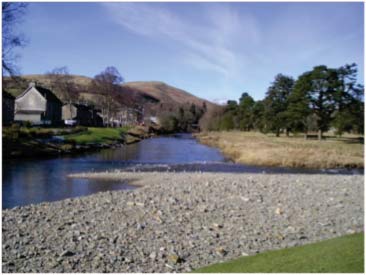
THE RIVERS ESK AND EWES AT LANGHOLM.
Sir John was born in 1542, son to an illustrious family which hailed from Lanarkshire. He was a direct ancestor of the Earls of Hindford.
He was Scottish Deputy March Warden at the ‘Day of Truce’ which was held on the Border in the hills aside present day Carter Bar in July 1575. The Day of Truce, a meeting to try the perpetrators of crime, both English and Scottish, was enshrined in Border Law. March Wardens from each side of the Border presided over the affairs and were charged with bringing the criminals for trial; juries were a mix of both Scots and English. Yet the ‘Day’ was a time when many men attended from both England and Scotland to witness that fair play presided throughout.
In 1575 numbers who attended were limitless; it was not unusual for a thousand men from each country to witness the events. Thus it was nigh on impossible to bring Scots and English together without inviting many who were at feud. Such was the turmoil that reigned in the Border country that even blood-feud prevailed as men from the same clans and same side of the Border rubbed shoulders at the Truce but smarted for revenge at the sight of an adversary with whom they were at odds. The atmosphere was charged with belligerence and aggression, yet there was little alternative. All invited might ostensibly be there to see fair play but there was another reason, unspoken yet acknowledged by all. Their presence was some insurance that neither side would take advantage of the other, nor resort to violence should any judgement be deemed unfair by family or friend of the accused. All who attended the Truce were to arrive unarmed but the reality was so different. No man would have been so foolish as to adhere to this code in the cauldron of ill feeling which prevailed. The Wardens turned a blind eye to the steel which swung at each man’s belt.
All took an oath to honour the precept of the Truce. They swore that they would not offend ‘by word, deed or countenance’.
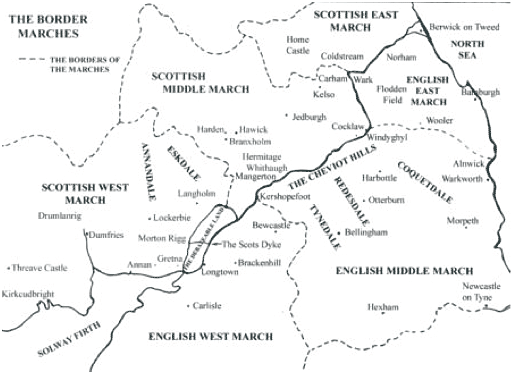
THE BORDER MARCHES
At the Raid of the Redeswire Carmichael fell victim to the invective and guile of Sir John Forster, seventy-five years old, and English Middle March Warden. Reaction to the aggressive exchanges of the two Wardens soon spilled over to the men of both sides who attended and all hell let loose.
The Redeswire affair was the last battle between English and Scottish Border Reivers and the last time that the English used the longbow in warfare. The English came off the worse in this encounter and Carmichael was warded in York in an effort to appease the wrath of Elizabeth l of England. Sir George Heron of Chipchase in Tynedale, Northumberland was murdered in the affray.
There was at least one other occasion where Sir John Carmichael played a prominent part. In the Raid of Ruthven in 1582 the sixteen year old king of Scotland, James Vl, was captured by William Ruthven, 1st Earl of Gowrie, and confined for ten months. Gowrie was unhappy at the influence of Catholicism and the effect this might have on the young king. Carmichael held the same views and readily espoused the cause of ridding the nation of the pro-catholic and pro-French influences epitomised in the young king’s cousin, Esme Stuart.
Carmichael was soon pardoned for his part in the affair. In 1588 he was one of the ambassadors sent to Denmark to negotiate the marriage between James Vl and Anne, daughter of the king of Denmark.
When Carmichael was made Warden of the Scottish West March in 1598 he had come of age. For all his turbulent past he was respected as a Warden who would see fair play between the English and Scots. There were many in the Scottish Border Lands who resented his impartial approach; none more so than the Armstrongs of Liddesdale.

LIDDESDALE
In 1600 Carmichael made it plain that he would use his power as March Warden even against his own people and especially the Armstrongs whose raids south of the Border were a particular embarrassment to a man dedicated to bringing peace to the Borders. The Armstrongs decided to plead for leniency on the promise of amendment to their nefarious ways and sought an audience with Sir John. They sent a brother of William Armstrong of Kinmont to parley with Carmichael, one Alexander Armstrong, known as Sandeis Ringane. Carmichael had heard the promises too many times before and would have no truck with the Armstrong clan. Their past outrages deserved the punishments he held in store.
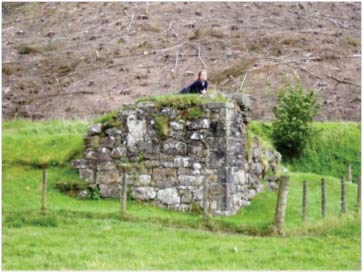
THE RUINS OF MANGERTON TOWER; THE MAIN ARMSTRONG STRONGHOLD
At the meeting with Carmichael were a few of his young followers. They began to taunt the elderly Armstrong and endeavoured to humiliate him at every opportunity. It would seem that Carmichael did little to curb their youthful pranks and overt hostility to the once powerful warlord. At one stage they removed his sword and filled his scabbard with egg yolks. Having replaced the sword it was now impossible to remove it from the scabbard.
Sandeis Ringane was besides himself with fury and swore that should any of the present company of Carmichael ever stray on Armstrong land he would have no compunction in pulling his sword and ridding the world of their odious presence. The meeting broke up with acrimony.
On his return home Sandeis Ringane told his sons of his mistreatment. His eldest son, Thomas Armstrong, said little in the way of comfort to calm the distress and shame of his unfortunate father but the thought of revenge was soon at the forefront of his mind.
He knew that next morning Sir John Carmichael was to leave Langholm and ride for Lochmaben where he was to preside over a Warden Court. The journey, through hilly woodland, would surely present the perfect opportunity to confront the illustrious March Warden.
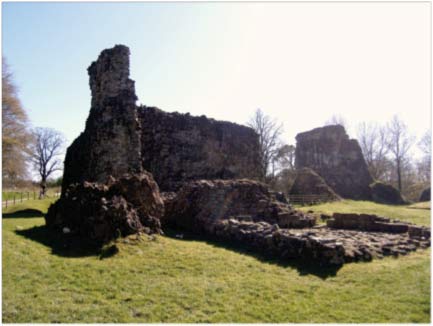
THE RUINS OF LOCHMABEN CASTLE
Accordingly next morning a party of Armstrongs including Thomas Armstrong and his father along with a Taylor, a Forrester, a Scott and a Graham lay in wait for Carmichael at a place still known to this day as the Raesknowes, on the way to Lochmaben. As the March Warden passed the ambush party a number of hagbutts rang out and Carmichael fell dead.
The ambush party scattered and sought refuge at the homes of friends who had been apprised of the intention to kill Carmichael but they were relentlessly pursued on the orders of King James.
Carmichael was a king’s Warden of the Marches and the perpetrators of the murder were therefore considered as traitors. Murder in the Border lands was pretty commonplace in the 16th century but this one was different. Murder of a man appointed by the King himself was not to be tolerated. The wrongdoers would pay the ultimate price for their rash and impetuous crime against a King’s man.
In 1601 Thomas Armstrong, son to Sandies Ringane, was apprehended, taken to the Mercat Cross at Edinburgh and hanged. Before he stood the drop that ended his life his right hand was cut off. Subsequently his body was wrapped in chains, the lifeless corpse hung up at the Borroughmuir.
‘And Thomas Armstrang, “sone to Sandeis Ringane” was condemned to be “tane to the mercat croce of Edinburgh, and thair his richt hand to be stricken fra his arme; and thaireeftir, to be hanget upoune ane gibbet, quhill he be deid; and thaireefter, to be tane to the Gallows on the Burrowmure, and thair his body to be hangit in irn chains…
Thomas Armstrong was the first man ever to be hanged in chains after death; at least he is the first recorded as such in the Scottish records. Even in death he was to suffer for his crime, his body subject to the butt of endless atrocity by the Edinburgh populace.
One man evaded capture until 1606.
Should you ever find yourself taking the road from Canonbie to Newcastleton in the Scottish Borders, you will come across a statue to Lang Sandy as you pass through the village of Rowanburn. It is on your right as you pass through the village.
Lang Sandy, as his name implies, was a huge man. His real name was Alexander Armstrong, the board at his feet simply declaring that he was hanged in 1606.
He took part in the ambush and murder of Sir John Carmichael in June 1600 but was not caught until six years later.
At his trial he admitted the murder but not before saying that the crime was brought on against his will.
The murder of Sir John Carmichael would herald the end of the Armstrongs as the superior force in the Scottish Border Lands. Within three years of the murder, James Vl of Scotland would also rule in England on the death of Elizabeth l. He would not forget the atrocity committed by a clan that had often been the bane of his endeavours to cement a lasting and firm relationship with the English queen before her death. Many of the Armstrongs would be unjustly hounded and persecuted, evicted from their lands, deported and executed without trial.
Carmichael‘s death would signal their demise.

LANG SANDY OF ROWANBURN

Border Reivers
Quick Links to Clan Armstrong Products from The Clan Shop
- Armstrong Tartan Tie
- Armstrong Tartan Pocket Square Handkerchief
- Armstrong Tartan Scarves
- Armstrong Tartan Kilts
- Armstrong Clan Crest Badge
- Armstrong Clan Crest Mug
- Armstrong Clan Crest T-Shirts
- Armstrong Clan Crest Belt Buckle
- Armstrong Phone Covers
- Armstrong Tartan
- Armstrong Clan Crest Crystal Glasses
- Armstrong Clan Crest Cufflinks
- Armstrong Clan Crest Sgain Dubh
- Armstrong Clan Crest Kilt Pin
- Armstrong Clan Crest Plaques
The post Border Reivers-West March Warden is Murdered by the Armstrongs. appeared first on ScotClans | Scottish Clans.
]]>