The post The Scott Monument appeared first on ScotClans | Scottish Clans.
]]>
The Scott Monument, sometimes referred to as the ‘gothic rocket’, is a Victorian Gothic monument to the author Sir Walter Scott. It stands towards the east end of Princes Street in Edinburgh, and happens to be the largest monument to a writer in the world, and was completed on August 1st 1846.
Scott was a poet, novelist, ballad-collector, critic and man of letters, but is probably most renowned as the founder of the genre of the historical novel, involving tales of gallantry, romance and chivalry. Beginning with the publication of Waverley in 1814, one of the most significant books of the nineteenth-century, his anonymously published Waverley novels proved hugely popular in Europe and America, and established his reputation as a major international literary force. It is a measure of Scott’s influence that Edinburgh’s central railway station, opened in 1854, is called Waverley Station, the only station in the world to be named for a book.
By the 1820s, Scott was probably the most famous of living Scotsmen, and was consequently chosen to organise the visit to Edinburgh in 1822 of George IV. He was heavily criticised by his Scottish contemporaries for the resultant tartan pageantry, in which the King appeared in Highland dress complete with salmon-pink leggings.
In 1825, his financial state deteriorated drastically, and rather than declare bankruptcy he placed his home, Abbotsford, and income into a trust belonging to his creditors, and proceeded to write his way out of debt. He continued to live at Abbotsford near Melrose, where he died on the 21st September 1832. Among other tributes, the Scott monument was raised on Princes Street in Edinburgh…

Upon his death the great and good of Edinburgh came together to agree on a fitting monument to this outstanding Scottish man. In 1836, an architectural competition was launched, inviting designs for an appropriate memorial. One entrant went under the unlikely name of ‘John Morvo’, a name shared by the medieval architect of Melrose Abbey. Morvo was in fact George Meikle Kemp, a 45 year old joiner, draughtsman and self-taught architect. Kemp had feared his lack of architectural qualifications and reputation would influence judges against his design. In 1838 it was announced that Kemp’s design had won the competition and his monument was to be built. At the same time the result was announced, Sir John Steell was unanimously selected to undertake the sculpture of Scott at the base of the monument.
The foundation stone was laid on the 15th August 1840, the anniversary of Scott’s birthday. In the foundations were deposited a glass jar ‘time capsule’ and two bronze plaques – one from the Freemasons, the other celebrating the author.
A silver trowel with a mahogany handle was used during the ceremony for laying the foundation stone of the monument. It has an engraved border of a rolling thistle flower and leaf, and on it is written:
‘To Commemorate the Laying of the Foundation Stone of the Monument at Edinburgh in honour of the Immortal Scott.
This trowel to be used at the ceremonial was presented to the Right Honourable Sir James Forrest of Comiston Bart., Lord Provost of Edinburgh, Most Worshipful Grand Mason over all Scotland.
The Right Worshipful Master, Office Bearers and Brethren of the Grand Masters Mother Lodge, The Ancient Lodge of Edinburgh No.92. Aug 15th 1840.’
The trowel can be found on display at the Writers’ Museum, Lady Stair’s Close, Lawnmarket, Edinburgh.

Construction began in 1841 following permission by an Act of Parliament. Specifically the Monument to Sir Walter Scott Act 1841, which allowed the monument to be built on the site chosen, as there was a ban on any construction between Princes Street and the Old Town, so as not to obscure the historic view.
Tragically George Meikle Kemp died when the monument was only half completed, on the night of 6th March 1844. It is thought he was to have lost his way in very thick fog after visiting his contractor near the old Canal Basin in Fountainbridge. His body was found in the canal one week later. Over 1000 people attended his funeral. His coffin was carried to St Cuthberts graveyard by his workmen, who by all accounts, thoroughly respected his humble origins and great depth of knowledge.
After Kemp’s death, work continued under the supervision of his brother-in-law, William Bonnar. He proposed an amendment to the height from 176 feet to 200 feet and six inches. For a while there was dissent from outsiders, especially when a rise in costs from £10,000 to £12,000 was forecast. However, when workmen on the project offered two weeks labour without pay in order to support Bonnar, the money was found.

Taking nearly four years, construction ran until August of 1844 with Kemp’s son placing the finial in that month.
The actual date of the inauguration ceremony seems to have been lost to time, but most accounts give it as the 17th or 18th of August 1846, with contemporary newspapers stating that it was the 15th (Scott’s Birthday).
Thousands of people attended the inauguration ceremony, some travelling great distances to see the monument. The steamer ‘Britannia’ brought nearly 300, the evening before some 400 people came from Dundee, other ferries arrived in the morning from Fife, and a train came from Burns country with hundreds aboard.
The procession comprised the Monument Committees, the Town Council of Edinburgh, the Magistrates of Edinburgh, Canongate, Leith and Portsburgh, various Masonic Lodges and Officials, who all assembled in the Royal High School. It was described in The Scotsman newspaper as “a moving stream of umbrellas, with long lines of stationary umbrellas for its banks”, although there is not an umbrella to be seen in this image.
It was preceded by mounted military band, and a detachment of Dragoons. There was an opening address by Lord Glenlyon, Grand Master of Scotland and a reply by the Lord Provost of Edinburgh, the Right Honourable Adam Black – whose statue is 100 yards to the west of the monument.

From the ground the pinnacle of the monument rises 200ft and 6in above Princes Street and the gardens surrounding it. The foundations were sunk 52ft into the ground to support its considerable weight, and added considerably to the total cost of the structure which amounted to £16,154 which today would be around £1.5m.
The monument was constructed of Binny sandstone, from the local Ecclesmachan quarry in West Lothian, which has left it’s own unique stamp on the structure. As it is an oily stone it has prematurely aged the appearance of the structure, although the soot of Victorian times and the exhaust fumes of the modern road and rail routes close by will have contributed a great deal.
On the ground, in the centre of the monument on a platform up seven massive steps, there is a statue of Scott carved from carrara marble and scale at double life-size. This was the work of the aforementioned Sir John Steell. It features Scott in a seated position, book in hand, with one of his favourite dogs, Maida, reclining at his feet.
This statue was carved from a 30 ton block imported from Livorno in Italy, which was no easy task. The block had to be retrieved from the bottom of the city harbour, as it was so heavy it ended up crashing through the hull of the ship and when it eventually arrived in Edinburgh, at Leith docks, it took a total of 25 horses to drag the cart carrying it through the streets to Steell’s studio on Princes Street.
It is actually the first marble statue to ever be displayed in Scotland and almost glows out from under the monument and the dark stone that surrounds it.

The monument also features a total of 68 figurative statues (not including Scott and his dog), placed all over the structure. 64 are visible from the ground, but 4 are hidden away above the final viewing gallery.
Each statue represents a famous Scottish person or a character from Scott’s literary work. Just a few of the figures that can be seen are Rob Roy MacGregor, Robert Burns, Mary, Queen of Scots, Bonnie Prince Charlie, Robert the Bruce, and John Knox.
Also featured are several ‘grotesques’. The grotesque character faces are a typical stonemasons ‘joke’. Common in Gothic Architecture when medieval stonemasons carved all manner of weird and wonderful faces, gargoyles and other ‘grotesques’, on the great cathedrals of Europe.

Today the monument still stands proud in the heart of Edinburgh, instantly recognisable and loved by the cities residents. Of the visitors that flock to Edinburgh every year, thousands still visit this fantastic attraction and take on it’s 287 steps to get access to some of the best views of the city centre.
The post The Scott Monument appeared first on ScotClans | Scottish Clans.
]]>The post This Week in History: Isabel MacDuff and Robert the Bruce appeared first on ScotClans | Scottish Clans.
]]>
Bruce is crowned for the second time in two days by Isabel MacDuff, Countess of Buchan. Colour litho by Williams, Morris Meredith (1881-1973).
With attention focused on the approaching 700th anniversary of the Battle of Bannockburn, it’s worth taking a look at the events and figures instrumental in the lead-up to the momentous battle. Strangely absent from the legends surrounding Bannockburn is the role played by women, even though one largely looked-over heroine enabled Robert the Bruce’s claim to the Scottish throne on this day 708 years ago.
Like a lot of periods in Scottish history, the early 14th century was a rather tumultuous time. Fresh of the back of the the 13th century’s succession disputes, and William Wallace’s failed uprising, Scotland was then ruled as a province of England by Edward I. Bruce had become a guardian of Scotland, alongside his biggest rival for the Scottish throne, John III Comyn, Lord of Badenoch. In 1306, Bruce quarreled with Comyn and stabbed him to death at Greyfriars Kirk in Dumfries, cementing a deep hatred between the Bruce and Comyn families.

The killing of John Comyn in the Greyfriars church in Dumfries, as seen by Felix Philippoteaux, a 19th-century illustrator.
Isabel MacDuff, second cousin to Robert the Bruce, had the great misfortune of being married a few years earlier to Comyn’s cousin, John Comyn, Earl of Buchan. Some historians and authors believe she may also have been one of Bruce’s lovers. Following the murder at Greyfriars, it’s safe to say times were tough for Isabel. She took the contrary view to her husband, instead supporting the Bruce by taking the Scottish side in the Scottish Wars of Independence.
Bruce, knowing he would be excommunicated for killing a man on holy ground, and knowing an excommunicated man could not be crowned king, did the only thing he could in order to claim the Scottish throne as his own: he dashed for Scone, traditional crowning place of the Scottish kings, in a race against the messengers flying to the Pope with news of the Greyfriarsmurder and the messengers speeding back equally hastily with news of his excommunication.
Robert’s coronation took place on either March 25 or 26 1306 in Scone, however tradition at the time stated all Kings must be crowned near the stone of destiny and/or anointed by the Kirk. Unfortunately the stone had been removed by Edward I a few years earlier, and the Kirk would have been hardly willing to crown Bruce following his actions at Greyfriars. Another tradition was sought to cement the claim, and it just so happened that the MacDuff clan held a hereditary right to crown Kings of Scotland.

Robert the Bruce and Isabel MacDuff immortalised in stone at Edinburgh Castle
Meanwhile, Isabel’s husband John was in England at this time so, on hearing the news of the impending coronation of the new king, she took her husbands horses and rode to Scone, unfortunately arriving a day late. However, because so many traditional elements of the crowning were absent from the first crowning, a second crowing with Isabel representing the MacDuff family tradition on either the 26th or 27th of March solidified Bruce’s right to the kingship of Scotland, thus effectively cutting off Isabel’s ties to her Comyn family.
Isabel stayed on with Bruce, but was betrayed and captured shortly after Bruce’s defeat at the Battle of Methven in June 1306. Edward I of England ordered her sent to Berwick-upon-Tweed with these instructions:
“Let her be closely confined in an abode of stone and iron made in the shape of a cross, and let her be hung up out of doors in the open air at Berwick, that both in life and after her death, she may be a spectacle and eternal reproach to travellers.”
She was imprisoned in this cage for four years, then moved to the Carmelite friary at Berwick. This was not necessarily a humanitarian move; it is suggested that by this stage Bruce was gaining support, his female relatives were potentially valuable hostages, and the English did not want them to die of ill-treatment. The last clear mention of her is being transferred again in 1313, one year before the Battle of Bannockburn, with her eventual fate uncertain.
The post This Week in History: Isabel MacDuff and Robert the Bruce appeared first on ScotClans | Scottish Clans.
]]>The post Bannockburn Visitor Centre Ready for Battle appeared first on ScotClans | Scottish Clans.
]]>
A 3D Robert the Bruce visits his troops at the new Bannockburn Visitor Centre
We’re just back from a quick trip up the road to just outside Stirling to check out the new Bannockburn Visitor Centre, set to open to the public next weekend. Coming in (on time, and on budget) with a price tag of £9.1 million, the centre uses state-of-the-art motion capture techniques and fight choreography to immerse visitors in a realistic and historically accurate 3D Battle of Bannockburn. (View a gallery from our visit here.)
A thoroughly impressive experience, the visitors centre is the first tourist attraction in the world to use this kind of technology, providing a very 21st century view of the battle in this the year of its 700th anniversary. You’ll find no objects in glass boxes here – there are no surviving artefacts from the battle anyway. The centre appeals to the ‘modernologist’, moving away from passive ‘museum’ viewing, and instead offering visitors the chance to interact with history.
Interpretation designers Bright White Ltd worked with an Academic Advisory Panel of some of the UK’s top historians and leading 3D modellers at the Centre for Digital Documentation and Visualisation (a partnership between the Digital Design Studio of the Glasgow School of Art and Historic Scotland) to bring the battle to life for 21st century audiences.
Revered as the most famous Scots victory – the Battle of Bannockburn marked a pivotal moment in Scotland’s history, paving the way for the signing of the momentous Declaration of Arbroath. Our tour began with a 3D puppet-show prologue by two of the battle’s well-known figures – Sir James Douglas representing the Scots, and Isabella of France, wife of Edward II of England.
We then moved through to the next room to ‘Prepare for Battle’. Robert the Bruce and King Edward II feature as life-size 3D projections, witnessing the two sides preparing for battle. If you’ve ever wondered what it feels like to be a fly on the wall in the Scots or English camp the night before Bannockburn, this is about as close as you’re going to get. Eerily lifelike (and lifesize) Scots soldiers were practicing hand-to-hand combat metres from where I stood, while English soldiers fired arrows at targets on the other side of the room.
Iconic moments from the battle also dramatically play out, including when Bruce encounters Sir Henry De Bohun with his axe on the first day of the battle. I also had a very interesting briefing from Sir James Douglas in the digital character section, who presented me with his reasons for supporting the Bruce.

Let the battle begin!
From there we moved through to the jewel in the centre’s crown, the battle simulation room. Upon entry you are given a number from a battlemaster which determines where abouts around the interactive battle map you stand, and more importantly, which side you’re on. I was placed on the English side, and given control of a division of longbows and heavy infantry.
During the first day of battle my divisions moved about near the rear of the action, warily trying to get into a good strategic position. But once I sent forward my first longbow attack, I’m rather ashamed to admit I had the taste for it, and went on a little bit of a rampage, sending cavalry and longbows hurtling after Robert the Bruce (who was cowering somewhere behind Stirling Castle). By the end of the second day it looked as though we were going to take the castle, but just at the last minute we were foiled by traps set by the Scots.

Tense times! The final moments of the battle
Our battlemaster David Weinczok, 24 from Nova Scotia, controlled the game and was on hand to flesh out historical details, and throw in tips and advice before declaring the successful side, summarising the results of the action with an overview of how the battle played out in 1314, and revealing the 21st-century version of the landscape and locations of conflict. The only thing I’m a bit confused by was his costume – looking more like a sci-fi knight sent from the future than a 14th century soldier.

Battlemaster David Weinczok provides an overview of the real 1314 battle.
After the battle we entered the epilogue room, where another 3D puppetry styled video was shown in which Sir James presented the aftermath and consequences from the battle, most importantly Scotland’s assertion as an independent kingdom. Topical stuff, in this the year of the referendum. We finished our visit outside the centre at the recently restored Bruce monument and flagpole. After being immersed in so much state of the art technology, we finished our day by walking twenty metres through a field to stand in the place where these events of Bannockburn exactly 700 years ago.
View our gallery from this mornings event here! The centre is open from 1/3/2014.
The post Bannockburn Visitor Centre Ready for Battle appeared first on ScotClans | Scottish Clans.
]]>The post Poem Marks Bannockburn Anniversary appeared first on ScotClans | Scottish Clans.
]]>
Rotunda Monument at the Bannockburn Battleground
A new poem has been unveiled to mark the upcoming 700th anniversary of the Battle of Bannockburn. The specially commissioned poem appears on a new timber ring crowning on the Rotunda Monument at the historic battle site.
The designer behind the original monument, Sir Robert Matthew, planned for it to bear an inscription however nothing had been inscribed since the monument was installed half a century ago. Expert carver Richard Douglas from Andrew Miller Architectural Joinery, based in Stirling, began the inscription works back in June.
Poet Kathleen Jamie, a professor of Creative Writing at Stirling University, said the poem was inspired by Scotland’s landscape and deep literary traditions. She said: “As Bannockburn is so important in Scottish history, it seemed proper to acknowledge our cultural traditions, especially poetry and song about landscape. From the start I wanted this piece of work to make a nod to the Scottish literary tradition and the Scottish landscape, to evoke the deep love of a country that makes one community out of many people.”
David McAllister, director of the Battle of Bannockburn project, said: “The Rotunda is the central place for commemoration of the Battle of Bannockburn and our intent is to continue that tradition of memorial and contemplation.”
“Kathleen’s poem encapsulates the essence of the Battle of Bannockburn project – introducing a contemporary take on the battle and the landscape while paying respect to the memory of this important moment in Scottish history.”
The inscription is part of a series of site-transformations happening at the battlefield in preparation for 2014′s anniversary commemorations. A weather-beaten statue of Robert the Bruce has already been restored and a state-of-the-art visitor centre is set to open in 2014.
The poem:
Here lies our land: every airt
Beneath swift clouds, glad glints of sun,
Belonging to none but itself.
We are mere transients, who sing
Its westlin’ winds and fernie braes,
Northern lights and siller tides,
Small folk playing our part.
‘Come all ye’, the country says
You win me, who take me most to heart.
The post Poem Marks Bannockburn Anniversary appeared first on ScotClans | Scottish Clans.
]]>The post The Lion and the Clans appeared first on ScotClans | Scottish Clans.
]]> The image of the lion in art and culture dates back to pre history and cave paintings. Our ancient ancestors who’s story began in Africa would have admired these powerful beasts and they would become symbols of noble savagery. As society advanced the symbolism became stronger; In ancient Egypt the lioness was merged with the human to create the sphinx.
In almost every other culture the lion was also present. Hittites, Assyrians, Babylonians, Persian and many early islamic cultures. Its not hard to understand, after all the lioness is a dedicated mother and ruthless hunter, the male lion a majestic animal that defends his pride with fury. a good role model for early civilisations.
The lion probably entered early Christian culture via a manuscript called the ‘Physiologus’. This document probably dates back to around the 2nd century AD and consists of a number of descriptions of animals and birds as characters in a series of moral tales. In the opening story a lioness gives birth to stillborn cubs but the lioness brings them to life by breathing upon them, this and other similar stories are a direct reference to the idea of Christ’s resurrection and the redemption of man. The Physiologicus also gives us the story of the Pelican wounding herself to feed her young, an image that can be seen on the Stewart crest.
In the middle ages the manuscript was translated into latin and spread through central Europe and was adapted into several ‘Bestiaries’ With such strong links to these moral tales such animals would naturally form the cornerstone of heraldic symbolism where they would become like ‘moral flash cards’.
 Such tales established the idea of the lion as the ‘king of the beasts’ and so its understandable that heraldic art would take on this concept of using the lion as a symbol of the ruling elite. This symbol entered Scottish heraldry with King William I. Known as William the Lion this tag did not come from his appearance of character but simply from his adoption of the lion as part of his own standard. His successor Alexander II took the same red lion rampant on a yellow ground and made this the royal symbol that would become the well known Royal Standard of Scotland.
I have used the phrase ‘rampant’ above. this refers to the attitude that the animal adopts, in this case raised up on hind legs and paws raised to strike (the lion can stand on either one or two legs depending on tradition although in British heraldry it tends to be one with the other also poised to strike). There are many other attitudes that animals such as lions, wildcats etc can assume; ‘Passant’ is walking with one fore paw raised, ‘Statant’ is standing with all paws on the ground, ‘Salient’ is leaping, ‘Sejant’ means in a sitting position and so on. Other phrases you may hear are ‘Guardant’ or ‘Affrontee’, where the animal faces the viewer and ‘Regardant’ where the animal looks to its rear.
With such strong links to Scottish royalty its no surprise that the Scots nobility would incorporate the lion into their own arms, some such as MacGregor make no secret of this with a lions head and the motto which translates as ‘Regal is my Race’. Here are the clans and Scottish armigerous families we know of that use the lion symbol in their crests.
Baxter (A Lion Passant)
Broun (Rampant)
Bruce (Statant)
Chalmers (Head and Neck)
Cumming (Rampant)
Dundas (Head, Guardant)
Fairlie (Head Couped)
Farquharson (Rampant)
Heron (Demi Lion Rampant)
Home / Hume (Head)
Inglis (Demi Lion Rampant)
Little (Demi Lion Rampant)
Lundin (Demi Lion Rampant)
MacDowall (Lion’s Paw)
MacDuff (Rampant)
MacGregor (Head)
MacLaren (Head)
MacPhee (Demi Lion Rampant)
Maitland (Sejant, Affrontee)
Middleton (Demi Lion Rampant)
Moncrieffe (Demi Lion Rampant)
Moubray (Demi Lion Rampant)
Newton (Demi Lion Rampant)
Nicolson (Demi Lion Rampant)
Pentland (Head)
Primrose (Demi Lion Rampant)
Stuart of Bute (Demi Lion Rampant)
Vans (Rampant)
Young (Demi Lion Rampant)
Its easy to be confused about how an animal native to Africa could have such a profound symbolic influence in Europe, we should also remember that lions though not native or wild would have been brought over with invading Romans who would have kept the creatures for games or even as status symbols. Personally though I prefer to believe that it was not these poor caged beasts that influence the heralds of early mediaeval Europe but the lion tales of old that were seen as symbols of the ancient code of chivalry.
The post The Lion and the Clans appeared first on ScotClans | Scottish Clans.
]]>The post The Battle of Dalrigh and the Lost Sword of Robert the Bruce. appeared first on ScotClans | Scottish Clans.
]]>
Robert the Bruce
One famous battle immediately springs to mind when you think about Robert the Bruce; The Battle of Bannockburn. A great victory for the Scots led by Bruce over the English foe. But before this Bruce’s path had been a hard one and he suffered many humiliations on the route to victory.
It all started with a bitter rivalry. While Edward I of England strutted around north of the border, demanding that nobles swear allegiance to him two men came before him who hated each other far more than Edward. Robert the Bruce and John Comyn, The ‘Red Comyn’.
Comyn and Bruce were supposed to be working together as guardians of Scotland under the watchful eye of Edward but this was an impossible situation and it came to a head in 1306 when Bruce stabbed Comyn to death at the altar of Greyfriars church in Dumfries. This event and Bruce’s subsequent crowning at Scone palace was a signal of intent to Edward, ‘come and have a go if you think you’re hard enough’!
Edward responded with fury, he authorised the raising of the ‘Dragon Banner’ a sign that no quarter would be given to Bruce or his followers. Back in Scotland Bruce was still trying to convince his fellow Scots that he was the man for the job. Many still supported Comyn and he would have a hard time uniting Scotland. With Edward’s knights marching north this was not a good time for the newly crowned king.
By the summer of 1306 Edwards army had made camp in Perthshire and had linked up with Comyn’s supporters north of the border, it was a formidable force and not one to be taken on lightly. Nevertheless Bruce set off to engage them and suffered a great defeat at the Battle of Methven. The English army was led by Aymer de Valence, Comyn’s brother-in-law. According to accounts of the battle Bruce arrived at the appointed place but then retired with his army to camp for the night. Under the feudal rules of engagement Valence would not attack however under cover of darkness he did just that and routed Bruce and his forces.
This was a sign for Bruce that his enemies were not intending to ‘play fair’ remembering the campaign of his predecessor Wallace he resorted to more guerilla tactics.
As we already know Bruce had made a few enemies when he stabbed Comyn. By far the biggest of these north of the Border were the MacDougalls a powerful clan who held the lands around Argyll. This clan was descended from Somerled a great Hebridean king and it’s testament to their power that they had inflicted heavy defeats on both the MacDonald and Campbell clans. They had been great Scottish patriots, unfortunately for Bruce though Comyn was related to the MacDougalls and so they had come out in support of Balliol and the English. With Bruce and his surviving army fleeing westward they ran out of the frying pan and smack into the fire where a large force of MacDougalls were sharpening their swords in anticipation.
When Bruce reached Strathfillan, just to the south of Tyndrum around a thousand MacDougalls were there to meet him, led by the son of Alexander the chief John of Lorne (also known as ‘John the Lame). Bruce was trapped! With Valence pursuing him and the MacDougalls blocking his path he was forced to fight. Bruce and his men were not prepared for battle and the result was a foregone conclusion. What few horses Bruce still had were cut down by the MacDougall axemen and many of his most valued allies such as Sir James Douglas and Gilbert Hey were wounded during the engagement. This rather fanciful poem gives account of the battle:
They thereupon withdrew. In this
There was no mark of cowardice.
They kept together; and the king
Was ever busy rescuing
The rearmost of his company.
With skill and valour there wrought he,
And safely all his men withdrew.
He daunted those that would pursue
So none durst leave their cloe array,
For he was never far away.
The fighting was desperate for Bruce, at one point cut off from his allies he was fighting alone against a small lochan. A MacDougall man attempted to pull Bruce from his horse by grabbing his cloak. Bruce killed him but lost his cloak in so doing. The dead MacDougall was found later still grasping the cloak with Bruce’s brooch still attached. This brooch is still in the possession of the clan to his day.
Bruce and a handful of men escaped with their lives. His army was now non-existent and he fled to the caves and into the history books!
He hadn’t finished with the MacDougalls though and in 1308 at the Pass of Brander Bruce took bloody revenge against the MacDougalls. Once again with the Black Douglas by his side he completely destroyed the MacDougall’s and finally put an end to Scottish resistance to his claim to the throne.
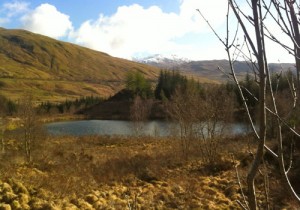
The Lochan of the Lost Sword
The place where Bruce’s darkest moment had come was named ‘Dail Righ’ or ‘The Kings Field’. Bruce had escaped by a hairs breadth (of maybe a brooch pin’s width). As Bruce had escaped he and many of his men threw any unwieldy heavy arms they had into a small lochan. Local legend has it that the king’s sword still lies beneath the surface. Whether its guarded by a ‘lady of the lake’ would be mere speculation.
The post The Battle of Dalrigh and the Lost Sword of Robert the Bruce. appeared first on ScotClans | Scottish Clans.
]]>The post New Bannockburn Heritage Centre for 2014 appeared first on ScotClans | Scottish Clans.
]]>
The new-look Bannockburn Centre
This is an artists impression of what the site will look like when the centre is opened for the 700th anniversary of the battle of Bannockburn in 2014. The Heritage Centre is currently a rather dreary building sat directly on the main road. Later this year it will close for the last time, and then be demolished. It’s an exciting and adventurous venture bringing the interpretation of one of Scotland’s most important battles into the 21st Century. The new centre will offer a truly interactive experience, where cutting-edge technology will bring the battle to life before your eyes. The National Trust website says they are working to create the most remarkable interactive presentation seen in this country.
Property Manager Scott McMaster said:
“The centre has been at the heart of Bannockburn for a long time and has served it well. Our last year here will be a big success. There are series of living history events from ‘strictly swashbuckling’ to academic talks. I urge everyone to see Bannockburn as it is now for the last time. We’re looking forward to welcoming visitors from near and far and sharing our knowledge of this important place with them.
“We’ll also be looking ahead to the amazing new facilities we’ll have onsite from 2014 – it’s going to be a whole new era for Bannockburn and visitors will be blown away.”

The Heritage Centre now
The project – a partnership between heritage agency Historic Scotland and the National Trust for Scotland – was announced in October 2010 by the then Minister for Culture and External Affairs, Fiona Hyslop.
In addition to the £5m initially awarded to the project by the Scottish Government, another £3.94m Heritage Lottery grant has been received for additional interpretation and landscaping works.
Speaking during a visit to Stirling Castle on Friday 3 February, the First Minister Alex Salmond announced the project would commence building and landscaping work in early summer, with work to conserve the historic monuments on site also scheduled to start later this year, subject to local planning consents.
He said:
“The eyes of the world will be on Scotland during 2014, with international events such as the Commonwealth Games and the Ryder Cup being held on our shores.
“2014 also marks the 700th anniversary of the Battle of Bannockburn, and I am delighted to announce today a significant milestone in the commemoration of this fascinating period of Scottish history in what will be the most ambitious partnership between the National Trust for Scotland and Historic Scotland.
“It is exciting to confirm that landscaping and building work on the state-of-the-art visitor centre will commence in the summer, with work to conserve the historic monuments also due to begin in the coming months.
“The backing in place from Historic Scotland and the Heritage Lottery Fund will ensure that the ambitious Bannockburn Project comes to fruition, paving the way for an unrivalled experience for those who are lucky enough to travel to this historic site in the future. We intend to use the cutting edge of Scottish technology to bring the battle to life and showcase our history in a dramatic way.”
Designed by Reiach and Hall the new centre will be part of an overall project to establish the site’s position as one of the most historically and culturally important places in Scotland, during the commemoration of the Battle’s 700 year anniversary in 2014.
Historic Scotland Chief Executive Ruth Parsons said: “In looking at all we want to achieve with world-class, cutting edge technology to immerse the visitor in the experience of battle, we quickly realised that the existing centre would not be able to accommodate everything we wanted.
“I am very excited to be able to unveil the new designs created exclusively for this project by Reiach and Hall. They bring with them a great empathy for what we want to achieve and I think they have created a design that will be the perfect canvas to the exceptional interpretation we are planning to introduce.”
National Trust for Scotland Chief Executive Kate Mavor said: “This is a once in a generation opportunity to look at how we present and interpret one of the most defining moments in our history and this new centre is the first step in achieving that.
“Another key element in the design is the landscaping which will open up the views of the memorial and give them back to the people of Bannockburn as the current building prevents you from looking straight through to the iconic statue of Robert the Bruce that is recognised around the world.”
Reiach and Hall design was unveiled just a week after their leading architect Neil Gillespie was awarded an OBE in the Queen’s Birthday Honours list for services to architecture. Gillespie was also made an Academician of the Royal Scottish Academy.
Neil Gillespie OBE said: ”Along with Landscape Architects, Ian White Associates, and Interpretation Designers, Brightwhite, we are extremely privileged to be working with The National Trust for Scotland and Historic Scotland at The Battle of Bannockburn, a defining moment in Scottish History and a wonderful site.
“Although modest in scale our project attempts to give some gravitas back to the site, concentrating attention on the story of the battle, the rotunda, the statue of Bruce and the great prospect to the north of Stirling Castle and the Ochils.”

The new design - very modern and simple

Here you can see the landscaping around the Heritage Centre

Plans for Bannockburn Heritage Centre
For more information go to the National Trust website at: www.nts.org.uk/Bannockburn2014/News/
So what do you think of the new design? Have you visited the Bannockburn Heritage Centre before – if so what are your memories of it?
The post New Bannockburn Heritage Centre for 2014 appeared first on ScotClans | Scottish Clans.
]]>The post Freedom and Chips Please! appeared first on ScotClans | Scottish Clans.
]]>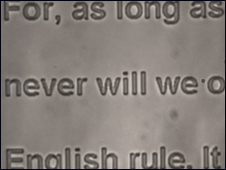
The Text on a chip
The Declaration of Arbroath is one of Scotland’s most famous documents. Scotland’s great cry of independence and freedom from the (then) yoke of the English. As with all great moments in history they do tend to appear on all manner of tourist souvenirs; there are Declaration of Arbroath fridge magnets, Declaration tea towels, probably even declaration loo paper (though I prefer the Act of Union loo paper myself!)
Now the words of Bruce and his followers have been immortalised in a small way – a very small way!
Andy Walker, a Blairgowrie boy made good and now running a successful business in Silicon Valley has managed to inscribe the whole declaration onto a silicon chip – in fact he had space left over so he did the whole thing again in Latin.
Mr Walker, said: “I designed the chip myself and there’s usually at bit of space left on the chip to put some other stuff on.
“So I thought it would be nice to put on the Declaration of Arbroath, knowing that it would end up being the smallest ever version.
“It shows you how small things can get on silicon chips.
In Edinburgh we’re used to having something on our chips too – broon sauce!
The post Freedom and Chips Please! appeared first on ScotClans | Scottish Clans.
]]>