The post Border Reivers – the ‘Great Cause’ appeared first on ScotClans | Scottish Clans.
]]>Alexander had been a good king and, for the most part, was friendly with his English counterpart, Edward I. Indeed his first wife, who had died, was Edward’s sister.
Edward had often demanded fealty from Alexander. He viewed England as the superior race, but he declined forcing the Scottish king to bend to his will. Such was their friendship, cemented by the ties of marriage.
Unfortunately for Scotland, Alexander’s children, two sons and a daughter had predeceased him. One of his sons died at the age of nine, the other on his twentieth birthday. He left as his heir a granddaughter Margaret, known to us as the Maid of Norway. She was the child of the marriage of Alexander’s daughter, also Margaret and now dead, and the King of Norway.
The Community of the Realm which, following Alexander’s death, ruled Scotland through six guardians, was keen to safe-guard the minority of the Maid and thus ensure her succession to the Scottish Crown.
In negotiations with the English king the young girl, about six or seven years old, was promised in marriage to Edward’s infant son, the future Edward ll. To the Scots it was a move which sought to maintain the peace which the country had enjoyed during the lifetime of Alexander lll; to Edward l a means by which he would eventually achieve total domination of his northern neighbour. The agreement was ratified at the Treaty of Birgham.
However Margaret died in Orkney on her way to Scotland from Norway in 1290, some say of seasickness. Her death put an end to any alliance of the two countries by marriage and any consideration that Edward had for the Scots as an independent nation.
It is not known how Edward l became involved in the succession for the throne of Scotland but he was seen by the Scots to be a man who could be trusted to make the right decision. Why should they question his involvement? To that time he had always treated the Scots with fairness. More-over he was well respected. He had the authority, the reason, the power and persuasion. He was perceived as a man with a formidable legal mind, the best in Europe it is said. He would sort the wheat from the chaff and chose the rightful successor from the thirteen claimants, the ‘Competitors’, who now squared up to each other in their quest to become the king of Scotland.
Edward’s involvement would, however, come at a considerable cost. He demanded that the Scots accept that England was superior to Scotland and that he was its Overlord. Indeed before he would begin his deliberations on who should be king he had demanded fealty from the Scottish lords. Most had accepted his dictates, the Bruce included, and signed what are now known as the Ragman Rolls which still exist. One name missing from the Roll is that of Wallace, synonymous now with ‘Braveheart’, a name that would resound throughout the lands of Scotland within a few short years.
Edward, satisfied that he was about to gain more than a foothold for the Plantagenet dynasty in the lands north of the Border, gathered the thirteen claimants at Norham Castle.

Norham Castle
The deliberations on who should be king lasted nigh on two years. They would become known as the ‘Great Cause’.
Both countries would suffer as a result.
The two main ‘Competitors’ for the throne of Scotland were the families of de Brus and Balliol. Eventually Edward chose John Balliol as the Scottish King. He would become a mere ‘puppet’ in Edward’s hands and eventually rebel in late 1295. In that year Edward demanded fealty from Balliol; demanded that he join the English in their wars in France. It was a move to far for Balliol; As king of Scotland he would not be treated as an ordinary English Baron whose lands were held at the behest of the King. He made an alliance with the French and invaded northern England.
The English Border people were savaged by the Scottish attacks into their lands. Not suspecting any inroads from the north, their lands were devastated by the Scots; crops and houses burned, both people and animals butchered in the merciless acts of retribution from the humiliated Scottish king.

Edward l Monument at Burgh by Sands, Cumbria
Edward’s response was quick and savage. At Easter 1296 he invaded Berwick, then in Scottish hands, and put all to the sword it is said. Tytler, a historian, tells us that 17000 folk lost their lives in the English attack on Berwick. Men women and children, he said, were put to the sword. Whilst this is not true, the population of Berwick in 1296 would be little more than 500, it is an indictment of Edward l’s policy of Scottish domination, that he was utterly ruthless in his treatment of the people of Berwick: people who, for the most-part were not in a position to defend themselves.

River Tweed
Thus began the Scottish Wars of Independence with the emergence of William Wallace (Braveheart) and Robert the Bruce.
The Wars would last, off and on, for 250 years.
The people on both sides of the English Scottish Border would suffer untold loss for their birthright. They were in the wrong place at the wrong time. Vast armies of English or Scots would lay waste the lands that they inhabited; their houses, harvests and beasts were razed, burned or stolen to satisfy the hatred of the soldiers of a foreign nation or fill the bellies of an army on the move.
The Border folk lost life, limb and loved one in the relentless surge for domination and were left destitute of the basic needs of life and living.
They were nothing if not hard and obdurate and they reacted in the only way left open to them in such dire circumstances. They stole where they could, be it from erstwhile friend on the same side of the Border Line or enemy on the other.
The Borderer became the Border Reiver. His dominance of the English-Scottish Border lands would last for centuries as feud, blood-feud, murder, death and extortion and blackmail would become the norm; a result of allegiance to the only people he could trust – his clan or family. It seemed, for centuries, that there was no answer to his disreputable activities.
In 1603, the Union of the two crowns of England and Scotland would eventually bring a form of peace to a troubled land. The two nations would be united under one King, James VI of Scotland and l of England. The Border Line from the Solway Firth in the west to the North Sea at Berwick in the east would still exist, indeed it still does to this day, but it would no longer divide two peoples.
The Border country became the Middle Shires of a new United Kingdom.
The Border Reivers were summarily executed, transported to the bogs of Roscommon in Ireland or conscripted to the protestant Low Countries in their fight against catholic Spain. They would slowly disappear from the landscape.
It would take another century but peace would eventually reign in the lands of the Scottish English Border.

The Statue of Robet the Bruce at Bannockburn
The post Border Reivers – the ‘Great Cause’ appeared first on ScotClans | Scottish Clans.
]]>The post Border Ballads – Fair Helen of Kirkconnel appeared first on ScotClans | Scottish Clans.
]]>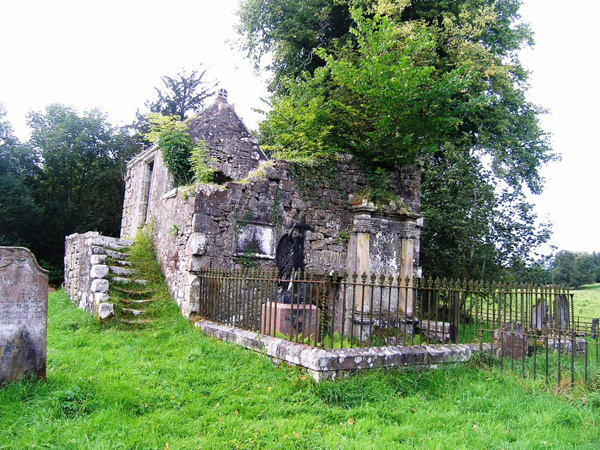
Kirkconnel Church
In the 16th century a tragedy of particular poignancy is said to have taken place very near to the churchyard.
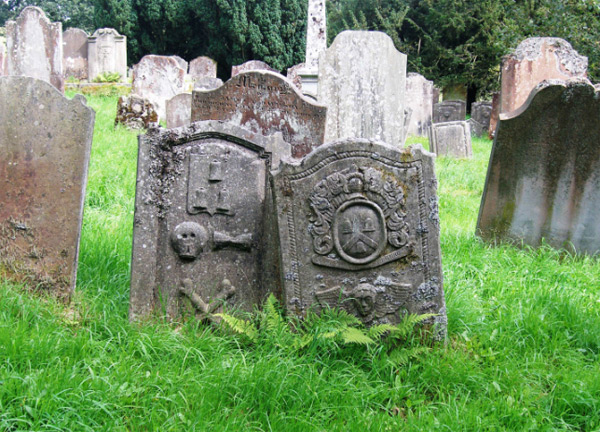
Kirkconnel Church Graves
On the hill to the east of the churchyard once stood a fine example of the Border Keep or Pele Tower which, in the days of the Border Reiver, dominated the landscape of the lands to north and south of the English Scottish Border. Here stood Bell Tower, alas no longer to be seen as its stone has followed that of the church and its wall to a more prosaic use .
Here lived Helen Irving. By all accounts she was a beautiful girl, much admired by the local lads. There were many suitors for her hand yet she loved but one by the name of Adam Fleming. All who loved her reluctantly accepted that her heart belonged elsewhere – all but one. Robert Bell of Blacket House felt spurned by Helen’s rejections, especially as he was favoured by her family. They were hopeful that she would marry within her station: Robert Bell, from a family of prominence, heritage and financial security, fitted their aspirations of a worthy suitor for Helen’s hand.
But Helen loved another.
She would meet the man she loved, Adam Fleming, in the twilight on Kirkconnel Lea or in the churchyard. Their meetings were brief, infrequent and full of the pledge of undying love. Helen was torn between love of her parents and their desires for her future, and the love she could not restrain for her manly and beautiful Adam. Love supersedes all bounds and though Helen was heart sore at the subterfuge which she employed to meet with her heart’s desire, she knew that Adam was the only man she would ever love. Many were the times she headed home after the brief passionate encounters with Adam, dull of pace in her walk to the Bell Tower, sorry that she deceived her parents, yet dreaming of a future where their happiness would reign.
Unbeknown to the two young lovers, they were watched. Robert Bell of Blacket House was insane with jealousy and determined to rid the world of his competitor for Helen’s hand.
Accordingly one night he followed the two lovers to their secret assignation and waited, watched, profuse with an insane desire to confront his rival. He was armed with a gun which made his intentions clear. When he saw the young lovers embrace any caution he might have felt was thrown to the wind. He lost any reason and waited for the lovers to part so he could get a clear shot at Fleming. The opportunity eventually presented itself and he fired off the gun at his adversary.
The two lovers, Helen and Adam, instinct and that inherent make-up which warns of danger, were instantly aware of the ferocity of ill-feeling which confronted them. Helen threw herself in front of her lover and took the full volley of shot in her breast. She fell dead on the spot. The shot was meant for Adam.
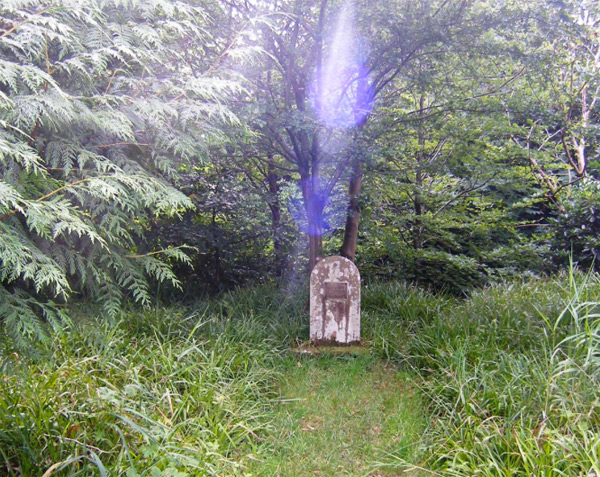
Site where Fair Helen was murdered
Adam, riled beyond any reason, knowing that his dear Helen was dead, launched himself down the banks of the Kirtle Water where the murderer Bell was frantically trying to reload his gun. Before he had achieved this Adam was upon him, sword drawn. In his rage he cut Bell to pieces, hacked him to death. There was no sweetness in the insane revenge. All thoughts of Bell immediately dropped from his mind, the sight of his headless body meaningless in his grief, Adam ran back up the slope of the Kirtle’s bank, cradled the head of his loved one in his arms, and sobbed until it felt as if his heart would break. He nursed his dead lover throughout the hours of darkness.
With the light there came some reason. Adam knew he would hang for the murder, that he had little alternative but to leave his home before he was apprehended. The deaths of Helen and Bell would not be easy to explain should he stay and confront her parents. They were aware that Helen had feelings for Adam which superseded friendship. They had tried to discourage them, hoping their daughter would marry a man of better means to support her through life. Robert Bell was such a man, or so they thought. It would not take them long to reach the conclusion that Adam was responsible for such a heinous crime. The discovery of the corpse of their daughter and the mutilated body of Bell which had all the hall-marks of a fierce encounter with a man of strength and resolution born out of intense hatred, would immediately point to Adam Fleming, thought of initially as the spurned lover. Adam Fleming fled the spot, left the country and was not heard of again.
Initially accused of a double murder in his absence, the truth finally came out. Friends of Helen vouchsafed for the integrity of Adam, for his love for Helen. They told of the meetings in the churchyard and the jealousy of Bell.
A few years later a servant of the Bell Tower, visiting the churchyard, was shocked to find the prostrate body of a man lying atop Helen’s simple grave stone. A quick inspection verified what he had thought as he approached the grave. The man was dead; he recognised the still handsome features of Adam Fleming who had lived at the Bell Tower some years before. He ran as swiftly as his old legs would carry him and informed the aged parents of Helen.
In due course Adam was buried next to Helen, a sign that her parents had forgiven the girl for her love of a man who had never forgotten her; a man who had proved after years on the Continent of Europe he had not forgotten his first and only love.
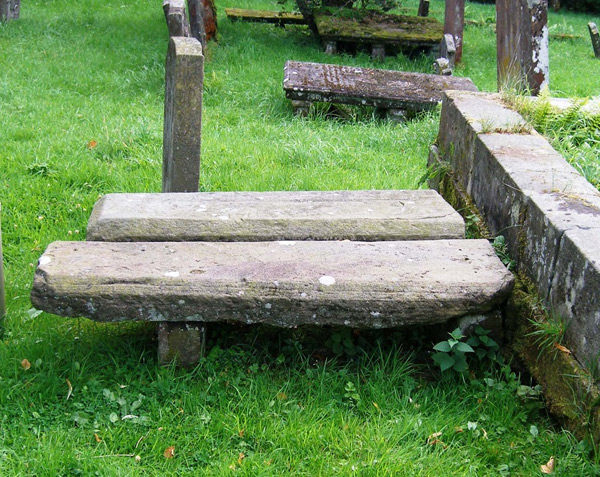
The Graves of Helen and Adam in Kirkconnel-Churchyard.
Afterword.
There is more than one version of the tragedy that led to the death of Fair Helen. In one Robert Bell escaped after he had murdered Helen and was pursued across Europe by Adam Fleming. He eventually caught up with Bell in the streets of Madrid and shot him dead. It was only then that he returned to Kirkconnel, and on seeing the grave of his lover, succumbed to grief at his loss, and died.
Sir Walter Scott, writing at the beginning of the nineteenth century, recorded the Ballad of Fair Helen in his ‘Minstrelsy of the Scottish Border’.
It is a poignant reminder that the aggression and confrontation which was rife for centuries along the English Scottish Border did not erase the finer feelings of all who were trapped in its maelstrom of death and butchery.
I wish I were where Helen lies,
Night and day on me she cries;
O that I were where Helen lies,
On fair Kirconnell Lee.
Curst be the heart that thought the thought,
And curst the hand that fired the shot,
When in my arms burd Helen dropt, (maid)
And died to succour me!
O think na ye my heart was sair (sore)
When my love dropt down and spak nae mair! (spoke no more)
There did she swoon wi’ meikle care, (with great care)
On fair Kirconnell Lee.
As I went down the water-side,
None but my foe to be my guide,
None but my foe to be my guide,
On fair Kirconnell Lee;
I lighted down my sword to draw,
I hacked him in pieces sma’ (small)
I hacked him in pieces sma’,
For her sake that died for me.
O Helen fair, beyond compare!
I’ll make a garland of thy hair,
Shall bind my heart for evermair (evermore)
Until the day I die.
O that I were where Helen lies!
Night and day on me she cries;
Out of my bed she bids me rise,
Says ‘Haste and come to me!’ –
O Helen fair! O Helen chaste!
If I were with thee, I were blest,
Where thou lies low, and takes thy rest,
On fair Kirconnell Lee.
I wish my grave were growing green,
A winding-sheet drawn ower my e’en (eyes),
And I in Helen’s arms lying,
On fair Kirconnell Lee.
I wish I were where Helen lies!
Night and day on me she cries;
And I am weary of the skies,
For her sake that died for me.
A Personal Thought.
Until last weekend, it has been some years since I last visited Kirkconnel church yard. It is a wonderful place, replete with an ambience of former times, of centuries long past. To the romantic, with a knowledge of the story of Fair Helen, it is a place to stand, think and consider her fate and that of her lover, Adam Fleming, their love, and the rash impetuousness of a spurned lover.
Such feelings are naturally tempered with thoughts that the story, though based on fact, has clearly been embellished down the years. The romantic in me, whilst succumbing to the sadness of the story, still readily accepts that parts of it cannot be true.
Imagine my surprise then when I viewed the story board set in front of the graves that are the supposed resting places of Helen and Adam.

Story Board in Front of the Graves of Fair Helen and Adam.
The last sentence runs as follows:-
‘The romantic story of the Ballad might be an 18th century invention, and the association of the monuments in the churchyard is questionable’.
Britain is awash with political correctness. Do we really need to take it to the realms of romance, poetry, folk-lore and legend?
Please think about it!
The post Border Ballads – Fair Helen of Kirkconnel appeared first on ScotClans | Scottish Clans.
]]>The post The Wardens of the Marches appeared first on ScotClans | Scottish Clans.
]]>In 1249 in an attempt to deal with crime an agreement was signed between both nations, a system began called the ‘Laws of the Marches’ this was to be carried out by the ‘Wardens of the Marches’ who were appointed by their respective monarchs.

Borders area showing the different marches

Sir Robert Carey, Lord Warden of the Marches
The border lands on each side divided into three marches: an east, middle, and west march. Each march had its own warden, who was responsible for the security of the area and its people Each Waarden answered to the Lord Warden. The Scottish wardens were familiar with their territories, and knew the people from the marches, and this gave them the opportunity to get involved in questionable dealings in order to further their position. However, the English wardens were not as familiar with the area and the ways of the Borderers, and often went about creating more problems than they solved when trying to administer any justice.
Examples of some of the families you would traditionally find on the Scottish side are: Hume, Trotter, Dixon in East March; Kerr, Scott, Turnbull in Middle March; and Bell, Irvine, Johnstone in West March.
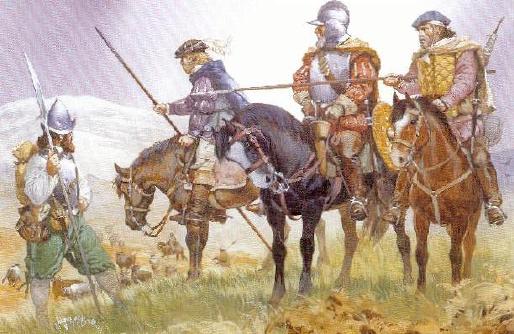
Wardens of The March
Wardens from both sides of the border would meet monthly in peace on the day of truce. They would assess the complaints from either side, and administer the appropriate justice. The Wardens had to bear in mind that both countries valued things differently, and this created many difficulties when trying to solve these grievances. Many of the crimes would range from cattle rustling to murder.
To explain about how the Wardens of the Marches worked; if for example you were English, and went north of the border to Scotland and stole some cattle, it used to be quite normal to get a a pat on the back back in England, because you had committed a crime in the opposite realm. You would go unpunished. The purpose of the Wardens was to prevent this from happening. The Wardens were expected to talk to their foreign counterpart. So if someone went across the border to steal something, then the warden whose land was plundered would tell his counterpart, and the issue would be resolved on the day of truce. The task of solving each person’s grievance was a taxing and thankless task, which usually provided solutions that left no-one happy.
Those who were accused of a crime were supposedly tried by six honest Scotsmen and six honest Englishmen. However it has been said that this could never have happened because you would not have been able to find any honest men from either side of the border.
The ‘Calendar of Border Papers’ has recorded a large number of complaints that were made to the Wardens of the Marches. They go into some detail as how many of these people were wronged by raiders both sides of the border. The papers are still available to read to this day.
By 1603 the role of Warden of the Marches became unnecessary, after the union of the crowns when James VI & I, in his attempt to permanently put an end to the Border Reiver clans, got rid of the name “Borders” to represent that area, and renamed it the “Middle Shires”. Over the following 100 years you saw a gradual change of the borderers putting down the sword and picking up the plough.
The post The Wardens of the Marches appeared first on ScotClans | Scottish Clans.
]]>