The post The Brooch of Scotland – Stirling appeared first on ScotClans | Scottish Clans.
]]>
Stirling Castle
Scotland, it has from time immemorial been a key strategic location securing the kingdom; indeed the very name Stirling may derive from an ancient term for ‘struggle’ or ‘battle’. It was here in 1314 that Robert the Bruce defeated the English king, Edward II at the Battle of Bannockburn and saw Scotland reclaim her freedom – and with the 700th anniversary looming; and all the potential events planned it is a good time to look at this most enigmatic of cities.
The Dark Age annals record a famous siege at an unidentified fort in central Scotland called Iuddeu in the year 655; when King Penda of Mercia (a kingdom in the English Midlands) surrounded his Northumbrian counterpart. Most scholars are in agreement that this mystery fort is probably Stirling Castle. The geography seems right: plus the much travelled Roman road runs close by and until the medieval period the Forth was navigable as far as the modern town. Combining this with Stirling’s natural defensive position close to the border of several Dark Age kingdoms the case is strong.
Castle rock has probably had some sort of fortification built on it since at least 500BC, and during the early middle ages it way a key site for the Maetae (a Celtic people related to the Britons of Strathclyde and the Goddodin of Lothian), until absorbed into Scotland around 1000 years ago. Over the next 600 years it played a huge part in the evolution and defence of the realm – kings were born, crowned and killed here; and the battles fought under the ramparts forged a nation that would be as stubbornly resistant as the very basalt rock itself. The town of Stirling developed below these ancient walls, echoing the growth of Edinburgh’s Royal Mile; and soon became and important market town; both independent from and welded to the castle and court. In 1130 King David I elevated Stirling into a Royal Burgh: a town with special rights and trading privileges derived directly from the crown, giving the burgeoning settlement a huge economic boost (nearly 900 years later his descendent Queen Elizabeth would bestow City Status, again resulting in economic advantages).
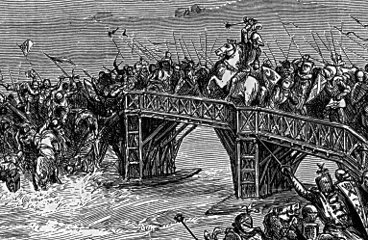
The Battle of Stirling Bridge
As part of that deal, Bruce held fairly regular parliaments, and one in 1326 was at Cambuskenneth Abbey across the river from Stirling. Although little remains today, apart from the tower, it is still possible to visit the site. Within the grounds is the grave marker to King James III who was killed nearby at Sauchieburn in 1488 by a rebel force loyal to his teenage son (later James IV). Queen Victoria paid for the elaborate tomb, paying homage to her ancestor who met with such a bloody end. Above the ruins lies Abbey Craig, and in 1861 work was begun on an even more elaborate expression of Victorian historical sycophancy – the Wallace Monument. That said, it is fantastic tower and worth the visit; and today the exhibitions do tell the story of Wallace and the Battle of Stirling Bridge well. Seemingly airbrushed out of that history is Sir Andrew Moray, the co-commander that day – but Stirling Council now plan to set this right with a statue to the accepted brains behind the operation.
Following the battle in 1297 a new bridge was erected, this time of stone, and it still remains. Although no traffic crosses today it you still get the sense walking across its cobbles of being ushered north into the Highlands. Capturing and crossing the Bridge was a key objective for any Highland army heading south; particularly during the Jacobite wars. However, during the ’45 Rising the Jacobites chose to by-pass both Bridge and Castle and crossed the Forth upstream at the Fords of Frew and marched unhindered to Edinburgh. It was a vision of the future: the age of stone castles was drawing to a close. By ignoring completely Stirling and her huge garrison the mobile Jacobite army ushered in a new age of modern warfare. It is perhaps fitting then that within a year the last battle would be fought on British soil; a new dawn was rising.

Wallace Monument
In 1603 James VI, who had been christened and partially raised behind the cold walls of Stirling Castle (and crowned nearby at the Church of the Holy Rude), became the king of England; and moved south to London. The Stewart dynasty owned and variously resided in a large number of castles and palaces across Scotland, but with James’ move south many of them became redundant. Indeed, only the Palace of Holyroodhouse in Edinburgh would be retained as an official royal residence. Stirling, with her royal association and long traditional as residence needed a new role – and the most obvious was as garrison. Many regiments would come to call home a castle more used to kings; but, the collapse of the Jacobite cause in 1746 raised the question of the necessity of retaining such places – where was the practical value in comparison to the utilitarian and effective moderns garrisons such as Fort George near Inverness? Yet, there was something special about Stirling Castle – a sense of connection with both the nation and the monarchs that have ruled it that fostered a sense of sentimentality. Not until 1964, when the Argyll and Sutherland Highlanders finally departed did the citadel cease to be an active military barracks.
Today, the Castle is essentially a museum – but a brilliant one, with few parallels, especially after all the renovation work to restore it to her Renaissance heyday. Hundreds of thousands visit yearly, making it the second most visited castle in Scotland after Edinburgh. Technically, it still belongs to the Crown and the Queen has visited on more than one occasion. The town remains a bustling market, although with a heavy reliance on the service industry, and the university has brought a lot of rejuvenation. Tourism of course plays a big part in the economy and good links to Edinburgh and Glasgow adds vitality. In 2014 we hope to host the next international Clan Gathering here, and what a celebration that has the potential to be!
The post The Brooch of Scotland – Stirling appeared first on ScotClans | Scottish Clans.
]]>The post ScotClans Visit the South West. appeared first on ScotClans | Scottish Clans.
]]>
Bothwell Castle
When we set off from Edinburgh it was 6am; still dark and cold. Our first stop was Bothwell Castle in South Lanarkshire, which we found in under an hour, with little hassle thanks to the very useful satnav we had in the car. Bothwell is a large castle standing on a steep hill beside the River Clyde, and was built sometime during the 13th century by descendents of Clan Murray. During the Scottish Wars of Independence Bothwell was captured by Edward I’s army, taking those inside prisoner. The castle eventually went back into the hands of the Murrays. Through the marriage of Joan Moray of Bothwell, in 1362, to Archibald ‘the Grim’ Douglas, the future 3rd Earl of Douglas, the castle changed hands from the Murrays to the Douglases. Bothwell Castle now lies in a ruined state, and is in the care of Historic Scotland, and open to the public.

Strathaven Castle
After taking a few pictures of the castle we headed west, with our next stop being Strathaven Castle. Night time was well and truly gone by the time we reached the town of Strathaven where the castle sits. It was still cold, and pretty misty allowing for some atmospheric shots of the ruined structure. In fact, the mist prevented us from finding the castle straight away, meaning we had to ask a local, who promptly told us that on any other day we would be able to see it, and that it was just a minute along the road. The castle was built around the middle of the 14th century by the Bairds, and between then and 1717 when the castle was finally abandoned, it passed through the hands of the Sinclairs, the Douglases, the Stewarts, and the Hamiltons, with Anne Hamilton, 3rd Duchess of Hamilton (1632-1716), being Strathaven’s last occupant.

Dean Castle, Kilmarnock
We continued west, where the mist was starting to lift and blue skies and sunshine starting to appear. Dean Castle in Kilmarnock was our third castle of the day. Built by the Boyds, the lords of Kilmarnock for over 400 years, in the 1350. The lands Dean Castle was built on was granted to Sir Robert Boyd in 1316 by Robert I for his services at the victorious Battle of Bannockburn in 1314. In 1975 the castle was passed into public ownership by John Scott-Ellis, 9th Lord Howard de Walden, and it is now kept by East Ayrshire Coucil, and is open to the public.
It was after 10 by the time Amanda and I reached Dundonald Castle, and even though it was late morning on this spring day, it was still pretty cold, with a lot of the frost yet to lift. As we drove down the road into the village of Dundonald (situated somewhere between Troon and Kilmarnock) we could already see the castle in the distance, which sits nicely on top of a hill looking over the village, and so we decided to get out of the car, walk back up the road a wee bit, and take some pictures. After getting a few snaps, and really noticing the strong smell of fresh, country air, we headed for the castle itself.

Dundonald Castle
The name Dundonald means ‘Donald’s Fort’, however it is not known who Donald was. It has been suggested by historians that he could have been one of the kings of the Kingdom of Strathclyde, as three of this name ruled. Dundonald Castle was built on the same grounds as where a wooden hill fort is believed to have once stood. It was constructed sometime after Robert II‘s accession to the throne in 1371, after the death of his uncle David II. Dundonald was used as a royal residence by Robert II, and it was where he died in 1390. It remained as a royal residence for the Stewart kings well into the 16th century.
Our next stop was not a castle this time, but instead the birthplace of Scotland’s national bard, Robert Burns, in Alloway, South Ayrshire. The cottage was built by William Burness, Robert’s father, in 1757, and was where he was born in 1759, as well as three of his siblings.

Burns’ Cottage from the back
Amanda and I went to the front of the building and took some pictures of the cottage, deciding not to go in because of the large number of places still on our list to visit within the day. After getting some pretty generic shots we visited a nice wee cafe opposite the cottage for some coffee before hitting the road again for our next destination. However, as we headed back to the car, the very nice man at the entrace desk for the cottage ushered us over and said that we could get in for free since we were just looking to take a few pictures for our site. So we decided to go along and we were glad we did. The cottage had a beautifully, well kept garden, even growing vegetables, and inside was an interesting and informative museum to the bard, letting us see what Burns’ early environment was actually like. We would highly recommend visiting it.

Amanda getting in my shot of the view across to Arran
Dunure Castle was next on the list, but not before a brief stop at the ‘magical’ Electric Brae. The journey to Dunure was great, with some beautiful views of the snow covered hills on Arran. It was still sunny and clear, and it was really starting to get warmer.

Dunure Castle and its Dovecot
Dunure Castle is a picturesque castle, sitting on a rocky bay overlooking the sea to the west. Built sometime in the 1200s, it was a seat for Clan Kennedy, and in use up until the 17th century. A famous visitor of the castle was Mary, Queen of Scots, who, in 1563, spent a few days there.

Culzean Castle
The next castle on our list was Culzean, just a few miles down the coast from Dunure. Much to our annoyance, and reluctance, we had to pay to just get onto the grounds for a few photos, but perhaps it was worth the money to see the lovely gardens and view out to sea. There is not as much history to Culzean Castle, having been built in the late 18th century by architect Robert Adam, under the instruction of the 10th Earl of Cassilis, David Kennedy.
Sawney Bean’s Cave, at Bannane Head, was somewhere that we were really looking forward to seeing, however it took us a wee bit longer to find the place than we had hoped. But we found it eventually, and it certainly was an interesting place. Sawney Bean was said to have been the head of a family of cannibals living in this South Ayrshire cave. Bean and his wife supposedly went about murdering and travelers they saw and ate their bodies.

Inside Sawney Bean’s Cave
They incestuously built up their family over a couple of generations, and it was claimed that they killed over 1,000 people. Once caught the family were said to have been executed in Edinburgh; the men allegedly having their limbs cut off, and they would bleed to death, whilst the women were burned alive. Yet, unfortunately this story could be just a tale since there are no records to support any of it, not even for the executions in Edinburgh.
The cave itself was still used as a place to live many centuries after the Beans supposedly stayed there. Up until the late seventies, or early eighties, a vagrant known as Snib Scott lived in the cave. Henry Ewing Torbet (1912-1983), as he was originally known, was a resident of the cave for many years, and it is said that people would often leave charity for him in form of either food or clothes, however, it’s claimed that he was too proud to accept it directly from them, and would only collect it once they had left. There is a memorial cairn near the caves entrace dedicated to Snib Scott.
Time was moving on quickly, and the sun was really starting to get low, so we tried to get down to the town of Leswalt to visit the Agnew graveyard as quickly as possible. We got to Leswalt quicker than we thought, but due to some poor directing by the passanger we took a wrong turn in the village and started heading in the wrong direction. However, this proved not to be too disastrous, and it allowed us to pay a quick visit to Lochnaw Castle, which wasn’t originally going to be part of our trip. The castle is a 16th century building, and a private residence, not open to the public – which means that Amanda and I probably shouldn’t have been their in the first place. We took a few shots and left down a very bumpy track, no doubt doing some serious damage to the cars suspension at the same time.

Agnew mausoleum at Leswalt
We got back to Leswalt pretty quickly, and in no time found the grave yard, taking some pictures of the resting places of some relatively important Agnews as the sun was getting lower and lower. And thanks to a friend on Flickr for telling us about the grave yard.
We were now in a race against the setting sun to try and get as much more into our day as a we possibly could. We decided to skip a few of the castles on our itinerary, and try our best to get to St. Ninian’s Chapel at Isle of Whithorn before it was too dark; and thankfully we did.

St. Ninian’s Chapel
The chapel is now in ruins, but it is said that the remains belong to the chapel that was built sometime around 1300, and thought to have been built to replace an even earlier building.
The sun was almost gone once we had got our pictures of the building, and also admire the touching collection of stones with personal messages on them dedicated to remembering lost loved ones, and it was now time to head back to Edinburgh, but not before stopping off at a wee pub in the village of Kirkinner for some food. It was well after seven by the time we were on the road heading back to the capital, and it was a long haul, taking a good few hours before getting back to the city and ending what was a very enjoyable and productive day.
Now we are planning our next day out, and perhaps this time have a slightly more realistic target of places we want to visit. Anyone out there with good suggestions as to where we our next visit should be, feel free to leave a comment.

Map of route
The post ScotClans Visit the South West. appeared first on ScotClans | Scottish Clans.
]]>