The post Clans to take part in the Edinburgh Military Tattoo in August appeared first on ScotClans | Scottish Clans.
]]>
Rallying the Clans together. Chiefs of Clans Bruce, Leslie, Macnab and Carmichael on Salisbury Crags with Edinburgh Castle below.
Clan chiefs have been sending out rallying calls to their Clansmen and Clanswomen all over the world to come and join them at the Edinburgh Tattoo this August. Rather than setting a fire on-top of a hill – this time they’re using the internet.
Back in 2009 many of us remember the epic Clan March up Edinburgh’s Royal Mile to the Castle, Clans walking behind their banners and many with their Clan Chiefs, being cheered on by thousands of onlookers. This was the largest Clan display by far seen in Scotland, Over 125 Scottish Clans took part in the parade . Since then Clans have had their individual gatherings and clusters of Highland games but nothing touching what happened in 2009.
Jamie Macnab – Chief of Clan Macnab said in an interview for The Times .”It was absolutely phenomenal… I don’t think anyone who took part that weekend will ever forget it.”

Clan Douglas at the Clan Parade in 2009
So now in 2017 the Clans will be marching again – this time to the Tattoo. It will be a series of Clan Parades that will take place each night of the Tattoo. This will be a major event within the Clan-themed Events that will be happening throughout this year, backed by the Scottish Clan Event Fund.
There are 25 performances of the Edinburgh Tattoo. Tickets have been put aside for the clans to buy for each performance to make sure that as many tartan-clad clansmen, women and children attend as possible.

The Edinburgh Tattoo
The Tattoo’s Chief, Brigadier David Allfrey approached the Standing Council last August to gain support for his ‘Splash of Tartan’ theme for the Tattoo. This opportunity provides an excellent platform to promote Ancestral Tourism to International audiences. 2017 is Visit Scotland’s year of History, Heritage & Archaeology. The Clans will be playing a large part.
Clan Chiefs have been contacted and have signed up, now it’s all about mustering up support to get people to follow them up the Royal Mile. Currently 53 Clan Chiefs have signed up, so each night there will be 2 Clans in the parade. Some Clans have already got 100 people signed up.
Jamie Macnab explains that this is a great opportunity to reposition the views within Scotland of Clan Heritage. Here especially it can be seen as a bit twee – a shortbread version of Scotland, one that is just for tourists not for the people that live here. Jamie adds:
” My hope is that our involvement in the Tattoo will get some home-based engagement and Scots will don their tartan and go, ‘Right, I’m putting my kilt on and going on my clan night.’ I mean, I think this is the first time the Tattoo has ever done anything like this so hopefully it will generate some interest.”
Clan events have always attracted people from oversees. the Convenor of the Standing Council, Sir Malcolm MacGregor has been over in the US trying to drum up support for this event.
Visit Scotland’s research has shown that history and heritage is the second most popular reason cited by visitors coming to Scotland from overseas. First was landscape and scenery.
So if you’re interested in joining your Clan – please contact your Clan Society and join in, let’s make this a great event!
For full list of clans and dates please see: http://www.scotclans.com/list-of-clans-and-dates-for-tattoo-clan-parade/
The post Clans to take part in the Edinburgh Military Tattoo in August appeared first on ScotClans | Scottish Clans.
]]>The post A Piece Of Edinburgh In Chicago appeared first on ScotClans | Scottish Clans.
]]>
A chunk of Edinburgh Castle in Chicago’s Tribune building
It may be sister cities with San Diego, but what you might not be familiar with is Edinburgh’s more subtle connection with America’s Windy City. Sprawling 463 feet into the air at the bottom of Chicago’s famous ‘Magnificent Mile’ is the Tribune Tower, home to the Chicago Tribune and an epitome of the American architect’s desire to construct not just buildings but behemoths. Skyscrapers to the heavens.
Housing restaurants and shops as well as publishing houses, this gothic imprint in the city also has a fun secret for both tourists and residents to explore: set all around the base is 120 blocks of stone imported from places all around the world – including a chunk from our very own Edinburgh Castle.
But why is it there, and who would go to the trouble of lugging all those blocks around?
That would be a man named Robert Rutherford McCormack, or ‘Colonel McCormack’ as he became known after his exploits in the First World War. One of the Tribune’s original owners, the out-spoken man was against his country’s involvement in the fighting, yet served anyway, and ended up taking back with him a piece of rubble from a battle at Ypres as a souvenir.
This gave him the idea to lace his building with blocks of stone from famous locations all over the world, and thus he instructed staff to collect whatever pieces they could by “well mannered means” (one assumes this is code for “without stealing”). How this could be done is something of a mystery, but it’s hardly a surprising idea from a man who would install secret staircases giving him covert escapes from his office.
The real significance of each block is that it comes from a famous landmark, like the Berlin Wall and Notre Dame, so it’s no surprise to see Edinburgh Castle nestled in right by the entrance on the south wall. Scotland has a long history of influence in The States – this is just another neat little reminder.

Edinburgh Castle
The post A Piece Of Edinburgh In Chicago appeared first on ScotClans | Scottish Clans.
]]>The post The Auction of one Drunken Wife in the Grassmarket, Edinburgh appeared first on ScotClans | Scottish Clans.
]]>
A wonderful story from a broadside (early version of a newspaper) from 1828, about a man who was auctioning off his drunken wife at the Grassmarket in Edinburgh. Details of the extraordinary auction are held by the National Library of Scotland in its vast collection of broadsides, single newsheets which were distributed or pinned up around towns and cities. These were the tabloids of the time.
Mary Mackintosh was brought to the Grassmarket by her husband, Thomas M.Guisgan, who held her by a straw rope tied around her middle with the words “to be sold by public auction” pinned on her bosom. She was accused of being a notorious drunk and an adulterer but when the sale got underway on July 17 1828, a “bloody battle” broke out with punches thrown and people whacked with stones wrapped in stockings.
It had started out civil enough. Several thousand spectators had assembled to witness this novel sale, held around 6pm, with the auctioneer, described as a “knight of the hammer”, wrestling for attention above the rowdy crowd. According to a report of the day, quietness fell as people started to note the “countenance of the woman”.
Stepping through the crowd, a man pulled his wallet and said: “She be a good like lassie, l will gi’e ten and twenty shillings for her.” The crowd cheered at the offer but it was not long before “a stout tinker” made a bolt to the front of the crowd to say she should never go to the Highlands before offering a six pence. The clamour of the crowd heightened further. The next bid was quick to follow and came from a “Killarney Pig Jobber” whose “mouth open as wide as a turnpike gate”. Half drunk, he offered two shillings more, given she was a “pratty” – or mischievous – woman. It was at this stage that the atmosphere started to tilt. A brogue maker emerged from a public house “as drunk as 50 cats in a wallet – and hit the Killarney man, leaving him knocked out on the ground for a good 10 minutes. Mary Mackintosh is said to have “laughed heartily” at the punch with the cheers of the crowd now “long and incessant”. But the scene rapidly deteriorated as bare knuckle violence broke out, much of it executed by women armed with stones. First, however, the Brogue maker walked up to the auctioneer. A report of the day said:
“He was so enraged, he knocked the auctioneer down, and made his claret flow desperately.”
The women of the neighbourhood gathered to the number of 700, and armed themselves with stones, some threw them, and others put them in their stockings and handkerchiefs, and made a general charge through the mob, knocking every one down that came in their way, until they got up to the auctioneer, when they scratched and tore his face in a dreadful manner, in consequence of the insult the fair sex had received. One woman, described as a “true female hero” and the wife of a sweep, pelted Mr Guisgan, the man who had tried to sell his wife, before decrying him as a “contaminated villain”. Mr Guisgan hit her back between her eyes, leaving them like “two October cabbages.” The report added: “A general battle ensued, and only for the interference of the police, there would have been lives lost.”
After the disturbance was quelled, the husband continued to insist she should be sold. According to report, she was brought up again before the crowd and an elderly Jack Tar – a term used for seamen of the Merchant or Royal Navy, stepped forward. He described Mary Mackintosh as “well rigged” before offering half a Crown more than the last bidder. But he was to be outbid by a farmer, described as a widower, who pledged two pounds and five shillings for Mrs Mackintosh. The sale was agreed. The report concluded: “The farmer took her up behind him on his horse, and away they went amidst the cheers of the populace.”
Full Transcript of Original Article
Transcription
SALE OF A WIFE.
A full and particular Account of the Sale of a Woman, named Mary Mackintosh, which look place on Wednesday Evening, the 16th of July, 1828, in the Grass Market ‘of Edinburgh, accused by her Husband of being a notorious Drunkard; with the Particulars of the bloody
Battle which took place afterwards.
ON Wednesday evening last, in the Grass-market, Mary Mackintosh was brought down about six o’clock by her husband, for the purpose of being sold. Her crime was drunkenness and adultery. She was held by a straw rope tied round her middle, and the words, ” To be sold by public auction” in front of her bosom. Several thousand spectators were assembled to witness this novel occurrence. John F——n, pensioner, and knight of the hammer, commenced business, but the acclamations of the people were so great, that no one could get a hearing for ten minutes, to bid for the unfortunate Woman;
When, the crowd got a little quiet the people began to examine the countenance of the woman ; a Highland Drover stepped through the crowd, and pulled out his purse, and Said, ” She be a good like lassie,’l will gi’e ten and twenty shillings for her.” This caused great cheering among the
crowd? then a stout Tinker made a bolt into the crowd, and said she should never go to the Highlands?he then bid sixpence more for her. At this time, one of the KlLLARNEY PIG JOBBERS, with his mouth open as wide as a turnpike gate, and half drunk, eried loudly, FAUGHAHOLLICE , I will
give two shillings more, for she is a pratty woman. A Brogue maker, from Newry, coining out of a public house; as drunk as 5O cats in a wallet, came up to the Killarney man, and hits him in the bread bag, and he lay there for the space of ten minutes, which made the woman for sale, laugh
heartily, and the cheers of the crowd at this time was long and incessant.?
The Brogue-maker being a supposed friend to the woman, went up to the auctioneer,and told him there were three bidders: he was so enraged, he knocked the auctioneer down, and made his claret flow desperately. Great cheering among the people, at the expense of the knight of the hammer.?
The women of the neighbourhood gathered to the number of 700, and armed themselves with stones, some threw them, and others put them in their stockings and handkerchiefs, and made a general charge through the mob, knocking every one down that came in their way, until they got up to the
auctioneer, when they scratched and tore his face in a dreadful manner, in consequence of the insult the fair sex had received. One resolute woman came up with a stone and knocked down Thomas M.Guisgan, husband to the woman who was exposed for sale. This woman, a true female hero,
and a SWEEP’S WIFE, displayed great courage in favour of her sex, and said I will learn you to auction your wife again, you contaminated villain Tom returned the blow, and hit her between the eyes, and made them like two October cabbages. The sweep seeing his wife struck, made a sally with his bag and scrapper ; the women all took the sweep’s part, and cried with a loud voice, mill him the old boar, a general battle ensued, and only for the interference of the police, there would have been lives lost. Alter the disturbance was quelled, the husband insisted she should be sold. She was brought up again, and the auctioneer declared that if he could not be protected, be would have no more call to her. Some young fellows shouted he should, and the sale began again. An old pensioner, a Jack tar, stepped forward, saying, damn my tarry top-lights and chain plates she is a tight little frigate, and well rigged too, and I will give half a crown more than the last bidder. Well done, cried the mob to the sallor, you are a spirited fel-
low, and you must get her; when a farmer, who was a widower, bade two pound five shillings for her, he being a friend to the sex, and the auctioncer knocked her down. The farmer took her up behind him on his horse, and away they went amidst the cheers of the populace.
W. BOAG, PRINTER, NEWCASTLE.

Click to see at full size
The post The Auction of one Drunken Wife in the Grassmarket, Edinburgh appeared first on ScotClans | Scottish Clans.
]]>The post Greyfriars’ Bobby and Bum the Dog! appeared first on ScotClans | Scottish Clans.
]]>Edinburgh has the tale of Greyfriars’ Bobby and San Diego has the story of Bum the dog, who for a homeless dog became something of a celebrity, loved by all in his hometown, much like our very own Bobby. When the two cities twinned in 1977, they each presented the other with a statue of these loveable dogs.

This statue of Bum the dog is found in Princes Street Gardens, alongside the following plaque…

San Diego has the original statue of Bum alongside a replica of Edinburgh’s Bobby statue…

Which includes a plaque explain more about Bum…
The love and loyalty of both legendary dogs forever joins San Diego and Edinburgh as sister cities.
The post Greyfriars’ Bobby and Bum the Dog! appeared first on ScotClans | Scottish Clans.
]]>The post The Naming of Edinburgh’s New Town… appeared first on ScotClans | Scottish Clans.
]]>
The post The Naming of Edinburgh’s New Town… appeared first on ScotClans | Scottish Clans.
]]>The post The Battle of Prestonpans! appeared first on ScotClans | Scottish Clans.
]]> 271 years ago, a mere 12 miles from Edinburgh, one of the first and arguably one of the most important battles of the Jacobite Rising of 1745 took place. It was the first step in a campaign to place a Stuart back on the British throne.
In the early half of 1745, Charles Edward Stuart or Bonnie Prince Charlie, saw an opportunity to reclaim what he considered to be his father’s two kingdoms, Great Britain, formally united in 1707, and Ireland. George II and the British army were occupied in the War of the Austrian Succession, leaving only around 6,000 troops to defend England. Aided by the early support of Donald Cameron of Lochiel, XIX chief of Clan Cameron, he and is party of men were successful in raising a force of 2,000 Scots.
With word of this force ready to march on the Lowlands, it was up to Sir John Cope to give a response root he government. Cope was the general in command of the 4,000 government troops stationed in Scotland, but unfortunately the most of his troops were only recently raised and as a result inexperienced. Cope and his troops marched on Fort Augustus in the heart of the Highlands in an effort to awe the Highlanders into surrender and end the rebellion before it had truly begun. Upon hearing that the rebel army was looking to oppose him at Corryarrack, he instead marched to Inverness hoping to be the one to decide the battleground. Cope had underestimated the men commanding the rebel forces.
Bonnie Prince Charlie and his troops marched straight down to the Lowlands, which by now were almost undefended. A small force which held Edinburgh retreated in the face of the superior foe, leaving the city open for the taking. On 16 September, some of Prince Charles’s army captured the city with little or no fighting, though Edinburgh Castle was still defended for the government. Cope meanwhile furiously marched to Aberdeen are he had urgently ordered ships, so he and his troops could make haste o the south. On the same day the Jacobites took Edinburgh, Cope and his men disembarked in Dunbar.
Even though Cope knew his troops were far from the best, he was determined to engage the Jacobite force. His intelligence told him that the rebels only numbered around 2,000 men, and whilst they were fit and hardy, they were ill-equipped. Cope believed this would mean his force, in two regiments of dragoons and three and a half regiments of infantry, should easily overpower them. It was even said that on their march towards Edinburgh they assured the locals that there would be no battle.
It was on the 20th of September that the two forces first met, just outside Prestonpans near Preston house. The Jacobite army had secured the high ground to the south of Cope’s position, but Cope was determined to face the rebels and made the best of his situation. He drew up his force facing south using the park walls of Preston house to provide protection for the right flank and a marshy bog to the front. Although they had secured a good position the Jacobites were dismayed by the way Cope had taken advantage of the land. A traditional Highland charge would flounder in the marshes and be decimated by musket and cannon fire. The senior Jacobite officers knew they must change their plans if they were to come away victorious but could not agree on what should be done. It was Lord George Murray who pushed for them to move their force to the East so they could assault the exposed left flank of the government forces and it was Lieutenant Anderson, a local farmers son, who knew the lay of the land and knew of a way to get the force where it needed to go. At 4am on the 21st the Jacobites began to move, 3 abreast along a narrow defile, in order to reach the east flank.
 Meanwhile, Cope had noticed some movement in the opposing force juts before dark, though this move was the result of confusion in the Jacobite ranks and was abandoned. He feared that the Jacobite planned to attack both his flanks and thus redeployed in forces in a north south front, the formation that they would fight in the next day. He also ordered that 200 dragoons and 300 infantryman should take on picket duty and light fires in the front of his position in order to thwart any plans for a surprise night attack. Cope felt secure with these measures and in addition ordered 3 companies of Louden’s Highlanders to guard the baggage park in Cockenzie, as well as dismissing some 100 volunteers ordering them to report back in the morning. Cope also made a last minute attempt to gain reinforcements from Edinburgh Castle, requesting Artilleryman to attend his position. It would be for nought though, as the battle would take place a lot earlier than Cope had expected.
At the crack of dawn on the 21st September, Cope’s Dragoons beheld a spectacle that would send a shiver down any sane mans spine. Out of the early morning mist, making “wild Highland war cries and with the bloodcurdling skirl of the pipes” came 1,400 Highlanders charging straight towards Cope and his men. Cope’s inexperienced army wheeled to meet a foe they were not expecting to come from the east, and Cope even managed to scramble some artillery into position. Undaunted by the light and inaccurate fire the Highlanders continued their charge. The centre of this charge became bogged down in an are of marshland, which meant the straight line of the charge became a v formation. The wings on either side met with the dragoons on either side of the British force, which caused them to immediately flee.
This meant that Cope was left with only the centre of his force, which also happened to be the experienced Royal Infantry. Unfortunately for hem the unplanned flanking manoeuvre by the Jacobites, which happened when the wings of the v wrapped around the side of the Royal Infantry and the centre met them head on, meant the were effectively surrounded by Highlanders and they suffered for it. After sustaining heavy casualties they eventually gave way.
Around 10 minutes after the battle had begun, it was over. Hundreds of government troops were dead or injured, and thousands were taken prisoner whom Bonnie Prince Charlie himself ordered should be treated with the greatest of care. The Jacobite’s on the other hand had only suffered around 100 casualties. Cope still in charge of around 200 men, pulled them away to reorganise and rally them in an adjacent field, but they refused to engage the enemy further. Cope had no choice but to retreat and make the long journey south to the relative safety of Berwick-upon-tweed.
Cope’s baggage train in Cockenzie was seized giving the Jacobites around £5000, many muskets and plenty of ammunition but this was not all the victory gave to the cause. It signalled the true beginning of the rebellion, greatly boosting the morale of the Stuart supporters, and causing a surge in recruitment to the Jacobites in Scotland. The battle cemented the seriousness of this new Jacobite rebellion and it’s effectiveness to claim victory in the battles to come.
 A cairn was erected in 1953 to commemorate the memory of all those that fell in the battle. A coal bing was also erected, atop which flies Prince Charlie’s battle flag, using the remains of the area’s coal shale shaped into an obelisk to provide a vantage point for today’s visitors.
In 2006 the Battle of Prestonpans 1745 Heritage Trust was established with the goal to ensure much better presentation and interpretation of the battle. Plans include a visitor Centre in the grounds of Prestongrange Industrial Heritage Museum, ‘Living History’ battle re-enactments, battle-related storytelling and new novels, and a new ‘Flowering of the Arts’ including embroidery.
In 2008 the Trust commissioned Glasgow University Archaeological Research Division to undertake a comprehensive survey, followed by selective excavation, of the battlefield. Although it was thought that the location of the battlefield was known for years the team actually discovered that the true site was located some 500 yards away. Based on concentrations of musket balls and other evidence, this new site is where it is believed the Highlanders charge actually took place.
Details of all the Trust’s activities can be found at its website - www.battleofprestonpans1745.org
The post The Battle of Prestonpans! appeared first on ScotClans | Scottish Clans.
]]>The post The Luckenbooth Brooch! appeared first on ScotClans | Scottish Clans.
]]>
The Royal Mile, one of the most famous streets in Edinburgh, runs from the castle all the way down to Holyrood Palace. When Edinburgh castle was first established this was the only accessible route, a natural ramp formed thousands of years ago gave access to a castle otherwise impregnable from the east.
With the establishment of Holyrood palace, or rather the original monastery in the 12th century, the route between the two became an important thoroughfare. Businesses and government offices sprang up as well as several churches such as the magnificent St Giles Cathedral.
 By the 16th century many parts of this route became dedicated to markets and the wide area running down from St Giles towards the Canongate featured some of the city’s first permanent shops. Many of these housed small trade people who made and sold their wares, and among the most popular were the jewellers. The shops themselves were very small and were known as ‘Locked Booths’. From this we get the word ‘Luckenbooth’.
The Luckenbooth brooch became a very popular item in 16th century Scotland. It featured the ‘Heart & Crown of Scotland’ and was romantically linked to the tragic Mary, Queen of Scots as it was the brooch she had given to Lord Darnley.
The style of the Luckenbooth brooch became very popular throughout the UK. By the 18th century the trade in silver to the new world featured the little brooch and many ended up traded with Native Americans, particularly the Iroquois of the Six Nations. As a result of this the Luckenbooth became a popular decorative symbol in their costumes.
The tradition was that the young man would give his lady a Luckenbooth brooch on their wedding day. When their first  child arrived the brooch would then be pinned to the babies shawl to protect it from “evil spirits”. As such it had very similar connotations to the Irish ‘Claddagh’ ring especially with the similar heart shaped theme. This tradition can be carried over to today. A Luckenbooth Brooch makes a fantastic gift for your bride on your wedding day, or a gift for a newborn as a symbol of protection and love. Whatever you pick one up for, it is and always will be an enduring symbol of Edinburgh and of Scotland.

The post The Luckenbooth Brooch! appeared first on ScotClans | Scottish Clans.
]]>The post The MacKenzie Poltergeist appeared first on ScotClans | Scottish Clans.
]]>
One of the most famous of these, and one that gets the crowds going is a walk through Greyfriers Graveyard. Best done as the light has disappeared to get the full effect, in this dark kirkyard it’s not difficult to feel spooked, large faceless angels surround you, skull and cross bones and eerie mausoleums with the tales that someone on the previous tour collapsed through fear. It’s not all about loyal dogs now.
The kirkyard is also the home of plague pits where the bodies of thousands of victims of the Black Death were buried in mass graves. Also on the grounds is the Covenanter prison, people that died here were buried in the kirkyard; some escaped, some executed. In the prison they would wait in terrible conditions for many months awaiting trial. Conditions were so inhumane that this prison is often described as the world’s first concentration camp. There was no shelter and the only food they were allowed was a daily ration of 4oz of bread.

Covenanters Prison
It is no wonder that Greyfriers has the reputation of being one of the most haunted places in Scotland. Here the dead do not rest.

The highlight of a ghost tour around Greyfriers graveyard comes when you approach an impressive forboding mausoleum. This is the final resting place of Sir George MacKenzie, chief persecutor and prison guard of the Covenanters.

The Black Mausoleum of Sir George Mackenzie

Sir George Mackenzie
MacKenzie was an infamous, brutal man with the nickname ‘Bluidy MacKenzie’. He was made advocate in August 1677 by King Charles II. From here MacKenzie organised an enthusiastic and bloody prosecution of Covenanters in retaliation for their refusal to replace Scotland’s Presbyterian Church with the Episcopalian Church that had come to dominate England to the south.
In 1679 the Covenanter were defeated at the Battle of Bothwell bridge, 3,000 of them were captured. These men were brought to Greyfriers. Some were beheaded, some hanged, decapitated heads rotted on walls around the city. It was a time of public torture. By just mid November of the same year 1,200 prisoners had died from starvations or exposure. The survivors were packed onto a boat bound for Australia.
MacKenzie is said to have been responsible for around 18,000 death of Covenanters (his fellow countrymen) during a reign of terror known as ‘The Killing Times’. Now his mausoleum is said to be the point of the ‘the world’s most recorded poltergeist activitiy’.
A chain and padlock holds the door to his mausoleum shut. An attempt to keep out the living, rather than keep in the dead. In 1998 a homeless man looking for shelter came across the Black Mausoleum and took refuge inside, at this time it was just a simple lock on the door. This break in is said to have woken the evil Bluidy MacKenzie from his slumber.
Inside were coffins of Mackenzie’s relatives, the homeless man opened one out of morbid curiosity. Suddenly beneath him the floor gave way and he fell down into a pit. Many bodies were contained here, they had filled the pit with plague bodies – basically they had so many that bodies were stuffed into anywhere they could find for quick disposal. Despite their age, the sealing up of these bodies had meant they were still in a state of decomposition. This scene could have come straight from a horror film, imagine the man’s terror as he tried to claw his way out of the pit, grasping body parts on his way.
From this point people started getting hurt. It was only a few days later that a woman looking into the mausoleum was blasted by a cold force. Then soon after another woman was found unconscious next to the mausoleum, her neck covered in bruises.

Locks can not keep the undead at bay. – Some of the injuries blamed on Buildy MacKenzie from people who have taken The City of Dead Tour
But the vagrant falling through the floor of his tomb wasn’t to be the last desecration to stir up the poltergeist. In 2003 to add insult to injury a group of 17 year olds out for mischief and trying to be all macabre and impress the local goths were caught playing in the graveyard with what was thought to be a football under one of the boys arms, this turned out to be the severed muffified head of George MacKenzie. The kids had broken into the tomb and chopped off his head with a penknife. According to coverage in the Daily Mirror of the trial the teenagers were throwing the head to each other jokingingly pretending it was performing sex acts on them and wearing it as a glove puppet. The teenager in question was given 200 hours community service and his partner in crime was given two years probation.

The severed head of George Mackenzie
Two years later unknown intruders gained access despite increased security at the churchyard, removed a head and posed it on one of the spikes that top the cemetery’s gates. They left behind a note with the message “The Vampire Lark”. They have not been traced.
Tours now start with the warning “The Mackenzie Poltergeist can cause genuine physical and mental distress. You join the tour at your own risk!”. Exorcisms have been carried out twice at the location, first by a spiritualist minister named Colin Grant and a year later by his son. Both were unsuccessful and the attacks continue.
Long before the homeless man fell into the corpse filled pit there is the story of John Haynes, a petty criminal, possibly a highwayman who used the second chamber in the mausoleum as a hideout for six long months. Eventually the police caught up with him and found him to be completely insane. Haynes kept insisting that the coffins kept moving around at night.
There are some other explanations for the feelings people have around the tomb. One suggests it’s the result of high voltage machinery which is housed to the rear of the mausoleum by Edinburgh University’s Artificial Intelligence Unit. These machines can give off electromagnetic energy, a force that some believe could create hallucinations in people that are ‘EM sensitive’ and be the explanation for certain paranormal activity. This, however, does not explain the physical attacks that visitors to the vault have suffered.
Another scientific explanation concerning these phenomenons looks deep underground. Sandstone forms much of the rock underneath the Greyfriars area. Brian Allen of SPI suggests that:
“If the pores of the sandstone were to become saturated with mineral electrolytes, this in effect would create thousands of tiny batteries. Given the right conditions, a micro-tremor perhaps, the stored energy could be discharged, creating an electrical field above the ground affecting a sensitive person by causing a tiny seizure in the temporal lobes of their brain. These seizures appear to run in distinct patterns, with the people affected experiencing the same or similar images”.
What ever you believe – would you dare challenge Bluidy MacKenzie by knocking the door of the Black Mausoleum three times saying” Bluidy Mackingie, come oot if ye daur, lift the sneck and draw the bar!”?
The post The MacKenzie Poltergeist appeared first on ScotClans | Scottish Clans.
]]>The post Bluidy Tam and his card game with the devil appeared first on ScotClans | Scottish Clans.
]]>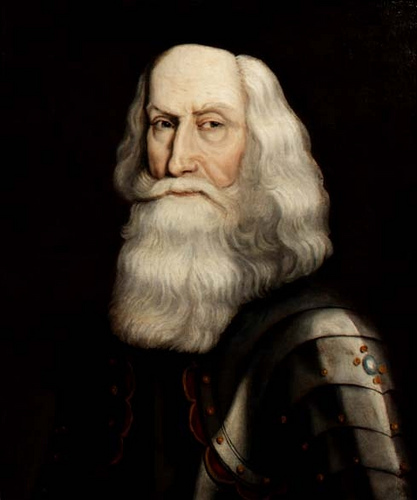 Dalziel or Dalzell, as well as Bluidy Tam and the Muscovite de’il. He was a Scottish Royalist General in the Wars of the Three Kingdoms.
Born in Linlithgowshire; the son of Thomas Dalyell of the House of the Binns, Linlithgowshire; head of a cadet branch of the family of the Earls of Carnwath, and of Janet, daughter of the 1st Lord Bruce of Kinloss, Master of the Rolls in England.
Legend has it that “Bluidy Tam” enjoyed on occasion a hand of cards with the Devil. During one of these games, the Devil losing threw the card table at the General. The Devil missed and the Table flew threw through the window and ended up in a pond on the grounds of the House of the Binns. This tale was passed down through generations of inhabitants of the Binns. In 1870 following a particularly hard drought, a Marble topped Card table was seen poking through the low waters of the pond. In 1930 the Mother of the present Tam Dalyell asked a local joiner to repair the legs on the table, to find out that the about to be retired tradesman’s first job was to retrieve said table from the pond.
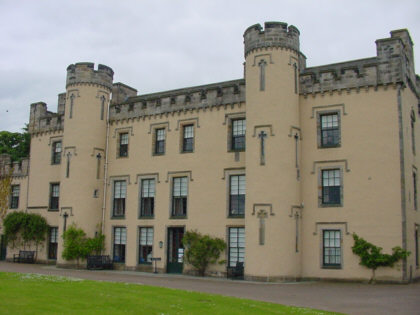
Matt Smith as Doctor Who – In his Itchy Old Mans Jacket
The post Bluidy Tam and his card game with the devil appeared first on ScotClans | Scottish Clans.
]]>The post Scotland’s Most Inspiring Places: A Personal View appeared first on ScotClans | Scottish Clans.
]]>1. Skye: The Trotternish Peninsula.
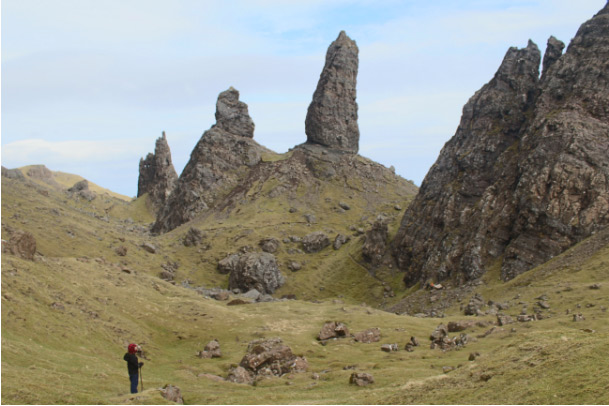
The Old Man of Storr
The Island of Skye is nearly always on peoples ‘bucket list’ and with good reason. The island is very large with so many different things to see its hard to know where to start. Dominated by the brooding ‘Black Cuillins’ a ragged mountain range that sits in its centre the island fans out to a number of peninsulas. All of them have spectacular views and hidden gems to explore but our favourite is the Trotternish peninsula.
Travelling north beyond Portree; the island’s main town a strange jagged ridge comes into view, this ridge features the Old Man of Storr, a giant rock tower that sits at an impossible angle near the rugged Storr cliffs. Further up the Quiraing extends the ridge line, the remnants of an ancient landslide of epic proportions. Walking through this area is like entering another world, the complexity of the landscape and broad vistas as you reach the ridge tops is quite simply astonishing.
What else is like this: In many ways it reminds me of Hadrian’s Wall (yes I know thats in England). Also the sea stacks of Orkney.
2. Glencoe and Rannoch Moor.
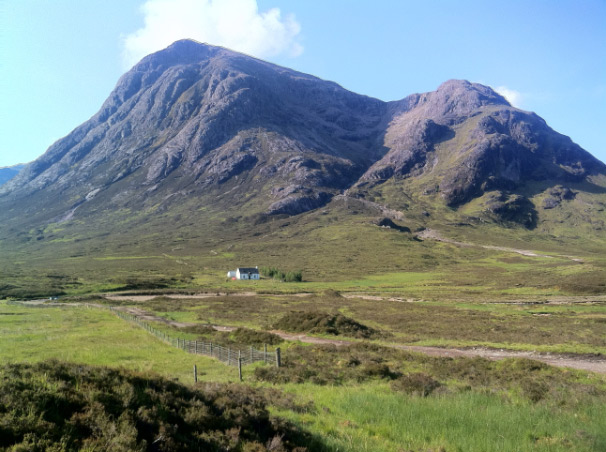
Glencoe
It would be impossible and indeed unforgivable to not include Glencoe in this list but I would extend it a little south to cover Rannoch Moor, an extraordinary landscape of bogland and small lochans that signal your approach to the glen as you venture north. The main road seems to float over the landscape and its hard not to find yourself trying to imagine what it must have felt like in the days before Thomas Telford build the first metalled road here as people picked their way through the moor. It must hold many dark secrets.
Then there is Glencoe. The majestic Buchaille Etive Mor stands guard at the entrance to the glen with her sister peaks lined up beside her, on the other side the Aonach Eagach ridge, the narrowest and most exposed ridge in Britain is a place not for the feint hearted. Handy parking places are scattered along the length of the glen, nearly always packed with tour busses and the odd bagpiper raking in the cash. The real rewards though, come when you take a step or two away from these busy lay byes and out into the glen itself. Despite its fearsome reputation in winter Glencoe has meny less challenging low level walks that get you away from the crowds and give you the space to contemplate life before the ‘quieting of the highlands’ and the tragic events that have been so linked to this place forever more. Caution and a sensible attitude (and footwear) of course goes without staying, this is a wild place that can claim lives in any season.
What else is like this: Scotland has many deep glens like Glencoe though few are so well known. Glenshiel with it towering 5 sisters comes to mind or for a more scaled down version Mennock and Enterkin passes in Dumfriesshire feels like a lowland rural equivalent.
3. The Border Abbeys
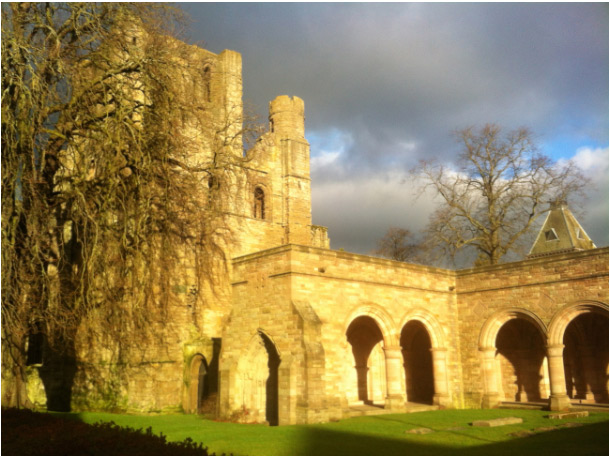
Kelso Abbey
The cluster of small border towns that nestle in the south east part of the Scottish borders feature a ring of magnificent ruined abbeys. In their heyday Monks from the Tironesian, Augustinian, Premonstratensian and Cistercian orders occupied these impressive buildings which became centres of learning and sat at the centre of many small communities. Inevitably though, sitting as they do in the heart of the sometimes lawless border region and with neighbouring England a few hours ride away the abbeys were partly destroyed, much of the damage being done during the ‘Rough wooing’ of King Henry VIII of England.
The violence of that time has long gone now and what is left of the abbeys are preserved as they were left all those centuries ago. Each has its own character and are peaceful places where you can sneak away from a busy market day and try to imagine the sounds of morning prayers being offered up in an echoing chapel.
For people of a fitter disposition it is possible to follow a 5 day walking route that takes in these wonderful buildings. The walk is not too challenging and gives you even more opportunity to explore this often missed part of Scotland.
What else is like this: Our own Holyrood Abbey in Edinburgh of course, Iona (featuring shortly) and Linlithgow Palace certainly have a similar feel in many ways.
4. Arisaig
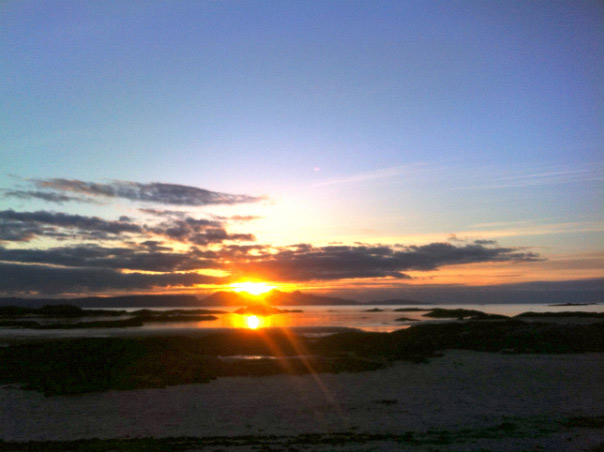
Arisiag at Sunset
As you take the route north to venture into the North West Highlands you hit the town of Fort William, spreading near the foot of Ben Nevis this busy town is an inevitable stop off for a quick snack and a stretch of the legs. Most travellers continue to the north towards Skye and Loch ness but just taking a left turn will lead you on a journey that rewards you with fantastic beaches, scenes from Harry Potter and romantic tales of Bonnie Prince Charlie. This road which was once a twisting and perilous single track is much improved, it takes in the Jacobite monument at Glenfinnan and an added bonus of a view from there of the Glenfinnan Viaduct a victorian marvel of railway engineering that will now forever be known as ‘the Harry Potter Bridge’. If you are very lucky you might catch the steam train that regularly travels this way on tourist trips puffing over the viaduct.
This was where the ‘Young Pretender’ (not the young wizard) first landed on the Scottish mainland in 1745, raised his standard and forever changed the covers of shortbread tins and tea towels, just a few minutes drive away loch Nan Uamh is where he set sail back to Europe a year later, his followers scattered in the highlands or buried in the mass graves at Culloden.
At the small village of Arisaig is what could only be described as a camper’s paradise, a collection of campsites sit along this stretch of coast set into grassy areas beside beaches with impossibly white sand. Its hard to compete with the feeling of settling down to a mug of tea or something stronger watching the waves on the shore as the sun sets over the islands of Rhum and Eigg. A sunset in Arisaig is not just a sunset, its gods own theatre, and he knows how to put on a good show!
For those who want to venture further though this route has one last gift to give, the Malliag ferry to Skye. An altogether gentler and more dignified way to reach our first destination on the list. As the ferry pulls out of Malliag harbour its inevitable that you catch yourself humming the Skye Boat Song to yourself.
What else is like this: The west coast and in particular the islands have incredible beaches, Tiree for example or Durness in the far north, The small island of Eriskay has the connection with Bonnie Prince Charlie too as of course does Culloden.
5. South Uist
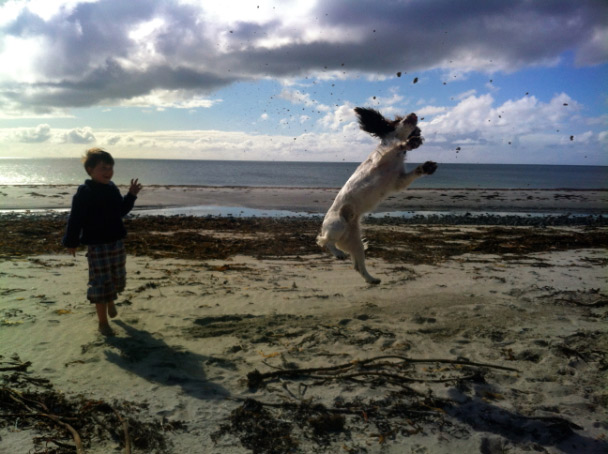
Happy Dog on South Uist!
The island of South Uist forms part of the Outer Hebrides (more of them to feature later). The island stretches from north to south linked by causeways to Benbecula and Eriskay. A modest range of low mountain peaks run like a spine down its east side and to the west is the legendary Machair. The Machair is a low lying coastal plain, formed by millennia of wind blown, calcium rich sand that forms a valuable fertile layer. The habitat is the fragile home to many species of birds and small crofting communities are scattered along the island’s east side.
There is something about the light here that feels like nowhere else on earth. There always seems to be some drama in the sky as another raincloud skids in over the Atlantic to the sound of oystercatchers and gulls.
This is an ancient place too – Settlers have been here since neolithic times and this is the only location in Britain where prehistoric mummies have been found. Looking at the ramshackle collection of little crofts you are reminded that now just as then the people who live here have a relationship with the land and pace of life that many of us would envy (in the summer at least).
What else is like this: Orkney and Shetland certainly have that feel of a link with the prehistoric past though the Machair is peculiar to the Outer Hebrides. also Barra and Vatersay just to the south and further on, the islands of Islay and Jura.
6. St Kilda
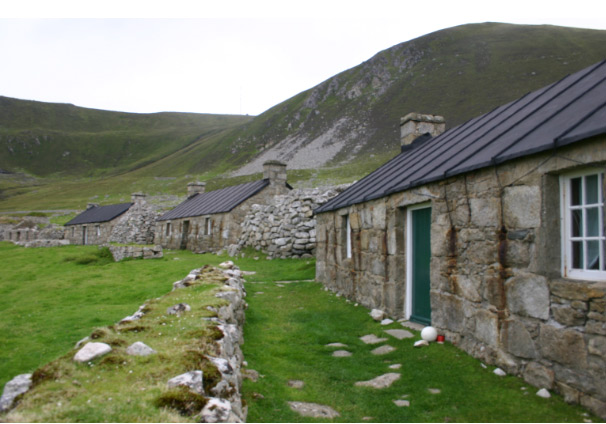
St Kilda
On 29 August 1930, 36 men women and children boarded a boat to the mainland from the island of St Kilda. Breaking a continuous period of settlement that had stretched back over two thousand years. These people were not evicted by harsh landlords, they had asked to be taken away to start a new life elsewhere. For them life in the most remote part of the British Isles had simply become too difficult.
Remote is too simple a word for St Kilda, just getting here is an adventure, and something of a hit and miss affair as the journey over rough seas is not always possible at all. Arriving at the small bay on Hirta, the main island in this small group is like arriving at the edge of the world, the deafening sounds of Gannets, Fulmars and Skuas fills the air and the island itself seems to rise out of the sea to meet you, one second there, one second disappearing as the boat lurches between the waves. As you step onto the shore you step back in time to the moment those last settlers left the island behind. The village street still stands as if trapped in amber, the remains of centuries of island life lie scattered up the hill side.
If you want to come to Scotland and get the feeling of being totally alone try spending a few days here with just the mice for company (and the army personnel who man a nearby base but thankfully never leave their quarters). There is a peculiar feeling to standing on the shore watching the tiny boat head back out into the open sea wondering if it really will be ‘back on Wednesday’ as promised.
Where else is like this: The Monach Islands off the coast of Uist were also until lately inhabited and North Rona is another remote destination. There are also a number of clearance villages such as Bororaig in skye and near Tongue in Sutherland.
7. The Isle of Lewis.
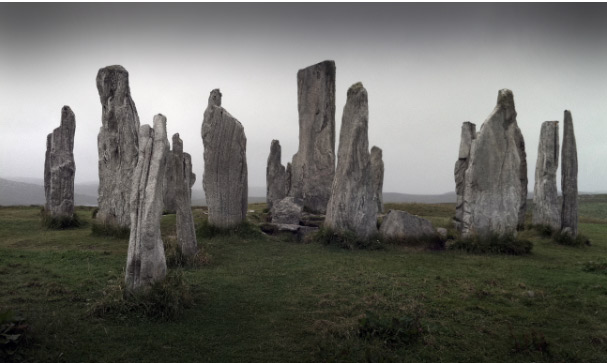
Callanish Standing Stones – Lewis
A few years ago I was on a flight back from Iceland on a clear summer evening. The flight path took us over the Butt of Lewis and as first sights of ‘home’ go, its about as good as it gets (also see entry number 10). Lewis has become a popular destination recently thanks to Peter May’s ‘Black House’ trilogy of books, May’s infectious description of the landscape has also inspired an excellent coffee table photography book. A trip to Lewis inevitably begins with the long ferry journey from Ullapool to Stornoway, passing by the Summer Isles, the setting for the classic British horror movie ‘The Wicker Man. Stornoway is a bustling small town that has a bit of a frontier feel about it, its a bit rough round the edges and can be a bit wild of a Saturday night before the ‘sabbath’ calls a halt to all activity. But before you disappear off to explore the island, stop off at MacLeod’s Butchers and stock up on as much Black Pudding as you can sensibly carry.
The stand out feature of Lewis is the standing stones at Callanish. For nearly 5,000 years these remarkable stones have stood here. Academics still argue over their true purpose, partly as a burial site possibly as a calendar no one can really say for certain. Folk tales say that they were a family of giants who refused to convert to Christianity and Saint Kieran turned them to stone as punishment.
Like many parts of the west coast, Lewis has its fair share of incredible coastal landscapes with wide open beaches and stark cliffs. As you travel south from Stornoway towards the mountains of Harris you pass seemingly endless expanses of peat bog, stacks of freshly cut peat stacked up and drying ready for collection. The smell of peat smoke is the air is a reminder once again that this is a place where people work and live not just a toilet stop and cafe.
What else is like this: Again, Orkney springs to mind for its unrivalled collection of ancient artefacts (the only reason Orkney is not on our list is because we have yet to visit there and this is our personal list). Wick and Thurso in Caithness have a similar frontier feel about them that Stornaway does and the wetlands of Caithness and Sutherland are very much like the Interior of Lewis in some ways.
8. Iona
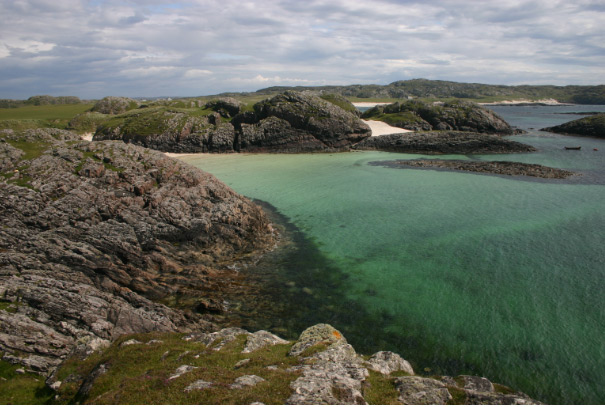
West Coast of Iona
Sometimes the beauty of a place is magnified by the effort it takes to get there. If thats the case then Iona must be one of the most beautiful places on earth! First of all you need to get to the island of Mull, that is either reached via a ferry from Oban or by a couple of smaller ferries and a long drive down towards Ardnamurchan. This is followed by a long drive down the Ross of Mull until you literally ‘run out of island’. From there a small ferry takes mostly foot passengers (theres is not much point in taking the car as theres not really anywhere to drive to) over the short hop to Iona. The famous abbey is immediately visible as you land in the tiny village that sits beside it.
Iona abbey is one of the most famous in Scotland. its by no means the largest and would be dwarfed by the Border abbeys though it is one of the best preserved. St Martins Cross is probably the most photographed and recognisable celtic cross there is and the abbey grounds have more than a few famous interments: Kenneth MacAlpine, Donald II, Malcolm I, Duncan I and Macbeth all lie here, as does the late Labour leader John Smith.
The island is tiny and can be walked round entirely in a day. If you chose to do this there is a good chance you will hardly spot a soul the whole time as pretty much all the tourists flock to the abbey. Their loss is your gain though, the island circuit takes in more sandy beaches on the north shore the rugged west coast with crustal clear waters and small secluded bays, a spouting cave and the remains of an abandoned marble quarry before returning back to the village for a well earned drink while you wait for the ferry back.
What else is like this: Right next to Iona is the small island of Erraid. its tidal so can easily be walked to. There is an incredible campsite at Fidden farm nearby too. Holy isle (in England,,, just) is also very similar and also Inchcolm Abbey in the Forth Estuary.
9. Plockton
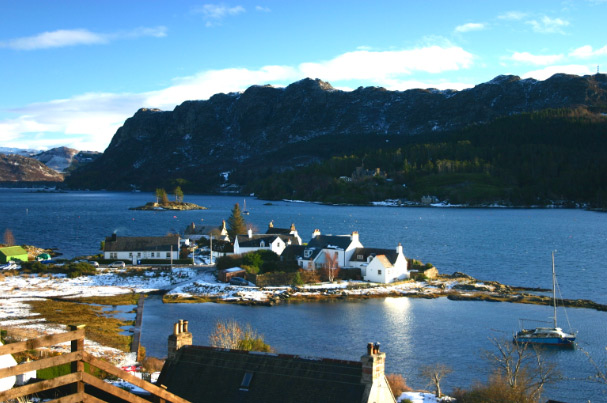
Plockton
The tiny village of Plockton sits at around the same line of latitude as Moscow, yet the little road around the bay is lined with palm trees! These are not made of plastic but thrive here thanks to a phenomena properly known as the Atlantic Conveyor though most of you know it as the Gulf Stream. a current of warmer water that runs North-East from the Gulf of Mexico makes landfall on Scotland’s north west coast leading to a far milder climate than we would expect. Before you pack your bermuda shorts and beach volleyball set though remember this is STILL Scotland.
The small village was a fishing community that sprung up in the 19th and 20th centuries in an attempt to slow down emigration from the highlands. The end result is possibly the most picturesque small village in Scotland. Just like Iona above, getting here is half the fun. There is the long drive skirting within touching distance of the Skye bridge and up the road to the ironically named ‘Stromferry (no ferry)’ , or you can take a more indirect route via Lochcarron, or you can treat yourself to one of the worlds greatest train journeys, travelling north to Inverness and then west via the tiny settlement of Achnasheen through some of the grandest majesty that the highlands can serve up, it might be a long journey but I really wouldn’t bother with a book unless its dark 
For those who like an element of terror on their days out then its not too far from Plockton to the small town of Applecross. The last half hour of your trip will be memorable as you wind up the notorious Bealach na Ba (the pass of the cattle) a single track road that twists steeply up an impossible looking slope before sliding down the other side. On the way back you can reward yourself with an early tea at the excellent seafood cafe at Kishorn, where the seafood is so fresh it answers you back.
What else is like this: Rothsay on the Isle of Bute is also known for its palm trees though its a much larger and busier town. The East Neuk of Fife also has a string of quaint fishing villages and Tobermory on Mull is also very picturesque.
10. Edinburgh
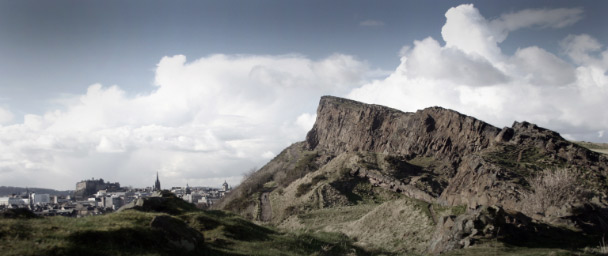
Salisbury Crags, Edinburgh
This comes as no surprise to anyone who knows us, after all its where we live. what can you say about Edinburgh that not already been said. Known as the Athens of the North the city has some of the most impressive architecture in the world covering the Middle ages, and Neo Classical eras in particular. Arriving in Edinburgh by train is one of the great tourist experiences of all time: As the train slips through the outskirts it could be anywhere in Britain, then the train dives into a long tunnel, for a moment you emerge to catch a glimpse of the castle rock and gardens before ducking under the art galleries on the mound and arriving in the station. If you have never been before (or even if its been a while) Then walk up the sloping roadway to emerge on Waverly Bridge. Ahead of you stands the impressive if rather rocket like structure of the Scott Monument, the Classical pillars of the National Gallery and Royal Scottish Academy and behind that Castle rock with the iconic Edinburgh Castle crowning the top. It really is one of the most impressive cityscapes in Europe if not the world.
Edinburgh is bursting to the point of overflowing with history and culture, the compact city centre makes most sites easily walkable (for those who can easily walk), you can take in an art gallery, loose yourself in a museum or scare yourself witless on one of the many ghost tours that run from the high street.
And if all that bustle is too much then in 15 minutes or so on foot you can find yourself at the bottom of the Royal Mile past Holyrood palace and into Holyrood park, Here you can leave the city behind and feel like you are back in the highland wildernesses that I’ve eulogised about above (in fact parts of Arthurs Seat in Holyrood park have been used to represent the wild highlands in film shoots). After half an hour or so of puffing you might find yourself on top of Arthurs seat or nearby Salisbury Crags giving you a reward of an incredible view over the city and down the east coast on one side and up to the Forth bridges on the other.
What else is like this: Glasgow’s west end is for Victorian architecture what Edinburgh is for Georgian. Stirling has its castle too and is handy for Wallace Monument and Bannockburn, Inverness too is worth visiting if only for the beautiful Ness islands and Leakeys bookshop.
Well thats our personal top ten list for now. I’ve set a date in the Calendar to revisit this list same time next year and see what new places we have discovered by then…
Rodger and Amanda Moffet – Scotclans
The post Scotland’s Most Inspiring Places: A Personal View appeared first on ScotClans | Scottish Clans.
]]>