The post John Clayton – The Man Who Saved the Wall appeared first on ScotClans | Scottish Clans.
]]>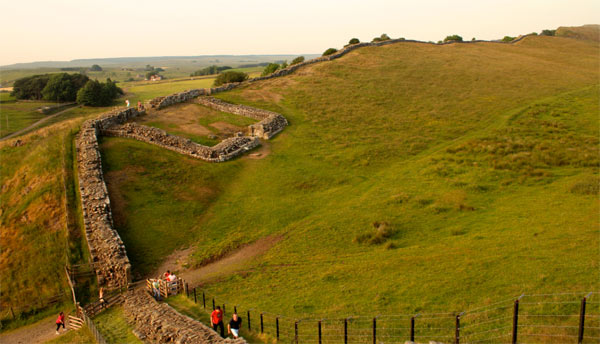
Hadrian’s Wall and Mile Castle Today
We have just returned from spending a week near to Hadrian’s wall. The wall was built by the Romans under the orders of Emperor Hadrian in AD122 and runs from coast to coast for 73 miles. This remarkable feat of building marked the northern edge of the mighty Roman Empire. By the late 4th century though the Romans began to evacuate northern Britain and the wall fell into decline, much of the stone was used to build General Wades military road that runs alongside it and other stone was used in the building of castles and churches etc.
This once impressive structure around 6 metres in height and 3m thick gradually disappeared back into the ground from which it had risen. The fact that there is indeed any trace left today is down to the work of one man, John Clayton.
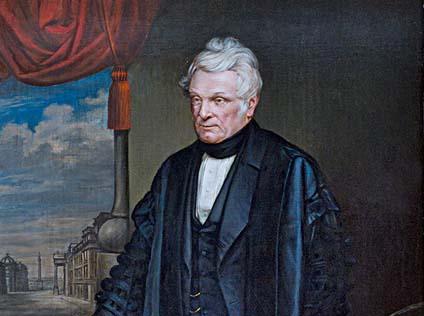
John Clayton
In 1796 John Clayton’s father Nathaniel Clayton bought an estate called The Chesters, near to the wall. He had ruins of a Roman barracks and stables levelled to form a park between his mansion and the river. This wilful destruction seems almost criminal now but in the late 18th century there was little interest in archeology, this took hold in the Victorian era. However to Nathaniel’s son John this was unacceptable. When John succeeded his father’s property in 1832 he put a stop to the removal of stone from the wall and began to consolidate and even rebuild sections, making some parts safe with a turf top (now referred to as a ‘Clayton wall’ ) He also began to excavate the previously flattened Ruins.
Clayton was a trained Lawyer and Town Clerk for the city of Newcastle, He worked alongside planner Richard Grainger to accomplish much of the Neo Classical architecture of Newcastle’s city centre. Clearly a man of considerable talent, not content with merely securing his own estates his attention moved to other areas of the wall; he began to systematically purchase land along the length of the wall, setting workers out to rebuild and repair sections as he went. He also worked with the local farmers to improve the land and livestock, ensuring not only that the income from the estate could cover the cost of rebuilding but also that the work done was sympathetic to the needs of those who lived on the estate.
As I stood on the wall last week and watched the steady streams of walkers enjoying the magnificent views and remarkable architecture of this fantastic site I felt compelled to raise an sadly fictional glass to John Clayton – the man who saved the wall.
The post John Clayton – The Man Who Saved the Wall appeared first on ScotClans | Scottish Clans.
]]>The post What is a Clan By Dr Bruce Durie appeared first on ScotClans | Scottish Clans.
]]>Clans and Families
Clans are a consequence of the templating of the Anglo-Norman feudal system onto pre- existing territorial holdings, but with certain specific features (such as a military elite), and were a phenomenon of the Scottish Highlands and Borders, not the Lowlands.
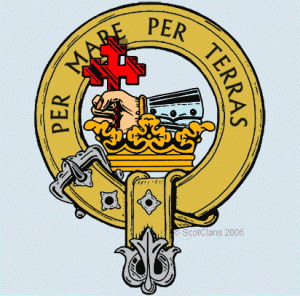
MacDonald Clan Crest
A lot of spurious genealogy derives from a misunderstanding of the legal and historical background to a particular topic. This is an especially vexed question in connection with what is, or is not, a “clan” in Scotland. In the popular imagination, everyone of Scottish descent is a member of a clan, typified by one or more related surnames, a particular tartan and allegiance to a chief. However:
- clans were a Highland and Borders phenomenon, not applicable to the Families of the Lowlands, where the majority of the Scottish population lived then and lives now;
- clans were not just, and not even, a kinship group;
- the “clan system” was one, but not the only, consequence of importing the Anglo-Norman feudal system to Scotland;
- most Scots were never part of the “clan system” (however defined);
- the term “Clan” ceased to have any real meaning post-1746, and assumed a different meaning post-1820;
- clans have no formal place in Scots law, although chiefs do, to some extent;
- tartans, although in some cases ancient, did not have the one-to-one relationship to surnames as is now affirmed, until the early 19th Century.
What was a Clan?
The Gaelic word clan is derived from the Gaelic word clanna, meaning “children” or “progeny”, but this does not convey the same meaning in Scotland as it originally did in Ireland (see below). Clans were territorial, accepting the authority of the dominant local grouping and looking to that chief as the patriarch, head, principal landowner, defender, military commander and dispenser of justice. Dependent families and individuals would often adopt the clan name as an indicator of affiliation and fealty to the Chief, so very often there is no genetic descent from a common ancestor or from the chiefly house – a vexed issue in the modern day of DNA test and genetic genealogy.
There is a much-quoted definition, attributed to Nisbet and his System of Heraldry (1722):
“A social group consisting of an aggregate of distinct erected families actually descended, or accepting themselves as descendants of a common ancestor, and which has been received by the Sovereign through its Supreme Officer of Honour, the Lord Lyon, as an honourable community whereof all of the members on establishing right to, or receiving fresh grants of, personal hereditary nobility will be awarded arms as determinate or indeterminate cadets both as may be of the chief family of the clan”.
However, the actual source is Sir Thomas Innes of Learney, Lord Lyon 1945-1969, writing in the introduction to his revised edition of Frank Adam’s Clans, Septs and Regiments of the Scottish Highlands. The current Lord Lyon is reviewing the contents of the Clan portion of the official Lyon Court website, so there may soon be a more up-to-date definition. There is more on clans and heraldry below.
The Irish “Clann”
It is, perhaps, natural to look back to an Irish origin for the Clan system, given the influx of Gaels (the “Scotii”) from Dalriata before and during the 5th Century AD into Dalriada or Argyll (Ard-Gael) and the importation of Gaelic language and culture into the West and later the Highlands of Scotland. However, much in the same way that many Scottish emigrants have moulded a half- historical, half-imagined “Scottish culture” from that left behind, and fitted it to the needs of modern- day America, Canada, Australia etc., the Gaelic culture of Scotland was not identical to that of Ireland but adapted to the new circumstance. For one thing, the difference in landscape did not permit the same farming practices, which in turn influenced kinship and other social groupings.
Who can belong to a clan or family?
It is a convenient fiction in heraldry – and accepted as no more than that – that everyone of the same surname as a chief is heraldically related, and if granted arms, these will be clearly derived from the chief’s. (Not absolutely – an example of that is given below.) By extension, everyone with the same surname as a chief is considered to be a member of that chief’s clan or family.
Additionally, anyone who offers allegiance to a particular chief is recognised as a member of that clan or family unless the chief decides otherwise. The best-known example is that of Fraser, Lord Lovat offering a boll of meal (six bushels in Scotland, or about 140 lb.) to nearby families who pledged allegiance, and took the name Fraser as their own.
Thus, Scottish clans could consist of “native men” (some kin relationship to the chief and each other), and “broken men” (individuals, or from other clans, who sought the protection of and offered fealty to the chief).
The idea of smaller groupings linking themselves to more powerful neighbours is also what led to the concept of “septs” – unrelated surnames allied to a particular clan or family – but there is no official list of these and it is a matter of tradition, for each chief to agree or not. Largely, septs were a Victorian invention, promulgated by or for the benefit of those who could stake no claim to a clan but wished to be associated with one or other.
The early period
The first known divisions of Scotland (other than the “tribes” identified second-hand in Ptolemy’s Geography and Tacitus’s Agricola) were territorial, but with some reference to kinship. The settlement of Dalriada in the early 6th Century was said to have been established ca. 465 AD by Fergus, Lorn and Angus, sons of Erc, and subsequently territory was divided among four groupings: the Cinel Gabran and Cinel Comgall (descended from grandsons of Fergus) and the Cinel Lorn and Cinel Angus (descended from his brothers). Notice the use of the term cinel (originally cineal in Irish Gaelic), indicating “people of” rather than clann (“children of”).
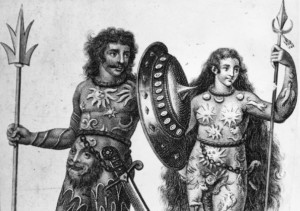
Picts: Re-imagined by Victorian Artists.
Whatever the historical reality of that, what the Gaels found, as they penetrated deeper into Pictish “Caledonia” north of Forth and Clyde rivers, was a pre-existing political geography of large tribal districts, sensibly determined by the topography – based around islands, the straths along great rivers and sea lochs, inland glens etc. Some of these were much later mythically named for seven sons of a Pict king named Cruithne (the Gaelic word for Pict), son of Cing. Cruithne, it is told, reigned for a hundred years and had seven sons named Caitt (or Cat), Ce, Circenn (or Circind), Fib, Fidach, Foclaid (or Fotla) and Fortrenn (Fortriu), with Fortriu (present-day Moray and perhaps as far south as Strathearn) dominant. These names are still in use today as Caithness, Keith, Fife etc. Of course, the “Picts” never called themselves that, any more than the Britons of what is now Wales called themselves “Welsh” (and English word indicating “foreigner”. Pict it is probably a corruption of Old Norse Pettr, Old English Peohta and Old Scots Pecht which may or may not be cognate with Pritani (“Briton”). The point is, there was a pre-existing territorial grouping principle at work. When the Kingdom of Alba was forged from Gaeldom and Pictland in the 9th Century by the House of Alpin, that would have been the natural next tier of administration.
This differs from the Irish concept of clanship in a number of ways, but the main one is a matter of climate. The economy of the Irish clans was pastoral – lush, green pastures and arable land, in a countryside that was both flatter and more temperate than the sparse Highland moors and hillsides away from the coasts. It also offered far less by way of natural defences. This meant that the “kindred” was a more natural form of organisation in Ireland, as had been the case on the European plains that gave rise to the Celts originally.
In Scotland (except for the Central Lowlands and the coastal areas of the North and East) the staple was whatever grains would grow on the marginal hillsides, and seasonal common grazing of livestock. Raiding the neighbours’ livestock was the national sport, which led to defended glens acting as natural stock-pens and thus homelands. The chief and his military fine kept order and provided defence in return for tribute, and the individual glens, straths and lochsides were looked after by lesser “gentry”. This was a system that took naturally to feudalism.
Actual kinship was not the issue so much a geographical co-locality. The original concept of heritage bound up with the clan was not surname. At this point, and well into the 13th Century, surnames (in the sense of passing unchanged from fathers to sons) were a rarity. Fergus, Iain’s son (MacIain or Johnson) would have sons all called Fergus’s son (MacFergus or Fergusson). The important concept was that of duthchas – the right to inhabit and control the territories over which the chiefs and senior members of the clan held sway and habitually provided protection. In exchange, all clansmen recognised the personal authority of the chiefs and his captains as the clan’s trustees – for the lands, honour and patrimony. However, the growing power of the Sovereign was expressed in the granting of charters to the chiefs and lairds which defined the lands held – known as their oighreachd (or eiraght, meaning “heritage” in the sense of stewardship and inheritance, over and above mere ancestry). This was a natural correlate of the imposition of Anglo-Norman concepts of feudalism which David I (r. 1124-53) imported into Scotland when he took the throne in the early 12th Century. Well used to the English system, where he had spent years at the court of his brother-in-law, Henry I, David saw the power of feudalism to harness but also reward the powerful mormaers (“Earls”) and other large landowners, including chiefs.
The basic feudal concept is of a hierarchy of heritable possession – all land ultimately belonged to the Crown, but was granted in feu to tenants-in-chief, termed Barons. The payback (reddendo) was originally a stated amount of military service by so many armed men, but eventually collapsed into payment in cash or kind – farm produce etc. Barons could sub-infeudate (parcel out, heritably) parts of their estate to others, whether family or not, again in return for service or payment of some kind, even if only nominal (“peppercorn”). As chiefs would naturally wish to bind their relatives and supporters to them, and because the clan’s warrior elite (the “fine”) would naturally wish to become landowners and thereby territorial warlords, the system suited the Highlands and Borders well. David also used this system to reward Anglo-Norman, Flemish and French supporters who came to Scotland with him, by inserting them into the landed society. In such a way did the ancestors of Robert Bruce – already transplanted from Cherbourg into Yorkshire after following Henry I after his victory at Tinchebray in 1106 – come to be Lords of Annandale. The old Celtic clans and families now rubbed shoulders with (and intermarried) Anglo-Normans, particularly where the Highlands and Borders met the Lowlands – as witness the Earls of Strathearn and the Cheyne (Le Chene) family in Perthshire in the 13th and 14th Centuries.
Gaelic was by no means the predominant culture or language in Scotland by the 12 Century. The Normanisation – a process actually started by the parents of David I, Malcolm III Canmore and Margaret – meant that the landed classes spoke Norman French and the clergy and scribes necessarily knew Latin, but the native language was more similar to Northumbrian English influenced by Angles and Danes and the earlier Pictish/Cumbric, similar to Welsh. The Strathclyde area was originally Brythonic and “Welsh”-speaking, albeit with more influence from the Gaelic- speaking neighbours. The speech of the Burghs developed into Scots. There is no evidence of clan-like structures in the Lowlands – in fact, the Highlands came to resemble the Lowlands as feudalism took hold.
1314, Bruce and Bannockburn
With 2014 and the 700th anniversary of Bannockburn looming, many “clans” are keen to assert their presence at the Battle of Bannockburn, alongside Robert I (“The Bruce”). The historical reality is that we have absolutely no idea what “clans” or families fought alongside (or against!) Bruce. We do know the names of some individuals on the Scottish side, mainly nobles and what would be considered the chiefs of clans and families, so it reasonable to suppose that at least some of their kin and followers – from the Lowlands Highlands and the Western Isles – made up the 5,000 schiltron spearmen and the other infantry and the cavalry. The most authoritative list is considered to be that composed by military historians Christopher Rothero and Tim Newark.
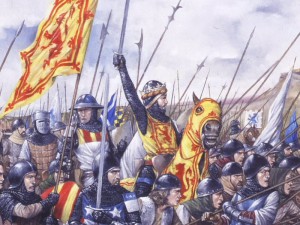
The Battle of Bannockburn
It is noticeable that what is considered the most authoritative source on Bannockburn and Robert Bruce (Johne Barbour’s The Brus), not composed until 1375, makes no mention of “clans”.
The Law of the Clan
Other features of the Clan system, which reinforced both the authority of the chief and social bonding, were:
- fosterage – the chief’s children would be brought up by a member of the clan “aristocracy” and their children by others members of the clan; this can also be seen a sophisticated form of voluntary hostage;
- manrent – a bond between the chief and the heads of family groups accepting territorial protection even if they did not live on the actual clan lands;
- calps – death duties on a family group when the head died, paid to the chief as a sign of allegiance and protection, and usually the best horse, cow etc.; this strengthened the manrent and continued quietly even after banned by Parliament in 1617;
- marriage bonds – both a way of reinforcing local alliances within the clan or with neighbours, and a matter of commerce involving payment in cash or kind by and to the families of the bride and groom (tocher and dowry) and with what would now be recognised as pre-nuptual agreements; these were also enacted among the landed families of the Lowlands, and, indeed, at royal marriages; in addition, the chief’s consent was often required for any marriage.
1587 and an Act against Clans
The first mention of “clans” in any Act of the Scottish Parliament or other statute is in 1587 (often mis-dated as 1597)
“held at Edinburgh upon 29 July 1587 for the quieting and keeping in obedience of the disorderly persons, inhabitants of the borders, highlands and isles”.
There is one earlier mention, in 1384, of a “clan”, which is a special case. In the 1587 Act there is a description of the
“Chiftanis and chieffis of all clannis…duelland in the hielands or bordouris”
This mention of “Chiftanis and chieffis of all clannis…duelland in the hielands or bordouris” is often mistakenly applied as if “Highlands and Borders” encompassed the whole of Scotland, and that therefore the term “clan” equally refers to Lowland families. In reality, it specifically excludes the Lowlands, such as (in Fife alone) Bruce, Lindsay, Leslie, Durie, Hay and others, whose chiefs were among the most influential men in Scotland at the time. Bruce, therefore, and to take but one example, is not and never was a clan – the present Chief, Andrew Bruce, Earl of Elgin, uses the term “House of Bruce”.
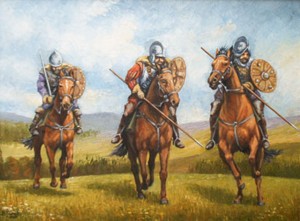
Border Rievers
A Lowland family, moreover, may well have had an armigerous chief and feudally-held lands, but did not have the typical clan structures of “septs” of associated names living nearby and in thrall, or a military structure. By contrast, at one point the Armstrongs, based around Langholm in Dumfriesshire, could put 3,000 men on horse into the field. They were one of the Borders clans who had raised “reiving” (sacking and cattle-rustling) to a high art. “Clans” are therefore a phenomenon of the Highlands and Borders and the equivalent kinship/territorial structures in the Lowlands are the “family”, usually based on a feudal barony.
1560s – Reformation
In theory, the formation of the Church of Scotland (“The Kirk”) meant that the whole country was either part of the established church, or was “recusant” (really meaning Catholic) and outlawed – although the monarch, Mary, Queen of Scots, was herself Catholic. Some clans and families – mainly those distant from Edinburgh and the authority of Church and State – remained adherent to the Catholic faith, notably Chisholm, Clanranald, Farquharson, Glengarry, some Gordons, Keppoch and Macneil of Barra.
The Kirk, notably intolerant and convinced of the rectitude of its position, considered much of the traditional Gaelic culture “heathenish”, including traditional healing, the celebration of Yule, bonfires at Samhainn, the veneration of holy wells and, of course, dancing. One weapon in this was the suppression of the “Irish” (Gaelic) language, which the Society in Scotland for Propagating Christian Knowledge continued until at least 1716.
1600s – Union of the Crowns, the Civil Wars and the Killing Time
The Borders clans had long been a thorn in the sides of both Scotland and England, so when James VI took the English throne as James I in 1603, he was able to solve the problem at a stroke by scattering some of them to England, to northern Scotland and the Isles, to Ireland and even to the Colonies.
It was early in 1603 that Campbell, Duke of Argyll, manipulated the already-broken and landless MacGregors into slaughtering the Colquhouns of Luss at Glenfruin, which led to their extirpation. The name of MacGregor was proscribed, none could carry any weapon except a blunt knife for eating with and no more than four than of them could meet together. The persecution did not end until 1774, and many MacGregors took other surnames – Rob Roy MacGregor, for instance, used his mother’s surname (ironically, Campbell) – so to this day there may be many Stewarts, Campbells, Murrays and others who descend from re-named MacGregors, and many a MacGregor who is no such thing.
The War of the Three Kingdoms (often called the English Civil War, as if it wasn’t also played out in Scotland and Ireland) saw the loose confederation of Protestants called Covenanters supported by the powerful Clans of Campbell in the West and Sutherland in the North, opposed by Royalists led by Huntly (Clan Gordon). The division was more religious than support for the absent monarch, Charles I. Originally siding with Cromwell’s Parliamentarians, the Covenanters shifted their allegiance to Charles II at his Restoration on the promise – not realised – of toleration, as many equated freedom of worship with political and civic liberty. Charles was a secret Catholic and used Episcopalianism as its stalking-horse. Episcopalianism became widespread among the Highland clans – it promoted Royal authority and fitted with the hierarchical clan structure more that the egalitarian Presbyterianism. Some clans were converted or re-converted by Catholic missions. Highlanders were occasionally used as a blunt instrument of Government (and religious) policy, as when 10,000 of the “Highland Host” were unleashed on Glasgow in 1678.
In 1682 Charles’ brother, James Duke of York, instituted the Commission for Pacifying the Highlands. Many clan chiefs cooperated in keeping order locally, and it was also seen as remedying the land-grabbing greed of the Campbells. Succeeding as James VII, he was popular in the Highlands, but feared by the Lowland political elite, who found the king’s Catholicism and his close links with France equally troublous. This was made manifest when he had a son and heir in 1688 – James Francis Edward Stuart – which upset the line of succession via his daughter Mary, the Protestant wife of William of Orange, who was not only his son-in-law but also his nephew. It set the stage for support for the (Catholic) Stuarts and the Jacobite rising of 1689 when James was deposed by the “Glorious Revolution” of William and Mary, who had sworn to “maintain the Protestant faith”. The “Jacobites” (literally, supporters of James) were an alliance of Episcopalians and Catholics, and their grievances erupted after the death in 1714 of Mary’s sister and heir, Anne, last of the Stuarts, and her succession by the avowedly Protestant (and German) Hanoverians. This was seen by many – not just in the Highlands – as adding insult to the injury of the 1707 Union of Parliaments which effectively closed down Scottish government except as an extension to Westminster. Finally in 1745 Jacobite disquiet culminated in open rebellion and the Battle of Culloden.
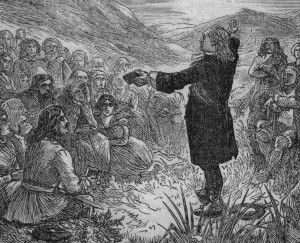
Covenanter’s Sermon
1745-47 – Culloden and the “Clan Acts”
It is a mistake to see “the ’45″ as a conflict between Scotland and England, or the Scottish Highlands against the Lowlands or even Catholic vs. Protestant. It was far more complex than that. Many Highland clans had divided loyalties, as the clansfolk might be Catholic but under a chief who was Protestant out of realpolitik – the impossibility of a Catholic receiving a government post or a senior commission in the army, for instance.
The last pitched battle fought on the British mainland, Culloden was the culmination (and end) of the aspirations of the son of James Francis Edward Stuart, the undoubtedly romantic but utterly hapless “Bonnie Prince” Charles Edward Stuart. It is important to remember that by this time many of the old military Clans had become institutionalised as regiments or units of the British Army. On the one hand, the Jacobite army was mainly Highlanders, but with a number of Lowland Scots, a detachment of English from the Manchester Regiment plus French and Irish units, all supported and provisioned by France. The Government forces were indeed mostly English, but there were a significant number of Scottish Highlanders and Lowlanders, some Hessians and Austrians plus a battalion from Ulster. The battle on 16 April 1746 at Culloden Moor – which was over in about 25 minutes – routed the Jacobites. But it was the aftermath that sealed the fate of the Clan System.
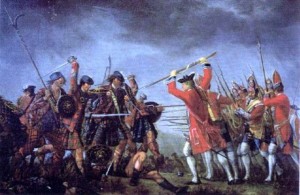
Battle of Culloden
Just to select a few examples, the Jacobite army included:
the Atholl Brigade (three regiments or battalions raised not as a clan but as a feudal levy, which possibly explains the significant number of desertions); Cameron of Lochiel’s Regiment; Fraser, Lord Lovat’s Regiment (whose son’s battalion missed the action by several hours); as well as (some) Farquharsons, MacDonalds of Keppoch (including MacDonalds of Glencoe, Mackinnons and MacGregors), MacDonalds of Clanranald, MacDonnells of Glengarry, Mackintoshes with Maclachlans and Macleans, and the Stewarts of Appin.
The British Army had:
the Loudon’s Highlanders, commanded by Lt Col John Campbell, 5th Duke of Argyll; the 21st North British Fusiliers (originally raised in 1678 by the Stuart loyalist Charles Erskine, 5th Earl of Mar and the progenitor of the Royal Scots Fusiliers); Semphill’s Regiment of Foot (which later became the King’s Own Scottish Borderers) – in total one Highland and three Lowland infantry regiments and one Scottish battalion of dragoons (cavalry).
It would be also be a mistake to equate the name of any particular regiment’s Colonel with the idea that all of the regiment shared that surname. Certainly, a “clan” regiment’s officers would be the clan gentry, but the common soldiers could be any of their tenants and dependents, with a variety of surnames. Furthermore, only the front-rank officers were properly armed, compared with their impoverished and poorly-provided soldiers, but as a consequence suffered a greater proportion of casualties, thus depleting the “middle class” of many clans.
It is instructive to see artistic depictions of Culloden made very soon after (as opposed to the many later, idealised portrayals) which show individual clansmen and even officers wearing as many as three different tartans, which emphasises that there was not a one-to-one relationship between pattern and surname at this time (see below).
There is no question that the aftermath of Culloden and the previous 50-odd years of Jacobite insurrection led to a policy-driven repression of Highland culture. The immediate punishments were rather indiscriminate. For example, Jacobite prisoners were taken to England to stand trial for treason, many held in Tilbury Fort or on prison hulks on the Thames, with executions at Carlisle, York and Kennington. However, the common men drew lots so that only one in 20 came to trial and only 120 were executed (some of those deserters from the British Army). Although given the obligatory death sentence, most had this commuted to life transportation to the Colonies – just under 1,000 were transported and over 200 banished – but 900 or so were released under the Act of Indemnity of 1747 and a further 380 freed in exchange for prisoners of war held by France. Another 650 out of the almost 3,500 prisoners recorded disappeared without trace, but some at least must have made their way home. However, the higher-ranking officers and “rebel lords” were executed at Tower Hill in London as an example to Scotland.
The British Government then set about consolidating the military victory of Culloden with occupation and continuing the building of military roads and garrisons, and by enacting laws to fully incorporate Scotland – and more specifically the Highlands – within the “British” system. Scotland became widely known as “North Britain”. The Episcopalian clergy had to make oaths of allegiance to and prayers for the reigning Hanoverians (those who did not were known as “non- Jurors” and hounded).
There had been a Disarming Act after the Jacobite Rising of 1715 aimed squarely at the Highland clans, which outlawed anyone in specified areas from having, unless authorised:
“in his or their custody, use, or bear, broad sword or target, poignard, whinger, or durk, side pistol, gun, or other warlike weapon”.
It didn’t work, and had to be reiterated in 1725 with Major-General George Wade as its enforcer. However, the ill-equipped Jacobites had been able to rearm themselves from government firelocks and bayonets left by the Redcoats fleeing after the disastrous Battle of Prestonpans in September 1745. Keen to learn from earlier mistakes, the government passed a new Act of Proscription, 18 strengthening the provisions of the old Disarming Act, with more severe punishments from fines (and jail until payment) to forced conscription for late payment and transportation of repeat offenders. 19 Various actions were taken against the wearing of the highland dress, to everyone except those in uniform as officers or soldiers in the British Army plus certain landed men and their sons. (It is from this that the famous Black Watch or “Government” tartan derives.) There were also measures to prevent children from being “educated in disaffected or rebellious principles” and a requirement for school prayers to be offered for the King and Royal family. The Abolition of Heritable Jurisdictions Act (1747) ended the feudal hereditary right of landowners to administer the law and enact justice within their estates through barony courts or heritable sheriffdoms, which affected the Lowland lairds with baronies every bit as much as Highland chiefs. Clan chiefs also lost their traditional rights to call clansmen to arms.
The Jacobite-supporting lords and clan chiefs had their lands forfeit and either sold or managed by factors (who, frankly, did a far better job in the main of managing the estates and improving agriculture and the rural economy). By contrast, those who had been loyal to the Government were compensated with military rank, government positions and/or cash.
Resurrection and reinvention
The tide did turn, and on July 1st 1782 Royal assent was given to repeal the Dress Act and a Royal Proclamation was issued in Gaelic and English:
“Listen Men. This is bringing before all the Sons of the Gael, the King and Parliament of Britain have forever abolished the act against the Highland Dress; which came down to the Clans from the beginning of the world to the year 1746. This must bring great joy to every Highland Heart. You are no longer bound down to the unmanly dress of the Lowlander. This is declaring to every Man, young and old, simple and gentle, that they may after this put on and wear the Truis, the Little Kilt, the Coat, and the Striped Hose, as also the Belted Plaid, without fear of the Law of the Realm or the spite of the enemies.”
However, two generations had passed and irrevocable damage had been done to the Highland way of life, the heritable powers of clan chiefs and thus to the “Clan System”, which became no more than a form of estate management. It also has to be realised, unpopular though this sentiment is, that it freed Scotland from two centuries of turmoil, and allowed a period of unparalleled stability and prosperity that produced, among many other benefits, the glories of the Scottish Enlightenment, expressed in the arts and architecture, science and technology, education and philosophy. Also, many chose (rather than were compelled) to seek their fortunes abroad, swelling the ranks of the many merchants, soldiers, architects, engineers and others who had worked throughout Europe and the colonies for centuries before, and establishing the reputation of the immigrant Scot as capable, hard-working and better educated than almost anyone else. It is from this very period – and from their activities both at home and abroad (see below) – that Scots got the reputation as “inventing the modern world”.
Nonetheless, there was enthusiasm for “the garb of old Gaul” and various Highland Societies sprang up in Edinburgh, Aberdeen, London and elsewhere. These were essentially exclusive clubs for landowners – the very ones “improving” the land (see below) and promoted “the general use of the ancient Highland dress” at a time when it had ceased to be the “general” at all. There was also dancing. Lowlanders joined in too, and adopted many of the affectations of their Highland counterparts. This found its full flowering in 1822 (see below).
The “Clearances”
There is no doubt that some Highland estates were “cleared” of tenants and their subsistence crofts or tenanted small-holdings, usually to provide room for sheep grazing and/or deer-shooting. This is still keenly felt in many areas of the Highlands. It also resonates with the Scottish Diaspora overseas, even against evidence to the contrary. It is not unusual to meet descendants of émigré Scots who, their descendants claim, were “forced out of Scotland”. This is often given an overlay of religious persecution, class warfare, unjust criminal sentences and so on, and an image is conjured up of entire crofting communities being herded onto boats for exportation to the Colonies. The author was recently treated to a moving description of how Andrew Carnegie (or was it Alexander Graham Bell?) turned up in America after the family was “forced off the land” by unfeeling, grasping landlords. Even the most casual reading of the biographies of these individuals will show how ridiculous such statements are – but, as ever, cognitive dissonance kicks in and no evidence to the contrary will change the mind of the convinced.
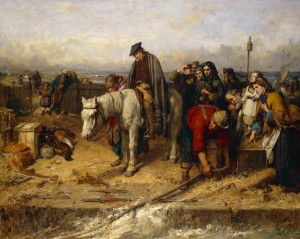
“The Last of the Clan”
Historically, the majority of emigration from Scotland was from the Lowlands, and even Highlands emigration was for the most part voluntary, albeit often enforced by economic necessity. There were already Scottish estates in the Caribbean and the American Colonies, especially the Carolinas (it is no coincidence that the Confederate flag is based on the Scottish saltire). Migration had started in earnest after 1715 and even before this, the disastrous Darien scheme of the 1690s was an expression of the wish of many Scots to make it abroad. Darien was ruinous – almost a quarter of the total economy of Scotland was poured into the ill-conceived plan to colonise the Isthmus of Panama, and on top of a few failed harvests left many nobles and landowners in financial ruin and more than ready to accept the conditions of Union in 1707.
To many Scottish landlords, land clearance (which they generally termed “improvement”) did not necessarily mean depopulation and forced migration. In fact, Highlands estate owners successfully petitioned for laws designed to halt emigration, which emerged as the Passenger Vessels Act of 1803, trebling the cost of passage to Canada and the USA, ostensibly on health and safety grounds, but in reality putting emigration beyond the purse of most Scots. Until at least the 1820s, landlords needed cheap or almost free labour, supplied by families subsisting in newly-built crofting townships, albeit in conditions of virtual slavery. Much of this was at the hands of traditional clan chiefs rather than some demonised “English” or “sassenach” landlord. The collection of kelp for processing was profitable until the removal of import tariffs, which made a Spanish product much more attractive. These attitudes changed just before and during the 1820s – the Sutherland Clearances of 1814 are a case in point – and the potato famine which of 1846 (which had also provoked an influx of even cheaper labour from Ireland) gave landlords even more reason for encouraging or enforcing emigration. That, plus the draw of new industrial jobs in the large cities like Dundee and Glasgow, led to the mass depopulation of the Highlands, despite the best efforts of Highlands Destitution Board
Walter Scott and the New Tartanry – the 1820s
This is not to deny the reality and the brutalism of the Clearances, which certainly took place. But paradoxically, at exactly the same time, there was a great flowering of romantic nostalgia for “Highland life” – or what many imagined it to have been. Sir Walter Scott had already invented tourism to Scotland, and romanticised the Highlands in Waverley and other works to such an extent that everyone who was anyone wanted to join in. Scott – an enthusiastic member of various “Highland” and “Celtic” societies – set the seal on this in 1822 by inviting King George IV to Edinburgh. His Majesty duly turned up, suitably be-kilted (over pink tights) in what is now known as the Royal Stuart tartan
Scott and his accomplice Major General David Stewart of Garth also issued helpful pamphlets on what to wear and how to behave, and invented a number of “ancient traditions” more or less on the spot. The various pageants and in particular the “Highland Ball” held by the nobles of Scotland required “the ancient Highland costume”, so many Highland and Lowland gentlemen suddenly found a need to discover or invent a suitable pedigree and a tartan to match. Scott persuaded nobles and other chiefs to turn up with their piper, sword-bearer, shenachie and other retinue, and wearing their “ancient tartan”. Many of these worthies lived in Edinburgh or even London, and more than a few had no idea what their “ancient tartan” might be, so they simply picked one from the pattern-books of weavers. In many cases these were newly-invented tartans, woven into thick woollen cloth for export. Thus, quite a few “ancient tartans” were being sported as work garments in America, say, before they became “ancient” in Scotland (think of the traditional lumberjack’s shirt). The Countess of Sutherland, for instance, merely adopted the tartan of the Sutherland Highlanders, at the instigation of James Loch, the auditor who had been so assiduous in clearing 15,000 crofters tenants off the Sutherland estates in the previous decade.
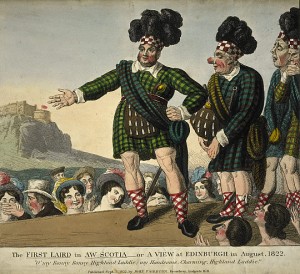
George IV’s Visit to Edinburgh Mocked in a Cartoon of the Time
Perhaps
Perhaps no-one thought to question how the recently-suppressed costume of those dismissed as mere mountain-dwelling brigands came to be the national dress of the whole Scottish nation, but it was certainly the key event in its determination. Suddenly, it was “cool” to be a Highlander.
Much has been written on the hoaxers (or perhaps outright con-men) calling themselves John Sobieski Stuart and Charles Edward Stuart and claiming to be grandsons of Bonnie Prince Charlie – but in reality a pair of brothers from Wales called Allen. They perpetrated the great fraud of the Vestiarium Scoticum, ostensibly copied from an “ancient” collection of tartans, which is still held up the source of many current tartans and the traditions surrounding them. Tartans will feature more in another article, along with a consideration of Clan and Family heraldry.
Conclusion
It is mainly the descendants of those who were pushed off the lands by their own chiefs and lairds, chose to leave the Highlands for a better life in the Lowlands and subsequently overseas, or who had already spurned Scotland and emigrated by the time the Clans were broken, who are the backbone of the Scottish Diaspora and the great supporters of Highland Games, pipe band contests and all the other trappings of “Scottish identity” in America, Canada, New Zealand, South Africa and other parts of the Empire over which the sun has now set.
The “traditional” Highland costume has become so ingrained in the public imagination worldwide that it cannot be dislodged, and possibly should not.
It is, of course, a fine thing to seek Scottish ancestry, and engaging with all aspects of Scottish history and culture is to be encouraged – but it must be done in the full knowledge that much of the mythology about clans, surnames, tartans and the like is just that.
DR Bruce Durie.
For more help finding you Clan see What’s my Clan? >
The post What is a Clan By Dr Bruce Durie appeared first on ScotClans | Scottish Clans.
]]>The post Highland Titles’ Twitter Battle with Scottish Lawyers (result: home win) appeared first on ScotClans | Scottish Clans.
]]>Highland Titles is run by the Bevis family, although they apparently live in Scotland they run their businesses from the tax haven of Guernsey. The Company is run under the created ‘charity’ with the grand title of ‘The Highland Titles Charitable Trust for Scotland’, also set up by Bevis. The charity is only registered in Guersey so it bypasses the laws and transparancy of being regulated by being a Scottish Charity. So their accounts are not public.
Anyway on with the story…
ROUND 1
It all began with some tweets from @loveandgarbage in response to the following ad Highland Titles put out as a general promotional tweet:

Love and Garbage blogger explains: “The other morning I was on twitter and saw a tweet from a twitter user called Highland Titles:
“Buy land in Scotland & you may style yourself as Lord or Lady of Glencoe! From £29.99.”
Now this raises immediate suspicions. and so I visited the website which was linked to from the tweet. For the Scottish property lawyer this is a mysterious hinterland that we rarely venture into. The site though was staggering.
It sells tiny plots of land, some of only a square foot in size.
 This set alarm bells ringing. Scots law, since the introduction of land registration under the Land registration (Scotland) ACt 1979 has not allowed ownership of souvenir plots to be sold. Section 4 (2)(b) of the 1979 Act prevented registration of a souvenir plot…” (from https://loveandgarbage.wordpress.com/2015/02/12/i-cant-believe-its-not-ownership-or-the-curious-tale-of-highland-titles-selling/)
— Here are the original tweets —
@loveandgarbage
No you can’t. You’re talking bollocks @highland_titles Never heard of the rules prohibiting registration of souvenir plots?
@loveandgarbage
I see your website says you get a personal right to the plot @highland_titles. You know that means you don’t own it?
—Malcolm Combe joins in – a well known Scottish Lawyer—
@MalcolmCombe
@loveandgarbage ah, that just means you can transfer a wee plot without registration AT ALL. Because that makes sense.  @highland_titles
@loveandgarbage
@MalcolmCombe I guess @highland_titles are well up on the 2012 Act and the implications of the 2000 ACt for barony titles.
@loveandgarbage
So basically your deal is pay us money to not become an owner of a bit of land in Scotland @highland_titles
@loveandgarbage
Do you think people are idiots? @highland_titles
@MalcolmCombe
@loveandgarbage Indeed. Finger on the pulse when it comes to Scots law (as applied via the Channel Islands). @highland_titles
—then Highland Titles joins in—
@highland_titles
Yes, the 2012 Act confirms the status of Souvenir plots – sold without registration http://tinyurl.com/ohu7mqk @loveandgarbage @MalcolmCombe
@highland_titles
We sell land. If you do not understand how land can be sold in Scotland, ask a Scottish lawyer http://tinyurl.com/ohu7mqk @loveandgarbage
—- this was brilliant and set the hounds racing as they didn’t realise who they were talking to—-
@MalcolmCombe
Hahahahahahahahahahahahahaha. Ha. https://twitter.com/highland_titles/status/565108747258064896 … cc @loveandgarbage, who really should speak to a Scots lawyer to clear this up.
— so loveandgarbage asks themselves—
@loveandgarbage
well @highland_titles . Hey, @loveandgarbage how do you sell land in Scotland?
@loveandgarbage
Well @loveandgarbage as a Scottish conveyance I am aware that the sale of land requires missives of sale then a conveyance @highland_titles
– lovenadgarbbadge proceeded to tell Highland Titles about Scottish Land Law
@loveandgarbage
And @loveandgarbage both require to be formally valid under the 1995 Act @highland_titles The conveyance is then sent for registration
– there were a good few more tweets from love and garbage about the law (see all at: Buy land in Scotland… style yourself as Lord or Lady of Glencoe! Or something.’ By Malcolm Coombe. A short Storify about Scots property law)
—basically it can all be summed up with this following tweet—
@loveandgarbage
when I suggested earlier you were talking bollocks @highland_titles this is because, as a Scots conveyancer, I see you’re talking bollocks
—Highland Titles replies for not registering the land sold were—
@highland_titles
If Souvenir plots had to be registered, the extra cost would be prohibitive http://tinyurl.com/ohu7mqk @loveandgarbage
@highland_titles
Thank you for your opinion, Bill. We prefer to take the advice of an actual Scottish solicitor http://tinyurl.com/ohu7mqk @loveandgarbage
— to which Ian Smart gets invited into the discussion—
@loveandgarbage
Hang on @highland_titles I’ll ask @ianssmart who is a former President of the Law society. Ian, is my analysis of land transfers accurate?
@ianssmart
@loveandgarbage @highland_titles I am happy to confirm that it is.
— Highland Titles get asked to loop their solicitor in—
—Yet more Scottish Lawyers start to see this and respond—
@HighlandLawyer
@MalcolmCombe @loveandgarbage Need to be infeft in land to call oneself Laird thereof, and can’t be infeft in souvenir plot…
—Highland Lawyer also links to what the Lord Lyon has to say ‘http://www.lyon-court.com/lordlyon/776.html‘—
— sadly Highland Titles do not bring in their lawyer and proceed to block everyone in the conversation.—
You can read the full discussion at ‘Buy land in Scotland… style yourself as Lord or Lady of Glencoe! Or something.’ By Malcolm Coombe. A short Storify about Scots property law There are some hysterical tweets from people that are well worth reading.
Coombe on Storify explains …
“Since the 17th century, ownership of land in Scotland has been tied to registration: put simply, if you are not registered as the owner of land, you are not the owner.”
(Malcolm Combe is a lecturer in law, former solicitor and an advisor to the Land Reform Review Group – oops!)
Highland Titles’ move was to block them all, this only set fuel to the fire ….
ROUND 2
The world of twitter is where not just lawyers but bloggers, journalist and politicians hang out. This twitter ‘gubbing’ was reported on at The Common Space.

Highland Titles Scam
Read their article at:
https://commonspace.scot/articles/314/highland-titles-land-sales-demolished-on-twitter-as-legal-bollocks The Common Space is the blog of the Common Weal think tank, which is used by political activists who want to create a better Scotland and lobbies for new policies. So bit of a hit there. Among regular contributors are the likes of Caroline Leckie and Leslie Riddoch; a journalist who has written extensively about land reform in Scotland.
ROUND 3
On our ScotClans Facebook page we reported on what was going on:
 See the full feed at:
https://www.facebook.com/clanshops/posts/909954222390870
Although a few comments got removed we think by Facebook after we exposed one of the pro Highland Titles posters was a fake profile and reported it the argument continued on the page – HT owner Peter Bevis waded in with the usual personal insults which’ if you have ever found a spare three days to read the comments on this article you will be familiar with. However my favourite moment from this one is here:
 ROUND 4

Meanwhile in twitter land more and more people were joining in. Many of them lawyers involved in Property Law. It was going well and truly viral
ROUND 5
More blogs appeared reporting the story…
 https://basedrones.wordpress.com/2015/02/12/highland-titles-scam/
ROUND 6

Love and Garbage systematically takes apart the highland titles land ownership ‘bollocks’ (their words)
KO!
While all this was going on Andy Wightman was doing the maths. How much land did they own, how much money were they taking. The money taken was all through the Guernsey based company so did not touch Scotland.
http://www.andywightman.com/archives/4152
His shocking conclusion was that if HT did indeed manage to sell all the land they had earmarked as souvenir plots then they would stand to rake in £479 MILLION! Now given that HT make a lot of noise about how they have donated a few thousand here and there to various local charities and that they have been busily upgrading footpaths and planting trees (the ones that cant quite manage to plant themselves) Andy quite rightly has asked just where the money is going.
Today is Friday the 13th, unlucky for some indeed. This story doesn’t look like its going to end here and no doubt we will see the usual suspects (and their fake profiles) adding comment below over time. HT have played fast and loose for too long and this time they have found themselves on the wrong side of A LOT of influential individuals. Twitter is a dangerous place to play these sorts of games, bloggers use twitter, lawyers use twitter and… politicians use twitter. It may alarm HT to know (if they are not already off the scale when it comes to alarms) that many of those twitter ‘trolls’ they blocked yesterday are not only followed, but read regularly, by senior people in the Scottish Government right up to and including the First Minister herself. The leader of a government that is just ending the consultation phase of a major land reform bill – talk about bad timing!
Today is also the anniversary of the Massacre of Glencoe – this dreadful event is why this place is so well known around the world and its been taken as an insult to many who bear the name MacDonald that companies have piggybacked on this event to peddle their wares. It could be that one of them may soon be left out in the cold.
The post Highland Titles’ Twitter Battle with Scottish Lawyers (result: home win) appeared first on ScotClans | Scottish Clans.
]]>The post Anthrax Island appeared first on ScotClans | Scottish Clans.
]]>
Anthrax Island
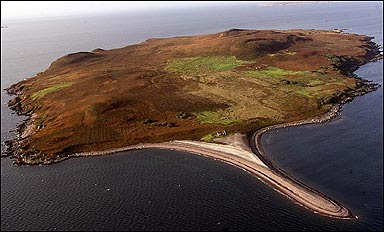
Gruinard island is just off the mainland, in Gruinard Bay, along the A832 halfway between Gairloch and Ullapool. During WWII it became the focus of the UKs secret effort to find a weapon capable of defeating the Nazis. These experiments left the island so contaminated it was deemed out of bounds for almost 50 years.
In 1942, driven by fear of biological weapons developed by Germany and Japan, scientists from the Chemical Defense Experimental Establishment (CDEE) ferried their way across to Gruinard Island, off the North West coast of Scotland. This was to be the first experiment with live bacteria; could they survive an explosion and still retain their deadly properties?
Sixty sheep were tethered in concentric circles around a wooden gantry where the ‘bomblet’ containing billions of anthrax spore was to be exploded. Inside were 3-4 pinks of the anthrax liquid plus a bursting charge. The team withdrew and the bomb was set off.
Sheep began to die a day after the first blast. Local crofters knew nothing – Duncan Matheson of Laide was an auxiliary Coastguard and observed the experiment from his lookout post, viewing the scientists dressed in their strange protective gear as they inspected the damage.
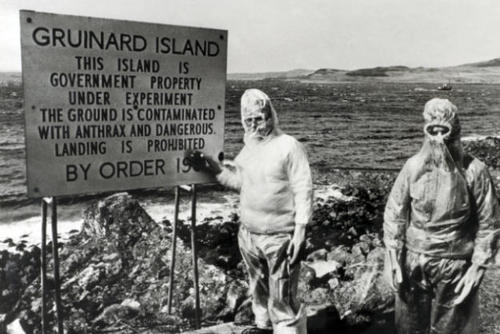
Gruinard Island
The post Anthrax Island appeared first on ScotClans | Scottish Clans.
]]>The post Legend behind the MacLachlan Coat of Arms appeared first on ScotClans | Scottish Clans.
]]>
MacLachlan – Chief’s Coat of Arms
There is an old Scottish tale behind the MacLachlan Coat of Arms. Legend has it that the reason behind the two roebucks (deers) supporting the MacLachlan Chief’s Coat of Arms came in 1249, when King Alexander II made his great show of strength in Argyll, he ordered the local chiefs to send their money (taxes) by the fastest messenger, and Lachlan Msr (the younger) tied the moneybags to the horns of a roebuck. In wonder if this was a statement by the MacLachlan chief about paying taxes. Deer’s are fast but not exactly reliable transport.
The post Legend behind the MacLachlan Coat of Arms appeared first on ScotClans | Scottish Clans.
]]>The post The Gordons at Otterburn appeared first on ScotClans | Scottish Clans.
]]>
Otterburn Battle
On the 5th of August, 1388, the Battle of Otterburn took place. This was a skirmish between Scotland’s James, 2nd Earl of Douglas, and England’s Henry “Hotspur” Percy, the son of the Earl of Northumberland. This battle was part of continuous Anglo-Scottish border conflicts that were quite common at the time. It was a decisive Scottish victory, but was also a relatively bloody affair, with thousands of casualties, mainly on the English side.
Since it was a border fight, many of the lowland clans fought along with the Earl of Douglas. Some of these families included Clan Lindsay, Clan Johnstone, Clan Montgomery, Clan Graham, and Clan Gordon. Since it was such a decisive and famous victory several ballads were written about it, including a ballad called The Battle of Otterburn.
In the ballad a number of the families get mention, including the Gordons on a couple of occasions.
The ballad begins:
It fell about the Lammas tide
When the muir men win their hay,
The doughty Earl of Douglas rode
Into England to catch a prey.
It then continues to mention some of the clans there:
He chose the Gordons and the Graemes,
With them the Lindsays light and gay -
Later on in the ballad it goes on to claim that the Scots proved to have been quite blood thirsty, particularly the Gordons, and slayed a lot of their enemy.
The moon was clear, the day drew near,
The spears in flinders flew,
But mony a gallant Englishman
Ere day the Scotsmen slew.
The Gordons good in English blood
They steeped their hose and shoon.
There were also a number of Scottish casualties too, including, unfortunately for the Gordons, their leader, and father of Sir Adam Gordon, who also went on to give his life for his country.
The post The Gordons at Otterburn appeared first on ScotClans | Scottish Clans.
]]>The post The 20 Most Seen Scottish Facebook Posts appeared first on ScotClans | Scottish Clans.
]]>Numer 1: The Bono Heckler:

Sadistic Bastard!
To be fair this is actually quite a funny joke. It very cleverly pokes fun at U2 Lead singer Bono’s ‘saintly’ image. The joke being that at a recent U2 gig in Glasgow the singer asks for total silence and then slowly begins to clap his hands, then he says: “every time i clap my hands a child in Africa dies”. From the audience a man with a broad Scottish accent cries “Well stop doing it then ya evil bastard.”
We normally see this one maybe pop up a few times a year, not a proper regular but worth a mention.
Number 2: Thats Nae a Sword Laddie!

Away and get a real sword!
This one almost always starts a fight so don’t expect to see it that often on any group we admin as it has to be taken down almost right away. The joke of course seems to be that the two gentlemen have agreed to meet for a duel and the Scotsman has turned up with a very impressive claymore! Unfortunately as soon as this goes up then a fight kicks off about Scottish V English. As if the Scots need the English as an excuse for a fight, they are perfectly capable of doing that themselves; as someone once said to me “Put two Scotsmen in an empty room and they will start a fight with each other, put one Scotsman in an empty room and he will stab himself in the arm and call it a draw.
Number 3: Passport Control.

The Border Check
This cartoon has been doing the rounds for a while now but with some of the recent daft assertions from the people campaigning for a no vote in the referendum that there will be border controls at Gretna and Berwick it has been given a bit of a new twist.
Of course it would be churlish to point out that the whole concept of clan & family tartans was pretty much made up by Sir Walter Scott and his cronies for George IV’s visit to Scotland in 1822 wouldn’t it?
The first of many ‘kilt related’ humorous posts, more on this subject to come later, we promise.
Number 4: Tossing the… err …. Telegraph Pole?

Scots: Tossers of World Fame.
Considering how this image really pokes fun at the US military I’m surprised firstly by how many Americans actually post this and secondly by the fact that its never started a Scots-American feud.
We are definitely in the big league of Scottish photo humour here though, hardly a week goes by without this little gem popping up on Facebook, to be followed by streams of ‘LOLs’ from people who presumably have been held captive in a cellar for the last 10 years and so have missed the previous 12,000 times its been posted.
Number 5: Tartan Sheep.

Who are Ewe Looking at?
Somewhere out there there is a Scottish Farmer with way too much time on his hands and access to hallucinogenic drugs (makes you wonder what they put in the sheep dip these days). Debate rages as to whether this image really is sheep that have been painted with coloured marking dyes to recreate tartan or if the image has been altered.
Sadly though if these are really Scottish sheep then the fancy wool fleeces they are sporting won’t be appearing on a scarf, tie or kilt any time soon, most Scottish wool (apart from for harris tweed) goes to make carpets etc. The wool that your tartan garments are made from mostly comes from New Zealand.
Number 6: The Kilt Statement

I’m Sure They Do…
Well I did say we would be coming back to the subject of kilts again and here we are. There are as many variations of the ‘kilt statement’ as there are tartans, Other popular versions include ‘its called a kilt because thats what happened to the last person who called it a skirt’ and the almost endless procession of ‘whats under the kilt’ jokes.
Honestly I have never seen the point of this macho assertion. I cant think of anyone I’ve ever met who looked more effeminate in a kilt than the did in trousers, I mean its not as if all those gathered up pleats give men curvy hips and an hourglass figure is it?
Number 7: Calm Doon!

What a Carry On!
If you ever happen to be browsing the bookshops in Alnwick and get chatting to the owners of a shop called Barter Books you are speaking to the people responsible for this global phenomena. Not that they have become overnight millionaires though so I suspect that no matter how annoyed you might be by the prolific variations on the theme that has given rise to ‘keep calm and drink tea’ keep calm and use the force’ keep calm and …. your hobby here’, they are probably quietly seething with rage.
This classic British wartime poster (‘Keep Calm and Carry on’ if you don’t already know) was mostly pulped in 1945 but the owner of this small bookshop found a pristine version at an auction, bought it and hung it in the shop, the rest is history.
Of course there have been a million versions of this relating to Scotland in some way but I feel the most appropriate nods to the Scottish psyche of thinly disguised rage. Anyone who ever tried to get served in a Glasgow pub on a saturday night with only two staff on will have witnessed this first hand.
Number 8: If its No Scottish…

Craaaaaaap Indeed
This Slogan came from Mike Myers’ wonderful shop owner character that appeared in a regular sketch on Saturday Night Live, this was the Slogan of his ‘All Thing’s Scottish’ import store. Myers love of the Scottish accent is clear as it has been revisited many times; as a character in his Movie “So I Married an Axe Murderer, as the gargantuan Scottish assassin ’Fat Bastard’ in the Austin Powers movies and of course the voice of Shrek.
Myers’s comedic observations of Scottish culture are at times disturbingly accurate. He is Canadian by birth with English born parents with Scottish ancestry.
Number 9: Shir Shawn the Shchotshman

Big Tam – the Fastest Milkman in Gorgie.
OK that was probably the worst attempt to type his accent ever but you get the idea. Sean Connery, the quintessential James Bond grew up in the Fountainbridge area of Edinburgh. In his early days before acting he was a life model at Edinburgh Art School and worked as a milkman. Pretty much every elderly resident of Gorgie claims that Sir Sean delivered their two bottles of Gold Top every day which means he had a milk round that Santa would have struggled to fill in for.
Many years ago we were contacted by Madam Tussauds who were planning a waxwork of the man himself in his New York Tartan kilt outfit. Tussauds are big on accuracy so every detail had to be exact down to the last button. We ended up having to have a jacket hand made for him as his jacket sleeves were an unheard of XXL length! the man quite literally has arms like a gorilla!
Number 10: The Scottish Bar Stool

All is Safely Gathered In
I have no idea where this one sprung up from and I would not be sad to see it go back there to be honest. Hardly a week goes by without someone discovering this for the first time. Somewhere out there this bar stool probably exists, a man, a chisel some sandpaper and a bit of boasting have conspired to somehow reduce Scottish Culture to 4 dents in a chair.
I guess the big flaw in the bar stool would be that you might be a little reluctant to use it after someone else had warmed it up first – I mean that cleft ridge look affy high to me!
Number 11: Penguin Piper

“Do you know its a long the way to the South Pole?” “You hum it laddie and i’ll play it”
There is a fascinating history behind this image which hardly ever gets a mention on its numerous shares. The image is of Gilbert Kerr he was a member of the Antarctic expedition on board the ‘Scotia’ in 1902-04. Kerr was the official piper on the expedition (how typical of the time that a ‘piper’ was somehow essential to the voyage). The image appears to show an emperor penguin captivated by the sound of the pipes. The truth is somewhat less romantic as the poor thing was actually tethered to a large cooking pot which was filled with snow and buried underneath. The pipes in this image have an interesting story too. After the expedition they were given to the Edinburgh Battalion of the Royal Scots in 1914 and were played by Piper Anderson in the Battle of the Somme, sadly both piper Anderson and these famous pipes were lost in that terrible battle.
Number 12: Phwoooarrrrrr!

One for the Ladies?
Moving from the bizarre to the quite frankly ridiculous… Whenever the discussion gets round to man in kilts the reality is all too soon replaced by the fantasy (for some). This is one of the more popular images in this never-ending theme. The fact that he appears to be wearing a printed tablecloth rather than a kilt makes no difference. Neither does it seem to bother the hormonal women who swoon over this that its a very clearly homo-erotic image. In other words i’m not entirely sure this really is ‘one for the ladies’.
I can never decide with this one whether he has just found something incredibly funny or a ferret has just run up his tablecloth and discovered a warm burrow.
Number 13: Sorry for the Shite.

What About the Lake District?
This post comes in many different guises, sometimes a road sign or in this case a stone marker. I recall an afternoon many moons ago in an Edinburgh pub watching Scotland V Wales in the Rugby. I found myself chatting to, or rather being chatted at by a very large welshmen resplendent in a rugby shirt made from a bell tent. “I love Scotland I do” he said, “The only thing wrong is you have to drive through bloody England to get here boyo”. I commiserated on his plight and I suggested he maybe thought about flying next time but I got the impression that he considered power flight as a relatively new and unproven concept.
Of course theres a lot of issues you can take with this statement; the Lake District for one, I mean surely all those daffodils would make a welsh hear flutter (not to mention the sheep)? Then of course there is the sudden change in the standard of the roads, as you leave Northumbria and Cumbria to discover pot holes you could shelter a decent size family in and still have a spare room.
Number 14: The Braveheart Kid

Fweeeeeedom!
Who knows where this image appeared from but its been doing the rounds regularly for the last year. Its a very odd image for a number of reasons; the Tartan is very strange one and not easily identified – a little bit like Erskine dress green or maybe Galloway but not quite. The sword looks like straight out of the Kurgan’s armoury in the Highlander movie or maybe an early Klingon hand weapon. I wouldn’t mess with this kid either way though as he seems to be able to hold this heavy sword with only a thumb and two fingers.
Grudgingly I have to concede it is a very cute image (well maybe the first thousand times it was)
Number 15: The Blue Clyde, err I Mean Tay, Err I mean…

Ahh the Bonny Purple Banks!
<pet hate alert> This is not so much just this image but more a general swipe at the ‘Fantasy Scotland’ images. Here’s the thing, Scotland actually IS an amazing country with some stunning landscapes, our ever changing weather makes it a photographer’s paradise as the light can change from moment to moment, the sun bursting out from behind leaden clouds to illuminate a dazzling patch of heather or the multi coloured patterns of Perthshire in autumn.
Sadly for some photographers thats WAY too much effort when you have photoshop and some colour filters to use. A cut and paste sky, a cut and paste moon, a cut and paste highland cow. lets throw it all in like some sort of photographic paella dish.
And then of course there are the photos of Scotland that,, well,, aren’t! Believe it or not there are other landscapes out there, Canada, New Zealand, The Himalayas, The Little Chef at Chippenham. So just because a scene has a mountain, some water and some vegetation its not necessarily Scotland!
Number 16: The Scottish Proverb

Words of Wisdom…
A wise man once said… something interesting so we though we would turn in into a graphic. The rise of motivational graphics is probably index linked to the number of people starting careers as life coaches. What else will you use to decorate the walls of you new office with after all?
Personally I’m a big fan of the de-motovational message such as ‘if at first you don’t succeed redefine the nature of success’ and my dad and teacher’s favourite ‘you won’t amount to much’. or if you are pushed for time ‘just give up its all pointless’.
Thank god I never saw a career in HR.
Number 17: The Saucy Postcard.

Ooo Err Missus…. Nuts!
The seaside postcard brings back many warm memories. Those holiday trips ‘doon the watter’ to Rothsay or Dunoon. building sand castles in sand with a slight tint from the nearby sewage outlet, sticks of rock made from a substance that could pierce the armour or a guest house ladies pinnie at 300 yds. And of course watching your elderly relatives snigger like school girls at the postcards on the prom that make heavy work from the double meaning of the phrase ‘ginger nuts’.
The saucy seaside postcard is one of those odd ‘British’ traditions that somehow still works north of Gretna, thanks to the never-ending innuendos that a scrawny man in a kilt can inspire.
Number 18: Great Balls of Fire!

Devils in Skirts
In The fantastic comedy film ‘Carry on Up the Khyber’ the Actor Charles Hawtrey plays Private Widdle of the Highland Regiment the 3rd Foot and Mouth. Poor Widdle is chastised for wearing long johns under his regimental kilt uniform (kilt spotters and movie nerds might like to know that the kilt uniforms used were actually from the wardrobe of the 1960 film ‘Tunes of Glory’ )
Going back to the days when wearing the kilt and tartan were prohibited by the Proscription Act the only people who could still wear a kilt were soldiers from highland regiments in the British Army. It was said that an officer from one English regiment complained that the Scots billeted south of the border were having an unfair advantage over his men when it came to success with the local ladies!
The last time the kilt was worn as standard in battle was during the first world war. There is evidence to suggest that in the awful conditions of the trenches in places like the Somme and Passchendale wearing the kilt had advantages. There were far fewer instances of trench foot among kilted regiments and this was put down to the highlanders only wearing ‘hose tops’ as opposed to multi layering socks and so avoiding circulation problems. Also Mustard gas had a terrible caustic effect on delicate parts of the skin. This was less of an issue with a highlander who’s delicate parts had been pretty toughened up!
Number 19: The Scottish Toilet

Shunkie Dilemma!
Here is a true story: On the way home from school one afternoon my mate Jeff convinced one of our slower classmates that the sign on the public toilet in town said ‘Laddies” rather than “Ladies” and that it was a toilet especially for younger boys. He fell for this hook line and sinker and proceeded in. After a few moments of silence the poor lad came tearing out pursued by a large red faced woman, her tights still midway round her knees whirling a handbag like a medieval mace. I honestly thought I would choke from laughing.
As this blog has progressed you have seen a pattern running through that can be classified as kilt humour and we promise this is the last on the list. Incredibly this seemingly innocent post caused a complete uproar and led one woman to storm out of the group considering this to be the most offensive thing she had even seen.
I wonder if she ever used the public lavvy in Armadale?
Number 20: Let the Wind Blow High….

Trampoline!
The practice of naming hurricanes started in the Carribean when the locals named them after the saint of the day. In the late 1970′s this practice was picked up by US meteorologists giving each one a person’s name. This practice has now been standardised to be alphabetical lists so for example the first Atlantic storm of this year if its not already happened will be Hurricane Arthur.
In December 2011 a bad storm hit the coast of Scotland. The worst in 10 years, wind speeds of 165mph were recorded. The effects of the storm were shared over social media sites such as Twitter and some sharp witted individual had the idea to name it “Hurricane Bawbag” The name stuck so much that it was used by foreign news channels completely unaware that it was a Scots slang for both the scrotum and a person of low worth.
This image appeared not long after and suggests that it was a genuine message put up on the information boards on either the Forth or Erskine bridge by a disgruntled employee on his last day.
-0-
So thats our 20,,, errr ‘favourite’ social media shared images. I guess for those who have just parachuted in from darkest Borneo these might still be the funniest things you have ever seen, for those who have been on social media a year or so might find them less so and for the poor unfortunate souls who moderate Scots social media sites they are about as funny as being stuck in a lift with Jimmy Hill.
Rodger Moffet – ScotClans
copyright ScotClans 2014
The post The 20 Most Seen Scottish Facebook Posts appeared first on ScotClans | Scottish Clans.
]]>The post History & Mystery in Edinburgh’s Closes appeared first on ScotClans | Scottish Clans.
]]>As you walk up the Royal Mile, it’s hard to miss the arched entryways that sit on either side. Signposted with odd names like ‘Fleshmarket’, ‘Lady Stair’s’ and ‘World’s End’, these closes, wynds, courts and entries play an essential role in Edinburgh’s charming infrastructure.
Situated within the (former) town walls, the exceptionally narrow streets weren’t a mistake of engineering. With the threat of English attack always at the forefront, skinny streets surrounded by tall buildings provided early city dwellers with protection and peace of mind.
Edinburgh’s medieval honeycomb of hidden alleyways also contains some of the city’s best stories, secrets and mysteries. Many of Edinburgh’s most influential characters once called these closes home – and some are believed to still lurk among the cobblestones.
Mary King’s Close

Mary King’s Close
According to local folklore, Mary King’s Close, situated in the heart of the Royal Mile near the City Chambers, is one of the most haunted places in Edinburgh. For centuries, the close – and all of its secrets – were buried below the city and forgotten. It wasn’t until April 2003 that it finally re-opened to the public.
Historians and archeologists believe the close was more than just a single narrow passageway, but actually an entrance to several more closes and multiple tenements owned by 17th-century advocate Alexander King. King named the close after his daughter Mary, who is thought to have herself grown to be a prosperous Edinburgh business woman.
Of the many gruesome stories associated with Mary King’s Close, the most disturbing is the rumour of what happened after its residents were struck with plague in 1645. Legend has it that the local council incarcerated the victims and bricked up the close, trapping everyone inside. Some say this is what earned the close its nickname as the ‘Street of Sorrows’.
Today, Mary King’s Close is home to one of the city’s most popular ghost tours, titled ‘The Real Mary Kings Close’.
Lady Stair’s Close

Makars’ Court
Whilst this close may be named after the widow of John Dalrymple, the first Earl of Stair, it’s most famous for its role in Edinburgh’s literary heritage. Lady Stair’s Close is now the site of Edinburgh’s Writers’ Museum. The Museum is dedicated to sharing the stories of Sir Walter Scott, Robert Louis Stevenson and Robert Burns – all of whom once called Edinburgh home.
Within the close sits Makars’ Court, itself another tribute to Edinburgh’s literary greats (‘Makar’ is the Scots term for ‘poet’ or ‘bard’). The Court’s flagstones are inscribed with the words of the city’s most influential authors, from medieval writers like John Barbour (c.1320-1395) and William Dunbar (c.1460- c.1520), to modern-day literary figures like Sydney Goodsir Smith (1915-1975) and ‘Prime of Miss Jean Brodie’ author Muriel Spark (1918 – 2006).
Advocate’s Close

Advocate’s Close
Dating back to 1544, this recently renovated close was named in honour of Sir James Stewart of Goodtrees. Stewart was Lord Advocate of Scotland after the Glorious Revolution, serving from 1692 to 1715.
Famous former residents of Advocate’s Close include Adam Bothwell, Bishop of Orkney and head of the Augustinian monastic community at Holyrood Abbey from 1568 to 1582, and John Scougal, an official painter to William III and Queen Mary.
Visitors to Edinburgh can stay in Scougal’s former home and painting studio, now one of VieAmhor’s apartments. The close is also the site of Edinburgh’s newest ‘hidden’ gem, the cleverly named Devil’s Advocate bar and restaurant.
White Horse Close

White Horse Close
Situated near the bottom of the Royal Mile, this often-overlooked close is perhaps the most picturesque of them all. Whilst many of the buildings within White Horse Close have been rebuilt and converted since the Middle Ages, this historic corner of Edinburgh’s Old Town hasn’t lost its charm.
During the 16th-century, White Horse Close contained the Royal Mews, and legend has it that the close is named after a famous horse that was stabled there – Mary, Queen of Scots’ beloved white palfrey. However, it’s more likely that the close gets its name from the ‘White Horse Inn’, built by Laurence Ord in the 17th-century.
It’s also thought that the close is where Jacobite officers stayed when Bonnie Prince Charlie occupied Holyrood Palace during the Jacobite Rebellion of 1735. Less than 60 years later, the close served as the birthplace of William Dick, founder of Edinburgh’s Royal Dick School of Veterinary Studies.
These are just four of more than 70 closes, courts, wynds and entries situated off the Royal Mile. Each one contains its own unique history, and for those wanting insight into medieval Edinburgh life, there’s no better place to start looking.
Image credit:
Mary King’s Close image by The Real Mary King’s Close via Wikimedia Commons
Makars’ Court image by Stefan Schäfer, Lich via Wikimedia Commons
Advocate’s Close image by Ann Harrison via Wikimedia Commons
White Horse Close image by Kim Traynor via Wikimedia Commons
The post History & Mystery in Edinburgh’s Closes appeared first on ScotClans | Scottish Clans.
]]>The post Culloden Moor Housing Development and our Ancestral Heritage. appeared first on ScotClans | Scottish Clans.
]]>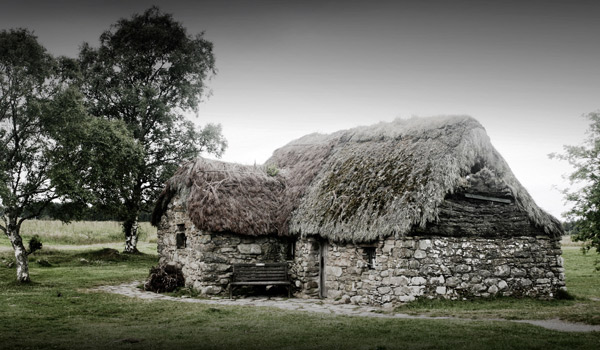
Old Leanach Cottage on Culloden Moor
As dusk fell over Culloden Moor on the 16th April 1746 the last major land battle to be fought on British soil had drawn to a conclusion. With close to 2,000 dead and wounded Jacobites the campaign to restore the Stewart monarchy to the throne had been dealt a decisive final blow. In the days and weeks that followed the dead were buried and the site of the battle was gradually reclaimed by nature, with the exception of a minor road, which ran by the site Culloden has remained untouched to this day.
Now the site is a magnet for those who wish to immerse themselves in the dream of Scotland, in the romantic stories of Bonnie Prince Charlie and Flora MacDonald, in the Jacobite cause that has been the inspiration of so many folk songs and tales. And so the cause of an Italian-born noble to recapture the throne of the United Kingdom from an incumbent German-born monarch became a story that has somehow come to define Scotland.
Two centuries and more have passed and now the site of this battle like many others around Scotland have been taken under the wing of the National Trust for Scotland and the site has been the subject of in-depth research by Historic Scotland and the Royal Commission for Ancient and Historical Monuments for Scotland (RCAHMS). In recent weeks however another battle has been played out over the moor. Not this time though does it feature blue-bonneted highlanders charging over moorland towards red-coated Hanoverians, this battle is taking place on the Internet, in the offices of planning departments and around Scotland’s parliament.
A collection of disused farm buildings which lie around 400m to the north of the battlefield have been the centre of a planning row. Developers who wish to tear down these buildings and erect 16 houses have appealed a local authority decision to refuse planning permission and despite objections from the National Trust for Scotland the Government reporter has overturned the refusal. For those who see Culloden as a symbol of their Scottish identity the very idea of this development is abhorrent and yet taken on its individual merit there is very little in this proposal that would appear to deserving of such a reaction; the footprint and profile of the proposed development extends very little beyond the brown field site that the farm buildings occupy, the increase in noise and traffic that 16 houses contribute to the landscape is paltry compared to the constant flow of tour busses and cars to and from the visitor centre itself and the site is screened from the battlefield by a stand of trees and on the other side of a minor road that has a surprisingly high traffic flow given its rural location.
Taken in isolation it is very hard to see why so many have been worked up into a frenzy over this, even claims that this development will somehow lead to a ‘creeping urbanisation’ of the Culloden area has very little evidence to support it
So there’s no problem and we should just let it go ahead then, right?
Wrong, very very wrong.
You see this issue is not about Culloden. It is about our stewardship of historical sites in every corner of Scotland and it is about the process of managing how developments in areas surrounding sites of historical importance are controlled.
As a race we have in the last century woken up to the responsibilities of managing our environment, not just our natural environment but our historical one too. Nowadays we find it incredible that so many sites, of major importance to our race, have been treated with disregard by our ancestors. Temples and tombs that have been robbed and razed to the ground. Ancient wonders where the stones have been removed to be used for local buildings. We have a lot to thank the Victorians for. It was their curiosity that led to the halt in the demise of our historical environment. People like John Clayton for example, who we have to thank for the fact that anything survives of the magnificent Hadrian’s wall.
Now this does not mean that every corner of our landscape that has a tale to tell must be trapped in amber, the creeping ‘disneyfication’ of Scotland is no better than a creeping urbanisation. People live in and work the landscapes that their ancestors fought and died on and they should be allowed to continue. Take for example the site of the battle Flodden, an event that was arguably more significant in the history of our nation but an event that is marked by a simple monument surrounded by the fields of a working farm, every season the land that saw one of the biggest massacres in Scottish history is ploughed over and grazed upon, life continues as it did before that date in 1513. And that is as it should be
What is required is a sensible approach to the management of our historical environment, it has to be taken into consideration that this environment is not just part of our history but the history of Scotland’s diaspora and their thoughts and views should be listened to. Any inventoried site in Scotland should have a level of protection that means that one civil servant cannot write it off with a flourish of his pen. We have a trust body in Scotland for a reason and their opinions must be considered with the highest regard. Only when all parties agree that a proposed change to a site of significance is right and proper should it be allowed to go ahead.
Viewhill development at Culloden is a fairly innocent piece of planning in itself. 16 family homes out of sight of the moor will have virtually no impact on the quiet contemplation of the landscape, however what Viewhill demonstrates is a lack of joined up thinking across government departments, local councils and trust bodies. The same lack of joined up thinking that has at times hindered the development of a solid approach to ancestral tourism. There is an awful lot of talk but not a lot of listening; in this homecoming year it is time we did just that.
The post Culloden Moor Housing Development and our Ancestral Heritage. appeared first on ScotClans | Scottish Clans.
]]>The post Clan MacThomas Diamond Jubilee Gathering 2014 appeared first on ScotClans | Scottish Clans.
]]>http://www.clanmacthomas.co.uk/Pages/SocietyNews2014Gathering1.aspx
Clansfolk attending the Diamond Jubilee Clan Gathering in Perthshire over the weekend of 22-26 August 2014 are asked to register with the Society before 28th February.
register now
Please remember that you also need to book your accommodation at Scotland’s hotel or elsewhere in the Pitlochry area.
Provisional Programme of Events
Friday 22nd August 2014 – Day One
12:30pm
Glen Isla Games, The Haugh, Forter.
Clan MacThomas sponsor the Hill Race at 4:30pm.
4:00pm
Rooms at the Scotland’s Hotel become available.
Register and collect name badges and tickets for prepaid events from the Society desk in the hotel foyer. Clan Merchandise will be on sale in the foyer.
Explore Pitlochry, 7.00pm

Explore Pitlochry at 7pm
The Chief’s Reception.

Andrew MacThomas of Finegand the 19th Chief of Clan MacThomas
Andrew MacThomas of Finegand, 19th Chief of the Clan MacThomas.
Preferred dress – kilts and tartan.
7:30pm
MacThomas Clan Barbeque.
8.30pm – Reeling Practice

Reeling Practice at 8.30 pm
(Dashing White Sergeant, Duke of Perth, Eightsome Reel, Gay Gordons, Hamilton House and Strip the Willow).
10:30pm
A Wee Deoch an Doris at McNabs Bar.
Saturday 23rd August 2014 – Day Two

Clach na Coileach
11:00am
Clan Gathering at Clach na Coileach, Glenshee.
Address by Andrew MacThomas of Finegand
Display of piping by the Clan Pipers
Preferred dress – kilts and tartan.
12:30pm
Strathardle Highland Games in Strathardle.
Clan MacThomas sponsor the Highland Dancing.
Clansfolk are encouraged to participate in events.
Picnic around the MacThomas tent on the games field.
8:00 for 8:30pm

Scotlands Hotel, 38-40 Bonnethill Road, Pitlochry
The 2014 Clan Society Dinner at Scotland’s Hotel.
4 Courses (Menu)
Dress – black tie, kilts and tartan, lounge suits.
10:30pm
Clan Raffle
11:00pm
A Wee Deoch an Doris at McNabs Bar.
Sunday 24th August 2014 – Day Three
11:00am
Clan MacThomas Society Annual General Meeting.
Scotland’s Hotel.
12:30pm
Tour of MacThomas Territory
To include sites associated with past chiefs such as Broughdearg, Finegand, Glen Begg, Forter Gastle, Crandart, Glen Beannie and McCombie’s chair. Visit to Glen Isla Churchyard where McCombie Mor is said to be buried.
There will be Lunch stop in Glenshee.
6:30pm

Traditional burns supper
Haggis Buffet Supper
Scotland’s Hotel.
7:30pm
MacThomas Clan Quiz
Scotland’s Hotel – Teams of three.
8:30pm
MacThomas Clan Ceilidh at Scotland’s Hotel **
Preferred dress – kilts and tartan.
Monday 25th August 2014 – Day Four
10:00am
Genealogy Presentation.
A short talk by Clan Sennachie, Grahame Thom.
Share your family tree with the Sennachie and other Society Members.
11:30am
Morning Coffee in the hotel lounge.
Your chance to meet the Chief and other members of Council for informal discussions on the Clan, the Society, the Gathering and the way forward.
12:30pm
Free time to explore Pitlochry and the surrounding areas.
6:00pm
Informal dinner.
At Pitlochry Theatre or a restaurant of your choice.
7:30pm
Pitlochry Festival Theatre.
For Programme and booking arrangements – click here.
10:30pm
One last Deoch an Doris at McNabs Bar.
Tuesday 26th August 2014 – Day Five
8:30am
Farewell Clan Breakfast at Scotland’s Hotel
An informal buffet breakfast and a chance to say good-bye to friends old and new. Free to hotel guests.
The 2014 Diamond Jubilee Gathering ends after breakfast.
The post Clan MacThomas Diamond Jubilee Gathering 2014 appeared first on ScotClans | Scottish Clans.
]]>